



The Many Worlds of Winnipesaukee
New England’s most popular summer lake holds something for everyone: the tourist, the nature lover, the seeker of seclusion.
By Yankee Magazine|Apr 12 2018|

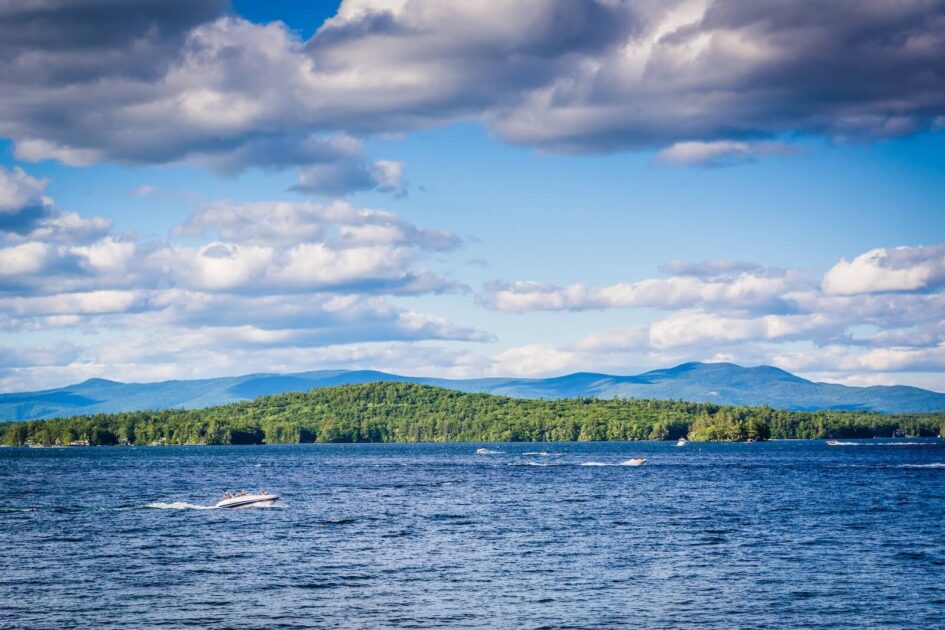
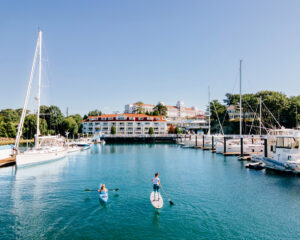
Boating is one of the many popular activities awaiting visitors to Lake Winnipesaukee in New Hampshire.
Credit: Jon Bilous/ShutterstockBy Bill Donohue
When Sophia Loren visited Lake Winnipesaukee in the 1980s, she dined at Mama Lucy’s, an Italian restaurant on Cow Island. French President Nicolas Sarkozy paddled a canoe on Winnipesaukee in 2007, bare-chested. But what of Madame Chiang Kai-shek, the demure and exceedingly private first lady of China, who for much of the 20th century maintained a tasteful summer home in Wolfeboro, surrounding herself with stoical bodyguards? What did she do, lakeside?
The historical record is, alas, vague, and we can scarcely even guess, for Winnipesaukee contains many worlds. The largest body of water in New Hampshire is, at 21 miles long, not vast, but it’s so beloved that on almost any summer afternoon it is home to water-skiers and fishermen and lackadaisical, backstroking swimmers and sleek, tanned party animals pointing their Jet Skis toward Braun Bay.
It is impossible to convey how deeply Winnipesaukee is linked with the joys of summer. One town on its shores, Wolfeboro, calls itself “America’s first summer resort,” and lakefront property is so coveted that the average home on Winnipesaukee sells for more than $1 million. Celebrities, meanwhile, keep showing the love. Drew Barrymore visits Winnipesaukee often, and when comedian Jimmy Fallon’s first child was born in 2013, she was christened Winnie, after her father’s favorite lake.
I should have been snared by Winnipesaukee’s charms long ago. I’ve spent summers in central New Hampshire my whole life. But my family has always favored another, lesser-known lake, and as a kid I saw Winnipesaukee only in glimpses—when I clambered over the granite slabs atop Mount Major, say, and gazed north at the emerald waters lapping the forested sliver that is Rattlesnake Island. I knew very little, and I wondered: Was it pitch-black at the bottom of Lake Winnipesaukee, 187 feet down? I wasn’t sure.
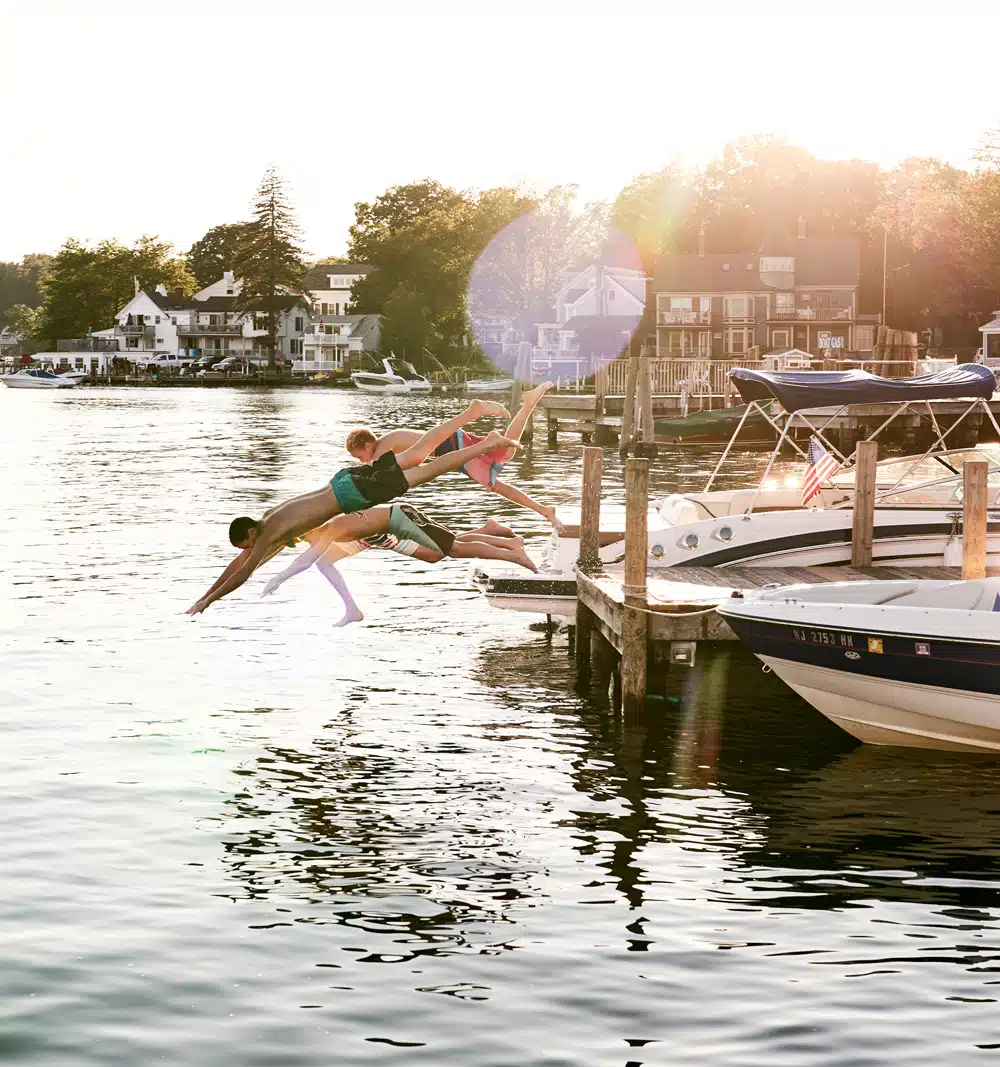
Credit: Mark Fleming
When I moved to New Hampshire’s Lakes Region full-time in 2015, I was intent on learning about the local lake—about its people and its wildlife and its legends. My initial scheme was to kayak the length of Winnipesaukee early last summer, camping on islands, hiding my boat in the weeds as I engaged Winnipesaukee savants in long philosophical conversations. But then I learned about Winnipesaukee’s rough waters: namely, that out on the long throat of the lake the waves are at times six feet high, big enough to sustain a small but hard-core surfing community. I chickened out—and decided I would first survey the lake from the seat of a seaplane.
I fly on a clear June morning with Dave French, a 59-year-old pilot who grew up summering on Winnipesaukee’s shores, staying in a breezy camp his dad bought in 1961 for $5,000. As a boy he knew every hidden cove on Winnipesaukee, every rope swing. More recently, in his vintage 1967 Cessna he has spent roughly 1,600 hours in the air over the lake. He gives seaplane tours, often customized: When I mention I have a friend on one minuscule island, he swirls down toward the only house there, cutting so low that I half expect my friend to emerge onto his porch to chase us away with a rolled-up newspaper.

Credit: Mark Fleming
We fly over Wolfeboro and two other lakeside villages, Meredith and Center Harbor, before we buzz a hilltop church on Bear Island. French tells me enough to fill a notebook, but when I ask him about the Lady of the Lake, the 125-foot steamboat that plunged to the bottom of Winnipesaukee while being towed in 1895, he can share with me only a tantalizing glimpse. “I saw it once, when the light was just right,” he says. “There was a cloud shadow, darkening the water above it, and the sun was shining from just the right angle to illuminate the ship on the bottom.”
Winnipesaukee, I realize, listening, is a different lake every day, shape-shifting with the light and the wind and the weather. No one will ever fully know it. But still people try.
*****
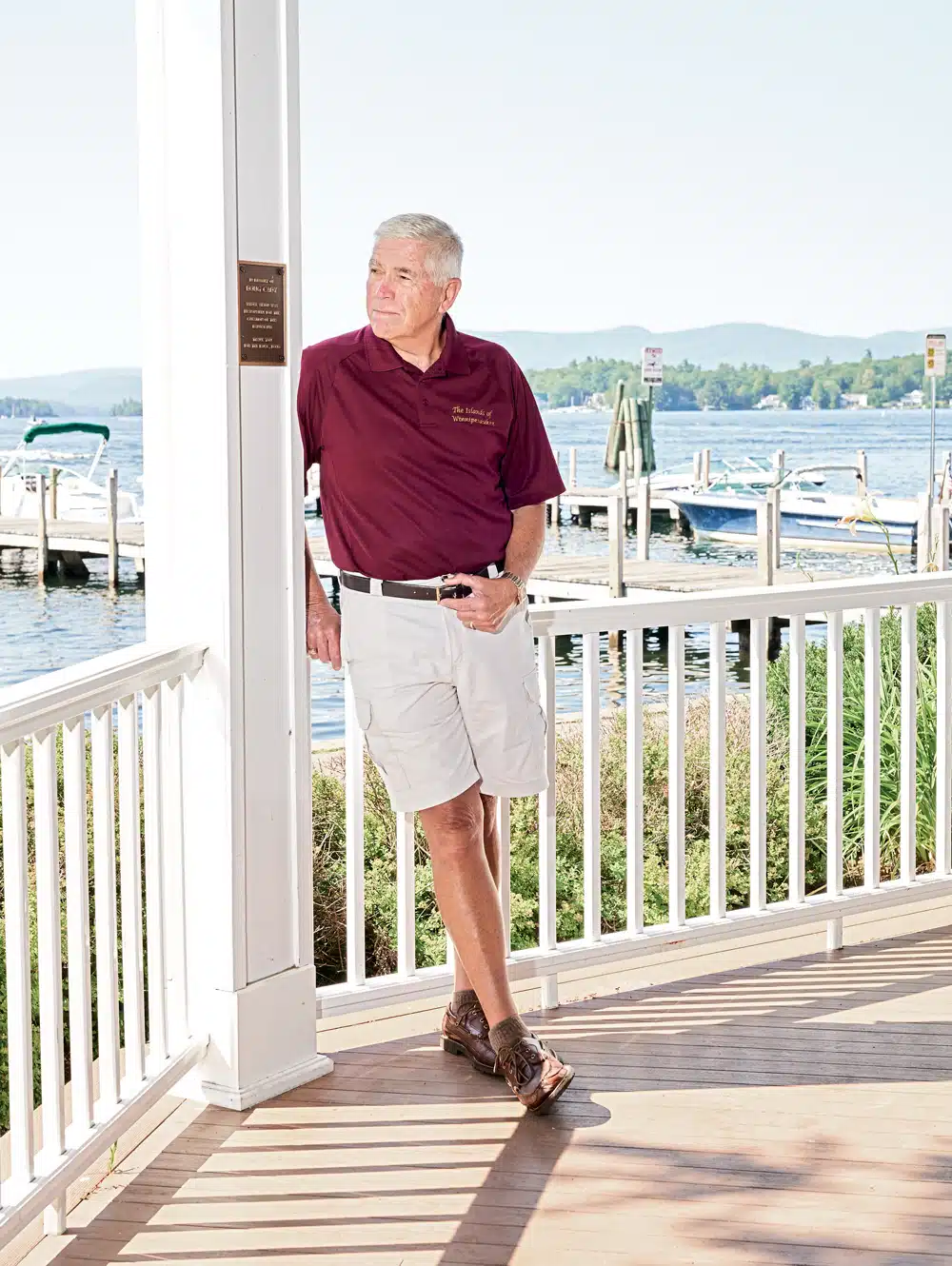
One sunny morning in July, I drive out to Wolfeboro to talk to Ron Guilmette, a retired Massachusetts state trooper who in 2011 decided he would circumnavigate every island in Lake Winnipesaukee in a kayak. Guilmette is tall, a bit intimidating, and still strapping at 70. He accomplished his goal, paddling about 150 miles in eight day-trips with his nephew, a police dispatcher named Jay Leccese. But when he sat down to write a photo-illustrated book about their adventures, he discovered that “half of the photos we had were of me standing on a rock, and the other half were of Jay standing on a rock.”
Credit: Mark Fleming
Soon, the two kayakers re-circumnavigated—and re-photographed—nearly every island. They are now the coauthors of The Islands of Winnipesaukee, a handsome self-published coffee table tome that has sold some 4,000 copies. When I meet them at the boat launch where they’re unloading three kayaks for us to take out, I see they’re wearing matching dark blue quick-dry T-shirts emblazoned with “The Islands of Winnipesaukee.” A large magnet stuck to Guilmette’s SUV bears the same slogan. But what I want to know is how many islands are in Lake Winnipesaukee.
Guilmette is solemn, even cryptic, in his response. “That’s an interesting question,” he says.
We put in and paddle through the calm waters of Wolfeboro Bay, left around a lone pine tree standing on Clark Point, until we reach the lakeside home of former presidential candidate Mitt Romney and spy a square-jawed 40ish fellow—a Romney son, presumably—in the boathouse. “Spitting image of his old man,” Guilmette remarks.
We continue southeast, into the unsung Varney Islands, to behold Melody and Harmony islands, Littlest Mud Island, and Cove Island. Eventually, Guilmette tells me that when he started his quest, the most common map of the lake, made by the Boston-area Bizer Corporation, listed 253 islands on Winnipesaukee (an island being any land mass that sustains vegetation). Guilmette would soon dispute that number. He documented several omitted islands, including a minuscule speck of land—two trees and a rock—that he personally christened Trooper Island.
Bizer now lists 264, but to Guilmette the count is still incorrect, as it includes Loon Island no. 4, which is connected to Alton’s Sandy Point by a causeway. “That’s not an island,” he tells me sternly. “If I can’t kayak around it, it’s not an island.”
The truth is that no one really knows how many islands there are, for they can emerge onto and vanish from the radar absent geologic forces. In the 1950s, I learn, a man living on Cow Island decided he wanted his own island, and chucked a bunch of dynamite at the island’s tip, blasting the rocks there to bits. So Rocky Ridge Island no. 1 was born. When a new owner bought the place in 1997, the dynamite man put a clause in the sales contract saying he could come back for picnics. And he has come back, once.
Now imagine that old man on the rock, please. See the picnic basket. See the checked blanket flapping about in the wind—and know that Lake Winnipesaukee has always been loved. Even its name, given by the Abenaki Indians, who began catching shad here around 8,000 B.C., carries a certain fondness. “Winnipesaukee” likely means either “smile of the Great Spirit” or “beautiful water in a high place.”
When white people first identified Lake Winnipesaukee as a vacation spot in the mid-19th century, they regarded the place with reverence. “The waters,” author John Hayward wrote in 1839, in The New England Gazetteer, “are remarkably pure, and [the lake’s] depth in some places is said to be unfathomable. Its sources are principally from springs within its bosom.”
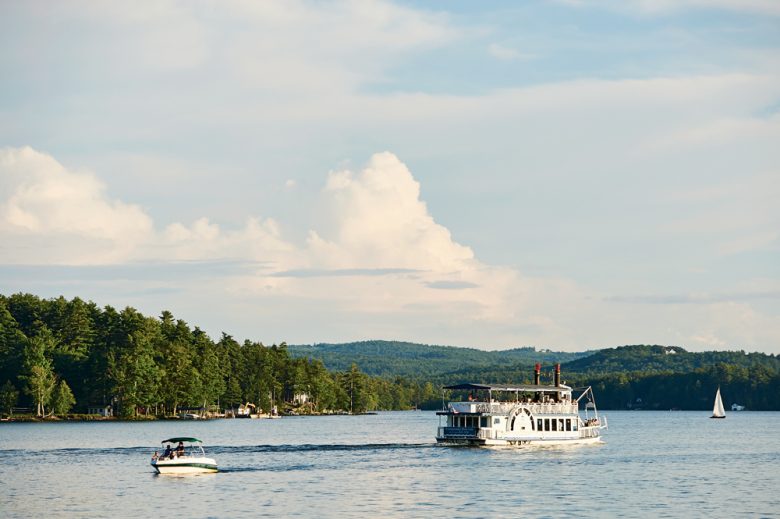
Credit: Mark Fleming
What is the best way to commune with the wonders of Winnipesaukee? For some, the answer is simple: Be wealthy, and build a humongous house on the shore. In the early 2000s, Bob Bahre, the founder of New Hampshire Motor Speedway, built a 63,000-square-foot Winnipesaukee estate replete with a helipad, an infinity pool, and a man-made grotto. Bahre has since vacated, favoring his seaside getaway in St. Barts, but his home, now on the market for $20 million, is just one of myriad mansions jutting turrets and three-car garages and heavily fertilized, near-fluorescent green lawns out toward the lake.
Let’s get the bad news out of the way: The fertilizer is one of many environmental challenges facing Winnipesaukee. Water quality in the lake, while still considered “good” by the Lakes Region Planning Commission, has in the past decade suffered a “downward or negative trend,” and today areas of the lake often don a sickly green skin—an “algae bloom”—that is deadly for fish and fairly icky for Homo sapiens swimmers.
Still, there is a beautiful bird that lives on Winnipesaukee. The loon—long-necked, ruby-eyed, and best known for its shrill, haunting cry—is actually rebounding. Its population here was under siege throughout the 20th century, largely because fishermen used sinkers made of lead. Fish ate the lead; the loons in turn ate the toxic fish and died off. In 1975, there was just a handful of loon pairs left on Winnipesaukee. But ever since then, a group called the Loon Preservation Committee (LPC) has been fiercely defending the bird: building artificial loon nests in thatches of grass, nursing injured loons, and, critically, fighting against the use of lead fishing tackle, which is now illegal.
These days there are 27 loon pairs on Winnipesaukee, and one morning I join Harry Vogel, the LPC’s director, for a meandering motorboat tour through the lake’s quietest, northernmost waters. It is mid-July, and this spring’s fuzzy-headed baby loons are by now proficient paddlers. We check out a few nests ensconced in high reeds and watch a loon plunge his head deep into the water for fish.
In time, Vogel tells me that of all birds, loons are especially appealing to humans. “They hatch only one or two chicks a year,” he says, “and from day one they have to feed their young. They have to care for them. They’re like your human family with 2.4 children. People can appreciate that they are good parents. And they’re rare. When you see a loon, you’re going to stop to marvel.”
Vogel doesn’t mention it, but there is another, deeper allure to loons: Their cry—melancholic and lingering, particularly over still waters at dusk—seems freighted with all the sadness implicit in summer, a season that is at once lovely and fleeting.
Credit: Mark Fleming
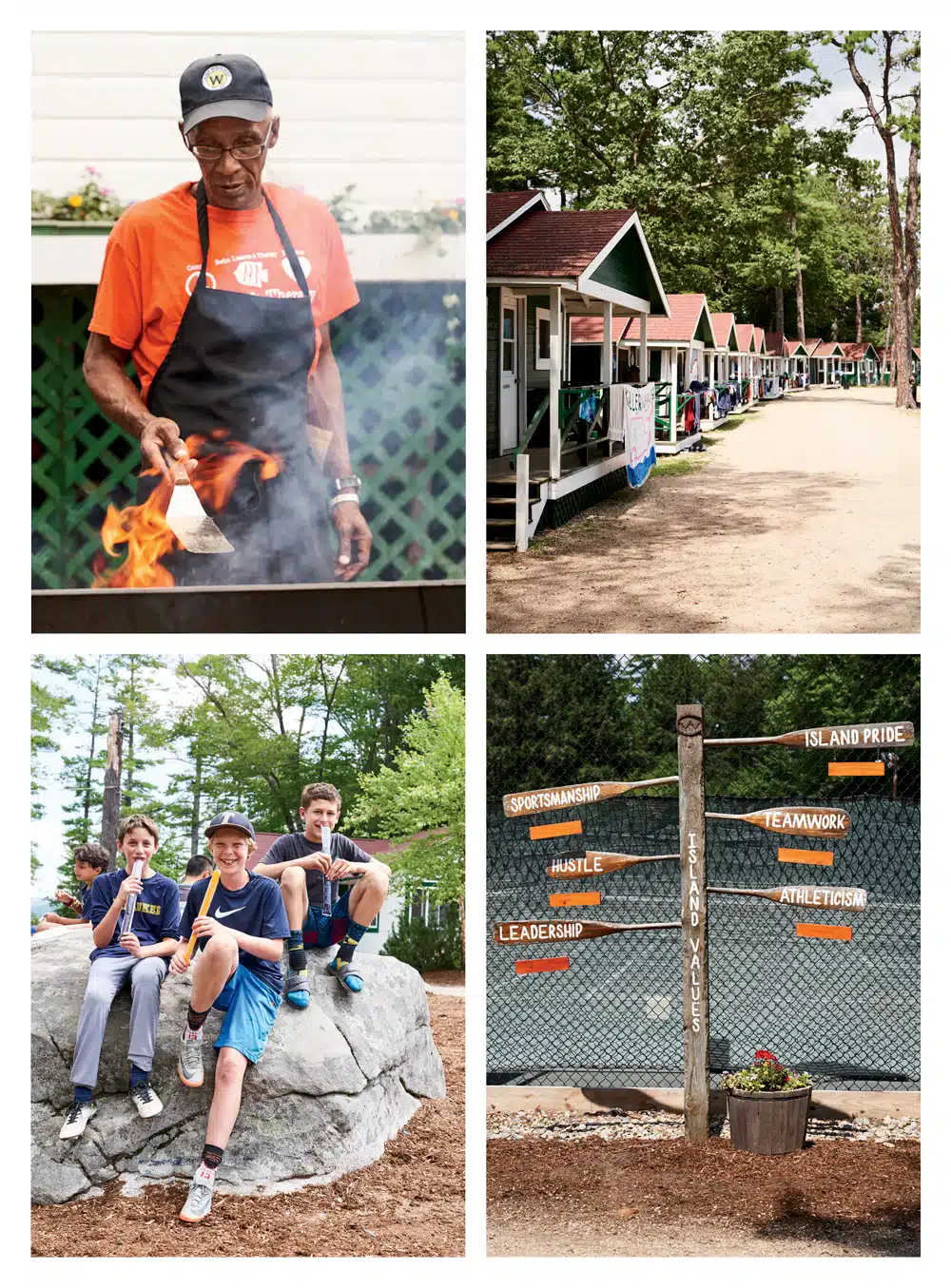
As July gives way to August, I keep returning to Lake Winnipesaukee. Before this adventure I had experienced only the peripheral joys of Winnipesaukee: the rickety Skee-Ball machines at Weirs Beach, for instance, and the tricky and technical miniature golf courses out on Route 3. Now, I find myself savoring small pleasures that will be gone when the leaves turn. One afternoon, I pedal my bike down a forested hill and feel the humid air cool and soften as I ride by the water. Later, I visit one of the summer camps on the lake—Camp Winaukee, this one is called—and listen to the chittering sound of boys’ laughter rising and falling over the water.
Credit: Mark Fleming

Credit: Mark Fleming
There is a music to Lake Winnipesaukee, and I’m not surprised to learn that in the 1970s a composer, Wheeler Beckett, wrote a symphony titled “Nocturne, Summer Night on Lake Winnipesaukee.” Beckett pieced his opus together on Ragged Island, in a small shack appointed with a piano, before it was performed, twice, at the New Hampshire Music Festival in 1976. If there was a recording, it is now lost to time (trust me, I searched). Beckett’s legacy lingers on the lake, however. A genteel and moneyed individual, he owned Ragged Island, all 11½ acres of it, and before he died in 1986 he sold it to the Lakes Region Conservation Trust, which now maintains it for the public to enjoy.
When I at last make it out to Ragged Island, it’s late August and the weather is cool and gusty, so that whitecaps foam on the rippling water. I begin hiking the island’s three-quarter-mile shoreline loop trail, and remember what a friend told me about Matilda, the black snake who lives out here, and about the deer who swim out to Ragged just after dawn, their black noses bobbing out of the water. The pines all around me are giant; they’ve never been cut. They’re primeval, I think. I am seeing the lake that the Abenaki saw when they caught shad. I’m seeing the lake fed by springs from its bosom. And I’m on a piece of Winnipesaukee that anyone can visit, whether they’ve got a million dollars or not.
It is a delight to be out here, feeling the wind in my hair.
You may also like…
Trip Planner: Editors’ Picks for Lake Winnipesaukee

Sorry you did not include Alton Bay in your article!
Very nice article!
Enjoyed this old destination lake article and remember my first introduction to the lake at a tender age of 14, at which time I was also introduced to my first mountains. Time for another trip back.
Terrific article, brought back memories of a family vacation,30 years ago, in Alton Bay. Stayed in a two story house, on the lake, with a wooden screen door, with a large dining table, with a vinyl-like tablecloth ( am I dating myself?) and stairs down the bank to the dock. Exploring Alton Bay, we found a not to be missed general store, with wood floors, next to the Post Office was Pop’s Donuts, fresh daily. Strictly take out. On a visit to Wolfeboro, took the road toward rt 16, and passed a farmhouse, with a sign that said “Pop’s Donuts “, which maybe was the hq for the Alton Bay shop. A miniature golf course and arcade. The only movie theater, which sadly burned down. On to Alton..a stop at the barbershop, where I was regaled with stories about his life and work. Also, the hardware store, the local diner and Floyd’s Car repair, just off Rt 11. Such wonderful memories of Alton/Alton Bay Area, and of course, Lake Winnie. I could fill pages with above about life in NH unique small towns.
I loved reading this article! I was raised on that lake during the summer. My daughters spent their summers on that lake. I worked on “The Mount” and Tarlsons general store. After my husband passed away, I foolishly sold my home in Gilford, a Condominium development that was years ago, Camp Samoset. Thank you for this wonderful article.
My home in Wolfeboro borders on a creek that flows into our beautiful Lake Winnipesaukee. I refuse to use chemicals so my dandelion filled grass and wild flowers attracts the birds and insects. I wish more people cared. The flow carrying chemicals from lawns farther away end up in our Lake.
Memories were awakened while reading the fascinating article on all
Memories were awakened while reading the fascinating article on Lake Winnipisaukee. Living in Southern California since my teen years I realize how much I missed out on enjoying and experiencing New England while living there (Wakefield, Ma). I recall attending Girl Scout Camp on this lake somewhere. I shared a tent with 3 other young girls and our (presumed) teen counselor. One girl had an insect crawl into her ear and woke all of us up with her screaming. The 4 of us had never been away from home, so we were all fearful to begin with. The 2nd day our teen leader was demonstrating how to chop wood. Using an ax while holding the small log down with her foot, we were all horrified as she chopped right through her shoe and the blood spurted out. Of course she was taken away for help and we girls just wanted to go home. I do remember it was a beautiful place in a wooded area surrounded by Lake W. I am enjoying your magazine and visioning a return visit sometime. My hubby and I explored the Maine coast a few years ago on a Model A Ford tour entitled “Lobsters and Lighthouses” starting from Kennebunkport and ending in Bar Harbor. The following year hubby and I flew into Boston for a wonderful cruise up into The St Lawrence River waterways, also along the coastal areas. We are now in our 60th year of marriage, so it’ s more challenging to travel, so I continue to dream and plan through your magazine.
I am looking for some cabins owned by the Davis’s on Lake W. Can you tell me the name of these cabins?
Very interesting read. I spent my junior and senior high school years at Brewster Academy. Awesome to look at the lake from study hall windows!
I really enjoyed your article, it brought back alot of memories. I grew up in Wolfboro on Trask mountain in a cabin from 1960 to 1980 every summer. Your article brought back wonderful memories and I have visited since to vacation. I live in Rhode Island so I’m lucky enough to be so close to visit often.
This story is beautiful wrote ..thankyou for the wonderful discription .
You make me home sick for Camp Lawrence, located on the lower half of Bear Island. Hiked to the church you mentioned numerous times. The first time I was 8 years old and you would have thought I had hiked miles across the Rockies. Are we there yet? Swimming, sailing, hiking, all thing camp – great training, going from an 8 year old camper to a 17 year old counselor. Wonderful memories. I keep virtually visiting the Weirs Beach web cam and I am a “friend” of the Mt. Washington Facebook page. Not the real thing but it helps refresh the memories. Thank you.