New England Victorian Gingerbread Houses: The Story Behind the Region’s Most Ornate Style
Discover how the exuberant New England Victorian gingerbread style, made famous at the Martha’s Vineyard Camp Meeting Association, became its most whimsical architectural tradition.
By Bruce Irving|Feb 23 2026|

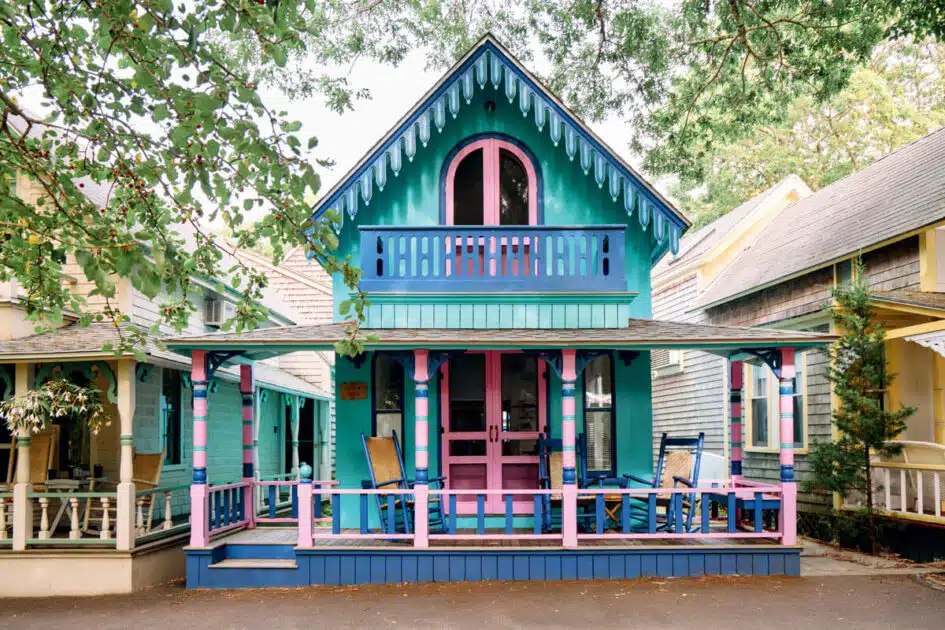
In his 1908 essay “Ornament and Crime,” the Austro-Hungarian modernist architect Adolf Loos declared, “Ornament does not heighten my joy in life or the joy in life of any cultivated person.”
To which I and the many fans of gingerbread houses say, “Adolf, baby—loosen up.”
Anyone who has ever walked along a street of sober, stalwart, sensible structures and then (surprise!) spotted an exuberantly decorated gingerbread cottage will know the delight that this architectural style provides. Wander through an entire neighborhood of them—namely, the 34-acre, 318-house Campground in Oak Bluffs, Martha’s Vineyard—and you just might feel as if you’ve landed in some New England version of Willy Wonka’s world of pure imagination. Overseen by the Martha’s Vineyard Camp Meeting Association, it is the region’s most enthusiastic repudiation of Puritanical plainness.
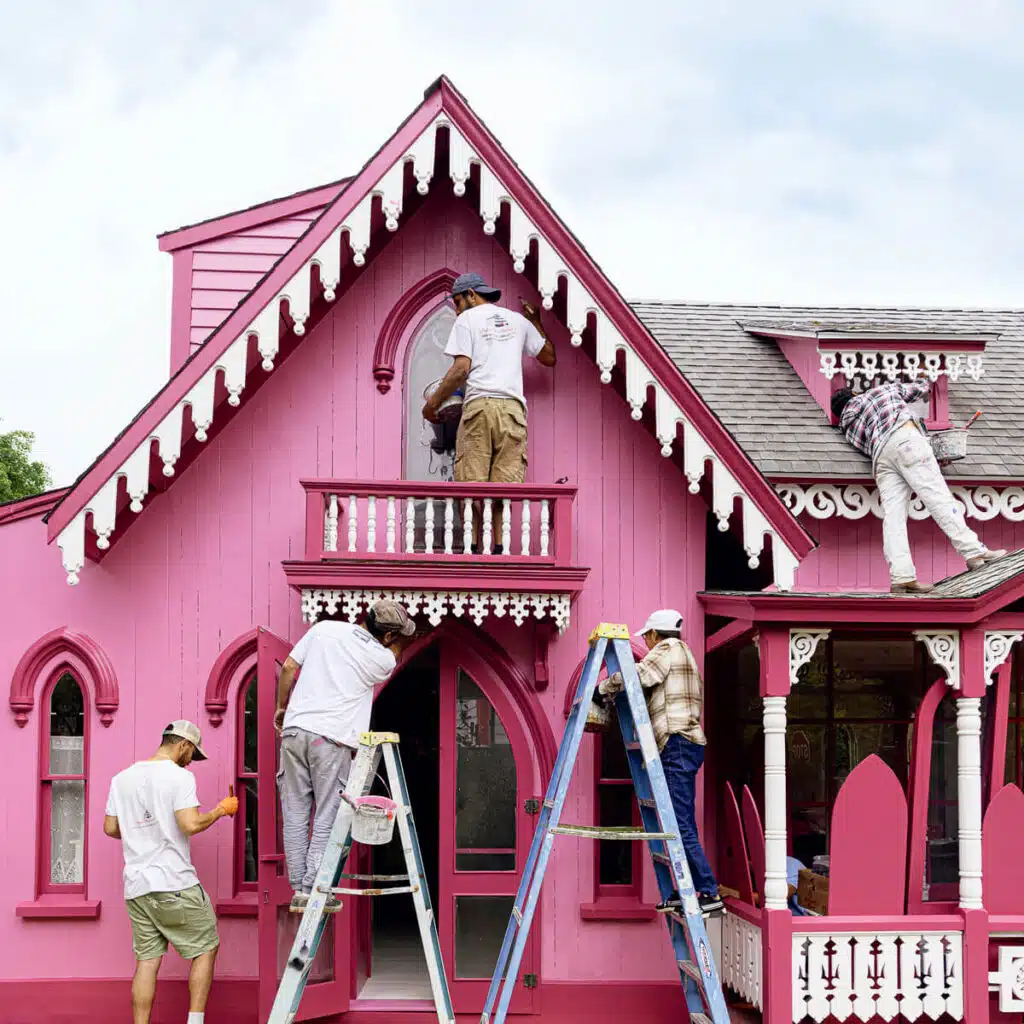
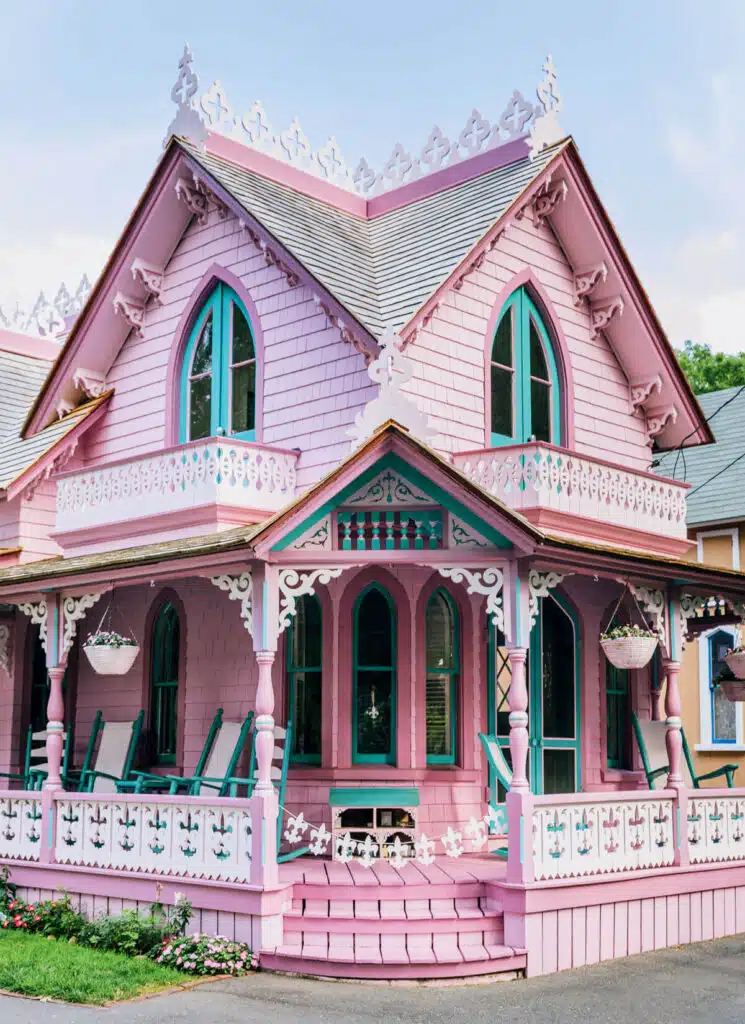
It makes sense that a group of like-minded folks, united in their faith and coming together each summer, would feel liberated from the conventions back on the mainland, wherever they called home. They originally housed themselves in tents, but when they started to make their little campground more permanent, they kind of went wild. Wavy vergeboards, looping scrollwork, elaborate turnings, dripping pendants—this was a riot of form and color that practically shouted freedom.
Credit: Alison Shaw
In many ways, the campers were a microcosm of something happening in American culture at large. In the mid-19th century, the country was moving away from being an agricultural society at the far edge of “western civilization” to becoming a manufacturing-based powerhouse, connected and interconnected like never before. In 1840, most travel was by coach and wagon and boat; there were 2,800 miles of railroad track. Four decades later, there were 95,000. Handcraft gave way to machinery, propelled in part by the material demands of the Civil War. As people’s movements sped up, so did fashions. New ideas flowed as quickly as new products, and the building industry was a prime mover, with catalogs full of eye-catching decorations ready to be delivered to the nearest train station. People expressed their expanded horizons in three dimensions, building houses that broke with the past.
Well, not quite. New architectural styles like Gothic Revival and Italianate softened the blow of the new by making a point of nodding to Old World models. But make no mistake: These were new ideas popping up in American cities and towns.
Yet unlike Capes and center-chimney Colonials, gingerbread is not a purely New England type. Its origins in new forms of manufacturing and transportation, marketed and distributed far and wide, dictated that it would be, if not a “national” style, a “nationally available” one, accessible to anyone with a catalog and a sense of adventure. Virginia and Lee McAlester’s classic A Field Guide to American Houses doesn’t even list “gingerbread” in its chapters. It’s more a question of adornment and ornament applied over a Victorian-era base style, the more the better, though just about any building, even a stoic Greek Revival, could get a little fillip from the addition of a bit of fancy work here or there. The ease of application aided the homeowner’s sense of whimsy.
Credit: Elizabeth Cecil
Aiding and abetting the adventure was the rise of machine-cut, standard-dimension lumber and the wire nails to hold it together. Before these, builders were limited by heavy timbers, whose bulk necessitated simple, boxy forms. The new lightweight “stick” framing allowed for easier corners, curves, overhangs, bays, porches, and dormers … and every exposed edge was an opportunity for tacking on some more decoration. In some cases, especially in the variant style known as Carpenter Gothic, there was little or no theory in operation, other than perhaps “more is more.” As Britannica describes it, “Turrets, spires, and pointed arches were applied, in many instances with abandon, and there was usually no logical relationship of ornamentation to the structure of the house.” Certainly the temptation was there: Illustrated catalogs from the time show page after page after page of turned work, square-turned work, sawn balusters, cornice brackets, pierced frieze boards, braced arches, scroll-sawn spandrels, pinnacles, porch roof cresting, and on it goes.
Much of this cornucopia was made possible by the mid-19th-century development of the scroll saw, the jigsaw, and the band saw, which allowed factories to turn out boxcars full of decorative woodwork. While fretwork—intricately cut patterned wood panels—had been around for centuries, these saws sped up the job exponentially. Novelty Wood Works in Boston’s South End became a center for such products, but the tradition of American handiwork didn’t die out. Our Homes and Their Adornments (1882) was both a catalog and something of a how-to book, encouraging its DIY-inclined readers to give it a go: “Some of the higher-priced scroll sawing machines have a turning lathe attachment, and are equipped with a complement of chisels and gouges, by means of which many useful and ornamental articles can be easily turned,” the author writes. “Some also have a buzz-saw attachment, a dovetailing attachment, a molding attachment, and buffing and polishing attachments, so that they are adapted to a great variety of work.” Norm Abram would be proud.
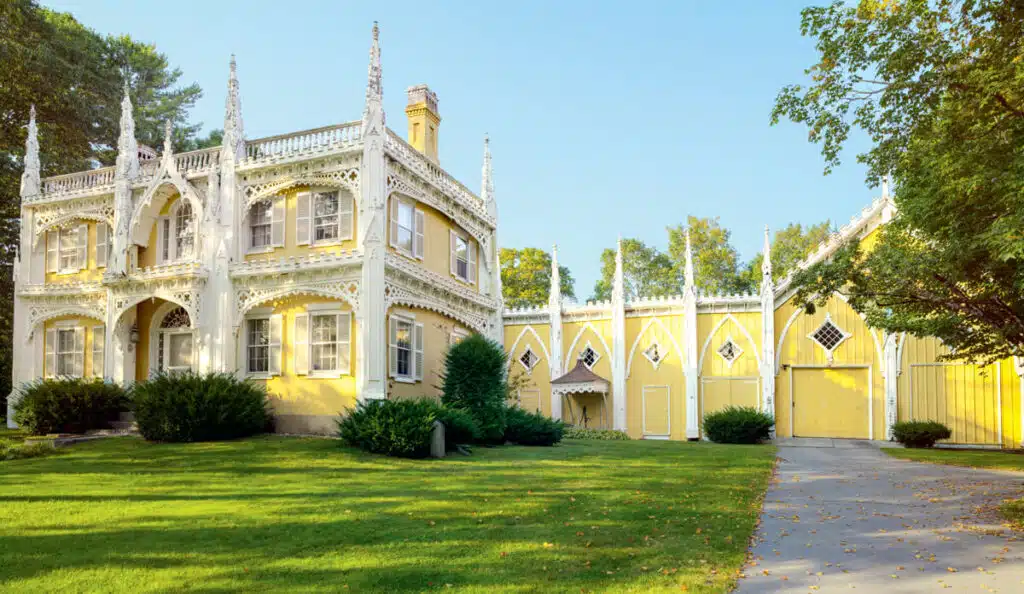
In the opinion of this author, scale is important to a successful gingerbread. The houses of Martha’s Vineyard’s Campground are smaller than some modern garages yet more ornamented than a cathedral—and it works. The eye can take in the whole. Larger structures seem to lose focus, the finely detailed fretwork becoming diluted as it stretches out over seeming acres of facade, the sweet shapes descending into gewgaw territory in their embarrassment. That said, the elaborate Wedding Cake House in Kennebunk, Maine, is high, wide, and quite handsome, not to mention valuable—it recently sold for $1,825,000.
Credit: Carol M. Highsmith/Library of Congress, Prints & Photographs Division
Another reason to support small? Upkeep is a bear. All that surface area, all those piercings and joints, the edges that hold water, the seams that open up…. “What we’ve noticed in a lot of these houses,” says painting contractor Hratch Iskenderian, “is that we find rot because there’s a lot of places for water to hide.” Based in Watertown, Massachusetts, his firm has painted gingerbreads all around the Boston suburbs. “We often have to have pieces fabricated to match. And the polychrome work is tough—you get into a bunch of color changing, which takes a lot of time. Some of the details get painted first, and then you have to work around them with the rest of the colors—it’s a lot of brushwork.”
Before he died in 1933, Adolf Loos wrote, “I have emerged victorious from my thirty years of struggle. I have freed mankind from superfluous ornament.”
That’s news to us!
Are you a fan of the New England Victorian gingerbread house?
This feature was originally published as “Uncurbed Appeal” in the March/April 2026 issue of Yankee.
You may also like…
Tour the Colorful Gingerbread Cottages of Martha’s Vineyard