



How the Triple-Decker Became a New England Icon
Sizing up the lore and legacy of New England’s iconic urban housing, the triple-decker.
By Bruce Irving|Jun 28 2026|

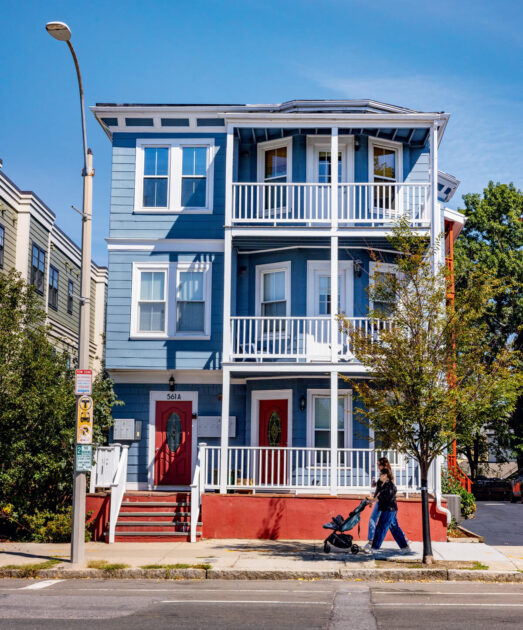
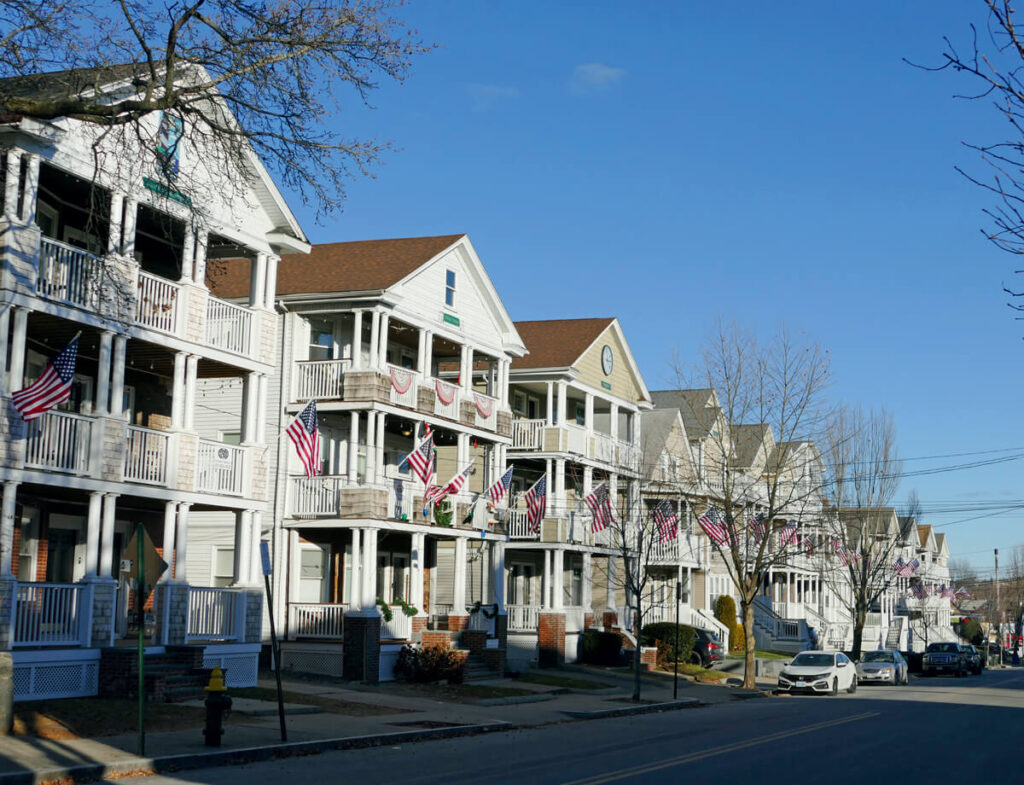
While many vintage triple-deckers, like this 1910 example in Somerville, Massachusetts, have been subdivided into condos and apartments, their signature three-family profile endures.
Credit: Adam DeTourWhen a new architectural style comes along, there are always the grousers. “Oh dear, this Gothic Revival fashion is simply too Old World.” “Ooh, these Modernist houses are so plain and boxy.” “Whatever happened to good olde Colonials?” Everybody’s entitled to their opinion, I suppose.
But when a building style appears that’s less about aesthetics and more about social values, look out. The rise of the triple-decker in New England brought out the best and the worst of our nature: They’ve been beloved as a means of affordable renting, or even homeownership, and maligned as a destabilizing blight on the urban landscape. That these hardworking assemblies of living spaces, three or six units on a lot, have endured is a testament to their problem-solving nature.
The triple-decker took New England by storm in the late 1800s. Instantly recognizable as a no-nonsense, efficient means to house more people by building up rather than out, they were built by the thousands in certain parts of Boston, Worcester, Cambridge, and Fall River, Massachusetts; Providence, Rhode Island; New Haven, Connecticut; and Portland, Maine; and dotted here and there throughout other working-class New England neighborhoods.
Credit: Adam DeTour
Their appearance came at the confluence of demographic change and technological advances. New England’s population grew by nearly a third between 1860 and 1880; Boston more than doubled in size. A rise in industrialization led to a majority of people transitioning from farm life to city-based wage work. Many of the new urbanites came from outside the country—French Canadians, Irish, and Portuguese foremost among them. Everyone needed housing, and stacking folks on top of each other was the logical result. Their wood construction was relatively cheap, and the recently introduced balloon framing method, with long wall studs extending from foundation to roof, could handle the load. Urban infrastructure was needed as well, and triple-deckers “did not appear until municipal utilities could provide water and sewage, and until building technology evolved to permit construction of flat roofs,” says Charles Sullivan, executive director of the Cambridge Historical Commission.
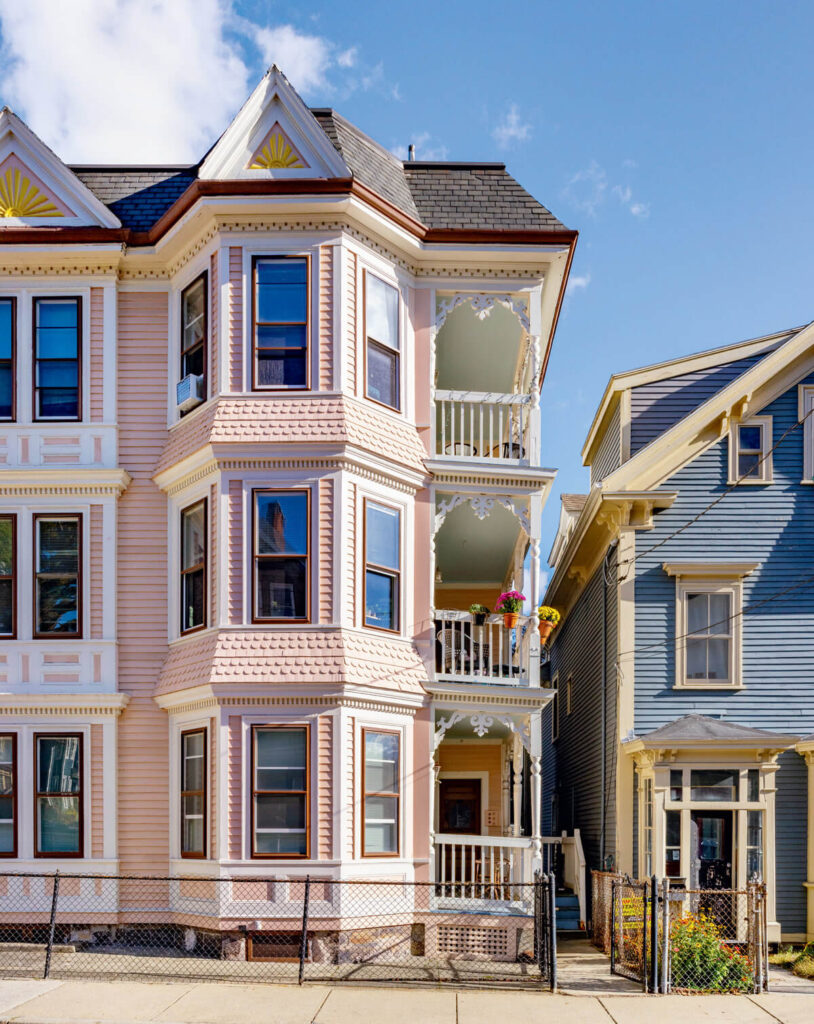
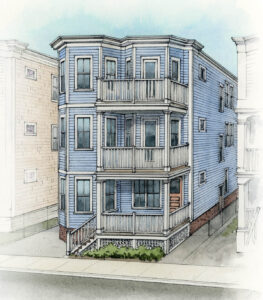
The buildings themselves could be trimmed out simply or with stylish elaboration. Queen Anne and Colonial Revival were the dominant types of embellishment, but all were essentially freestanding vertical arrangements of three apartments, sometimes doubled side by side to hold six. Kitchens and baths were stacked for efficient electrical and plumbing purposes, and there were windows on all four sides. Most had flat roofs, but some had peaks. Most had front and back porches to provide outdoor space, a little relief from the heat, and maybe even some of what the great urbanist Jane Jacobs would later call “eyes on the street.” This was key for developing neighborhoods where strangers were moving into close quarters with each other. A triple-decker might contain an extended family, or an owner (usually on the first floor) with renters upstairs to help pay the mortgage—everyone benefited from knowing who was coming and going.
Credit: Adam DeTour
Tenant or family member, people liked these places. Sociologists Robert Woods and Albert Kennedy wrote in 1914, “The values which the tenant receives in this modern flat are so little short of luxurious that it is no wonder they are in demand. A flat which rents for from 20 to 25 dollars a month includes a parlor, dining room, kitchen with set tubs, cook stove with gas stove and water heater attached, two bedrooms, front and back piazza, hot air furnace, electricity, and hardwood floors.”
So what’s not to like? Well, the very people who were benefiting from a chance to build equity or live in comfort—immigrants, poor folks, people of color—were not the people the owning class liked to see in town. As C. Morgan Grefe, executive director of the Rhode Island Historical Society, put it on the state’s public radio show Mosaic, “The house becomes a sort of metonym for the fear of the other”—a physical shorthand for social change, and not the kind the old guard wanted. In a 1917 Providence Magazine article about “the three-decker menace,” an urban reformer named John Ihlder praised the Yankee single-family houses of yore: “Dignified and beautiful dwellings arouse our enthusiasm not merely because of their dignity and beauty, but because they symbolize the spirit of their builders. These men and women not only conquered a wilderness but they set and, in spite of temptations, kept high standards for themselves and their community.” He went on: “The newcomers to Providence find an environment perhaps more kindly to the weak, but less kindly to the strong. The newcomers have lower standards. Are we raising these standards or are ours sinking toward their level? And what will be the results in the future?”
Credit: Adam DeTour
As a building type, you know you’re in trouble when both the Anti-Tuberculosis Association and the Municipal Art Society condemn you, as happened in Cambridge, Massachusetts, with even the local building inspector (heretofore not known as an architecture critic) taking to the local newspaper in 1913 to decry “street after street of so many three-flat wooden houses, resembling as many dry goods boxes standing on end.” Various laws were passed restricting triple-deckers—one banned cooking above the second floor, effectively outlawing them—but in the end, the pressures of growth prevailed. Cambridge’s mayor, Edward Quinn, could have been speaking about any New England city when he said in 1919, “While the tracts of vacant land for residential purposes are limited, there are sections of our city which were built up many years ago, largely with single houses that are fast declining in usefulness. These houses occupy for the most part large land areas, which could be utilized to a much greater taxable advantage for apartment house construction.” He called triple-deckers “one of the best means of solving our housing problems.”
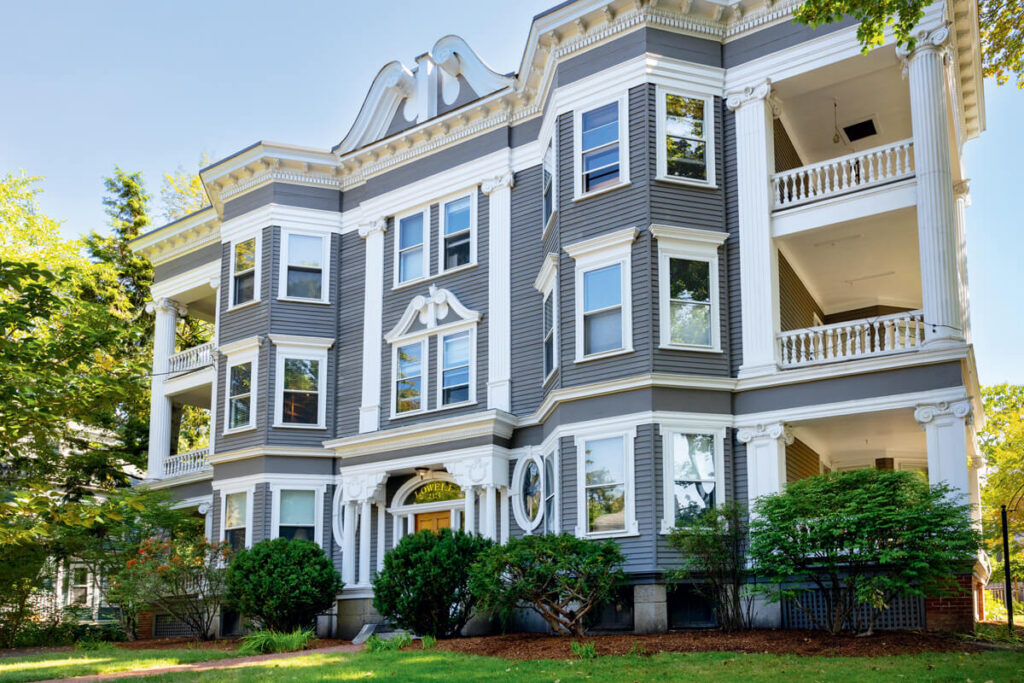
To lure folks out of their singles—to free up more land for building—some developers did their level best to make communal living respectable, offering elaborately designed and equipped multi-unit buildings, all gussied up for the gentry but, in the end, still triple-deckers. In Cambridge, they even gave them fancy names. The London started life as a Second Empire-style single but was converted to a balustraded confection holding three large apartments, while across town The Lowell was an architect-designed six-unit double triple-decker festooned with Ionic columns and pilasters and a monumental broken-scroll pediment. All up and down the urban demographic, the triple-decker offered good shelter in a rapidly crowding world.
Credit: Katy Pickens/Providence Preservation Society
The London and The Lowell still stand, as do blocks of more modest versions throughout New England, but all around the region, housing pressures continue to this day. Affordable rentals in triple-deckers still house newcomers, while others have been converted to condominiums, with units priced at numbers that would have made their original occupants faint. Far from being outlawed, the example of sensible density these century-old survivors offer has inspired more and more zoning laws that encourage multifamily structures, which ought to make housing accessible to more people. Looks like the spirit of their builders lives on, too.
See More: New England Architecture 101: Triple-Decker
This feature was originally published as “Three’s Company” in the July/August 2026 issue of Yankee.


I grew up in Bridgeport, CT where triple deckers are a common building template. I didn’t realize that that was a “New England thing” until reading your article but asI think back, I guess I haven’t lived anywhere else which featured them. My street was single family but the street behind mine and many of the streets that radiated off Madison Avenue were all triple deckers. Thanks for helping me better understand the neighborhood I grew up in!
I would love to see the three family homes make a comeback. They were and are beautiful, sturdy and so well made. Some of the hardwood and workmanship that went into things such as the staircase and banisters were just beautiful. It would be such a blessing to many families again, to have a home, yet each have their own space, and help defray the high cost of living, and housing in general. Do not forget the benefit of community, having others nearby for socialization and family traditions. I have frequently said it would be great to see new three family homes built again. I would strongly consider purchasing one to share with other family members.
A triple-decker is a sandwich. Where are you from, anyway?