An Ideal Setting | An 18th-Century Rhode Island Cape
Rhode Island jewelry artist Carolyn Morris Bach transforms an overgrown 18th-century Cape into a polished work-and-living space.
By Annie Graves|Sep 01 2017|

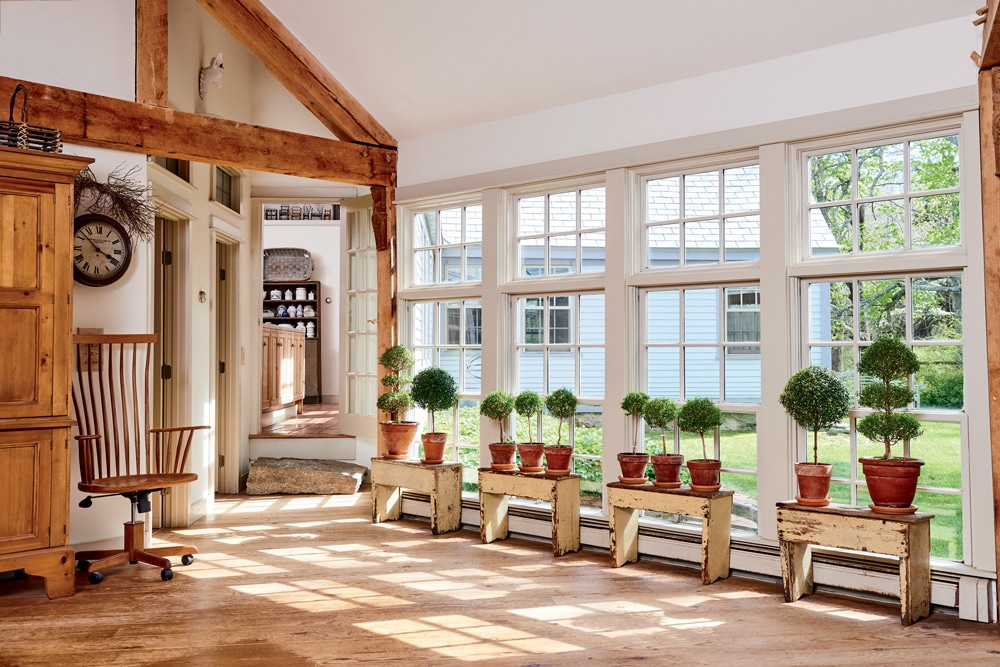
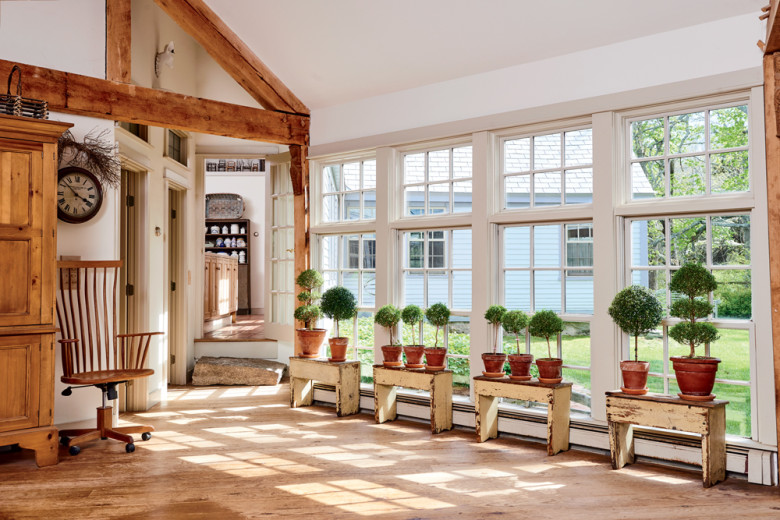
Myrtle topiaries march along the wall of windows in Bach’s “office,” which connects the house to the custom-built studio where she crafts her jewelry designs.
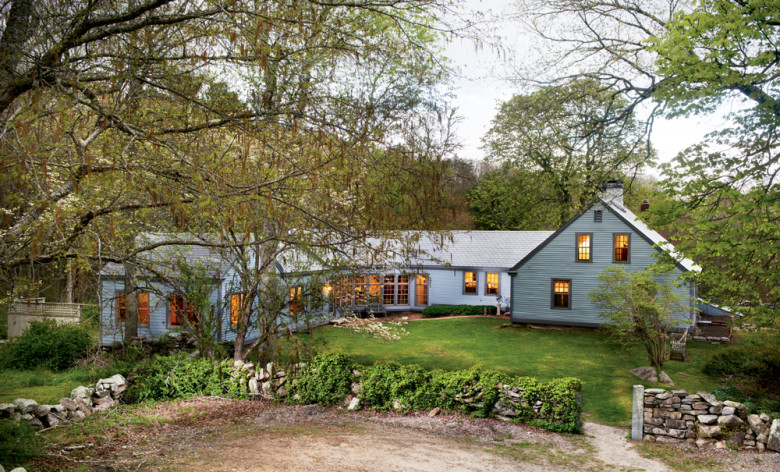
Credit: Mark FlemingThe house sits in a cup of sunlight at the end of a two-mile dirt road that winds past old sheep meadows. It sits with assurance and composure, a fact of the landscape. In 1784, this post-and-beam Cape in Richmond, Rhode Island, was built on the road to the mystical-sounding village of Usquepaug, about 10 minutes away; today it is Carolyn Morris Bach’s home and studio.
Credit: Mark Fleming
Credit: Mark Fleming
The house has sat here, in this clearing, longer than almost anything around it. It is a world unto itself, defined by clusters of birches and red sugar maples and a 200-year-old chestnut tree that leans toward the sunroom like an old friend. The corncrib, also c. 1784, was reclaimed by Carolyn from a raucous tribe of red squirrels. Graceful walls of Connecticut flat stone meander around the blueish-gray home; elsewhere, indigenous-stone walls trail off into the woods. “I call them Fred Flintstone stone walls—round and lumpy,” says Carolyn, a slender artist who moves through the house like a dancer on a familiar stage.
She sparkles when we talk about the house, “only 20 minutes from the raw Atlantic.” It is ideally sited for someone who makes intricate, beautiful jewelry that is sensitive to the natural world: “To be able to have the woods, and to know that the ocean is out there—I don’t know if you can improve on that.” At the same time, it fulfills the needs of an artisan whose work appears in the Boston Museum of Fine Arts and is cherished by the likes of Madeleine Albright (who featured one of Carolyn’s brooches in her book Read My Pins). T.F. Green, in Warwick, is “an amazing airport,” and Richmond is less than 15 minutes from Amtrak, offering an hour’s ride to Boston or three hours to Manhattan.
Credit: Mark Fleming
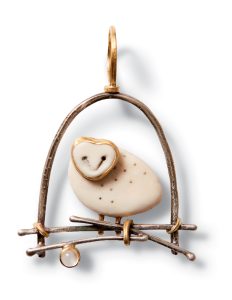
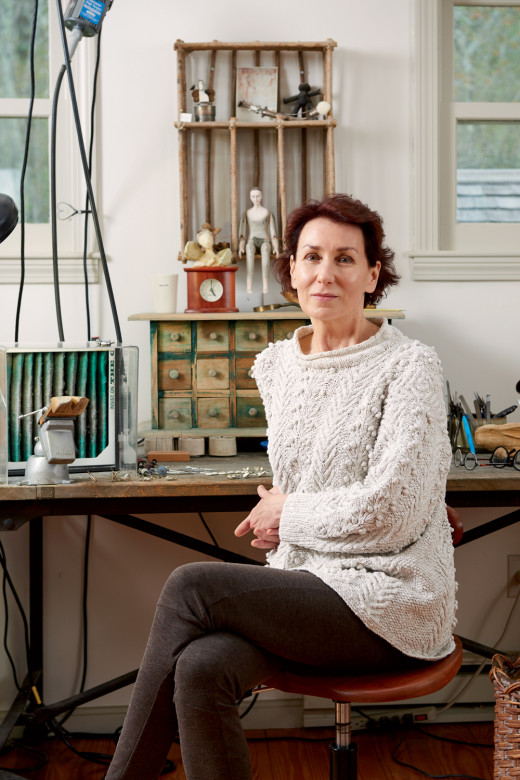
I originally came to see Carolyn for “Open Studio,” Yankee’s regular series of portraits of New England artists. I was prepared to enter the tiny world she inhabits, a world of images that are mysterious and elemental. Foxes, ravens, moon goddesses; creatures made of carved bone, moonstones, and golden twigs. Miniature works of art that her collectors often refer to as talismans. As a matter of course, most studios reveal something of artists and their craft. But in this case, Carolyn’s entire home, where she’s lived since 1991, breathes with the same sensibility imbued in her jewelry. “My life as an artist and this place are completely interwoven,” she agrees.
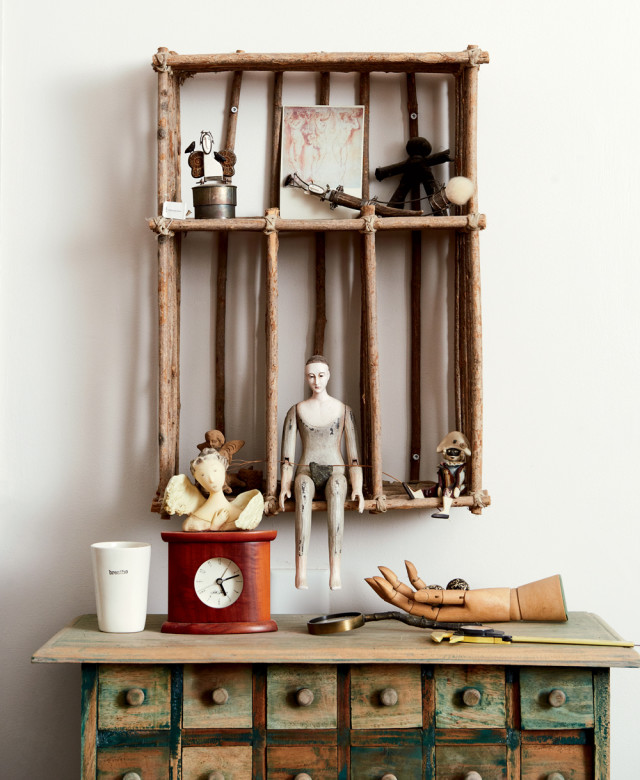
As we walk through the old Cape and into the newer ell, arcing behind like a scorpion tail, nature appears everywhere. Deer antlers picked up on walks through the more than 65 acres that she owns. Barred owl feathers parading like exclamation points atop a doorway. Shells displayed in a bathroom, tucked into the slots of an antique wooden fixture that once held room keys in an old Italian hotel. “I look at things literally—bathroom, water, shells,” she says with a smile.
Carolyn’s life as an artist began even before she attended the Rhode Island School of Design. “I studied ceramics at a progressive high school in Michigan,” she says. “I really had no interest in jewelry, but my art teacher suggested I try it. It was as if I was meant to make it. That’s something that people say about my work, too—it looks effortless. And in a way, it is. I don’t make mistakes. It’s usually right the first time.”
Clear vision is important when you’re working with precious stones and metals. But every homeowner knows it’s absolutely vital in renovation, where second-guessing can demolish a bank account. By the mid-1980s, Carolyn had begun to hit her stride as a crafter of tiny talismans. Her interest in Inuit artwork, sparked by a 1981 show at the Smithsonian Institution, had evolved into fashioning her own mystical little creatures. “And once I started doing figurative work, it just took off,” she says.
She and her then-husband were living at the time in a spacious Greek Revival in the center of Carolina, Rhode Island. “I wanted to be able to look out of my window and see no houses, only nature,” she says. “We saw a little blurb about this house in the local paper and came to look at it. It was so overgrown, a real wreck. I didn’t know if I had the heart to renovate another house, but really, I fell in love.”
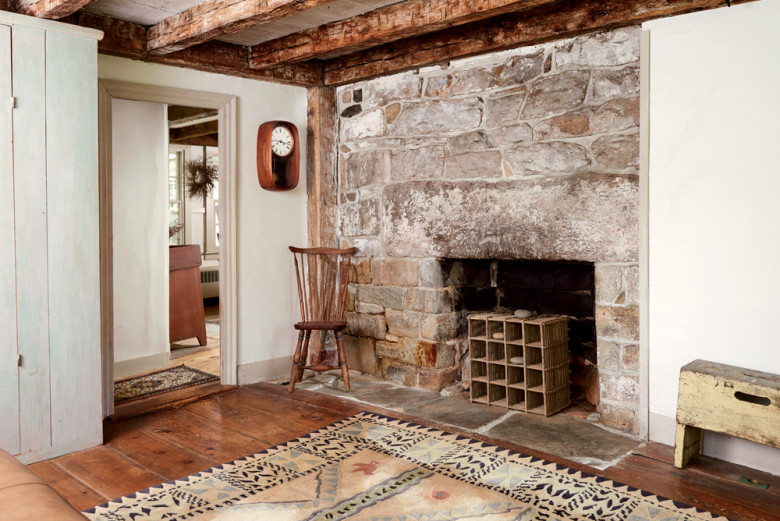
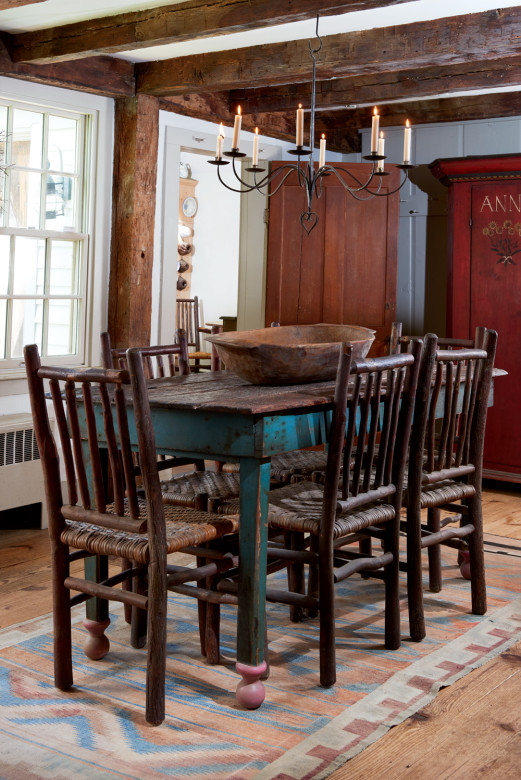
Love begat labor. The original center-chimney Cape is dominated by three massive granite fireplaces on the ground floor, one of which was hidden beneath vinyl paneling. The stones are staggering in size. In the low-slung dining room, a square bread oven punctuates a fireplace blackened by centuries of use. Particleboard ceilings were removed to reveal old beams, beautifully preserved under the layer of ugliness. “I wanted to cry some days, it was just such a mess,” Carolyn remembers.
Credit: Mark Fleming
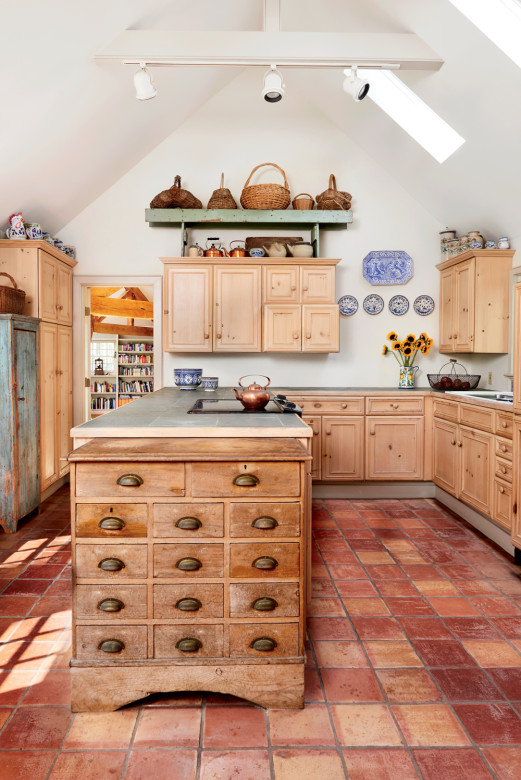
The dark kitchen—an addition from the early 1900s—was gutted to the studs and opened to the peak. Velux skylights now overlook a peaceful blend of pale pine cupboards and terra-cotta tile floors. High shelves display baskets, teapots, and doll-sized Adirondack chairs. The effect is masterful: Where many collections feel cluttered, this is pared down, painterly. A still life everywhere you look. “You don’t really notice they’re there, but when you do, it’s like, ohhhh,” Carolyn says, looking up. “I don’t know anyone who isn’t enamored of little chairs.”
Credit: Mark Fleming
As for the Mexican floor tiles: When she asked her tile man about the pile of accumulating rejects, he showed her their dog and chicken tracks. “He thought they were flawed,” she says. “And I said, ‘No, no, I want them in the floor.’” She points to an espadrille print. “Apparently as the clay was drying, all sorts of stuff was walking by. What could be better than dog paws?”
Credit: Mark Fleming
Meanwhile, as the beauty of the old house was emerging, there was new construction going on just a few steps away. Two studio rooms—one for storing materials and the other outfitted with tiny tools, like a fairy-tale workshop—were designed and built specifically for Carolyn’s furniture. “This is my paint box,” she says, opening a long drawer in an old printer’s cabinet to reveal a tumble of stones. Petrified sycamore looks like barred owl feathers. Flares of petrified manganese oxide in quartz resemble minuscule leaves. And rutilated quartz—“Each of those lines is a different mineral,” she explains, pointing at the golden filaments in the stone. “Doesn’t it look like spun straw?”
Credit: Mark Fleming
In the adjacent workroom, Carolyn hammers slender gold twigs, carves tiny fox faces from cow bone supplied by a dairy farmer in Little Compton, and fashions wings for a deer goddess. “This is where I spend most of my life,” she says. Here, too, the surroundings are spare and tranquil. “I couldn’t work in an ugly space. Ever since I was a little child, things that are ugly upset me.”
A few years after she moved in, Carolyn joined the house to the studio with a long, angled room that she calls her office. Paid for with “gold scrap,” it is flooded with natural light, thanks to the bank of windows running along each side, and filled with design books, Japanese-style sculptures from her days at RISD, and a few choice pieces of furniture, like the 1840 partner’s bench from Ireland. “Can you imagine trees being that big?” she asks, stroking the massive width of the desk.
“You know,” she says, “I’ve touched every square inch of this house. There is literally not one inch that hasn’t had my design and my mark on it.” As we stand in the office, with views into the old Cape one way, a glimpse of her studio the other, Carolyn’s clear vision is apparent on all sides.
Credit: Mark Fleming
It’s there in her jewelry, too. “I thought I would reinvent myself last year by focusing on gemstones,” she confesses. “People loved the work, but one woman came up to me at a craft show, pointed to a pair of opal earrings, and said, ‘You know, these are really beautiful, but any jeweler could do this.’ And then she walked over to one of my weirder goddess pieces, and she goes, ‘Only you can do that.’”
Carolyn nods slowly. “And that was like … the universe sends me messages when I need it. I just needed to hear that.”