Congratulations to Maine MacArthur Foundation Award Winner Jeremy Frey
Using skills and materials as old as New England itself, MacArthur Foundation fellow Jeremy Frey, a Passamaquoddy artist and seventh-generation basketmaker, adds a modern touch to his work.
By Yankee Magazine|Oct 10 2025|

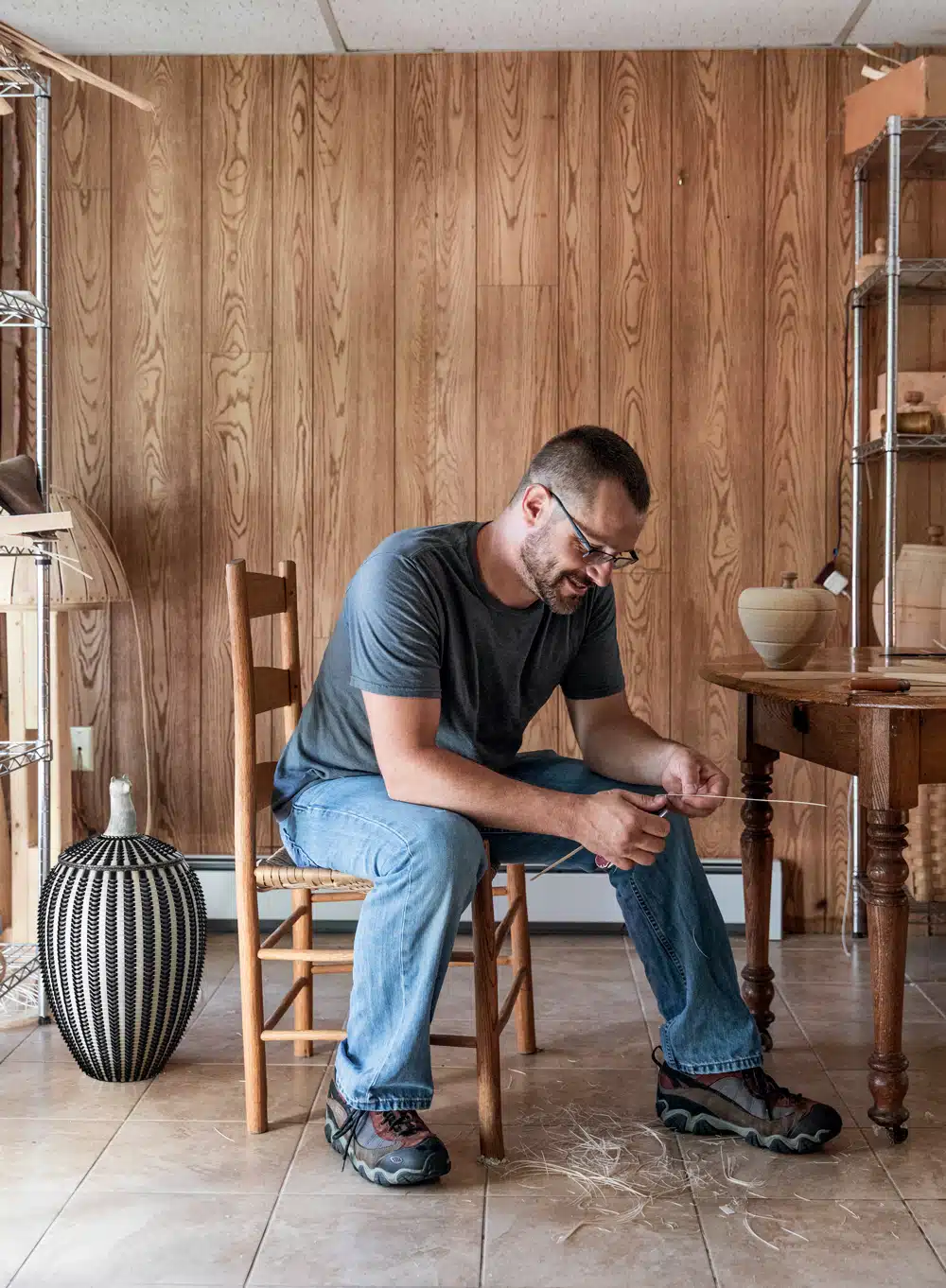
In 2019 Jeremy Frey told us “I wanted to do what no one else had ever done with baskets.”
Credit: Greta RybusEditors’ note: The list of 2025 MacArthur Foundation Fellows was recently announced. Of the 22 people named, four are from New England, and among them is artist Jeremy Frey. We were excited to see his name in the announcement, as we have been lucky enough to get to know him and feature his talent over the years. Meanwhile, the same week it was announced that Jeremy received a “genius grant,” his brother Gabriel was selected as a 2025 Maine Craft Artist Award recipient. Here we share excerpts from two previously published Yankee features, introducing the heritage and talent of these two basketmakers.
The New Makers | Jeremy Frey
Jeremy Frey’s hands rarely stop weaving, but there are exceptions. Once, he takes a break to explain the intricacies of a custom basket, its black latticework climbing the sides of a tightly woven body. And later, amid ash logs in the garage next to his basement studio, he shows how to whack a tree with the blunt end of an ax, battering every inch to loosen and strip the layers of fiber that will one day sit curled in his studio, waiting.
Credit: Carl Tremblay

Credit: Carl Tremblay
Raised in Passamaquoddy Indian Township, near the Canadian border, Jeremy learned to make baskets from his mother, Gal Frey. “Growing up, I always did art,” he says. “Our toys were pencils, paints, clay. I had my own jackknife when I was 5.” As he got older, he says, “I had no idea what I wanted to do with my life, except I wanted to be an artist. At 21, my mother said, ‘Why don’t you weave some baskets?’”
With seven generations of weavers in his family, it seemed inevitable. Then he got fierce about it. “I wanted to do what no one else had ever done with baskets.” His first show, in 2002, sold out. Since then, his work has won just about every prize that can go to a basket.
Unlike his grandfather’s sturdy utility baskets, Jeremy’s own pieces are called “fancy.” It feels like understatement. A Jeremy Frey basket swoops and curls, like music rendered in ash wood and sweet grass. “I like to do baskets that look one way from a distance and completely different when you’re up close,” he says. “A whole other world inside.”
–Annie Graves
Originally published as part of “The New Makers” (January/February 2019)
More Than Just a Tree | The Frey Brothers
Jeremy Frey is one of Maine’s youngest and most successful basketmakers. Some of Frey’s intricate baskets sell for upwards of $20,000 to collectors. Jeremy and his younger brother, Gabriel, also a basketmaker, are involved in every aspect of the craft. A typical run includes driving their truck three hours north of Indian Island and 30 miles off the tar, then riding ATVs six miles through mud to get to a stand.
“We go out in the woods,” Jeremy Frey says. “I mean in the woods.” In the woods, typically only five ash out of a hundred are straight and healthy enough for the Freys. The Freys haul those trunks home, strip off the bark, pound the growth rings off them in Jeremy’s driveway, and divide the splints between them. Pounding takes hours. They know they’re done when all of the cream-colored wood has darkened to a reddish brown where the hammer has struck, in a reaction known as “bruising.” Strips of pounded wood are threaded through a splitter, a stand about three feet tall, resembling an isosceles triangle with a narrow groove at the top.
The moist, rough ash at this stage emits a distinctive smell: Some compare it to watermelon, others to manure. With a knife, they bisect the end of the splint and, gripping each side, pull the growth ring into two pliable strips. The strips can then be split again and again, down to splints as narrow as floss, as smooth as satin, and as strong as wire.
Broad-shouldered Gabriel weaves sturdy pack baskets with wide splints the way his grandfather did—muscle baskets made by a muscle man. Jeremy, slight and bespectacled, makes obsessively precise, fancy baskets. The brothers guess that they’re around the seventh generation of basketmakers in their family—it’s hard to say for sure. Not only do they preserve the harvesting and the weaving they were taught, but in the purist’s version of the tradition, they also make all of their basket molds and many of their tools.
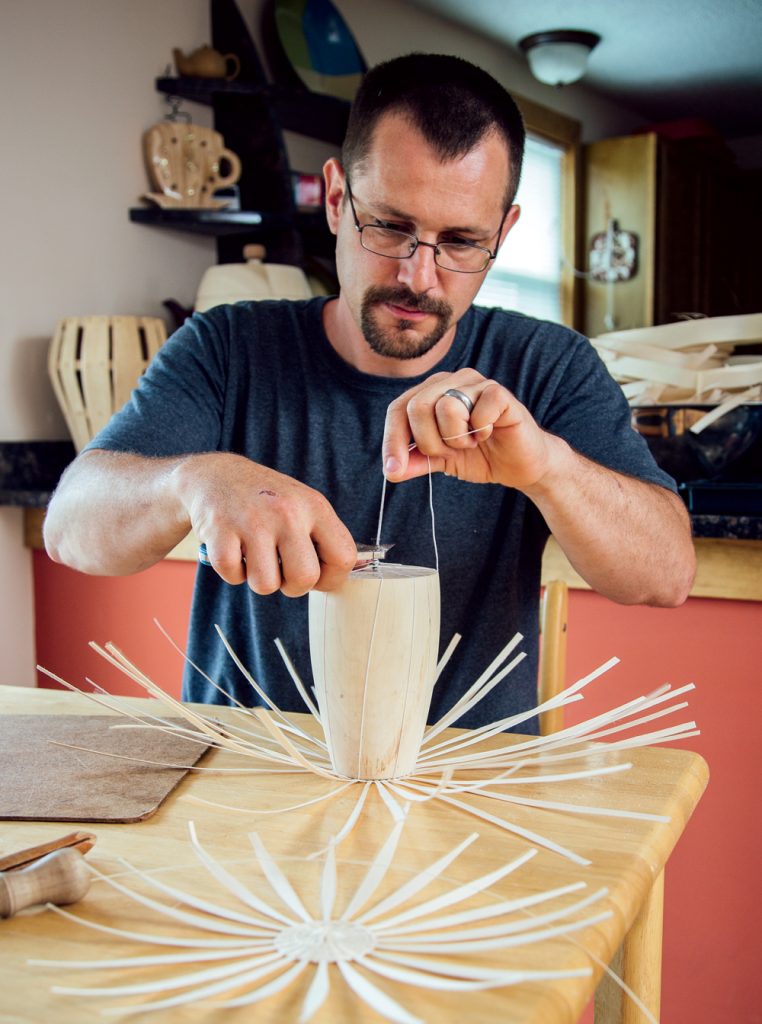
One afternoon a few days after a harvest, Jeremy sat at his living-room table weaving a threadlike splint into a small black-and-white barrel-shaped basket while his Chihuahua watched from her tiny bed in the corner.
“There are so many parts to making a basket that it can overwhelm you,” he says as his fingers plait the splint. “But for me, it’s just that I don’t get to that point until I’m there. So if I’m pounding ash, I’m not even concerned about a basket. If I’m splitting it, that’s what I’m doing. I’m just enjoying that little piece of the basket at the time.”
What Jeremy calls “the healing qualities” of basketry, Gabriel compares to collective memory. “When I actually sat down with my grandfather and made my first basket,” he says, “it wasn’t like I was learning something. It was like I was remembering something. All of the process, through making it and harvesting it, is something that is deeply connected to my ancestors. Even the smell when you walk into a basketmaker’s house. It’s difficult to explain. It’s like when you hear a song that you haven’t heard in a very long time, and it brings you back to that very first moment. That’s the connection.”
—Sara Anne Donnelly
Originally published as part of “More Than Just a Tree” (March/April 2016)