A Jewelry Designer and a Lobster-Trap Manufacturer Walk Into a Bar
The Patsy Kane line of nautically inspired New England jewelry has a deeply intriguing origin story and even deeper roots in the region’s jewelry-making traditions.
By Kim Knox Beckius|Jul 22 2026|

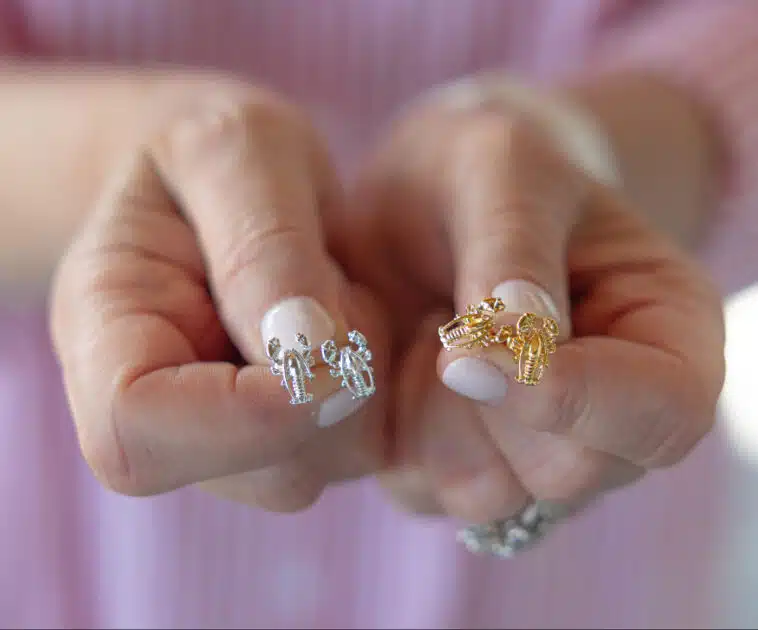
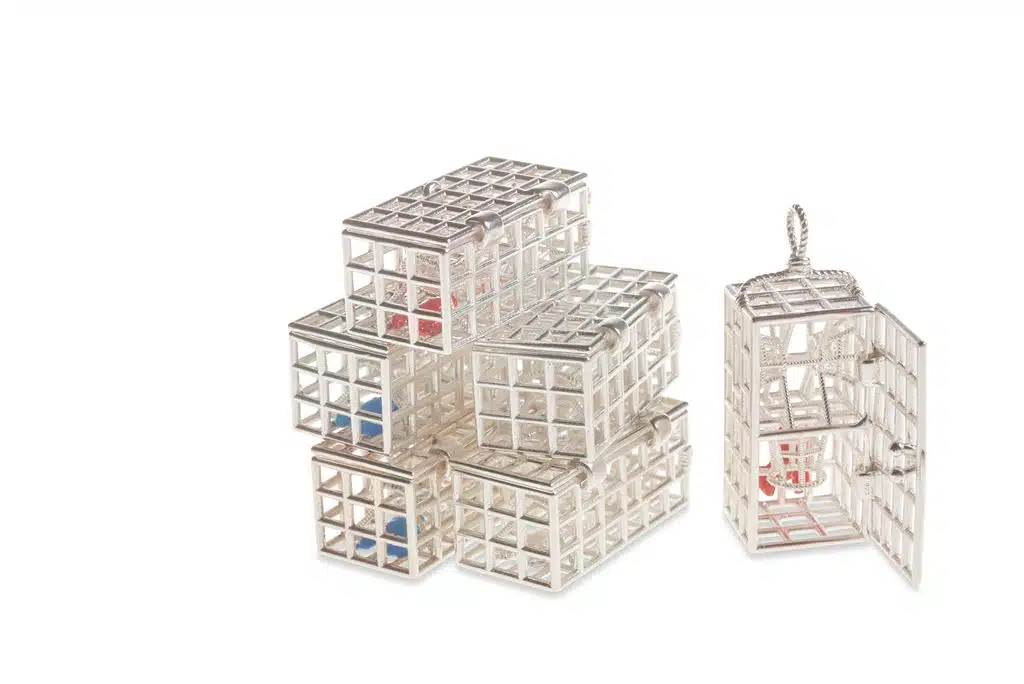
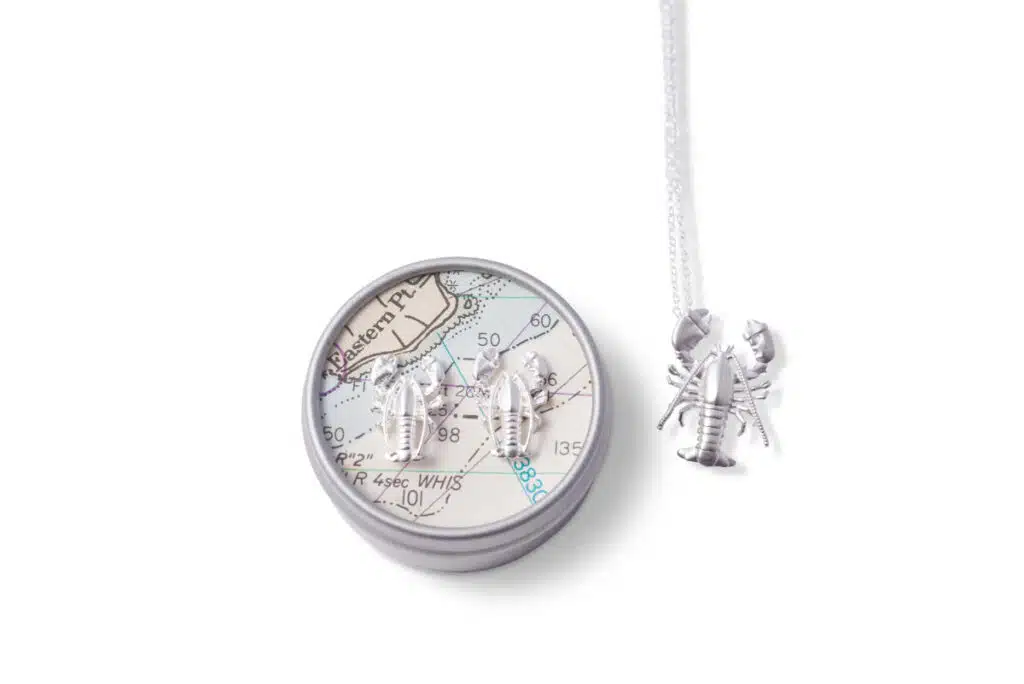
The Ketcham Lobster Earrings celebrate a New England icon.
Credit: Kristal HamThe history of jewelry making in New England stretches back to the late 18th century, but it’s not every day you meet a modern jewelry designer like Patsy Kane who’s committed to manufacturing right here … and whose most popular creations are conceived in collaboration with a lobster-trap manufacturer’s second-generation owner.
Yankee’s travel editor, Kim Knox Beckius, was understandably intrigued when she heard this unusual partnership began when Patsy Kane and Heather Ketcham walked into a bar as strangers and emerged as co-conspirators. Bob Ketcham, Heather’s dad, invented one of the earliest wire-mesh traps, now the standard for lobster fishers, and founded Ketcham Supply in New Bedford, Massachusetts, in 1975 to meet demand. When you wear a Patsy Kane piece, you’re sporting something that is both beautiful and authentic to New England’s lobstering industry and maritime traditions.
Credit: Katie Ring
Of course, Kim wanted to know the entire backstory, as well as what the future holds. “Listen in” on the three women’s conversation. And find the Ketcham Trap Pendant and select Patsy Kane designs available now in Yankee‘s New England Store.
Kim: When did your interest in jewelry begin?
Patsy: I’ve always been a jewelry lover and I’ve always been a maker. So merging the two seemed like a natural fit. I started with stringing beads, then learned about different manufacturing possibilities, and it took off from there.
Kim: What attracts purchasers to your designs?
Patsy: It’s emotional right off the bat. They look at them and say, oh, it’s a buoy! Or, look, the lobster trap opens! Or, I love oysters! It catches them right off emotionally. Then they say, oh, it’s so beautiful! Once they get past the look and see the authenticity, they’re sold.
Credit: Whitney Overocker
Kim: Do you consider jewelry making an iconic, enduring industry in New England?
Patsy: At one point Rhode Island was the jewelry capital of not only New England, but of the entire country. So there are generations worth of institutional knowledge that, if it doesn’t stay there, will be lost.
Kim: You work mostly in sterling silver?
Patsy: About 70 percent of our sales are sterling, and then we have our golden girls, who just wear gold. That’s a core of jeweler’s brass plated in 14-karat gold. We use a very heavy plate, which lasts longer than a flash plate. The plating is done in Rhode Island.
Kim: Have you always lived in New England?
Patsy: I have not. I’m from Westchester. I moved to Boston after college, moved to Marblehead to follow some friends, then met my husband and stayed.
Kim: Tell me a little bit more about that love story, and falling in love with a new place.
Patsy: We joke that it’s like a Hallmark movie: finance girl moves to Marblehead—meets guy who works in a boatyard—falls in love—and lives happily ever after.
Kim: Aww.
Patsy: Through my husband, I was introduced to a wider circle of Marblehead friends, which is how I met Heather. After commuting to Boston for a number of years, I was able to make jewelry as a side hustle and it slowly became my main hustle.
Kim: When you decided to launch the company, was there something that made you say, the time is right now?
Patsy: Age has something to do with it, because if it’s not now, then when? And it’s something I can do for the foreseeable future. I use my brain, meet people, get out in the world, overcome design challenges, learn new technology.
Kim: Tell me about the earliest designs. Were they nautical from the start?
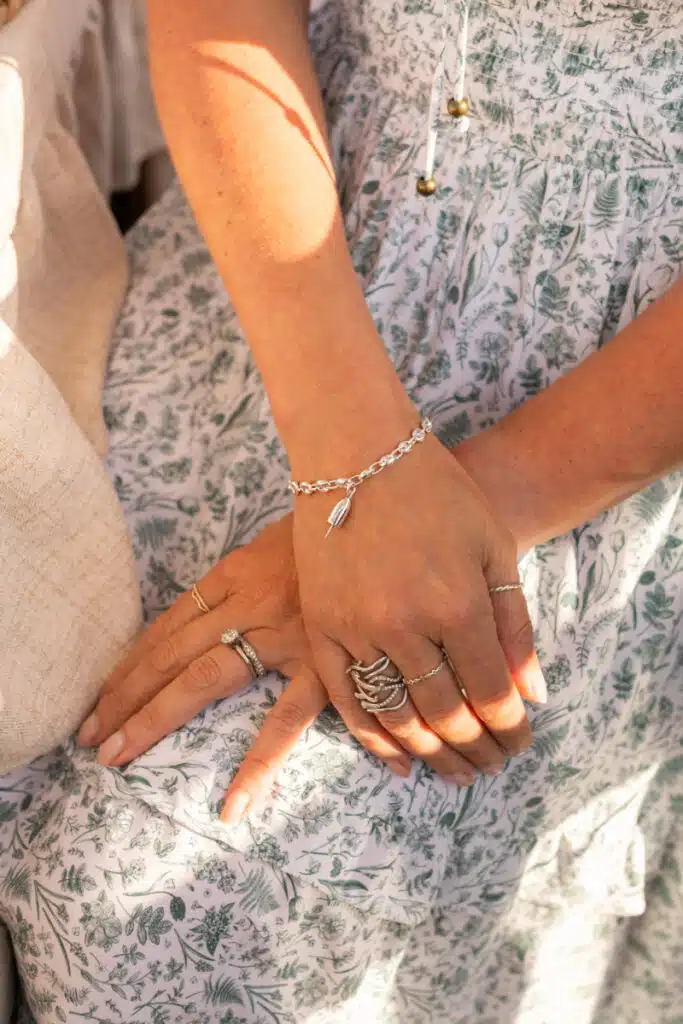
Patsy: Yes, from the start. The very first piece was a braided-rope bracelet. My first original design was the Marblehead Starfish pendant, which was followed by the New England Dory pendant based on the Swampscott dory. We then added the Mariner Shackle pendant and all sorts of complementary products.
Credit: Greta Tucker
Kim: Was it your passion that took you in that nautical, coastal direction, or did you do market research?
Patsy: It was my view of the world. I didn’t do any market research. I still haven’t done any. The coastal boom that’s happening now with coastal granddaughters and coastal grandmothers is just luck.
Kim: The coast is a place many of us only get to visit, and it’s so special because we only go there once or twice a year.
Patsy: And you want to be reminded of it year-round, so you bring back a little piece. We hope it’s a piece of our jewelry. But if it’s not, it’s a Christmas-tree ornament, or something fun for your house.
Kim: Talk me through how the two of you first met, how you started to talk about collaboration, and where this partnership has led you together.
Heather: Patsy was visiting Newport, where I live, and there was a big sailboat race. Her husband was racing, and a bunch of my friends were racing. And I wanted no part of racing. I said, you guys go out, you spend all this money, you come home, and you’re all mad. So I’m going shopping, and I’m going to have a nice lunch. And Patsy said, yeah, me too.
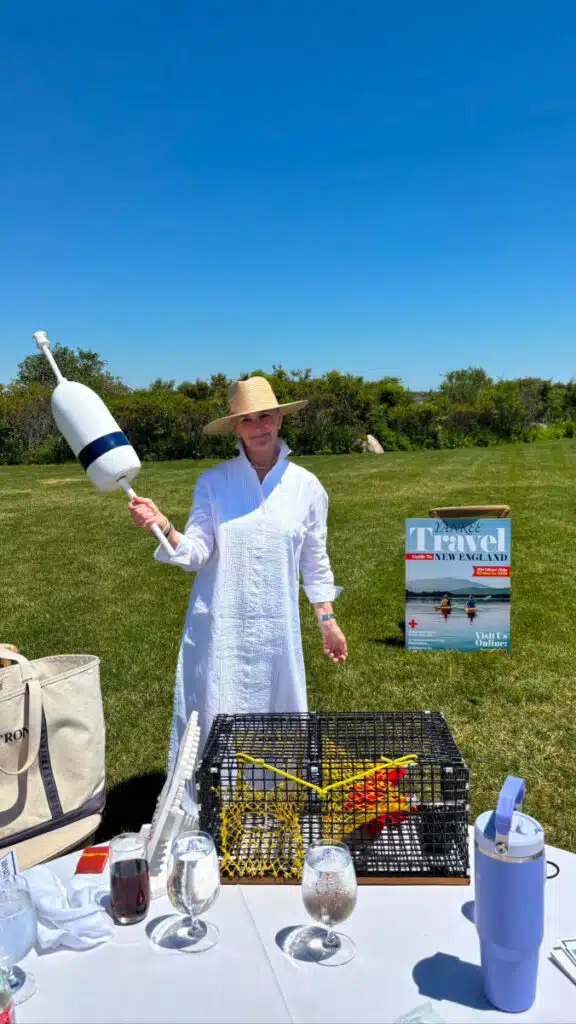
We spent a day walking around Newport, had lunch at a nice waterfront bar, and she told me about her jewelry business. My company sells wire lobster traps (as opposed to the old-fashioned ones with the round tops that are made out of wood), and I told her it would be really cool if I could carry jewelry that actually looks like the products I sell to my customers. They could buy it for themselves, for their wives, for gifts. And we started drawing on a cocktail napkin and coming up with ideas.
Kim: Contemporizing a New England symbol. Speaking of which, Heather, I understand that your family is responsible for modernizing how we fish for lobster.
Heather: My dad was a commercial lobsterman, and he started making wire traps in our garage. The other guys on the dock said, hey, that’s really cool, can you make some for me? Pretty soon, he had so many orders, he didn’t have time to go fishing, so he put his boat up for sale, and moved production out of the garage. Now we’re in two big industrial buildings in downtown New Bedford. We have two full city blocks, and 20 people working for us.
Kim: Is it true that your dad’s lobster-trap invention was inspired by finding a washed-ashore shopping cart?
Heather: Legend has it my dad just used what was around. He grew up on Cuttyhunk, which is a tiny island off the coast. There wasn’t much out there, barely any stores at all. You used what you had or what washed up on the beach. Repurposing was just how things got done on the island. The shopping cart is part of that lore. I can’t tell you how much is true and how much got better with the retelling. Either way it fits the spirit of the place, where nothing useful went to waste.
Kim: Does your family go back generations as lobster fishers?
Heather: My grandfather ran fishing charters out of Cuttyhunk. His family was from Long Island, so not in the commercial-fishing industry, but they were recreational fishers.
Kim: And you run the trap business still today?
Heather: I worked in biotech for 20 years, and, about 10 years ago, my dad said, I’m retiring and you need to decide if you’re buying the business and coming back, or I’m going to sell it to somebody else.
Kim: Did you instantly know what you wanted to do, or was that agonizing?
Heather: We had talked about it for years, and it never seemed like the right time. In that moment it became clear that it was time. At the end of the day, any kind of business is all about taking care of people and your customers.
Kim: Does Ketcham Supply have a retail presence in New Bedford that people can visit?
Heather: We have a store that caters to commercial businesses, but anybody can come in. And we sell a recreational version of our lobster trap. It’s a bit smaller, so people can operate it without a lot of heavy equipment. Tongue in cheek, we call it the YotPot. It’s available online as well, and we sell thousands of them every year to recreational boaters.
Kim: Is it legal for them to catch lobsters?
Heather: It is. In Massachusetts and Connecticut you can pay for a permit to put out 10 lobster traps recreationally. In Rhode Island, you can have five. A lot of people have no idea they can do it themselves. So we did a big marketing campaign about capturing your own lobsters.
Kim: This is such a good New England story, in part because the Patsy Kane brand touches so many states in New England.
Patsy: My CAD designer, Andrew, is a Mainer, and he’s actually a stern man on a lobster boat. Manufacturing is done in Rhode Island. Our chains for the pendants are made in North Attleboro, Massachusetts. I’m in Marblehead. Heather lives in Newport and works in New Bedford. And Ketcham’s products are made in New England as well. It’s very important to both of us that we keep that manufacturing alive.
Kim: A collaboration between two successful women in two very different types of industries seems rare. What is the special sauce for the two of you?
Heather: Every design usually goes through multiple iterations. Patsy does all the design work and heavy lifting on that side of it. And sometimes I say, well, this doesn’t ring true …
Patsy: So we achieve that overlap between authentic and sellable. Right away, both of us said there has to be a blue lobster option.
Kim: Tell me about your partnership with Northeast Arc.
Patsy: A friend who sits on the board of The Arc introduced me to Shine Jewelry in Peabody, which employs people with disabilities to handcraft jewelry. Shine is part of an umbrella called Heritage Industries, which is a division of Northeast Arc. Heritage also re-canes chairs and offers other services like paper shredding. My collaborator there, Paul, when he’s not making jewelry, is a paper shredder. He does the stringing on all of our I Love You bracelets. He is meticulous and we’ve had a partnership for about seven years.
Credit: Kristal Ham
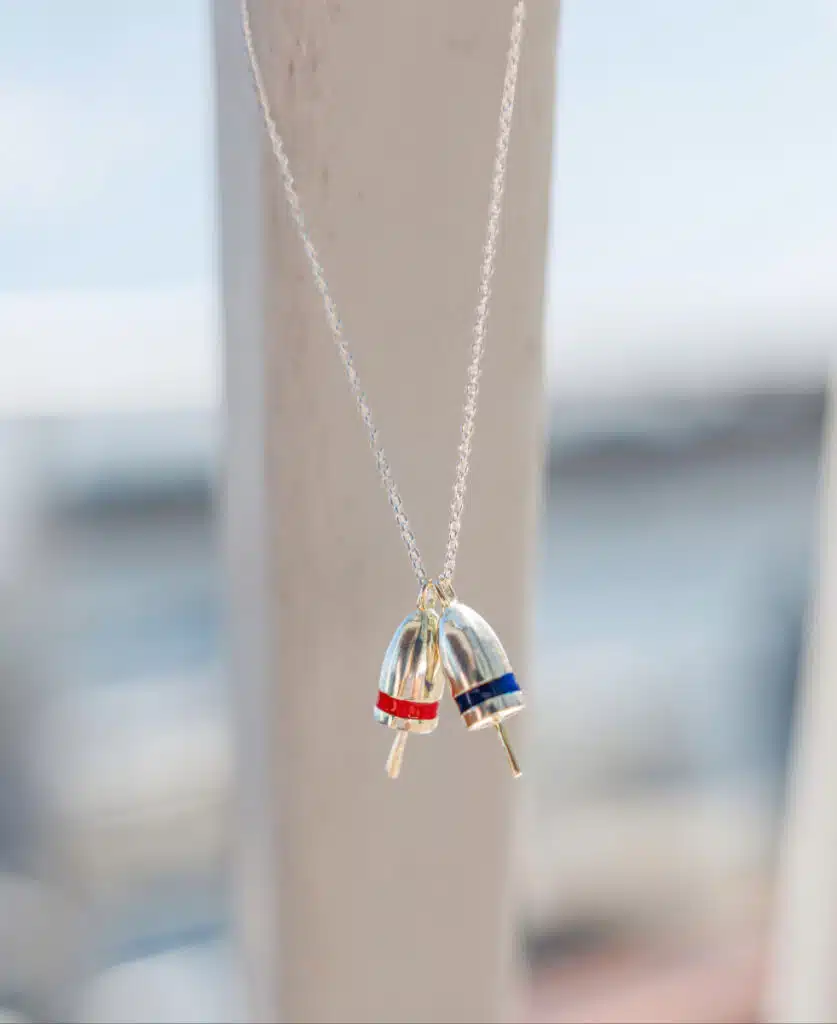
Kim: On the topic of true-to-life designs, lobster buoys in the ocean are a certain color for a reason, often a familial or symbolic connection. Your colorways have meaning there, too, right?
Heather: Patsy and I both sell the full line, but to completely different customer bases. I sell to commercial fishers. So, of course, they want the same color buoy they chose for their traps. And they tend to get them for the whole family.
It’s interesting to find out why they chose their colors. We saw one of our customers today, and his buoy colors are red and yellow. I said, tell me the truth, it’s ketchup and mustard, isn’t it? And he laughed and said, yeah, maybe.
Kim: Is there a piece from the collection that you like to wear most?
Patsy: I go between the buoy and the oar. Those are my go-tos.
Heather: I like the buoy, for sure, and the lobster trap because it was our first design. And I have the blue lobster in my trap.
Credit: Victoria Dosch
Kim: What new designs are you thinking about?
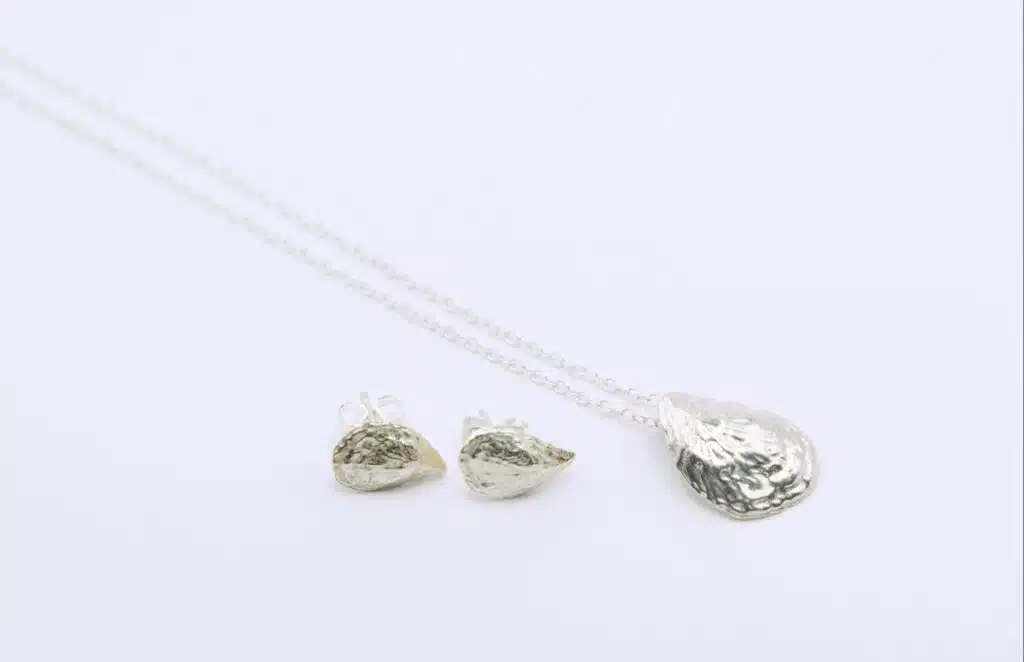
Heather: I can see us offering more aquaculture-based pieces. We’ve done a lot with oysters because that’s a huge part of the trap business.
Kim: Heather, are you building oyster cages and those types of gear as well?
Heather: Yes, we build a lot of oyster gear. Probably 40 years ago, the first oyster growers came to us and asked if we could make a cage to help keep oysters together and away from predators. Our tools and materials enable us to also manufacture gear outside of the marine business like feral-cat cages, dog kennels, fencing, turtle traps, pizza-cooling racks, and other equipment that people request. And since we manufacture locally, we can do a prototype in a couple hours.
Kim: Patsy, what are some of your favorite comments or reactions to your pieces?
Patsy: A rower in Gloucester commented on how authentic the oars are. A friend at Wellfleet Marine carries our jewelry at her shop, and also wears three buoys because they’re the colors of her son’s buoys. She saw them at a trade show, and immediately said I want three, and I’m going to carry them. When people recognize our work quality, that really resonates with me, because we try hard to be an excellently produced, excellently serviced brand.
Kim: What tips do you have for someone who’s dreaming of starting a business?
Patsy: Ask questions of anybody that might have any kind of knowledge, because people are usually willing to share. Reach out. People are there.
Heather: You can’t give up, and you have to solve a problem for somebody. If it were easy to solve, they wouldn’t need your expertise. Keep trying until you find something that works. Then you can spread it out to a larger and larger base of customers. Just being persistent is huge, and not getting down when something doesn’t go as planned.
Patsy: And nothing goes as planned.
Credit: Victoria Dosch
Kim: Is there anything you’d like to share from your area of the coast, like a favorite spot people would love to know about?
Patsy: Oh, Marblehead has so much history. General Glover rowed Washington across the Delaware. We defended the USS Constitution in the War of 1812. That’s why she comes up to visit. The painting The Spirit of ‘76 is in our town hall.
It’s a hard-working town. There’s a working waterfront, and it’s not just yachts. It’s families with center consoles, it’s lobster fishers, it’s somebody with a kayak, it’s somebody with a paddleboard. Access to the water should be available to everybody, and we do a good job up here.
Heather: It’s true that Newport has high-end restaurants and boutiques, but I don’t think people appreciate that it is also very accessible, even if you don’t have a lot of money. On Thursday nights newportFILM shows free outdoor movies, and on Sunday afternoons NIMFest holds free concerts at the King Park Gazebo. There’s Cars and Coffee, where you can walk around and look at classic cars on the weekend. There’s so much to do that’s free and wonderful and a lot of fun.
Kim: How does your sense of responsibility to your communities influence your business decisions?
Heather: We are a U.S. manufacturer and we use U.S. materials as much as we can. The thing we use most is wire, and we exclusively source it from a company in Massachusetts called Riverdale Mills. I don’t think any other lobster-trap manufacturer can say that. We employ local labor for making everything from nets to clips. We take pride in that.
Patsy: Both of our industries, though they’re very different, are traditional to New England. People have been fishing here for thousands of years. And Europeans have been fishing here for hundreds of years. Jewelry manufacturing is more than 200 years old here. We aim to sustain those traditions, respect the resources, and just be good people.