



In Praise of the New England Boiled Dinner
When it comes to eating real food, we’ve got the plainest, squarest, and most wonderful meat and potatoes meal in America — the New England Boiled Dinner.
By Jane and Michael Stern|Mar 09 2022|

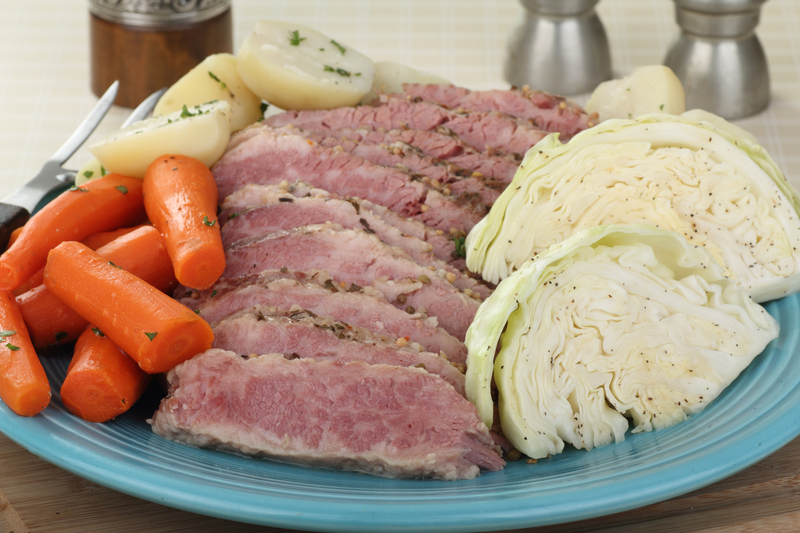
New England Boiled Dinner
Credit: DreamstimeLearn more about the history of boiled dinner and why New Englanders love it (and rightly so) in the Yankee Classic, “Let’s Give Boiled Dinner Its Due,” from April 1986.
In Praise of the New England Boiled Dinner
When Grover Cleveland took over the presidency from Chester A. Arthur in 1885, he inherited more than a new address and the nation’s problems. He came into a legacy of epicurean dining that he loathed. The former President had liked his food with its nose in the air: dits of foie gras, dots of charlotte russe; he even dandified his macaroni pie by adding oysters. Cleveland, a regular Joe of simple tastes, put up with the fancy food; but one night, catching a whiff of corned beef and cabbage being eaten by the servants, the president traded his Arthurian meal for theirs. “It was the best dinner I had had for months,” he later beamed. “Boeuf corne au cabeau!”
Hear, hear, Mr. President! In the current age of culinary frippery and fickle food fashion, of nouvelle cuisine and diet dinners of Pritikin paucity, there is something especially estimable about a plainly named plate of meat and potatoes. Health foodies and fussy chefs de cuisine be damned; the world needs real nourishment when it sits down at the table, a stick-to-the-ribs hunk of cow with vegetables dug up from the good earth. And when it comes to eating plain and square, we in the northeastern part of the United States have everyone else beat. We’ve got the plainest, squarest, clunkiest, and most wonderful meat and potatoes meal in America — the New England Boiled Dinner.
Picture it: a big hunk of corned beef brisket, brick-red, striated with juicy veins of fat, falling-into-shreds tender, sliced thick, in the center of the biggest platter in the house. Around this great meat hub glistens a faded rainbow of vegetables: beets in a crimson puddle that bleeds into the salty dampness of the beef; limp cabbage wedges, steamy and pale; small boiled potatoes and heavy rutabagas luxuriating in the mingled juices. Above this hot rugged landscape hover clouds of briny perfume.
With a glass of cider, hard or sweet, this is the ultimate, the Primal Meal. Compared to it, other contenders for the most basic food in America — steak and French fries or ham and biscuits or turkey and dressing — are fancy. If you doubt us, consider its name: Boiled Dinner! You could not get more generic, prosaic, or neutral unless you called it Dinner, Boiled.
Americans didn’t invent it. English boiled beef goes way back, and most other countries have similar dishes. French pot au feu; Italian bollito misto; even Mongolian hot pots. They are all boiled dinners. But none is a Boiled Dinner.
There is magic to the one and only real thing. It isn’t just corned beef plus cabbage plus other stuff; it’s all of them together on the same plate on Wednesday night, probably in Vermont.
Why Vermont? Because although Boiled Dinner is at home in every New England state, its essential qualities are Vermont’s. It is a commonsense meal, no exotic ingredients. It is a meal with integrity — throw everything into the pot, pull it out when it’s cooked. No tricky culinary manipulations allowed. It is frugal and spartan and pridefully common.
It even looks like Vermont, as much an icon of country life as a checked wool shirt or a hitched team of horses: solid inland food offering plenty of calories that will take a good day’s work to use up.
The simplicity of Boiled Dinner is logical. It gets cold in the North Country, so you stoke a fire. As long as the fire is going, why not put its heat to work cooking dinner? So you hang a pot of water over the heat, throw a bunch of food in, and go about your chores all day while the meal cooks. The rutabaga crop isn’t so good? That’s okay, throw in parsnips or turnips or carrots, whatever root vegetables are handy. It’s the original potluck supper.
Some early cookbooks even call for centerpieces other than corned beef. We’ve seen salt pork, dusted with cinnamoned flour and browned until the fat is rendered, boiled with vegetables and served in the center of the plate with no beef at all. Closer to the shore, you will find aberrant oceanic Boiled Dinners centered around codfish; further south, around — ulp — boiled chicken.
In Maine, it is said, cooks prefer the rump; some books call for beef flank; but the proper anchor is beef brisket, corned. Before it was available in every supermarket in cryovac bags, cooks had to cure their own, submerging the beef for weeks in a brine made from salt and gunpowder (the latter contained in shells known as “corns,” hence the name). Properly corned, the beef has plenty of tang to flavor the pot of water and all the vegetables thrown in. Some traditional Vermont recipes say the corned beef should be boiled with a strip of salt pork for more flavor. In his authoritative book, American Cookery, James Beard suggests studding the brisket with cloves after it’s been boiled, then glazing it with maple syrup or brown sugar and mustard. Beard also says that potatoes weren’t part of the repertoire until 1725.
Spice it up with bay leaves, garlic, peppercorns, throw in a squash or half a dozen onions. It is a tribute to the essential integrity of Boiled Dinner that you can dude it up a thousand ways, but the gravity of its own weight keeps it down to earth.
Which is not to say you couldn’t start a civil war about what is and is not proper on the Boiled Dinner plate. Esther Serafini of Sugar Hill, New Hampshire, is already on the warpath. Sixteen years ago the Time-Life Books cooking series printed her recipe for Boiled Dinner, but changed it to suit their taste by adding one onion pierced with one clove. When we checked the recipe with her, she was still steaming. “I was never so angry in my life,” she fumed. “Whoever heard of an onion in a Boiled Dinner?”
Mrs. Serafini, whose family has run the Homestead Inn for generations, is in charge of making the dowdy dish that has been the house specialty for more than 100 years. She explains its popularity among rural New Englanders by saying, “We were poor. All poor families could raise some vegetables and find a piece of meat to put with them. Boiled Dinners kept us strong and healthy.”
That’s the idea. Strong and healthy. In her New England Cookbook, Eleanor Early remembers that “Wednesday was Boiled Dinner Day. When Grandpa came home at midday, the hired girl staggered into the dining room with an enormous ironstone platter which she placed before him. To have dinner on the table at noon, Grandmother was up at dawn.” Up at dawn? Yes, the truth is that although the cooking technique — boiling the hell out of everything — is simple, a successful Boiled Dinner demands a lot of effort, effort and time that no modern kitchen implement can reduce. Boiled Dinner means making food the old-fashioned way.
That is the way they continue to do things at the venerable Homestead Inn. Like Eleanor Early’s grandmother, Mrs. Serafini gets up with the sun to start the beef boiling in a large kettle. When it’s properly tender, she removes it from its salty liquor, carefully wrapping it in aluminum foil to keep it moist. She then divides the cooking liquid into numerous pots, and boils each vegetable for the proper length of time, cabbage last.
Even if one wants to be more traditional and boil all the vegetables together, Mrs. Serafini warns, the beets have to be separated out lest they bleed into their pot-mates. She admits that this is a nicety for the sake of Homestead guests. She’d throw the beets right in with the rest if she were doing it just for her family, who she cheerfully says, “wouldn’t give a hoot.”
When everything is cooked, she serves dinner to guests on ten-inch glass plates which, like everything else at the Homestead, are family heirlooms. With an artist’s eye she places three strips of beef in the center, cabbage and potato — both pale — at each end, then adds the more colorful turnips, carrots, and beets in between. On the side comes a horseradish sauce that Mrs. Serafini says makes her guests go, “Oooooeeeahhh!”
Boiled Dinner is family food, served at grand old inns like the Homestead or Philbrook Farm in Shelburne, New Hampshire, but mostly at home. Still, there are some restaurants that are not too highfalutin to offer Boiled Dinner. The Bar-Jo Restaurant in South Paris, Maine, where the sign out front boasts of Electrically Cooked Foods, serves it every Thursday, as does Moody’s in Waldoboro; you’ll find it on occasion at the Fairlee Diner in Vermont, and at its sister restaurant, Roberts’ Country Kitchen in Thetford. Up north, in Berlin, New Hampshire, The Wayside Restaurant makes a grand Boiled Dinner three times a month, usually on Sundays, as well as an even rarer edible antique, salt pork with milk gravy.

Credit: Aimee Tucker
One other special item occasionally found on the Wayside menu is red flannel hash, the dish that many consider to be Boiled Dinner’s better half. Let it now be said: no Boiled Dinner is truly over with until days later, when the last of the red flannel hash is served. Indeed, Boiled Dinner cannot be honestly discussed without fair mention of this, its second, scarlet incarnation, for the simple reason that never in the recorded history of New England has an entire Boiled Dinner been polished off at one sitting.
All of us morning people, who think that breakfast is the gastronomic high point of the day, contend that the best reason to go to all the trouble of a Boiled Dinner is those lovely leftovers. Hack ’em up, moisten with a splash of cream, and slap a thick pancake’s worth into a greased cast-iron skillet. Fry it crisp, serve it with a sunny dropped egg on top, and when your fork breaks through the patty’s crust to its tender insides, the reason for the name becomes apparent — the beets have tinted the whole juicy mess a rosy red.
The chopped-up leftovers are actually prettier than the original dish. Boiled Dinner is a rugged, at best handsome, platter of chow; red flannel hash is ravishing, downright elegant. As the beets and corned beef sizzle, casting their resplendent spicy tang into the air, it is hard to think of this princely dish as leftovers.
And wonder of wonders, it is becoming something that its old boiled self could never have imagined — fashionable. Red flannel hash has been discovered and embraced by advocates of regional American cookery. It has gone “from the prosaic to the sublime,” according to James Villas in American Taste; “out of the roadhouse and into the serious kitchen,” proclaimed Cook’s magazine.
There are even some who maintain that red flannel hash should be made from scratch with bacon, beets, potatoes, and onions. But come on, admit it. That’s the sissy way. Anybody with backbone knows you’ve got to earn your hash by plowing through New England Boiled Dinner the night before.
Are you a fan of the classic New England Boiled Dinner?
“Let’s Give Boiled Dinner Its Due” was first published in Yankee in April 1986.
You may also like…
75 Classic New England Foods
St. Patrick’s Day Recipes
New England Boiled Dinner Recipe
Easy Corned Beef and Cabbage Recipe
Red Flannel Hash Recipe



Despite my Irish heritage, my love of corned beef came from my maternal, Swedish grandmother’s New England Boiled Dinners with vegetables from my New Hampshire Yankee grandfather’s garden! And that meant New England Style Grey Corned Beef!! I’m surprised your articles didn’t delve into the different types of corned beef. Actually, I was kind of shocked when I saw the red NY style corned beef in your article without any mention of the New England style.
If you try the grey corned beef, the water needs to be changed during cooking. (Or during soaking before cooking as I just read about.) I’ve always brought the brisket to a boil for five minutes then removed it and washed out the pot and re-filled it with fresh water bringing it back to a boil them simmering for hours. Without the changing of the water, the beef will be virtually inedible because it will be too salty. Learned that the difficult way the first time I cooked my own boiled dinner years after those grandparents had passed away.
Never had a bitter turnip in this boiled dinner! Brussels Sprouts are also excellent, need to cook a few minutes longer than the cabbage. And no chemicals turning the meat red in the New England style!! Unless you add beets of course.
That info about Maine…so wrong. I’ve never heard of anyone here in Maine putting anything but corned beef in a traditional boiled dinner. It is quintessentially Maine.
My paternal grandfather would cook a New England Boiled Dinner just about every weekend. It was easy for him to make and it would give grandma a day off of from cooking. However, grandpa insisted that a true New England Boiled Dinner is smoked shoulder, cabbage, carrots and potatoes and that Irish Corned Beer and Cabbage is Irish Irish Corned Beer and Cabbage. Grandpa came from a long line of mostly English colonists to New England going back to the Mayflower Pilgrims, and grandma was 99% Irish with her ancestors arriving in mid 19th century. I’m not sure if either of my grandparents ever cooked what they called Irish Corned Beef and Cabbage, as I don’t remember eating Irish Corned Beef and Cabbage at their house, as grandpa only served what he insited is a true New England Boiled Dinner, smoked shoulder, cabbage, carrots and potatoes. So at some point in my life, I was surprised to find that other New Englanders consisder what my family calls Irish Corned Beef and Cabbage a New England Boiled Dinner. Mad me go “Uh?” Even my mother’s parents of similar ancestry to my paternal grandfather, distinguished between the two and yes the maternal side would occasional coook the Irish Corned Beef and Cabbage, but more often their New England Boiled Dinner was also smoked shoulder. I enjoy either, but, I really prefer the texture of the smoked shoulder. And a couple of years ago, my dh and I went out for Irish corned beef and discovered that there is red corned beef and gray corned beef. We decided one of would order the red and the other the gray. We both discovered we prefer the red over the gray. It’s all in what you get used. Its funny the things we remember, how we think we know as normal from what we learned from our family when growing up. I seldom cook either corned beef or smoked shoulder (I can never find the latter), but this year for St. Paddy’s Day, I cooked the best Irish Corned Beef and Cabbage I have ever cooked. 🙂
Oh, how happy I am to see you mentioned smoked shoulder, cabbage, carrots and potatoes when they’re tossed together it is known as a “proper” New England Boiled Dinner.
Indeed!
Happy memories around this hearty cast of characters…
With respects to the varied names, well, I believe this is oh sooooooo New England too.
For example: ask anyone of Canadian heritage in New England, what is the difference between Gorton, Creton, or is it Corton??
And watch their heads tilt like a puppy hearing a noise for the first time.
But what you can count on is this – while the cast of ingredient may be slightly different here and there, what is omnipresent is the joy shared with this meal.
From the first time it hits the table to its last curtain call in the morning, it truly is a gift that keeps giving to the very end.
????
So, from the comments, there is no consensus on Boiled Dinner….Here in the Midwest we make it with pork shoulder or a big chunk of ham, no beets, plenty of onions, carrots, and potatoes, cabbage optional……Made with corned beef, and cabbage, it is properly Irish Corned Beef and Cabbage, though I don’t think the Irish used beets….
“The Bar-Jo Restaurant in South Paris Maine” was actually located in Norway and unfortunately closed down over 25 years ago, but was nice to see it mentioned! My grandmother always made boiled dinner with ham per my grandfather who found corned beef to be too fatty…
Even although I’m a former New Englander, this meal often turns a salty grey, and tastes like turnip — Yuk !
Nana from PEI would scour the earth for parsnips for her grey boiled dinner…. it was considered something of a status symbol,worthy of a Sunday….
My mother as Newfoundland and my father was from Massachusetts. In Newfoundland a boiled dinner is called a Jiggs Dinner. So, since my mother was the primary cook we called it a Jiggs Dinner.
My roots are Irish, mainly, Scottish and Englush. My Aunt was from Ireland. Everyone used the red flat cut corned beef for the boiled dinner. It is the most flavorful and less salty in my opinion.
The Community Church in Harrisville, NH served boiled dinner on the Saturday before St Patrick’s Day! 43 lbs of Corned Beef, 10 lbs of Carrots, 5 heads of cabbage, 12 lbs of potatoes, 5 loaves of Irish Soda Bread. Definitely comfort food here in New England…
I 100% agree that arguing over the “right” recipe could start a civil war. I found myself adamantly nodding along and agreeing at times and making disgusted face and shaking my head others. New England Boiled Dinner is one of my most favorite meals.
very interesting article – really enjoyed reading them.
Bravo! This fine article harkens back to the days of more literary food writing. Long live the Sterns!
I DO not agree that a New England boiled was Corn beef I am a life long New Englander (73yrs old) and my family had a N E boiled dinner once a wk and it was always Smoked shoulder (Corned Beef was only on St Pats day) W/pots cabbage and carrots…the left over shoulder was used for Ham salad that was ground up and mixed w/cains mayo and mustard…Also Sunday morning after church what was left was sliced and fried w/bacon… home fries and eggs… it was a weekly meal that I could not wait for….I WANT IT NOW !!!
I agree. My dad made our boiled dinner with a “Daisey ham”. If corned beef was used it was “corned beef and cabbage dinner” Both dinners had the potatoes, cabbage, carrots and turnip.
Same here. Miss a Daisy Ham.
I agree!
Agreed!
Corned Beef was for St. Patrick’s Day because it was so expensive.
My family on both sides are of Canadian descent when they came down, they settled in New Bedford, MA. and I’m 2nd generation and 100% French.
If Memere, the aunts, or my mother made a NE Boiled dinner it was always a Smoked Pork Shoulder… when it went on sale. The dinner included the usual Cabbage, Carrots, Potatoes, Whole Onions, a chunked Celery Stalk, Salt, Pepper, and possibly a Bay Leaf.
It never lasted very long.
It’s still a fond memory and I make it as often as I can in late fall and winter.
I’ve used a smoke shoulder for years. Made it for my siblings, my children and now my grandchildren. But I’ve always added turnip to the pot. They ALL loved it. Cooked ALL together in one big pot after I par boiled the shoulder, drained the salt water and started fresh. Oh So Good!!!!
Being a former NewEnglander now living in Broken Arrow, Ok., and a vegetarian, I take great delight in omitting any sort of meat product. But I love (and make often in wintertime) the boiled dinners. I start with a large head of brocoli or cauliflower or cabbage, and add all sorts of veggies and spices. Yum!
Rique’ Lydem
Former Burlington, Vermontier
In my house yes we love our cb hash. But we use it all for our hash. Cb, potatoes, carrots, and yes cabbage. I have yet to see anyone, anywhere use the cabbage. I do not understand why it is always left out.
Will it be heresy to make it in an Instant Pot? As a name “Pressure cooked corn beef” doesn’t ring true, but everything else I’ve cooked in it has been tender and juicy. It won’t steam up the windows and the wonderful smells should still scent the house. Hints and opinions most welcome!
In the fall, my grandmother would make a “Harvest Dinner” with ham with bone in, and fresh vegetables from the garden. She would grind up all leftovers and mixed well, served with or without an egg. Gram liked hers with pickles or relishes she had preserved, and always kept “pot liquor” (cooking liquid”).Not to waste anything she made pea soup with the ham bone. I make it this way, except for St. Patrick’s day I use red corned beef. Depending whom I’m cooking for beets go in (red potatoes), some folks don’t like red potatoes. But they get ground up in the “red” flannel Hash. Hash freezes well also. I live alone and find it hard to cook for one, its nice to have meals ready , just thaw and heat up .Sorry hit submit
comment bottom twice, now 3 times!
I think that “a brine made from salt and gunpowder (the latter contained in shells known as “corns,” hence the name)” is incorrect. “Corn” was originally a name for any small particle, not the container. (In England, most menus and packages still say “maize” if they mean what we usually call corn.) Grains of salt and of the gunpowder itself would both have been “corns”. Note that gunpowder wasn’t even necessary; one of your readers notes “grey corn beef”, which was made with plain salt, not reddened by the nitrates from gunpowder.
I grew up in NH and our boiled dinners we ham, cabbage, carrots, onions and cabbage.
But she did make corn beef the same as the ham dinner. I’ve been making boiled dinner with ham and veggies for all my life. I’m retired now so it’s a boiled dinner few times a week! Cornbread beef is ok but prefer ham!
I am a former Bostonian and proud of it! I miss my Mom cooking the boiled dinners on Sunday. It was always about traditions and I loved helping her. I now cook it with my children and grandchildren and it is such a wonderful comfort food for me!