Why You Should “Eat More Kale” | The Queen of Greens
How a savvy entrepreneur named Bo Muller-Moore took on a corporate giant and made a leafy green an “Eat More Kale” star in the process.
By Aimee Tucker|Oct 09 2014|

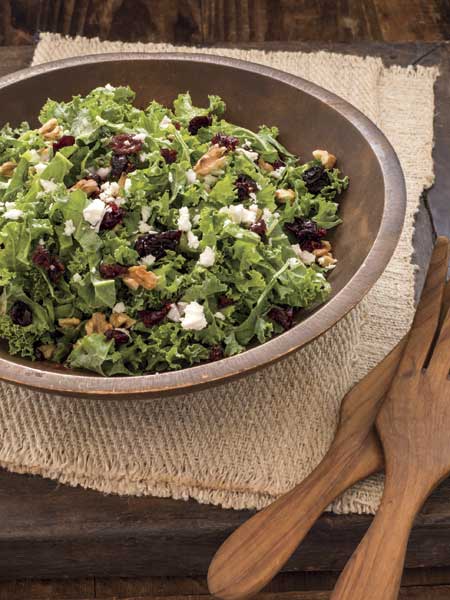
Harrisville Kale Salad with Cranberries, Feta and Walnuts is inspired from the delicious salad served at Harrisville General Store.
Credit: Piazza, Michael
Why should you eat more kale? It’s crunchy and nutrition-packed.
Credit: Piazza, MichaelCredit: Piazza, Michael Here in New England, we credit Paul Betz and Kate Camilletti of High Ledge Farm in East Calais, Vermont, for igniting what has arguably been kale’s largest public-awareness campaign to date. In 2000, faced with a surplus of greens but few takers, they asked Bo Muller-Moore, a local folk artist and fellow regular at Montpelier’s Capital City Farmers’ Market, to silkscreen the slogan “Eat More Kale” onto a few T-shirts for their family. Muller-Moore agreed, and within weeks, additional requests for “Eat More Kale” T-shirts trickled in, which soon led to a full line of stickers and hooded sweatshirts. The slogan became something of a mantra in Vermont, and in August 2011, Muller-Moore applied for a trademark. Unfortunately, that drew the attention of the Atlanta-based fast-food chain Chick-fil-A. The company argued that the phrase was too close to its “Eat Mor Chikin” campaign. (In the company’s ads, a trio of semiliterate cows try to persuade consumers to eat less beef, more poultry.)

Farmers Kate Camilletti and Paul Betz woth folk artist Bo Muller-Moore, creator of the “Eat More Kale” slogan.
Credit: Piazza, MichaelCredit: Piazza, Michael Undaunted, Muller-Moore held firm, and his plight was picked up by the media as a modern-day David-and-Goliath tale of local sustainable agriculture versus big business. With the national coverage, Muller-Moore’s sales exploded. The “Eat More Kale” slogan can now be spotted on supporters (and their vehicles) worldwide, and the artist has the photos on his Web site to prove it. Local farmers agree that the ongoing “Eat More Kale” trademark debate might have a little something to do with the green’s popularity boost, but selling more greens is only one up side. “The biggest and most tangible benefit,” Paul Betz says, “is that people are getting excited about their food and where it comes from.” They’re learning how to enjoy their kale, too. It can be eaten raw or cooked, and with its rich, nutty, slightly bitter flavor, it benefits from a bit of salt (goes great with bacon!) and shines when paired with nuts, alliums (including garlic, onion, and shallots), and sweet ingredients such as dried fruits and winter squash. For those who find the bitterness too strong, it’s worth noting that kale actually tastes sweeter after a frost. When purchasing kale, “look for leaves that are fairly firm,” Betz recommends. “The stem where the kale was picked should still look fresh.”
Harrisville Kale Salad with Cranberries, Feta and Walnuts is inspired from the delicious salad served at Harrisville General Store.
Credit: Piazza, MichaelCredit: Piazza, Michael Although you can find recipes featuring kale blended into smoothies, sprinkled onto pizzas, and baked into crunchy chips, one of the easiest and tastiest ways to enjoy kale is in a simple, fresh salad. Visit Bo Muller-Moore’s Web site, EatMoreKale.com, for gifts, photos, and meal suggestions.
GET THE RECIPE: Kale Salad with Cranberries, Feta and Walnuts