Life in the Kingdom | Heavy Lifting
As time passes, staying fit for farm chores can be a job unto itself.
By Ben Hewitt|Jul 01 2023|

Life in the Kingdom | Heavy Lifting
Credit: Illustration by Tom HaugomatIn December 2018, I was teaching as an adjunct at Sterling College in Craftsbury, Vermont. This arrangement granted me access to the school’s facilities, which included a small subterranean space crowded with iron plates and dumbbells, along with an assortment of complicated-looking machines that to me seemed like an invitation I did not wish to accept.
What compelled me to first enter that room? I can’t say precisely, but I suspect it had something to do with the simple fact of December, with its long nights and short, brutish, dark days. December is a cooped-up-feeling month—everything seems a little too close and a little too slow for my tastes—and I suppose the notion of pushing weights around felt like an antidote, albeit an unlikely one.
The other thing is that I had long struggled with an iffy lower back. I’d always chalked it up to being tall and gangly (because surely it couldn’t be for lack of strength, right?), and I’d just sort of lived with it. But every six months or so, my back would go out, usually while working in the woods, and I’d spend a few days hobbling around or (as was becoming more frequently the case) flat-out in bed, waiting for my spasming muscles to relax themselves while loudly bemoaning my circumstances. This did not seem like a promising trajectory, and it was very much at odds with perhaps my foremost fantasy as it relates to aging, which is that I’ll still be cutting and splitting our firewood when I’m 80. I couldn’t be sure that lifting weights would make this possible, but I was pretty certain it wouldn’t hurt.
Along one wall of Sterling’s weight room, there was a row of large windows right above ground level; on one of the sills, someone had left a bottle of smelling salts, which serious lifters like to inhale immediately before extreme efforts. I guess the way it works is that the ammonia provokes a surge of adrenaline, which makes lifting heavy weights just a bit easier. I never cracked that bottle, but I like the idea of the salts; they spoke to me of a purity of purpose and intent that felt like the answer to a question I didn’t even know I was asking.
Shortly after I started lifting, I asked my friend Annie to introduce me to her friend Ted, an ex-national-class powerlifter in his 70s who was living out his retirement deep in a conifer forest outside a small town not far from my home. Ted agreed to instruct me in the finer points of lifting, and so one evening I followed him down a narrow flight of stairs to his basement gym, which consisted mostly of homemade apparatuses he’d welded together from scrap metal. On the walls, he’d hung photos of himself in his prime, deadlifting and squatting hundreds upon hundreds of pounds. In some of the photos, an entire cow’s worth of weight hung from thick steel bars that were so bent, they looked on the verge of folding in half. I didn’t have much desire to lift an entire cow’s worth of weight, but I knew that one doesn’t successfully lift that much without knowing a thing or two about technique. I also knew that in my already-susceptible state, I’d be wise to establish good form early on, even if I’d never lift more than the equivalent of a hindquarter.
Ted didn’t talk much, but he spoke enough to correct my technique across the three major lifts that compose the core of any strength program worth its salt: the squat (with the barbell resting atop the upper back, lower yourself to a squatting position and then stand), the deadlift (starting with the barbell on the floor, stand forcefully until your legs are straight and the weight hangs from your arms), and the bench press (lying on a bench, press the barbell from your chest until your arms are straight above you). Forget all the superfluous “accessory” exercises, Ted told me. Those are for people with the misguided impression that big biceps make you strong. “Do you want to look strong, or be strong?” he asked me. “Be strong,” I answered, perhaps a little too quickly to be convincing.
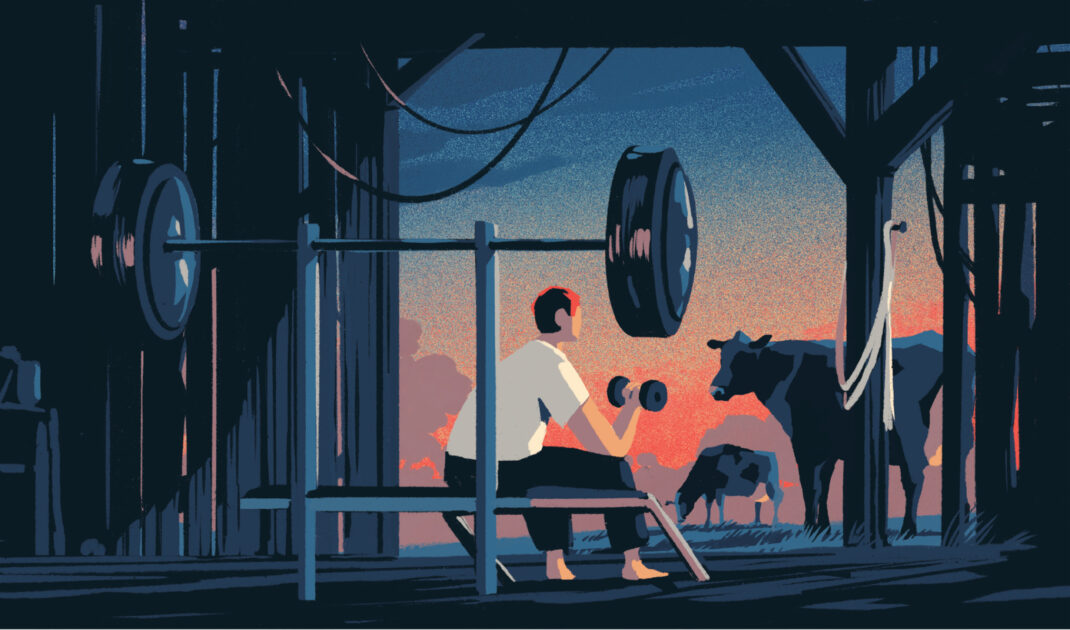
That was nearly five years ago, which seems almost unfathomable to me. Not merely for the rapid passage of that time, but also because I’m frankly a little amazed that I’ve stuck with it so long. At least three times each week for every one of those five years, I’ve lifted. When Covid struck, and my gym closed, I bought a set of used weights and fashioned my own homemade squat rack in the hay mow of our barn. I missed the accoutrements of the gym—the bright lights, the diversity of equipment, the locker room, even the heat—but there were compensations. In the barn, I breathed in the scent of hay and spilled chainsaw bar oil with each labored repetition, and I could hear the soft noises of cows as they went about their business on a square of pasture only a few feet from where I hoisted and grunted. In winter, I lifted in a puffy jacket and wool pants; in summer, I wore old work shorts and a tattered tee, and opened the big sliding door along the north wall so I could watch the cows graze as I did deadlifts. I came to love the routine of it, the discipline it required, and the way it made me feel. I’d leave the barn on legs gone wobbly from effort, but also with an intoxicating sense of levity in my body, as if the temporary burden of the weights was a reminder of just how good it can feel to be unburdened.
Over time and very slowly, I have gotten stronger. There’s really no other way to get stronger in your late 40s and beyond, and I’m OK with that. In fact, that’s another part of lifting that I’ve come to love: There is no easy road, no immediate gratification, at least not for me. But this only makes the improvement, however marginal and achingly slow it may be, more satisfying. I might add only 10 pounds to a lift in an entire year. Objectively speaking, that’s not a lot of weight. Subjectively, it feels like the better part of a cow.But for me, the best thing about lifting is that it’s allowed me to further cultivate my wood-cutting fantasy. Now, with my newly resilient body (I’m knocking loudly on wood, but my back hasn’t gone out even once since my visit with Ted), I’m inclined to think I was selling myself short. I mean, sure, it’d be pretty cool to still be cutting and splitting our firewood when I’m 80, no doubt about it. But you know what would be even cooler? To be doing it when I’m 90.
This column was originally published in the July/August 2023 issue of Yankee.