Goodbye to the Chief: Remembering Jud Hale
For decades, Judson Hale ran this magazine on humor, instinct, and an unerring feel for New England.
By Mel Allen|Oct 23 2026|

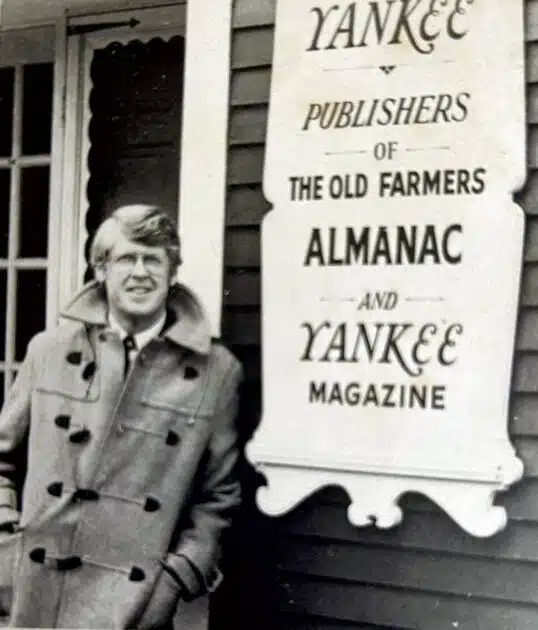
Jud Hale in 1986 outside Yankee’s New Hampshire headquarters.
Credit: courtesy of Yankee Publishing Inc.I will be telling Judson Hale stories for the rest of my life. With his insatiable love of New England he nurtured not only this magazine, but also The Old Farmer’s Almanac, and every one of us who worked with him. Jud “retired” as editor long ago, but until Covid sent us home, he still came to the office, greeted us, read the newspaper, made his calls. We knew he was there, that what we did mattered to him, and we loved him for that.
Jud left this world in the early-morning hours of Friday, August 28. He was 93. The morning of the previous day, the Monadnock Ledger-Transcript had published “The Unforgettable Judson Hale.” I wrote about Jud after visiting him and his wife, Sally, a few days earlier at their retirement community. I sensed time had grown short, and I hoped he would know one more time what he meant to all of us. The newspaper rushed it into print.
His son, J.D., texted me Friday morning. He told me that before his father passed with his family by his side, they had read the story to him. Jud’s eyes were closed, but when it ended he raised his hand. He had heard.
“If I cannot make other people laugh,” he once said, “I make myself laugh. Humor has been part of my life, and it’s part of my individuality.” I believe that Jud would laugh about my writing about him, and then his passing the next day. Who would ever want you to write about them now?
Over the past few years, he lamented the loss of many friends. He lost mobility and his eyesight dimmed—for a man who devoured books, especially those about history and New England, well, that was almost too much.
I read to him once from his memoir The Education of a Yankee. It was a chapter about being a young boy in Vanceboro, Maine, a northern wilderness settlement that still lived inside him. His family had a horse-drawn sleigh, and Jud once wrote this: “In my mind’s eye these many years later, I can watch Santa’s sleigh and reindeer flying above us through the thousands of stars overhead. It was always during the caroling tour about town that my mother told us we’d see him ‘in our imagination.’ And we always did.”
“When I dream,” he said, “I dream of Vanceboro.”
Jud filled this magazine with who he was and what he cared about. And in doing so, he made our region come alive for readers, many of whom had never even been here but, through Yankee, felt that they belonged. He looked at our stories through the eyes of his readers: If he liked what I had written, he simply scrawled “Terrific” in the margin. That was enough. I don’t think he ever felt what we knew—that he was the best writer of us all.
More than anyone, he understood the pull of place, the feeling of home. He ended his first book, Inside New England, this way: “I know where I’ll be, wherever I am. It will be very early on a calm, warm late June morning on Lake Winnipesaukee. I’ll walk down to the water’s edge below my camp on Sleepers Island, rest on the bench I built there years before, and sip from a mug of hot coffee. The sun will glisten through the tall pine trees behind me…. There’ll be long-ago voices and laughter like distant music. A solitary leaf on the poplar tree leaning over the shore near me will flap lazily…. I’ll look across the water to the hills that rise over the faraway shores and then on and on beyond for miles and miles of misty blue mountains to the north.”