



“The Hanging Judge” Samuel Sewall Repents | Footnote to History
In July, August, and September 1692, Samuel Sewall with six colleagues presided over the Salem witch trials. “Judge Sewall” was no lawyer as we know lawyers. Pious theocrats interpreted the law, and Sewall was among the most pious and thoroughly convinced of religious personages in Massachusetts. His convictions and their consequences in Salem — 20 […]
By James W. Crawford|Sep 11 2014|

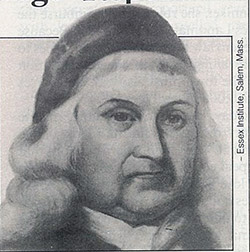
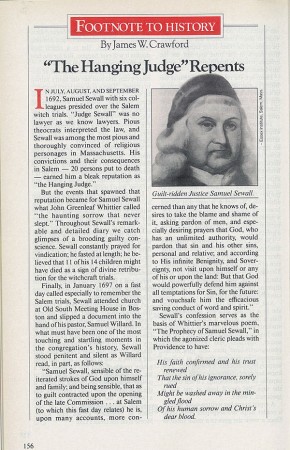
In July, August, and September 1692, Samuel Sewall with six colleagues presided over the Salem witch trials. “Judge Sewall” was no lawyer as we know lawyers. Pious theocrats interpreted the law, and Sewall was among the most pious and thoroughly convinced of religious personages in Massachusetts. His convictions and their consequences in Salem — 20 persons put to death — earned him a bleak reputation as “the Hanging Judge.”
But the events that spawned that reputation became for Samuel Sewall what John Greenleaf Whittier called “the haunting sorrow that never slept.” Throughout Sewall’s remarkable and detailed diary we catch glimpses of a brooding guilty conscience. Sewall constantly prayed for vindication; he fasted at length; he believed that 11 of his 14 children might have died as a sign of divine retribution for the witchcraft trials.
Finally, in January 1697 on a fast day called especially to remember the Salem trials, Sewall attended church at the Old South Meeting House in Boston and slipped a document into the hand of his pastor, Samuel Willard. In what must have been one of the most touching and startling moments in the congregation’s history, Samuel Sewall stood penitent and silent as Willard read, in part, as follows:
“Samuel Sewall, sensible of the reiterated strokes of God upon himself and family; and being sensible, that as to guilt contracted upon the opening of the last Commission…at Salem (to which this fast day relates) he is, upon many accounts, more concerned than any that he knows of, desires to take the blame and shame of it, asking pardon of men, and especially desiring prayers that God, who has an unlimited authority, would pardon that sin and his other sins, personal and relative; and according to His infinite Benignity, and Sovereignty, not visit upon himself or any of his or upon the land: But that God would powerfully defend him against all temptations for Sin, for the future: and vouchsafe him for the efficacious saving conduct of word and spirit.”
Sewall’s confession serves as the basis of Whittier’s marvelous poem, “The Prophecy of Samuel Sewall,” in which the agonized cleric pleads with Providence to have:
His faith confirmed and his trust renewed
That the sin of his ignorance, sorely rued
Might be washed away in the mingled flood
Of his human sorrow and Christ’s dear blood.
Excerpt from “’The Hanging Judge’ Repents,” Yankee Magazine, January 1988.





Interesting info! Some of my ancestors lived in Salem at the time of the ‘Witch Trials.’
My 8th Grandmother, Susannah Martin nee North, was one of the so-called witches that, based upon this article, he might have over sight on. Could he be responsible for the hanging of my relative? If so, its up to her to forgive him, before I can.
The Judge Samuel Sewall is my 10th great-grandfather. Thank you for the article!
Jim,
My ancestor, last name Brown, was unfortunately one of the accusers against Susannah Martin. He was a very old men and he was only one of a couple who spoke out against her. I am so sorry.
There is a wonderful stone marking the place where Susannah Martin’s home was located in Amesbury Mass….It is inscribed with some beautiful words in her honor. If you have an opportunity please locate and view it.