The Biggest Wind | New England’s Gifts
In New England there’s cold and then there’s “braggin’ cold,” and those who live in the North Country know what that difference feels like. But there’s one particular kind of person who knows all about “braggin’ wind”: the weather observers who live and work on the 6,288-foot summit of Mount Washington in New Hampshire. Their […]
By Mel Allen|Oct 30 2015|

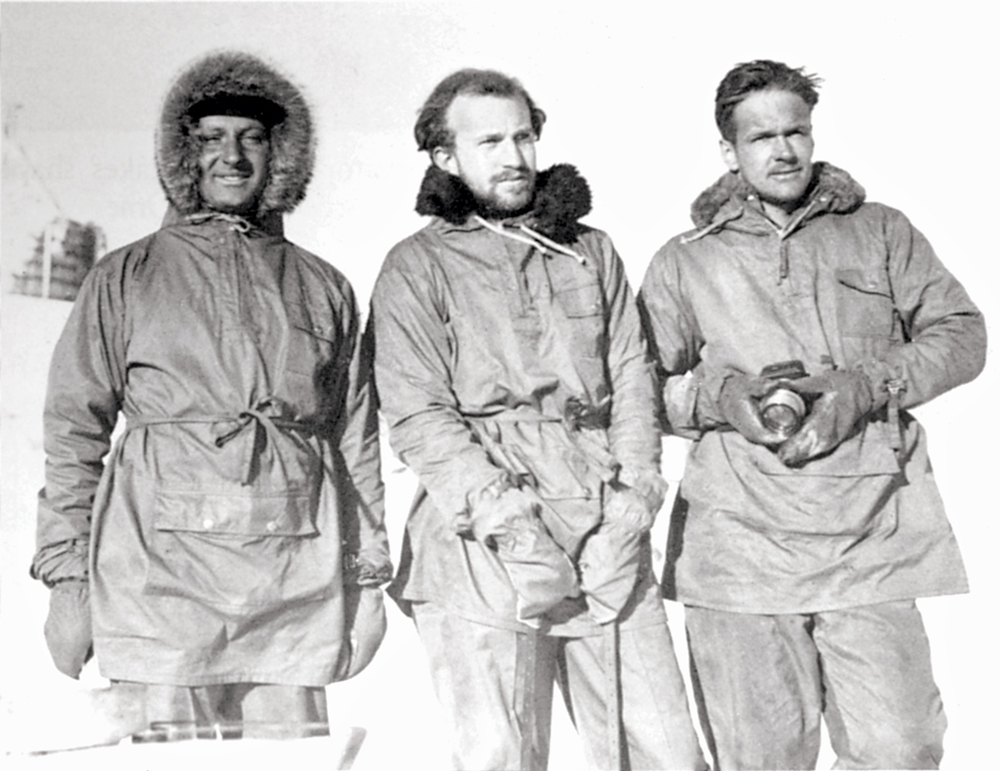
Salvatore Pagliuca, Alex McKenzie, and Wendell Stephenson (left to right)
Credit: courtesy of Mount Washington Observatory
Credit: courtesy of Mount Washington Observatory
In New England there’s cold and then there’s “braggin’ cold,” and those who live in the North Country know what that difference feels like. But there’s one particular kind of person who knows all about “braggin’ wind”: the weather observers who live and work on the 6,288-foot summit of Mount Washington in New Hampshire. Their names have changed many times since the observatory opened in 1932, but not their motivation: to witness and record weather through mild days and days of almost unfathomable storms and cold. And no one else has ever witnessed what Salvatore Pagliuca, Alex McKenzie, and Wendell Stephenson did on Thursday, April 12, 1934.
A fierce storm was building, flowing toward the mountain from the southeast. At 4:00 a.m. Stephenson fought through frigid winds to hammer ice off the exposed anemometer on the instrument tower. “There was no doubt this morning,” Sal Pagliuca entered into the logbook, “that a super hurricane, Mt. Washington style, was in full development.” At 1:21 p.m. came a wind no human had ever known: 231 mph. In meteorological terms it became the “highest natural wind velocity ever officially recorded by means of an anemometer, anywhere in the world.” After checking and double-checking his measurements, Pagliuca logged: “Will they believe it?”
In 1996 an unmanned station on Australia’s Barrow Island recorded 253 mph during a typhoon, but no one was there to feel the shaking, to hear its blistering sound. The weather observers on Mount Washington on that April day forever staked a claim that this place was home to some of the most savage weather anywhere—and braggin’ wind became part of the lore and the lure of being there, hoping for another.