



Blue Laws? Blame the Puritans | Only in New England
If you time travel to the 17th century, here is a useful guide to Puritan laws to help you stay out of trouble.
By Ken Sheldon|Oct 21 2016|

Blue Laws? Blame the Puritans | Only in New England
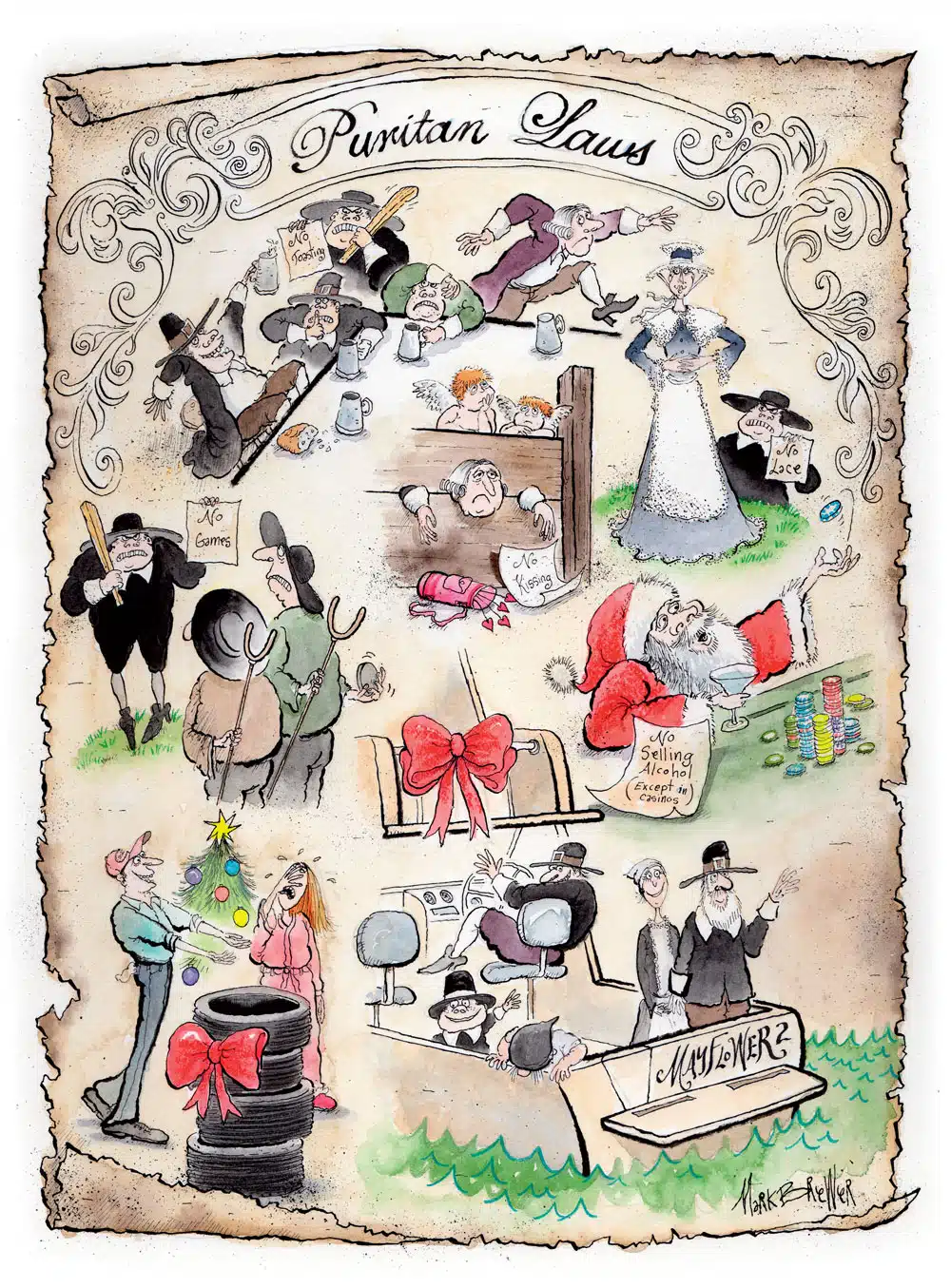
Credit: Illustration by Mark BrewerIn times past, kings made all the laws and the rest of us had to go along, regardless of how pointless or bizarre the laws might seem. Then in 1620 the signers of the Mayflower Compact—our country’s first governing document—gave themselves the power to enact “such just and equal lawes … as shall be thought most meete and convenient for the general good of the colony.” In other words, now we could make up our own pointless, bizarre laws.
Like the one the Puritans passed in 1639, banning the making of toasts—not drinking, just making toasts while drinking. Apparently toast-making had evolved into a kind of convivial one-upmanship that caused a dramatic increase in beer consumption—not to mention the invention of the Puritan hangover cure, the “cold cod compress.”
The Puritans may also have invented the fashion police. The same year they tackled the toasting crisis, the General Court of the Massachusetts Bay Colony decreed that some colonists were guilty of “excessive wearing of lace,” a practice that led to “the nourishing of pride and exhausting of men’s estates”—which makes you wonder just how much lace these people were wearing. The Court banned the purchase, sale, and wearing of lace, and violators may or may not have been punished by being forced to wear those silly Puritan hats with the big buckles.
Credit: Illustration by Mark Brewer
Back then, folks took the commandment about keeping the Sabbath seriously. Any number of activities were prohibited on Sunday, including washing dishes, going for a walk, visiting neighbors, and kissing your wife in public. That’s right, kissing your wife. In 1656, a Captain Kemble returned to Boston after being at sea for three years, met his wife at the front door and kissed her, right on the doorstep. It was a Sunday, and for this “lewd and unseemly behavior” he was ordered to spend two hours in the public stocks.
That same year, the New Haven Colony banned innkeepers and tavern owners from allowing any kind of game-playing on their premises, including the pernicious pastime of shuffleboard. The hard-core sinners who wanted to play shuffleboard while enjoying an adult beverage were forced to do so aboard “cruise schooners,” where Colonial seniors would gamble away their retirement shillings and complain about the high price of quill pens.
Over the centuries, most of the Puritan blue laws have been repealed or simply ignored, the victim of changing times. (Vermont struck down the remainder of its blue laws in the 1980s, although no one outside the state noticed until just recently.)
The blue laws that are still in place tend to restrict retail sales—especially those of liquor and cars—on Sundays and holidays. For example, in Connecticut, it is illegal to sell alcohol on Christmas day, unless of course you’re in a casino. (Because nothing captures the holiday spirit like a mistletoe margarita while you’re playing 21.)
And despite the backward creep of Black Friday sales, retail stores are still prohibited from opening on Thanksgiving day in Maine, Massachusetts, and Rhode Island, which is clearly an infringement of our right to be herded like cattle while spending money on high-tech gadgets that will be obsolete before we can sign our names on the credit card reader.
True, there are exceptions to the holiday laws. In Massachusetts, stores may open on Christmas if they sell, among other things, greeting cards, flowers, and “tires, batteries, and auto parts for emergency use.” (If you still haven’t bought a present for the missus, that qualifies as an emergency; spring for the all-season radials.)
In Maine, an exception is made for “establishments primarily selling boats, boating equipment, sporting equipment, souvenirs and novelties”—which means, basically, L.L. Bean. Even Puritans, after all, wouldn’t try to close L.L. Bean on Christmas.




I am 75 years old and still remember the blue laws that were in effect during the 1940’s and early 1950’s, especially in MA
I remember all store, except drug stores, small markets, movie theaters and restaurants being closed on Sundays. It was nice to have everyone home for one day of the week. Sunday Mass, a big lunch and family outings were wonderful things to look forward too. I learned to drive in the empty Shoppers World parking lot! It was like a much needed “time out” in the daily grind of life. I miss it.
There are blue laws where I live in New Jersey. It seems so strange to me when I go to New York and sees stores open on Sunday.
You must live in Bergen County like I do. I believe that Bergen is the only county left in the Garden State that still has blue laws. Just as most of the New England states have overturned the tyranny of capricious laws, let NJ join the Revolution.
The blue laws were not capricious – they were enacted by earnest people who believed they should protect the sanctity of the Sabbath. While that put them on a collision course with the not-yet-enacted Constitution, there is much to be said for the concept of a consistent day off for workers. In 2005 car dealers in Maine lobbied to keep the Blue Law banning vehicle sales, because they wanted Sundays off.
I remember the blue laws in Connecticut when the stores were closed on Sundays. We had a family dinner every Sunday.
How well I remember seeing the drinking folks disregarding the blue laws of Ohio by entering the unlocked back doors of local bars. There always seemed to
be a way around them with little to no enforcement. These laws were and remain ineffective.
Puritans weren’t allowed to get drunk but they drank extravagantly beer, ale, cider and wine at the dinner table if that included the colonial foods native to England and also Narraganset succotash and sweet Indian corn pudding with whipped or ice cream. Food includes and is not limited to pease porridge seasoned with a little turmeric topped with Cape Cod Bay mussels, marinated in sauerkraut juice with chili, ginger, and husk cherries, served cold, and also rye, oats and wheat, and drank beer, ale, cider, wine and rum, I get the general idea but I’m not going on the whole Puritan diet, I choose to eat asparagus, lettuce and squash, thank you, and also fish (fresh or salted), and Puritan dress excluded extravagant use of lace, and also black, and also gold or silver threads, gold belts or buckles, belts, and tall hats, beaver hats, etc, even fancy clothes. It’s a very cluttered system and avoids beauty for beauty’s sake, but this is all what I stand for: a religious diet and religious clothes. Besides that I’m a vegetarian and don’t agree with meats other than fish and seafood & caviare. I do, after all, need wine, and therefore brandy. Some of those Puritan foods are disgusting, so I decided on the best foods.
One subscriber wrote that she remembered when blue laws closed stores on Sundays in CT and her family had Sunday dinner. I think having family gather for Sunday dinner is preferable to family scattered, shopping their money away.
What an amusing article! Great way to start my day!