



Doing the Presidential Traverse Hike in New Hampshire’s White Mountains | Tips
New Hampshire’s White Mountains Presidential Traverse hike is one of New England’s premier outdoor activities. Here’s how to do it.
By Ian Aldrich|Jun 01 2022|

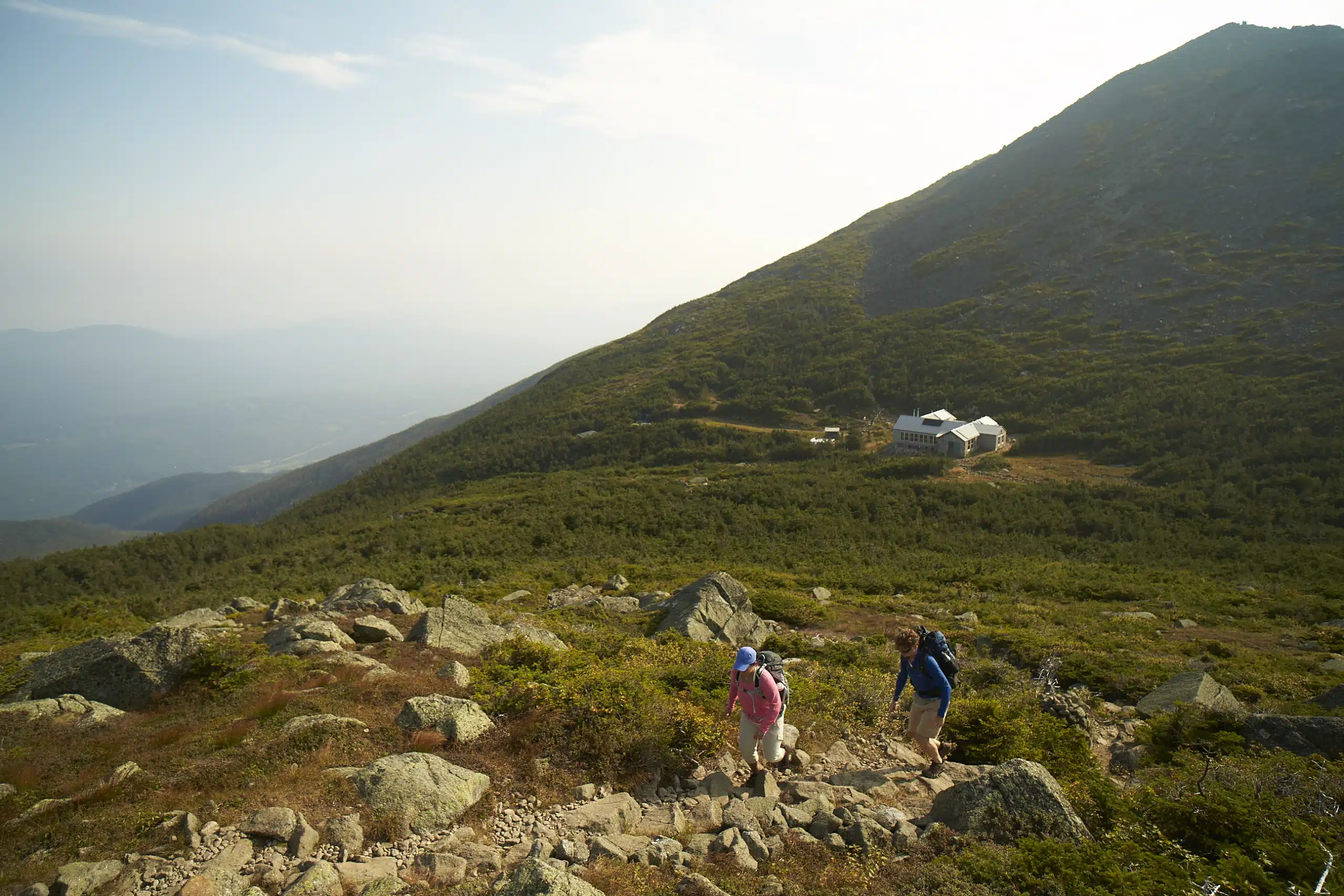
Hikers ascend Mt. Adams in the northern Presidential Range of New Hampshire's White Mountains. The AMC's Madison Spring Hut is in the background.
Credit: Dennis Walsh, AMCOne of the most intense and scenic activities in the Northeast is the Presidential Traverse hike in New Hampshire’s White Mountains. Covering nearly 20 miles of sometimes grueling, often beautiful terrain, it takes hikers over the Presidential Range, crossing seven 4,000-foot peaks, all named after U.S. presidents: Madison, Adams, Jefferson, Washington, Monroe, Eisenhower, and Pierce.
Hikers who want to tack on a bit more mileage can add four nonpresidential peaks to their adventure: Clay, Jackson (named for New Hampshire geologist Charles Thomas Jackson), Webster, and Franklin.
The rewards are plentiful. The Great Gulf and the Presidential Range–Dry River areas offer two superbly scenic ranges to photograph. There’s the opportunity to ascend Mount Washington, one of the country’s most famous peaks, and to follow in the footsteps of so many previous generations along the Crawford Path, the oldest continuously used and maintained hiking trail in the country. Different stops along the hike offer views that can extend deep into Vermont and even Maine.
But there’s plenty to be cautious of, too. This is not an adventure for newbie hikers — or even experienced ones, if they’re making their first trip to the Whites. The Presidential Range is well known for its harsh and unpredictable weather, which can change in an instant. During the summer, the winds can be fierce, and it’s not uncommon for lightning storms to quickly move in, forcing hikers to immediately go below the tree line or to take shelter at an Appalachian Mountain Club (AMC) hut.
Tips for Doing the Presidential Traverse Hike | White Mountains
So what does it take to do the Presidential Traverse hike? To find out, we caught up with AMC hiking guide Bill Quade, who’s hiked the Presidential Traverse several times and who leads guided trips of the range.
Preparing for the Presidential Traverse Hike
Quade says hikers need to be ready for the physical demands of the Presidential Traverse hike. After all, this trek accounts for nearly 9,000 total feet in elevation gain.
“You should plan on moving about a mile an hour,” he says. “So before anybody tries a Presidential Traverse, they should test their legs and either hike a segment of it or try another part of the Whites.”
One area that Quade recommends visitors consider when getting ready for the Presidential Traverse hike is the Franconia Ridge Loop.
This nine-mile trek brings hikers over Mount Lincoln, Mount Lafayette, and Little Haystack, offering the same kinds of challenges (weather and, to a certain extent, physical demands) of the Presidential Traverse hike. “It’s a beautiful hike,” says Quade.
Monitoring temperatures and conditions is a must for the Presidential Traverse hike. Weather systems change all the time, and the forecast for, say, downtown North Conway, or even the trail below the tree line, may be much different from what’s being predicted for the alpine zones. To get the most accurate weather forecasts, Quade advises, monitor the forecasts from the Mount Washington Observatory.
“But even if the weather does look good, allow yourself to be flexible,” he says. “Don’t be afraid to bail if you see bad weather moving in suddenly. Monitor the skies and get below the tree line if you see thunderheads move in.”
Where & When to Do the Presidential Traverse Hike
Hikers have two options for a starting point: the northern terminus, at the base of Mount Madison, and the southern terminus, beginning at the Highland Center at Crawford Notch. The northern half, which includes the peaks of Madison, Adams, Jefferson, and Washington, is recognized as the hardest part of the trail, and Quade recommends beginning there. “That way, you can hike that harder stretch when your legs are at their freshest,” he says.
Experienced hikers can and will do the Presidential Traverse hike in every season, but Quade says that most people stick to the summer months, when there’s maximum daylight. “July and August are very nice,” he says. “June offers more likelihood of thunder and lightning storms, and when you get into September the weather can turn cold. In October you can even hit ice.”
For safety reasons, Quade suggests that you do the Presidential Traverse hike with at least one other person. While it can be done in a single long day, he recommends that it be tackled over the course of two or more days. Hikers can either camp off-trail below the tree line or book a bed at one of the three AMC huts in the range: Madison Spring, Lakes in the Clouds, and Mizpah Spring.
Even for those without reservations, these huts offer a nice respite. During the day, the staff sells soup, baked goods, and lemonade to hikers; water bottles can also be refilled free of charge.
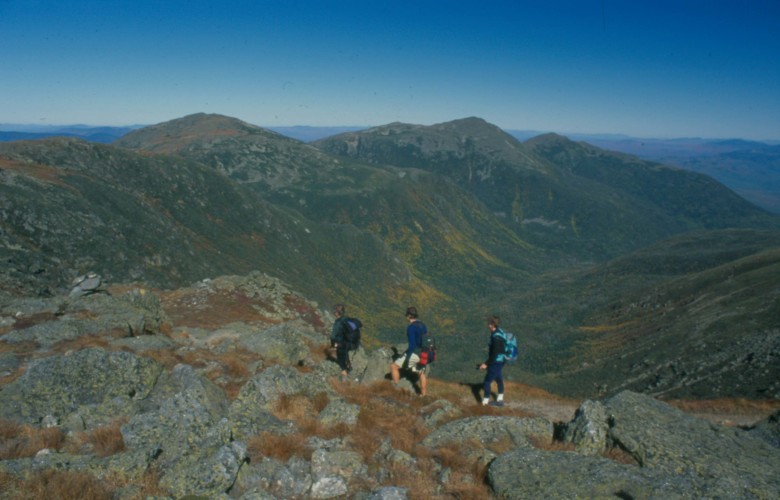
Credit: Josh Lake/Courtesy of AMC
Gearing Up for the Presidential Traverse Hike
What you bring can all make all the difference in terms of whether you finish and how you finish. For summer trekkers, Quade says, a backpack should include the following:
- Rain pants and rain jacket
- Winter hat and gloves
- Sun protection
- Whistle
- Compass
- Map
- First aid kit
- Trekking poles
- Headlamp
Well-broken-in shoes with good soles are also essential. Traditional leather boots are an option, of course, but Quade opts for lighter-weight trail runners. “My feet may get a little wet [from the puddles], but the sneakers are breathable and my feet do eventually dry out,” he says.
Quade recommends that for every day on the trail, each hiker have at least three energy bars, a large bag of trail mix, and a sandwich. Each person should also pack at least two liters of water.
Also…
Be sure your mobile phone is fully charged and turned to airplane mode when you start hiking. Cell reception is spotty, and if your phone is searching for a signal for a long amount of time, the battery will run down.
Stay on the trail. The alpine zone (the region above the tree line) is chock-full of tender moss and grasses, and hiker who straying off course can easily trample and kill this vegetation.
Finally, know that there is the option for a guided hike of the Presidential Traverse. The Highland Center offers expert-led trips through the range with stays at an AMC hut. There is a southern segment that runs two days and one night, and a complete traverse spanning four days and three nights. Trips are led only in summer and slots fill up quickly, so reserve early in the season. Call the Highland Center for details and pricing.
Have you done the Presidential Traverse hike? Share your experience in the comments!
This post was first published in 2017 and has been updated.
You may also like…
Franconia Ridge Loop | The Perfect White Mountains Hike
Favorite Late Fall Hikes in New England
The Flume Gorge | Hiking Through History




I hiked the traverse this summer with my 14 year old son. We don’t have much hiking experience so we decided to take three days. We were fortunate that the weather was perfect, but we were prepared in case it changed. The views were amazing and was one of the best things I have ever done. Highly recommend this hike.
Yes the traverse is a challenging and rewarding feat…another great tip I would recomcouri.if you don”t have 2 cars to carspot…arrange to have an independent hiker shuttle pick you up where you will end your hike. Then transported to beginning of your hike thus “hikin back to your car…not easy to find. ride back to car at end of your journey…and you will hug your car when you come down….Mountain courer shuttle is a 24/7 service 207-329-6433
I did the Presidential Range in early June 2003 with two friends. While we didn’t experience any severe weather, we found ourselves donning and removing layers of clothes and even rain gear numerous times. The views when not foggy, were spectacular. We even found ourselves crossing a patch of snow abiut 100 yds wide. We hike it over three days, a half day to Madison Hut, then a full day to Lake of The Clouds, a full day to Mizpah, followed by a short hike out.
Did the Franconia Ridge three times, the last time being June 2018. At 73, I’m probably done with both trails, but I have wonderful memories of both hikes. Still doing lesser hikes and loving it. Planning for a hike up Mt Washington and back down by Cog Railway in June.
I have done both the Franconia Ridge and the Presidential Range and highly recommend both. A first timer would probably not be able to do this in a day or two. Best approach is to stay in the huts which saves you from carrying the weight of camping gear and food beyond snacks and time spent preparing meals (you will need those calories) and setting up camp. For staying in the AMC huts you need to either go with a group that has already reserved stays or reserve months in advance for the nights left over once the groups have already booked their nights. Forget about weekends unless you book very early in the year. Going with a group costs more and somewhat reduces flexibility but provides the benefits of experienced leadership, camaraderie, and meeting new people. Consider using AMC’s shuttle service. It takes the hassle out of car spotting. Plus, if you have spotted cars and have to bail out due to bad weather or injury or equipment failure, all of which do happen, you’ll have to try to get on a shuttle anyway. If you want a long hike at elevation with limited but spectacular views, consider the Pemigewasset range from Franconia Notch to Crawford Notch.
i left the tucker man trail head at 3:00 pm and and told the ranger i was going to go in the grate gulf and do all the mt tops to tucker ravine and back down to trail head and be back the next day at 3:00 pm he said no way soi hitch a ride to the grate gulf and did it and back at 3:00 pm just like i said i would just a stretch of the legs
What is the tick situation? Bear Activity? probably should recommend tick spray to? looks like a pretty cool hike-
I did the Presidential Traverse @ the age of 67 in 2019 using an AMC guide . We did it starting from the Northern Terminus using a 4 days, 3 nights approach. We opted to not summit Madison, Adams or Jefferson. Beyond doing a day hike of Katadhin @ 60, the hike from Madison Springs Hut to Lake of the Clouds is the most challenging hike physically I have done (Have day hiked Mt Washington twice). It is entirely above the tree line. Weather was perfect. We did less than 1 mile an hour. It is as spectacular hike that I have done. Having a guide was key because I have seen the weather turn bad in the Whites and it is scary. We explained to our guide that we hired us to keep us safe. This AMC guide did a lot more than keep us safe. He taught us so many things about the trail, his experiences, equipment etc. I agree with the author’s suggestion to wear hiking shoes. I usually hike in them but did not for this hike. It was a mistake because the terrain although rugged has few water crossing. Staying in the huts was a wonderful experience. We had great conversation with the staff at all three huts and the food, especially the bread and soup was wonderful. Enjoy it. A once in a lifetime experience.