Adventureville: A Lake Placid Winter Travel Guide
Find a celebration of Olympic history, Adirondack adventure, and small-town magic in our Lake Placid winter travel guide.
By Annie Stoltie|Dec 30 2025|

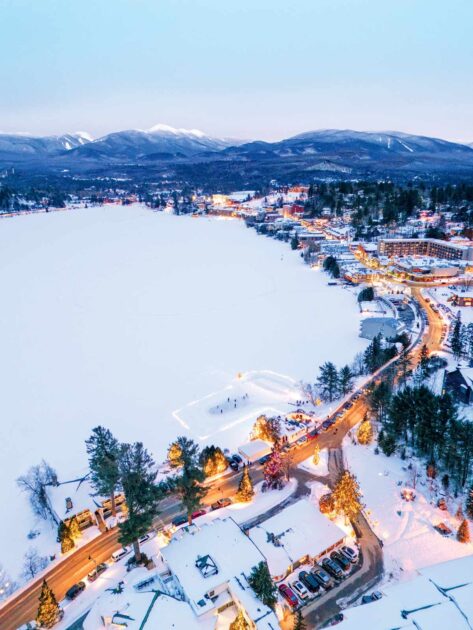
An aerial view of Mirror Lake nestled alongside the town of Lake Placid, with the Adirondacks in the distance.
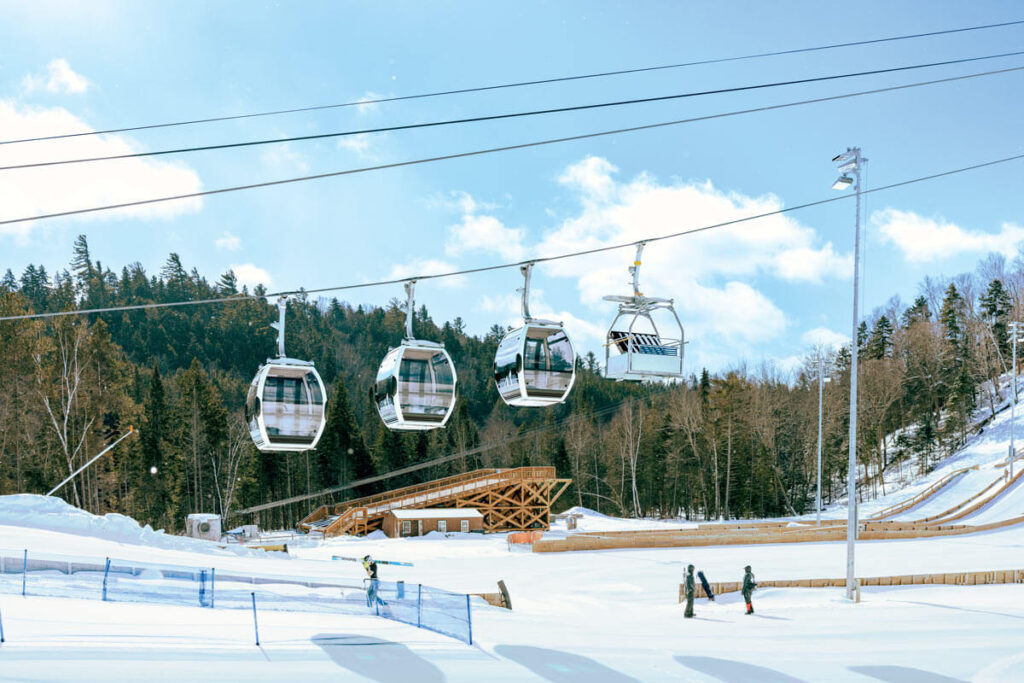
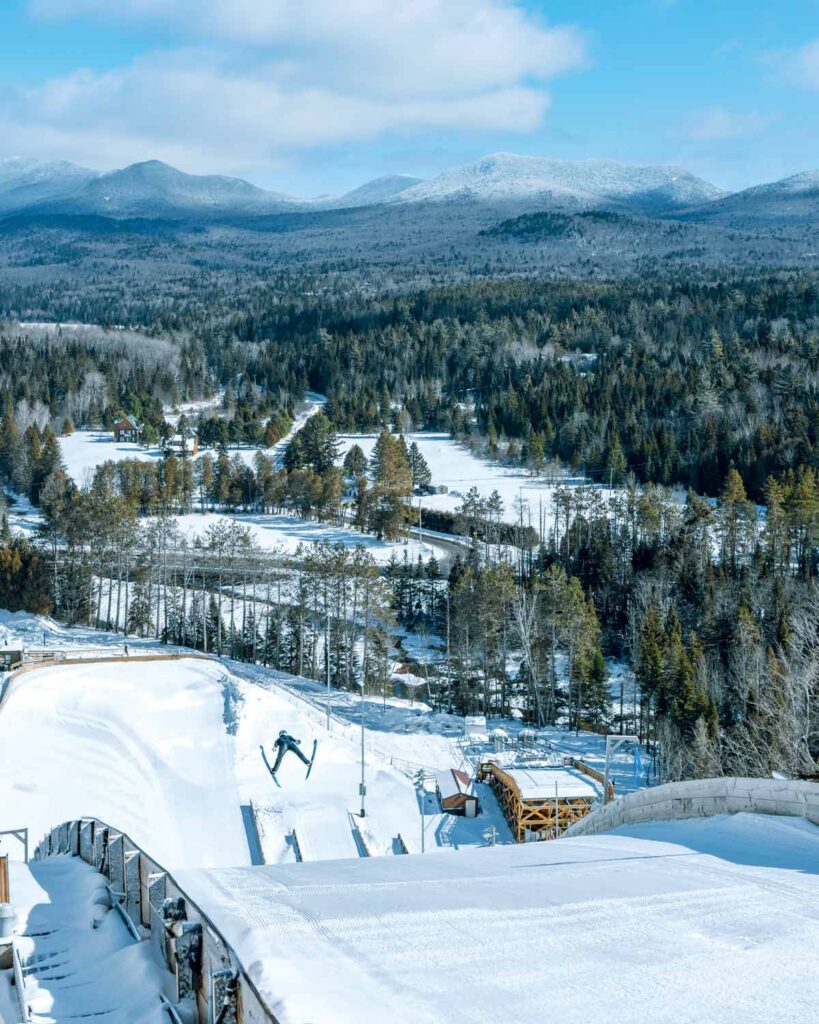
Credit: Pam and Chris DanieleFrom the observation deck of Lake Placid’s 128-meter ski jump, you can see the Olympic Village in the distance, and no matter which way you turn, Adirondack peaks poke into the sky. I’ve been up here half a dozen times, courtesy of a gondola and an elevator, but it never gets old. And on this February morning, a day before World Cup jumpers will snap into skis and launch off this hill, I take a moment to look down, to imagine what they’re thinking. A friend who’s a ski jumping coach tells me that the athletes actually try not to think. Jumpers get in the “zone,” focus strictly on what’s in front of them, then shoot themselves into the air, where they’ll fly for some five seconds at almost 60 miles per hour.
Of all the places in New York State’s Adirondack Park—bigger than Yellowstone, Yosemite, and Glacier national parks combined—Lake Placid best represents the intersection of human ability and the natural world. Here, grit and glory are as much a draw as the lakes, forests, and mountains.

Credit: Pam and Chris Daniele
Credit: Pam and Chris Daniele
I’ve lived in this part of the Adirondacks for more than 25 years, making a living by writing about the park. Lake Placid figures big in my life, and it’s where I bring visiting family and friends. Despite its million or so annual visitors, Placid, with a year-round population of 2,200, is really just a small town. Yes, there’s history, innovation, stunning views, and all sorts of opportunities for recreation, but there’s more, too. My Lake Placid—in fact, the Adirondacks I know and love—comes to life when you peel back a layer to see what’s beneath.
Take the landscape. While the mountain peaks that fill the sky are among the oldest on the continent, this ancient bedrock—including slide-streaked Whiteface Mountain, which you can see from most places in Lake Placid—still rises, pushed up, according to regional geologists, by a hot spot in the Earth’s crust.
Indigenous people lived here; archaeologists have excavated 13,000-year-old evidence of human activity in this region. Then came white and Black settlers. But the modern Lake Placid, the one synonymous with snow and sport, has everything to do with what happened beside a pretty little lake 130 years ago.
Credit: Pam and Chris Daniele
Credit: Pam and Chris Daniele
If you’re of a certain generation, you’ve likely heard of the Dewey Decimal System, once used to organize books in libraries. That was Melvil Dewey’s invention. Dewey also had the big idea to establish an exclusive club in Lake Placid where professionals could relax and take in the mountain air on the east side of Mirror Lake, the body of water in the heart of the village (not to be confused with nearby Lake Placid lake, almost 20 times bigger). Beginning in 1895, the Lake Placid Club, as it was called, grew into an all-season community, where winter sports, such as skating, skiing, and sliding, became the centerpiece.
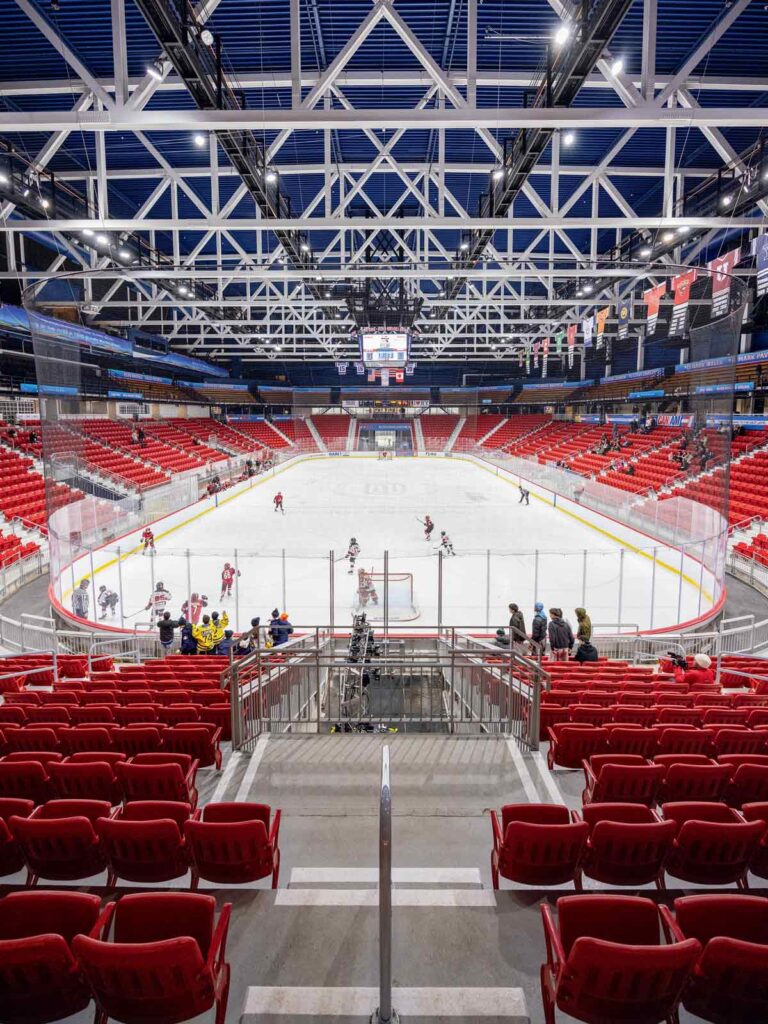
By 1930, Lake Placid’s reputation led to its hosting the 1932 Winter Olympics. The Games happened in Placid again in 1980, during which “the Miracle on Ice”—possibly the most famous men’s hockey game ever, in which Team USA beat the Soviets and went on to win the gold—helped seal Lake Placid’s legendary status. Today the Herb Brooks Arena, named for the “Miracle” team’s late coach, is a bucket-list attraction for hockey fans, but tournaments still continue at the facility. You can’t go anywhere in this town without seeing kids lugging hockey bags twice their size to and from the Olympic Center arenas. Placid is a place for big dreams.
Every now and then there’s chatter about another Winter Games in Placid, and it’s notable that New York state and the agency overseeing our region’s winter sports venues recently made a billion-dollar bet—literally—by investing in jumps, rinks, the sliding track, and other facilities. The gamble seems to be working: Lake Placid recently hosted World Cup events, the Empire State Winter Games, ECAC Hockey championships, the FISU Winter World University Games, and other high-profile competitions.
Only time will tell if those Olympic-size dreams ever come to pass. In the meantime, the region’s winter cred gives this place an adventurous spirit that any New England snow fan can appreciate.
Watching elite athletes push themselves in extraordinary ways is a thrill (if you’ve seen skeleton, in which sliders bomb headfirst down the track, you know what I mean). But it gets cold standing around, even if you’re ringing a cowbell.
Credit: Pam and Chris Daniele
Credit: Pam and Chris Daniele
For those who want to do more than spectate, a classic Lake Placid experience might mean visiting what for some of us is hallowed ground. My parents brought me to the ’80 Olympics to watch speed skater Eric Heiden, who won five gold medals in those Games. I was 6 at the time, and most of it’s a blur—my mom’s Polaroids fill in the blanks. Still, skating the outdoor oval where Heiden glided to victory is something special. The public is welcome to skate here during designated hours; I recommend doing it at night, under the lights.
Or go to the Lake Placid Olympic Museum, where there’s a collection of 700-plus Olympic trading pins on display; 1980 silver-medal winner Linda Fratianne’s skating dress and skates; a net from the Miracle on Ice game; an exhibit that features how host countries design their medals, torches, uniforms, and posters to reflect their national character; and lots more. A bobsled simulator offers an interactive experience, though I have friends who prefer to drink a beer at Zig Zags Pub on Main Street and take selfies with the old bobsled outside the bar.
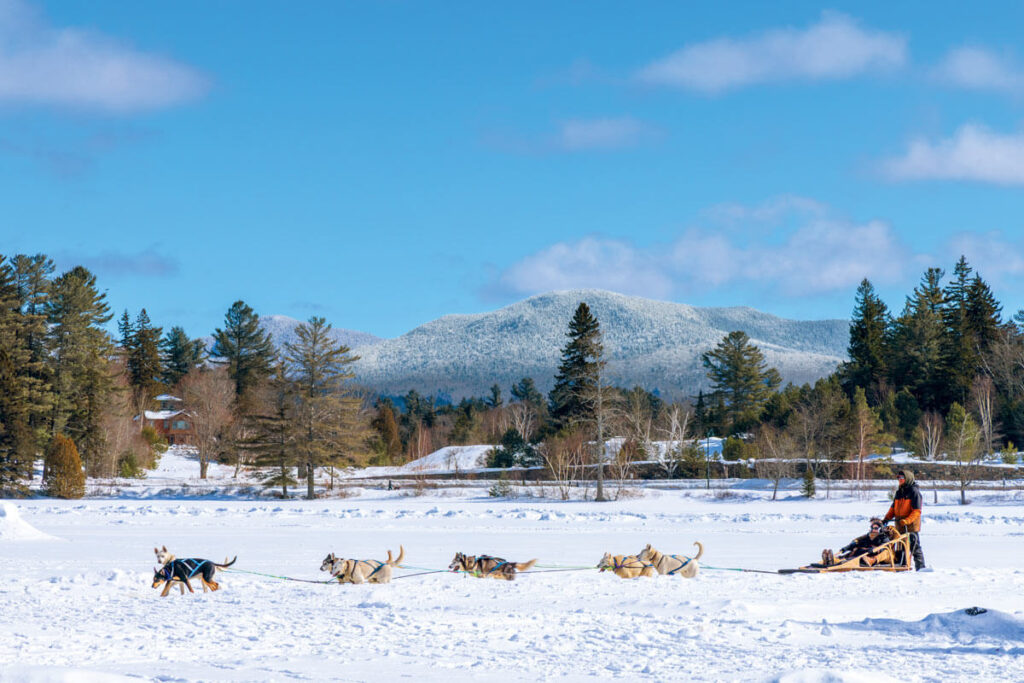
Activities here aren’t just Olympic-related. If Mirror Lake freezes a foot or more, a town-run toboggan chute gives a butt-bumping ride down a repurposed ski-jump trestle, then out onto the ice. Trust me, the backache is worth it. So is the rush that comes with a five-minute sprint across that same ice courtesy of Thunder Mountain Dog Sled Tours, whose owner, John Houghton, and his team of Alaskan huskies have helped anchor the local winter scene for years.
Credit: Pam and Chris Daniele
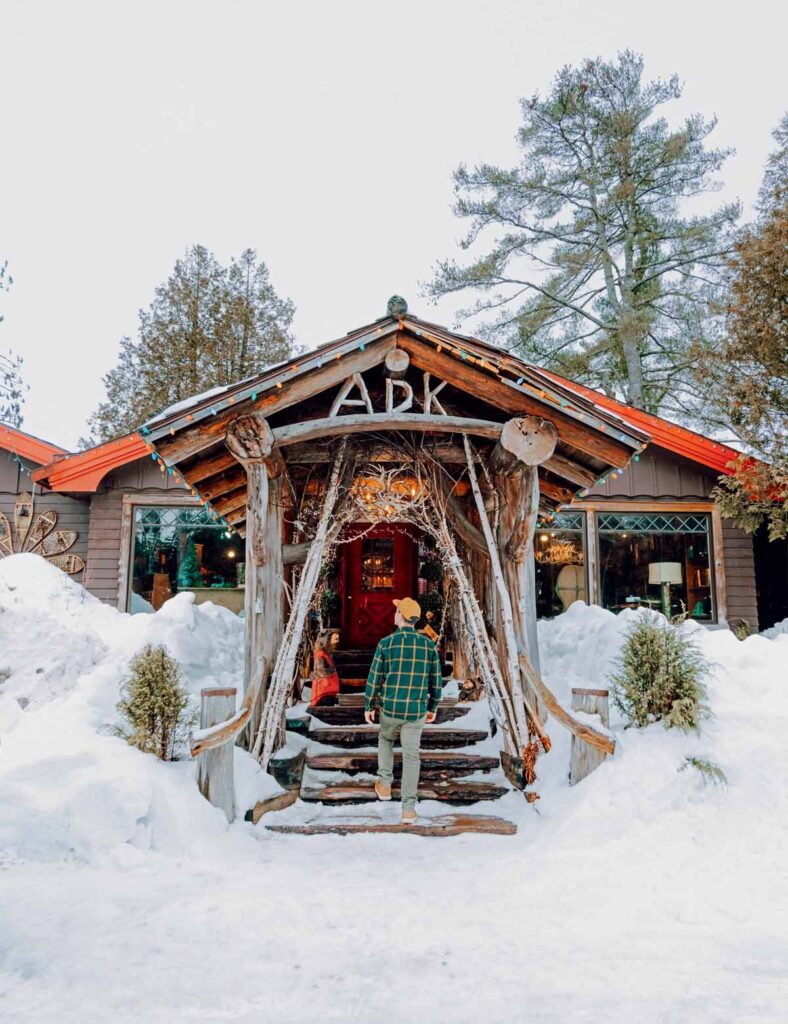
I like to explore on my own two feet by walking around Mirror Lake on its 2.7-mile paved loop. The trail to Cobble Hill, just off Mirror Lake Drive, is a 1.6-mile hike that takes you to an elevation of 2,343 feet—a tiny rise compared to the surrounding High Peaks. But Cobble offers winter hiking “lite” if the trails from Adirondack Mountain Club’s Adirondak Loj (it still uses Dewey’s “efficient” spelling system), about 15 minutes outside town, seem too daunting.
Then there’s John Brown Farm State Historic Site, whose 270-acre property pays homage to its namesake former owner. Brown was an abolitionist known for his 1859 raid on a U.S. arsenal in what is now Harpers Ferry, West Virginia; after he was captured, tried, and executed, his body was returned to and buried at his farm. Brown’s story comes into full focus on guided house tours and at the visitor center, but the property is a draw for more than history buffs. In a region that likes to move, the site’s nearly four miles of trails are open throughout winter to skiers and snowshoers, while staff-led moonlight hikes will leave you seeing stars under the region’s famously dark skies.
* * * * *
I grew up an hour and a half west of Lake Placid on a pancake-flat landscape near the Canadian border. A North Country childhood, at least in those days, meant you figure-skated or played hockey. I chose spins and jumps, and sometimes competed in Lake Placid. Back then, strolling up and down Main Street, a stretch of shops, restaurants, and galleries, was a treat. And it still is, especially during evenings when the snow swirls and the lights above the street twinkle—this could be a Hallmark movie soundstage.
Credit: Pam and Chris Daniele
Credit: Pam and Chris Daniele
Main itself is narrow and parking is a pain, but its sidewalks are a resort-town promenade where you might see groups of kids in team uniforms, couples in fur and fringe, and the latest in winter athleisurewear. Stores are dedicated to maple, Adirondackana, Team USA jerseys, olive oil, Dale of Norway sweaters, jerky and hot sauce, and all sorts of other things.
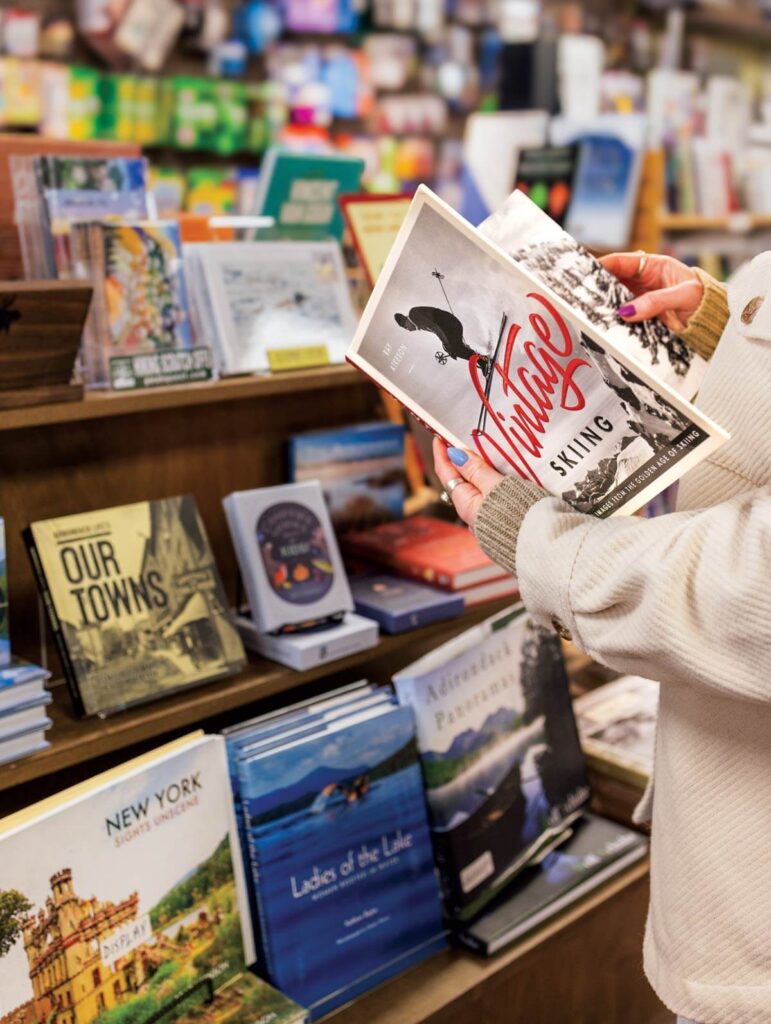
I always bring my guests to The Bookstore Plus, owned by Sarah and Marc Galvin. They carry the usual indie bookshop stuff, but also regional trail guides, magazines, calendars, photography collections, and books on Lake Placid history. The Galvins often host local writers’ book signings and other events.
On the other side of Main is Marcy Miller’s Pure Placid store, featuring scented candles and lotions. I’ve known Marcy for decades and have watched her turn nice-smelling homemade concoctions into a sleek brand. Her “Adirondack Chair” and “Mount Marcy” scents bring you lakeside or to the top of our highest peak. At Pure Placid you can also make your own candles, an activity favored by bachelorette parties.
Credit: Pam and Chris Daniele
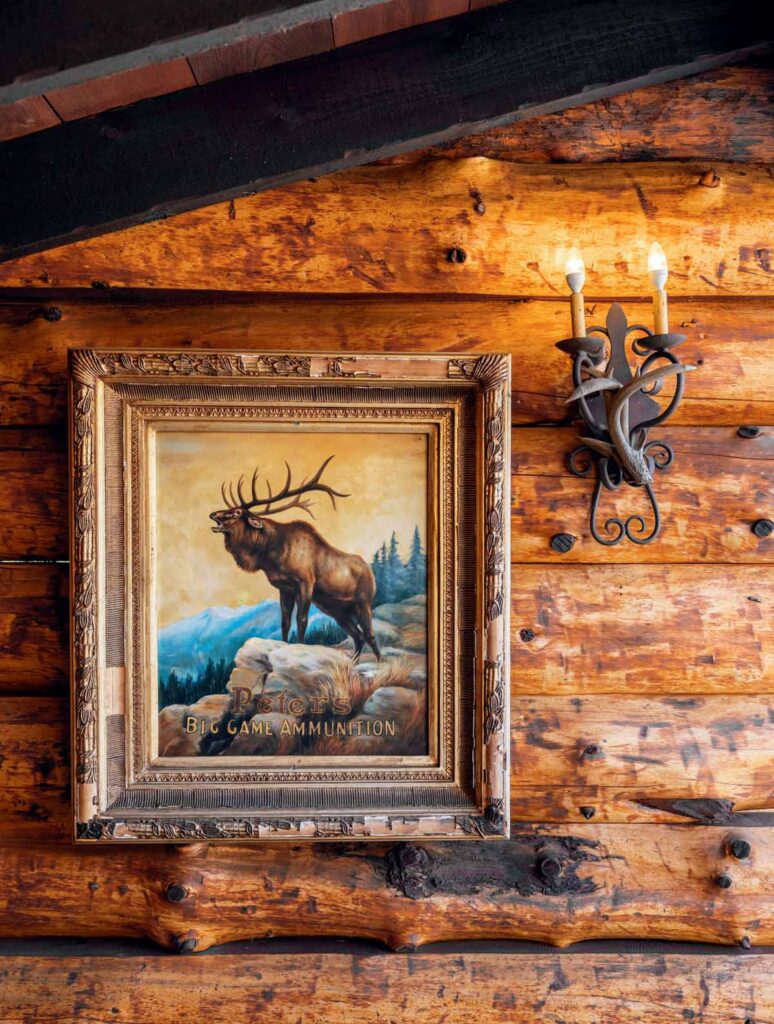
Other must-stops include Darrah Cooper Jewelers for high-end pine cone, pack basket, and canoe charms and other sparkly things. And for Adirondack-style furniture and decor, go to L. Post Rustics, on Saranac Avenue. Each member of the Post family has a special skill: Larry and Ryan are woodworkers, Joann paints, Jillian carves. Together, they craft twiggy but refined pieces that so remarkably mimic the woods, they appear to grow from the floor.
* * * * *
In the early 2000s, I interviewed Rachael Ray, who’d grown up in the southern Adirondacks. She was beginning to draw a following for her “30-Minute Meals” cookbooks and her show on the Food Network. I asked her how she defined Adirondack cuisine, and she said, “It’s very earthy,” with “woodsy spices” and everything chopped “big” in soups and stews to “go hand in hand with living on a mountain.”
Credit: Pam and Chris Daniele
Locals might also add, “anything with venison.” I’m unaware of how often deer cycles onto restaurant menus in Lake Placid, though I do know venison meatloaf, duck breast, and wild boar have been served at Andrea Lautenschuetz’s living room–size Salt of the Earth Bistro.
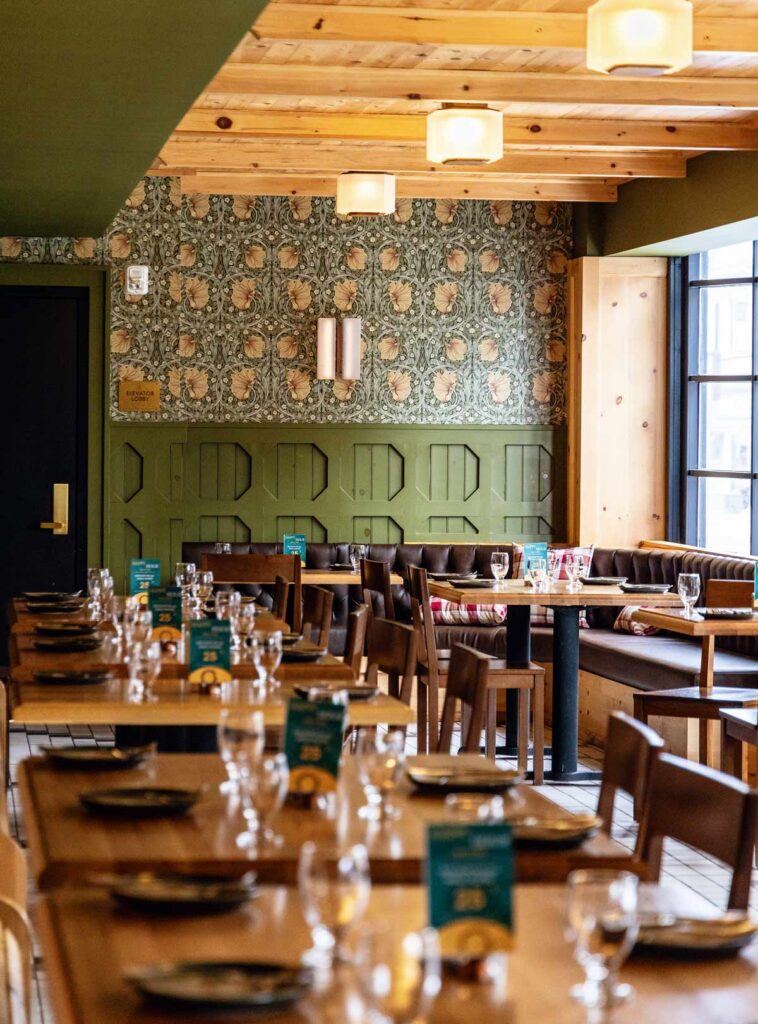
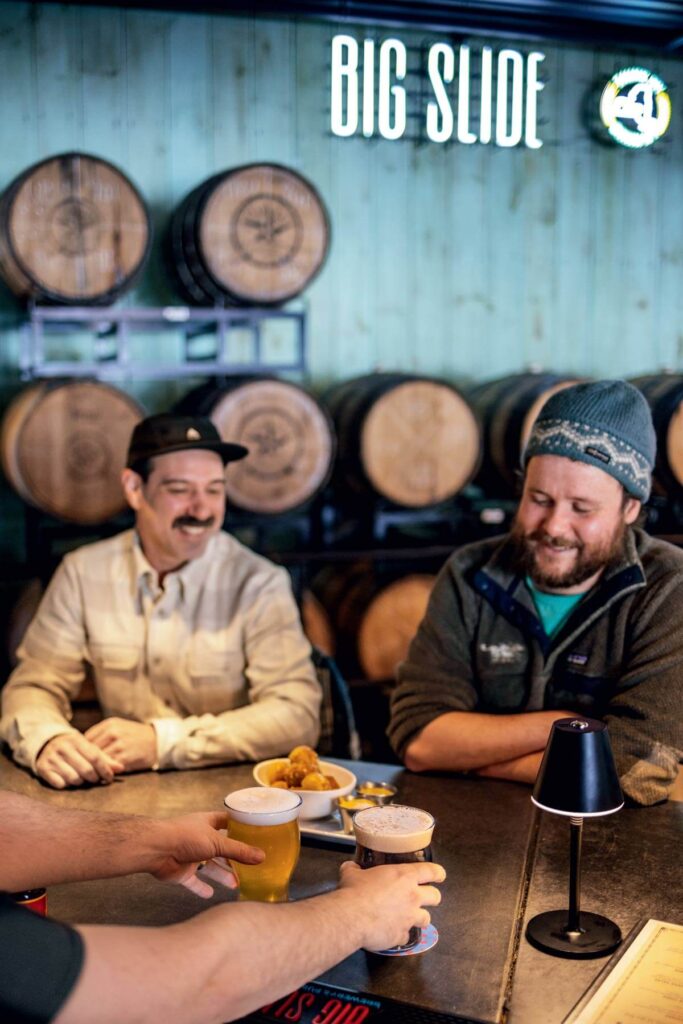
Big Slide Brewery & Public House, sitting practically in the shadow of its namesake ski jumps, has creative cuisine (think truffle steaks and kimchi chicken sandwiches) and inventive beer, including sours, jalapeno ales, and all sorts of IPAs. Don’t go here for quiet conversation: The cavernous space is a former tile store remodeled with an industrial vibe. (Intimate meals, locals will tell you, should happen over pasta or wood-fired pizza at Caffé Rustica.) Big Slide is co-owned by Chris Ericson, who also founded Lake Placid Pub & Brewery, on Mirror Lake Drive. In my 20s I worked there with cooks, servers, and bartenders who today are among my closest friends. How many Ubu Ales—named after a regular’s chocolate Lab—I’ve consumed over the past 20 years is beyond me, but if you go to the pub, that’s what you should drink.
These days I’m a regular at Lisa G’s, opened by Lisa Grigoriadis in 2000. This is my teenagers’ pick for wings and burgers. The former opera house can accommodate crowds of hockey kids and their parents, looking for a tasty meal away from the rink.
Credit: Pam and Chris Daniele
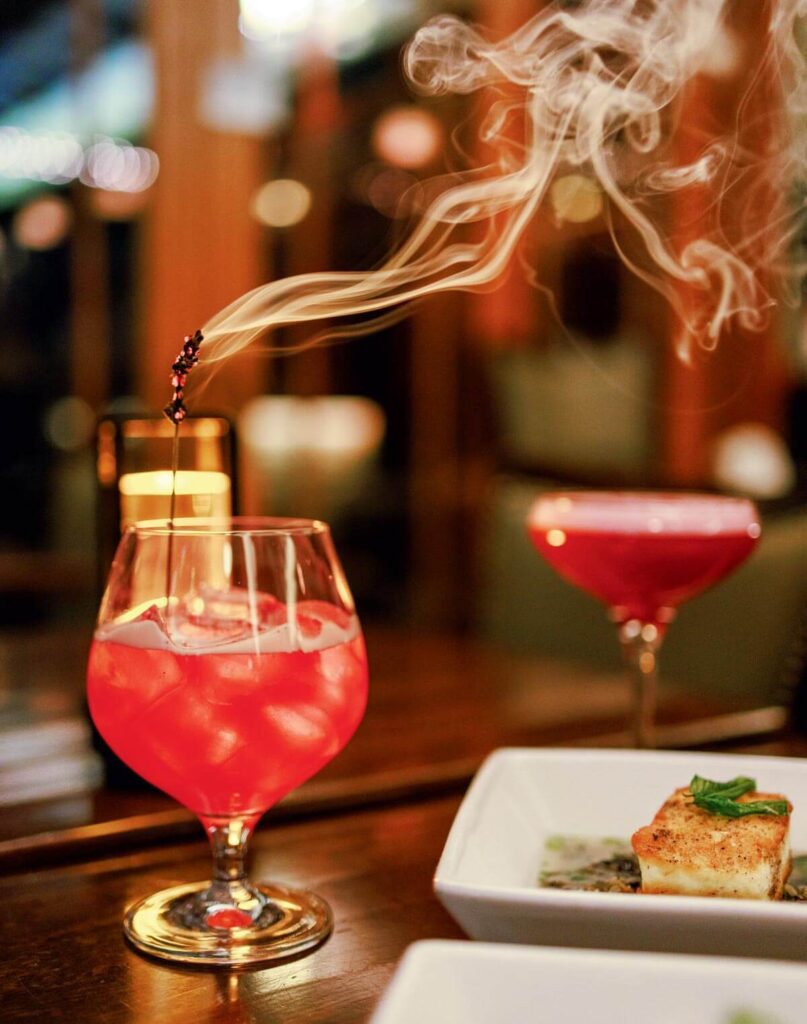
On Main Street, I get my coffee at Carolyn Bordonaro and Mike Barillari’s Origin Coffee Co., across the street from the oval (try the “Sweater Weather Latte”). Cocktails with friends often happen at Marcy Bar, at the Grand Adirondack Hotel, where we take over the corner couches. The historic structure—originally built in 1927, the first fireproof hotel in the community—was remodeled in 2022 and is a good spot to book a room if you want to be at the center of it all. Top of the Park, an upstairs eatery whose bar runs most of the length of the narrow dining space, has fancy drinks and small plates. (Insider tip: Get the pamplemousse cocktail and confit chicken wings.)
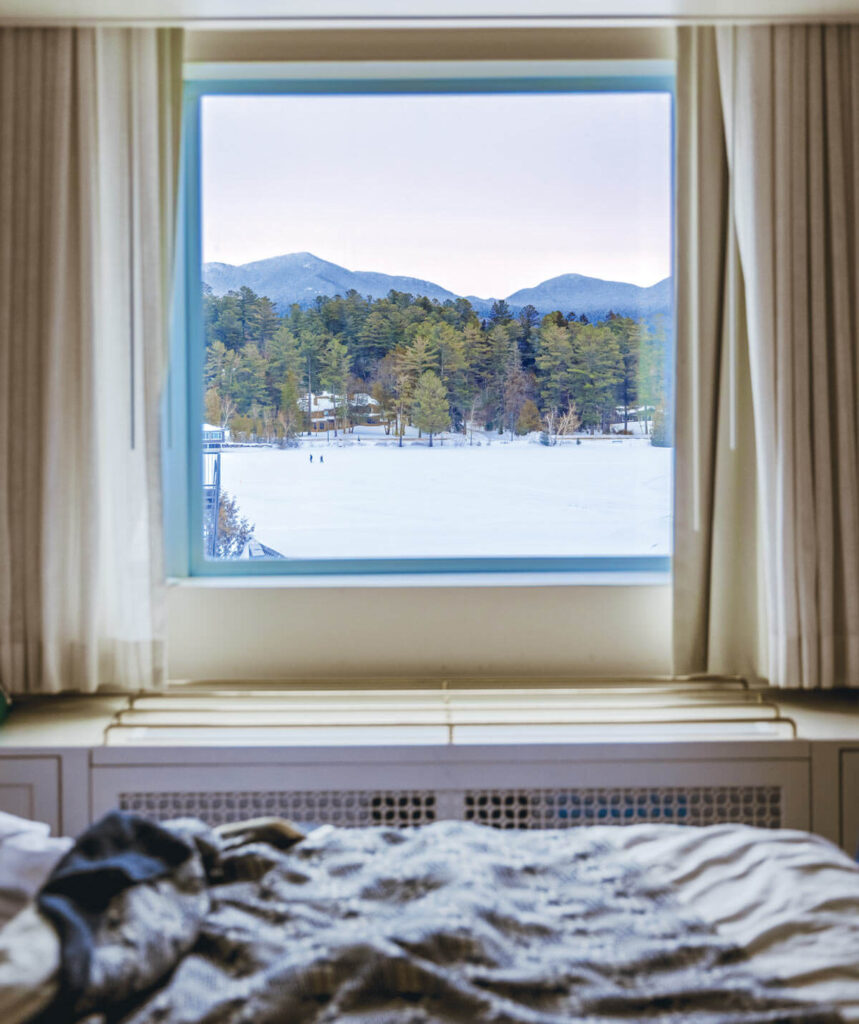
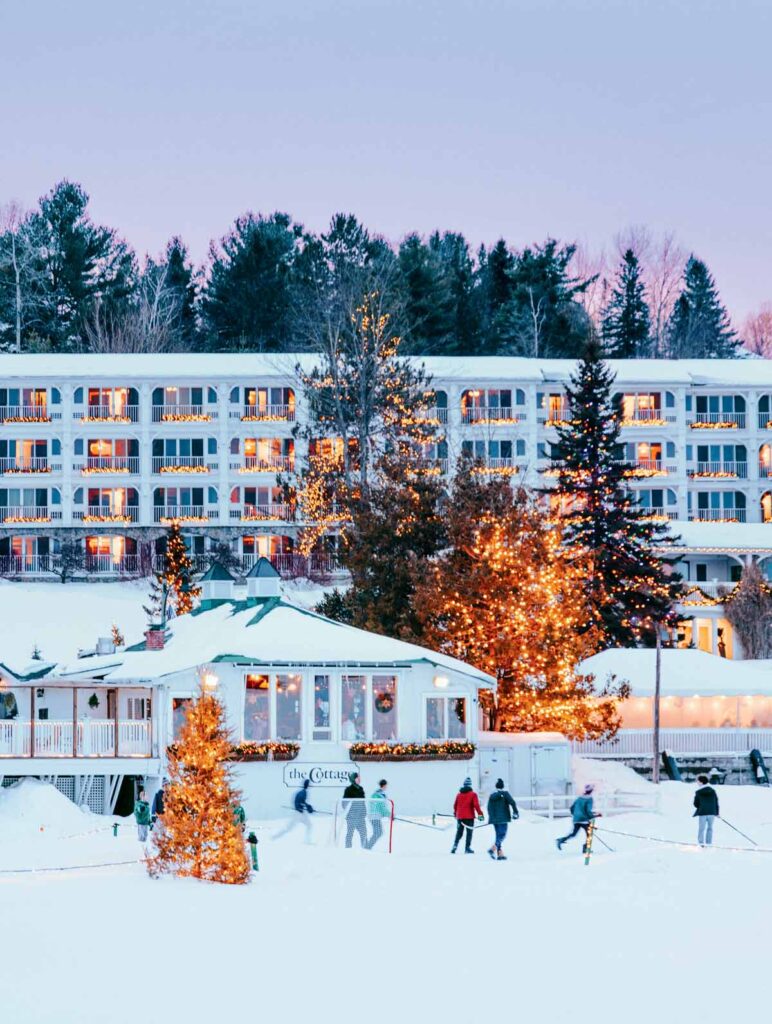
Anchoring Mirror Lake Drive, the classy white-tiered Mirror Lake Inn, with its twinkling lights, belongs in a storybook. The inn is operated by Alpine ski racer Andrew Weibrecht, a two-time Olympic medalist. Its lakeside restaurant, The Cottage, is reliable for a vibrant bar scene, mountain views, and soup and sandwiches. Sometimes local curling teams play on the ice just beyond the outdoor deck.
Credit: Pam and Chris Daniele
And then there’s Whiteface Lodge, a resort that echoes this region’s signature Great Camp style. Stay here, and you’ll have access to a bowling alley, ice cream parlor, spa, salon, skate rink, outdoor lean-tos, and indoor/outdoor pool. It’s a dream for families—but I also like coming to the resort’s bar, Peak 47, for a pint by one of the fireplaces.
* * * * *
Back on the 128-meter jump’s observation deck, the elevator operator tells me it’s closing time. The postcard-perfect afternoon, minus the biting wind, has given way to dusk. Anywhere else in the Adirondacks, scenery like this happens only in deep wilderness. But here, in my backyard, anyone can bring their big dreams, experience big views, and top it all off with a big night in a little mountain town.
This feature was originally published as “Adventureville” in the January/February 2026 issue of Yankee.
Find the Picks in our Lake Placid Winter Travel Guide:
Things to Do in Lake Placid, NY: Where to Eat, Stay, and Play