Yankee Magazine May/June 2017 Issue: Your Ultimate Summer Travel Guide [easy-social-share buttons=”facebook,twitter,pinterest,google,mail,print,more” sharebtn_style=”icon” counters=0 style=”icon” point_type=”simple”] Table Of Contents: Dear Yankee | Our Readers Respond A Traveler’s Best Friend | Inside Yankee The Bobolink Dilemma | Mary’s Farm Good Well Hunting | Life in the Kingdom A ‘Very Impressive Rock’ | Madison Boulder Seal of […]
When planning began last year for the feature “City of Hope,” our aim was to tell the story of how a wave of newcomers—specifically African immigrants—was helping to revitalize the former mill town of Lewiston, Maine. By the time the piece appeared in our March/April issue, though, the national debate over immigration had given our readers another lens through which to view the story. “City of Hope” has received a lot of reactions from across the spectrum; here are two that we respectfully share.
I just read the lengthy feature on African immigrants in Lewiston, Maine, and found the article so carefully slanted as to be very one-sided. The whole immigrant infiltration experience was presented as being a positive experience for all in Lewiston, but the article dwelt on immigrants and their lives and didn’t say much about the other Lewiston residents and how this immigration affected them….
But my chief complaint is that I don’t subscribe to Yankee for social relevance. I get plenty of that everywhere else. Yankee shouldn’t do politics.
Mary Weston
Dover, New Hampshire
My maternal grandmother was born in 1904 in the tiny town of Wales, Maine, just northeast of Lewiston, the eldest of 13 children. There was no high school in her small town, so in order to graduate with a secondary education she had to board during the school year with kind folks in Lewiston, who took her in and treated her as their own….
My grandmother would be so proud of the state of Maine and of her adopted city of Lewiston. In her 95 years on this earth, she always strove to support those in need and to reach out to strangers, to make them feel at home. This, I believe, she learned from her years in Lewiston, as a young girl from the country who was nurtured and strengthened by those in her new city. Thank you for shedding light on this wonderful pocket of America.
Laurie Daniels
Keene Valley, New York
Over the Long Run
Thanks so much for the “Timeless” reminder [“Game Changer,” March/April] showing the photographs of the first female Boston Marathon runner being attacked by the event’s male codirector. Just looking at the anger in his face helps explain what has fomented today’s political environment, with its toxic hatred toward those who want an equal chance to run, work, and vote…. I am glad the two main characters ultimately became friends—I just hope the same can be true for the rest of our country.
John Wengler
Nelson, New Hampshire
We want to hear from you! Write us at 1121 Main St., Dublin, NH 03444, or editor@yankeemagazine.com. Letters may be edited for length and clarity.
A Traveler’s Best Friend | Inside Yankee
by Mel Allen
Mel Allen
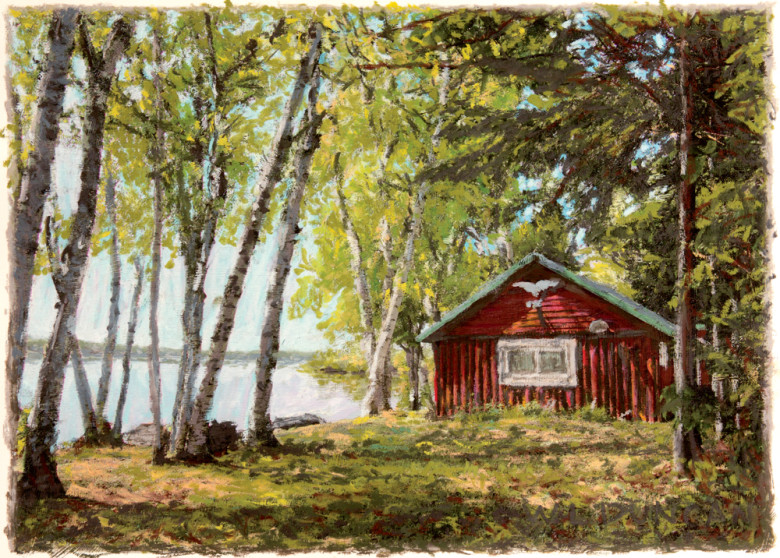
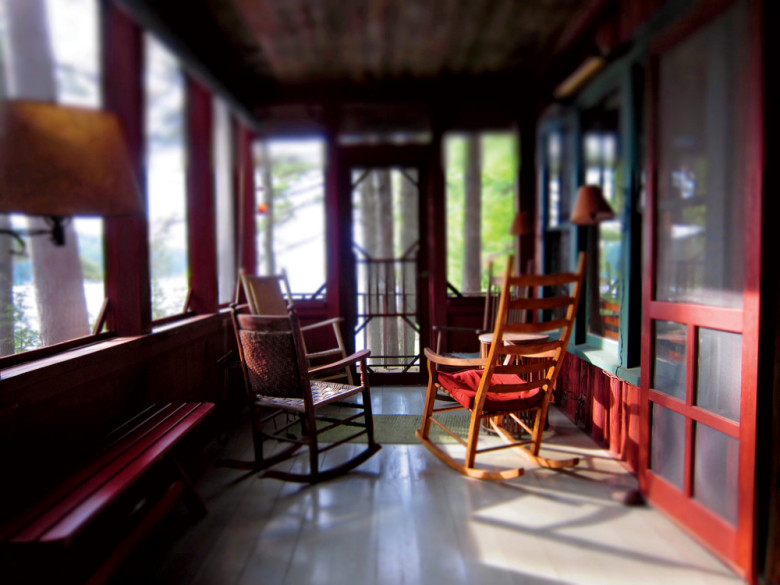
There may be better ways to vacation than living on a houseboat plying the waters of Lake Champlain beneath summer’s blue sky (“Slow Boat on a Big Lake”) but I can’t think of any. Well, maybe one: kicking back at a cabin in the Maine woods, a timeless retreat you return to year after year (“A Place to Get Away”). Or perhaps the open road is calling you to search out exciting things to see and do across our region; if so, our Best of New England guide has both old favorites and worthy newcomers to visit this summer.
I believe that a travel issue should bring readers respite from their everyday cares. Indeed, that’s a big reason why people leave home. But we do not live in a bubble. Since work began on this issue, months ago, the word travel has taken on a heavier weight. A word that once implied exploring, meeting new people, now is seemingly being used to assign us into slots: You over there, OK, come through; you, stay back. Anyone with knowledge of New England understands that we are all descendents of travelers brave enough, or desperate enough, to see what these mountains, forests, and harbors could offer. Hard work and fortitude and enough luck usually prevailed.
I once taught in the journalism program at the University of Massachusetts. The students were mostly seniors, and all they wanted was a chance to break in somewhere—to make their mark, ask the right questions, and find the stories that mattered. These were young people who cared about their world. I can’t imagine anyone calling their work “fake” without turning red with shame.
Every morning at my desk, starting north in Maine, then moving south and west, I read what New England reporters have covered in their backyard. I learn about the rural poor and the human cost of the opioid epidemic, about how towns grapple with alternative energy and how fishermen struggle with quotas. These reporters chase neither fame nor, surely, riches. And while there may exist unscrupulous journalists, they are always unearthed. The world of writing is a poor place in which to hide out—too many eyes.
As you travel this summer, remember that nearly every village, town, or city you visit will offer a daily or weekly paper that sheds light on its people and places. Most of these can be plucked for a dollar; The Boston Globe takes two. It’s worth it to get a better sense of where you are—and it’s the best way to honor the founders of this country in their demand for a free and open press. The New England revolutionaries who took on the tyranny of an English king in the spring of 1775 would thank you.
The Bobolink Dilemma | Mary’s Farm
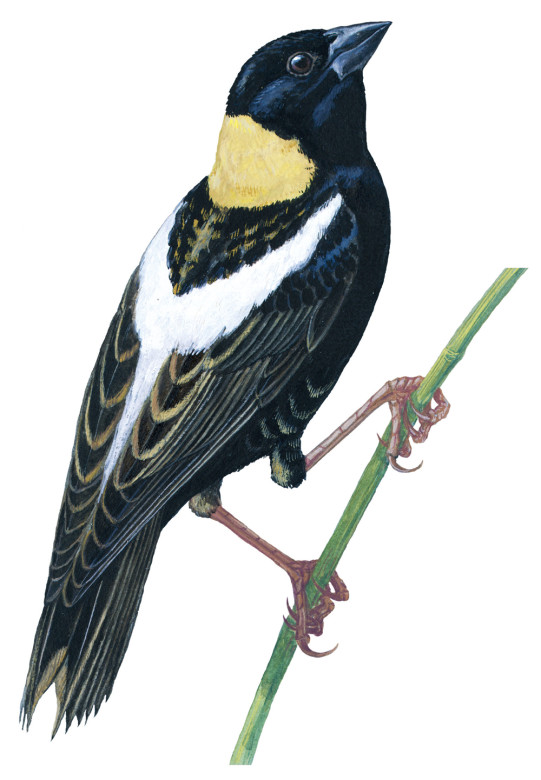
Instinct draws the sweet-singing birds to make their homes in the same fields that farmers must harvest for hay.
I have a unique vantage point from my property: Look to the west and there is a hayfield, not a large one but big enough to yield a few wagonloads of hay each year, as well as a clear horizon. To the north is another hayfield, about the same size though not as well situated, so the crop is less vigorous. And to the south is the big field, the one that opens its arms to the sky and yields a superabundant harvest of hay.
When I first came here, I didn’t know much about the bobolinks, migratory birds small enough to hold in my hand. I knew only their cheerful song, broadcast out across the greening fields, happy as the rest of us to welcome spring. In those early years of my tenancy, I had no idea that these birds nested in the fields instead of the trees. Animal instincts have always struck me as an ingenious way of keeping creatures from harm. The bobolinks must have a reason for nesting on the ground, but doing it that way seems extremely dangerous.
Birds and haying do not necessarily clash. But what happens when the fields are hayed is that, quite immediately, there is what one might call “road kill,” as the big blades of the cutter inevitably leave all manner of animals in their wake, from field mice to skunks and even a fisher-cat or two—whatever could not escape in time. Some of these unfortunate creatures even end up baled into the hay.
At first I didn’t fully understand the bobolinks’ plight. Friends were advocating to stop the farmers from haying until the babies had left the nest, but my sympathies went to the farmer. In haying, weather is crucial to getting in a good crop. I know how hard it is to harvest when weather won’t cooperate. The birds simply made a fatal mistake by nesting in a hayfield. What were they thinking?
Then, a few years ago, I was sitting at my kitchen table as the first cut began, the green tractor sweeping across the field, usually a cause for joy, a signal of new life. And I saw behind it a wave of young bobolinks, hopping and struggling in the cutter’s wake.
It was as if these small birds were drowning in the incoming tide of hay as it churned off the blades. It took several minutes for my brain to process the fact that the words of my bird-loving friends were true. The bobolinks’ instincts had led them to their end, silencing their beautiful songs.
For the rest of the season, each time I looked at the field my heart sank. But what was there to do? Every year, trucks hauling horse trailers line up at the gate to pick up the farmer’s freshly baled hay. Who or what is more important in the natural pyramid? I thought about it constantly as the season wore on. The farmer has to figure into this formula as well. A farmer friend of mine always has said, “Nature takes care of everything.” Maybe. Maybe sometimes it takes a while for the pendulum to swing back to where it’s fair.
Last June, there were no bobolinks nesting in the field. Had they learned their lesson and moved on to greener pastures? Or were there simply none of them left? There must be a reason why the bobolinks build their nests in the hayfield, but so far I don’t know what it is.
The Nature Conservancy and other like-minded groups advocate a program called the Bobolink Project as a way to help these birds survive. To learn more, go to bobolinkproject.com.
Good Well Hunting | Life in the Kingdom
When a sulfur-spewing spring makes life unbearable, a dowser is a good person to know.
by Ben Hewitt
By the first of May, the last vestiges of the mildest winter in memory are long departed. I cannot recall a winter of such enduring timidity, and although I’m grateful for all the ways in which it made our lives easier during the inherent challenges of home building, I also feel a certain loss. There’s a particular satisfaction in making it through a real Vermont winter, in sticking it out to the bitter end of the below-zero nights and the bottom of the woodpile with your mental and physical well-being intact. Or one out of two, at least.
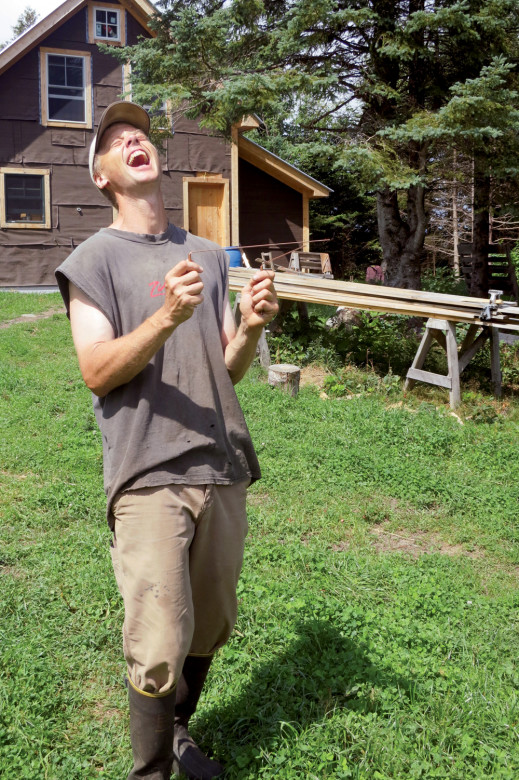
“This was the very moment we located that spot” where the family well would be drilled, says the author, shown with his dowsing rods. “It was so obvious the way the rods came together.”
Credit: Penny Hewitt
“This was the very moment we located that spot” where the family well would be drilled, says the author, shown with his dowsing rods. “It was so obvious the way the rods came together.” Credit: Penny Hewitt
This spring, however, there’s none of that. We’d had nothing to endure but the lack of winter itself; why, the pipes in the unheated pantry of our new house froze only once. What’s more, they didn’t even burst! It’s an outrage, really.
Now, with the frost out of the ground and the first cutting of hay stacked neatly in the barn, we’re faced with a hard decision. For months we’ve been suffering the unpalatable water that our spring produces. At first, in the early weeks of developing the spring, we assumed the off taste was due to soil disturbance and the presence of decomposing organic matter. I took the excavator to the spring and scraped off all visible topsoil and forest detritus, replacing it with clay from the bottom of our pond site. But these efforts proved fruitless, as the water continued to smell and taste like an egg left in the sun too long, and it soon became clear that we’d inadvertently developed a sulfur spring. We installed a large carbon water filter in the house; within two weeks, the sulfur had overcome it. At $60 per filter, this is no long-term solution.
It’s difficult to overstate how discouraged I am by this turn of events. In the grand scheme of things, developing a sulfur spring ranks pretty low on the hardship scale, but the spring had been a source of pride for me. I’d never developed a spring before, but for this one I had my hands on every step of the process, learning as I went, all the while anticipating the unending stream of crystalline water soon to flow into our new home. Equally painful was the fact that we dumped better than $3,000 into the project. That’s a steep toll for water that turns the nose from a dozen feet.
The decision isn’t whether we should drill a well now—that’s pretty much a given—but rather where we should drill. That’s because there are never any guarantees when one drills for water. Drill over here, and you might hit water at 100 feet; drill over there, and it might be 300 feet. Or more: Just a stone’s throw from our place—far, far too close for comfort—there’s a 600-foot dry well. Given that the current price for drilling runs about a dozen bucks per foot, the implications are obvious. So, we decide to hire a dowser. And that, in short, is how we meet John Wayne Blassingame.
Blassingame arrives on an idyllic early summer morning, the sky azure blue above, the grass verdantly green underfoot. Within minutes, Penny and I know the following about him: He is 89 years old (though he doesn’t look a day older than 70), he’s found water in 26 states, he was drafted into the Navy right out of high school, and he has a 14-year-old biological daughter. The last seems a particular point of pride, and, honestly, who can blame him?
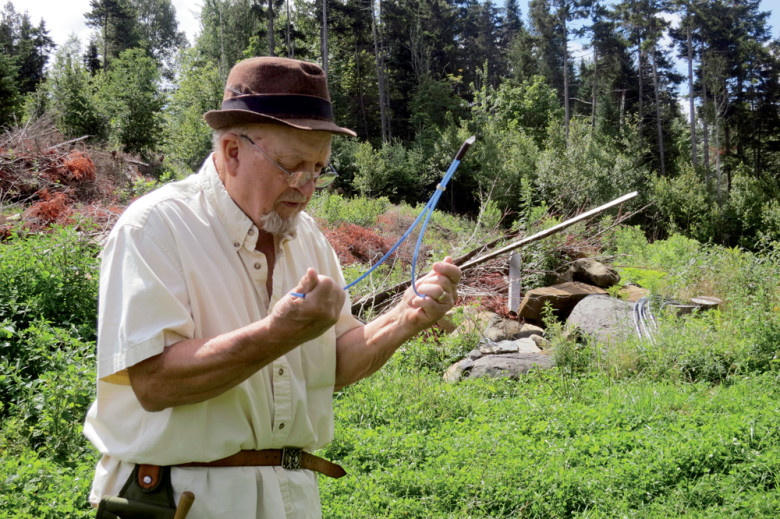
John Wayne Blassingame at work. The practice of dowsing—using a forked stick, rod, or other tool to locate underground water or minerals—was first described in detail in 16th-century Germany, though some believe it goes back to prehistoric times.
Credit: Penny Hewitt
John Wayne Blassingame at work. The practice of dowsing—using a forked stick, rod, or other tool to locate underground water or minerals—was first described in detail in 16th-century Germany, though some believe it goes back to prehistoric times. Credit: Penny Hewitt
“It’s all about tuning into the subconscious,” explains Blassingame, when I ask about the tenets of successful dowsing. “The subconscious knows all sorts of things.” Furthermore, it’s critical to know the limitations of the practice. “It’s got to be sincere,” he says, as he extracts copper dowsing rods from a case in the bed of his truck. “It’s got to be based on need, not greed, or it won’t be accurate. And you can’t infringe on someone’s personal life.” He tells us about the time he was giving a dowsing workshop and a woman tried to dowse whether her husband was having an affair. “I grabbed those rods right out of her hands.”
Blassingame has brought along homemade rods for both Penny and me because he wants “our energy in it.” He hands us each a set of rods; they’re maybe 16 inches long, with a 6-inch-long L to be held in the hand. Over each L he’s installed a copper sleeve; this allows the rods to rotate freely in our hands. The first thing we do is “tune” our rods by explaining to them (yes, out loud) what we want them to do in response to our questions: cross tips when the answer is yes, and swing outward when the answer is no. We then ask a series of yes/no questions to which the answers are well-established fact. “Is my name Ben?” “Am I a little green frog?” And so on.
My rods provide the correct answer to every question, but this seems easy enough to dismiss. After all, it’s a very different thing to ask the rods if I’m a little green frog compared with asking them if we’re standing atop a vein of potable water and, furthermore, whether that vein will produce a sufficient flow of water and, furthermore still, to gauge the approximate depth of that water. Yet Blassingame says we can do it, and who am I to doubt an 89-year-old with a daughter just out of junior high?
With our rods tuned and our subconscious awareness on high alert, we turn to the task of finding water. Because we’d already buried lines from the spring to the house, our strong preference is to drill our well near enough to those lines that we can simply tap into them, rather than trench for new lines all the way from well to house.
Blassingame instructs me to make a pass in the hoped-for vicinity. I walk slowly across the area, repeatedly asking, “Is there water here?” until the tips of my rods cross. It’s an astonishing moment; it feels almost as if I couldn’t stop the rods from crossing. I repeat the process, with the same result. Penny goes next, and her rods cross at the exact same spot. Blassingame confirms our finding, then homes in on depth (250 to 300 feet), palatability and potability (affirmative on both accounts), and flow (at least 8 gallons per minute). “Have them drill right here,” he instructs, pounding a flagged stake into the ground. Within seconds, a butterfly alights atop it. This pleases Blassingame immensely. “That’s a good omen,” he says, and chuckles.
It’s more than three weeks before the drilling rig arrives, and I cannot deny that over this period, doubt creeps in. I pass the stake multiple times each day, looking for some sort of clue that we’ve chosen the right spot. But to the naked eye there is nothing to differentiate this small square of ground from the millions of small squares of ground surrounding it. I wonder: Could Blassingame have scammed us? At $250, his services weren’t exactly cut-rate, especially considering he was on-site for less than two hours. A quick round of Googling reveals a study claiming dowsers are no more reliable than coin flips. If this is true, the $250 doesn’t bother me nearly as much as the lingering uncertainty over how deep we’ll ultimately need to drill. I console myself by recalling the butterfly, whose wings were deep blue—the color of water.
Turns out, we’re not able to be home the day the drillers arrive. When we return at 6:30, the rig is perched in our yard, the bit deep in the ground at the precise spot we’d installed the stake. I run inside to call the driller; I simply can’t bear waiting until the next day to find out how far they’ve drilled, whether they’ve hit water, and, if so, the rate of flow.
“We got to 165 feet,” the driller tells me. He pauses for dramatic effect, and I steel myself—surely, something must have broken. Then he continues, “And we hit 50 gallons per minute. At least that’s what I think it is. Honestly, it was coming in so fast, we could hardly measure it.” I cover the telephone mouthpiece and let loose a whoop. Fifty gallons a minute at 165 feet is better fortune than I even dared dream. And it’s far, far better than what Blassingame promised. For a brief moment, I consider calling him to alert him that perhaps those rods weren’t fully tuned. After all, we were wrong. But darn it all, at least we were wrong in the right direction.
A ‘Very Impressive Rock’ | Madison Boulder
If you’ve ever wondered about the power of glaciers, pay a visit to the Madison Boulder.
by Julia Shipley
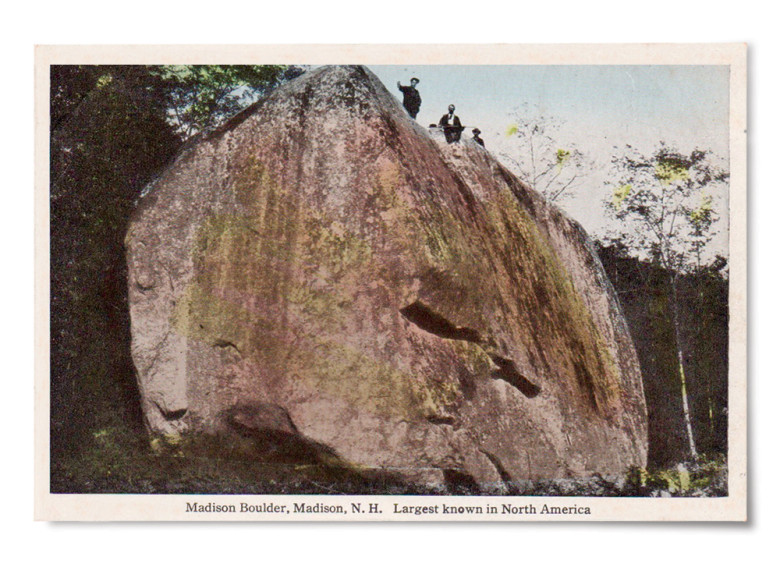
Nobody stumbles upon it. Or over it, for that matter, even though it’s been hunkered in the New Hampshire woods for the past 15,000 years.
My husband and I first learned about the monster rock known as the Madison Boulder, “the largest glacial erratic boulder in North America,” in a book about stone walls. Just from the description we already knew that no farmer had ever attempted to pry this specimen free and lug it to his boundary wall. The mention of the boulder was obviously for show, an extreme, something to elicit our sympathy and awe: Look at what these yeomen had to contend with!
But “largest glacial erratic boulder in North America” also elicited our imagination. Oh c’mon, how big? we wondered.
In early May, we left northern Vermont and drove east, across the Connecticut River into New Hampshire, surging up and over the White Mountains, cruising through North Conway’s fairway of motels and outlet shops, then poking along increasingly modest roads to reach the town of Madison. We passed a gravel pit, some small bungalows, and a recycling center. Could there really be a colossal rock near here? Finally, we rounded a corner and saw the sign: Geological Park.
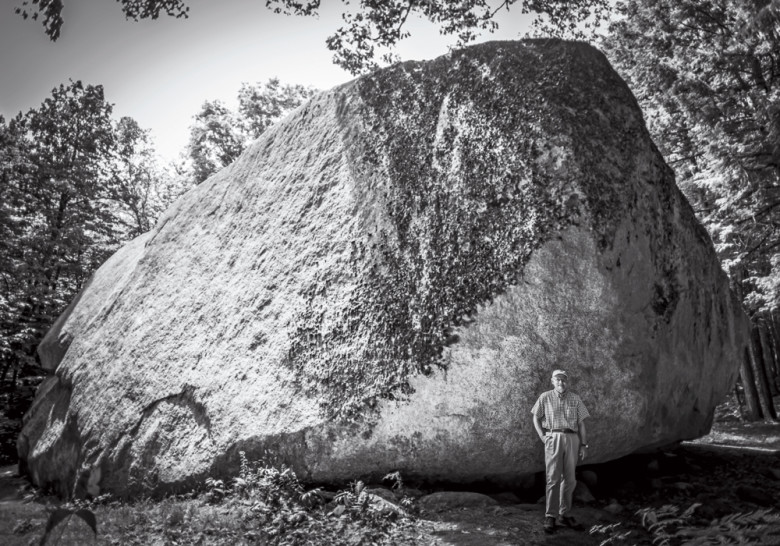
Friends of the Madison Boulder president Brian Fowler at the ancient slab, which not only towers over him but also extends another 10 to 12 feet underground.
Credit: Michael Seamans
Friends of the Madison Boulder president Brian Fowler at the ancient slab, which not only towers over him but also extends another 10 to 12 feet underground. Credit: Michael Seamans
After traveling two and a half hours, a distance of 120 miles in our Chevy, we had arrived in the vicinity of a boulder that had also made a voyage—one that took about 5,000 years, over the distance of a few miles, while trapped in a glacier.
Its chilly vehicle gave the boulder status as an “erratic,” which is the term used to describe any rock that thanks to glacial transport is constitutionally different from the rocks surrounding it. In designating the boulder a National Natural Landmark in 1970, the Department of the Interior heralded its transit as illustrating “the power of an ice sheet to pluck out very large rocks of fractured bedrock and move them substantial distances.”
A sign in the empty lot promised an easy 15-minute walk to the boulder. At scarcely the five-minute mark, I saw what looked like a slate barn roof in the distance and wondered aloud if it was maybe a three-story rangers’ quarters. “No, that’s it,” my husband said, just as we reached a clearing. The pamphlet we’d picked up in the parking lot described a “very impressive rock.” Oh yes.
The boulder’s dimensions—83 feet long, 23 feet high, and 37 feet wide—convey its enormousness, but how to account for its … sentience? The loafing rock emanates a presence, a heavy serenity. It seems like a petrified leviathan, with lichens freckling its flank like barnacles. At an estimated 5,900 tons, this behemoth of Conway granite in fact equals 35 blue whales.
I studied the boulder’s base, finding vole holes and violets and white-petaled stars-of-Bethlehem. In the distance, an ovenbird trilled; close by, a mosquito grazed my neck. All this delicate life, living with and beside the hulking rock.
Support and funding from the National Park Foundation has helped turn the boulder from a onetime thrill-seeker’s attraction into a protected landmark.
Meanwhile, my husband prowled the circumference. When I found him on the far side, he was peering at some spray-paint iconography scrawled onto the boulder’s surface. Then his eyes traveled upward, and he fixed his gaze on the boulder’s crown. “Wouldn’t it be cool to see what’s up there?”
A picture in A Brief History of Madison, published in 1925, features two gentlemen who did exactly that. They are standing on the boulder’s pate, grinning. According to Brian Fowler, president of the Friends of the Madison Boulder, some of last century’s visitors brought chisels and mallets to inscribe their initials on the top of the rock, which they reached via a staircase erected along the back side. However, by the 1950s the staircase had largely deteriorated, and nowadays ambitious visitors lean tree limbs and trunks against the boulder to try to shimmy up. The advent of spray paint, it seems, has made leaving a signature far easier, something Fowler laments.
“There’s a segment of our society that needs to express itself,” he said. It’s a primal segment, I think, one that harks back to our prehistoric ancestors’ making unmistakable marks on rock for us to discover. Nevertheless, it’s also directly at odds with the Friends of the Madison Boulder, which has raised thousands of dollars to sandblast said expressions off the rock’s front side, restoring its appearance to perhaps that of 20,000 years ago, when the Wisconsin glaciation was in full swing.
We circled around to the boulder’s front. My husband stepped back, squinting at the rock, there in a clearing surrounded by the infant leaves of maple and beech, as if trying to imagine how it had foundered here. And so I reprised the history lesson that Fowler, who is also a trained geologist, had offered.
In 1878, Charles Hitchcock led the team that created the first geological map of New Hampshire, which included the Madison Boulder. A geology professor at Dartmouth College, Hitchcock also was the first to propose that the boulder had been delivered by glacier to the valley floor. (The common thinking was that epic floods had rearranged big rocks across the state’s terrain.)
Since Hitchcock’s time, surficial geologists have further described how the boulder arrived: During the last ice age, an advancing glacier knocked a chip off the old block (of exposed granite) and sleighed it “downstream.” This chip likely came from the Whitten Ledge, a formation standing a mile and a half to the northwest; in his years of exploring the area, Fowler has noticed that the mineral structure of the boulder “matches up perfectly” with that of part of the ledge.
For a few thousand years, this dislocated granite chunk was suspended in ice. But about 15,000 years ago, the glacier began to melt and gradually release its debris, and—as Fowler put it—“down she went.”
And down she remained—while across the globe, our Stone Age forebears were on the verge of domesticating sheep, soon to be followed by cows, and grain farming, which was about to grow by leaps and bounds due to a new tool called the plow. Yet innovations like chicken farming, horseback riding, and writing were still a few millennia down the road.
And there she sat—while humanity inched toward omelets, cavalries, and magazine publishing.
And here she still sits—this humongous heirloom from prehistory, persisting.
The Madison Boulder Natural Area is located at the end of Boulder Road, off Rte. 113, in Madison, NH, and is open to visitors year-round.
Seal of Honor | Up Close
by Jenn Johnson
Credit: Mark Fleming
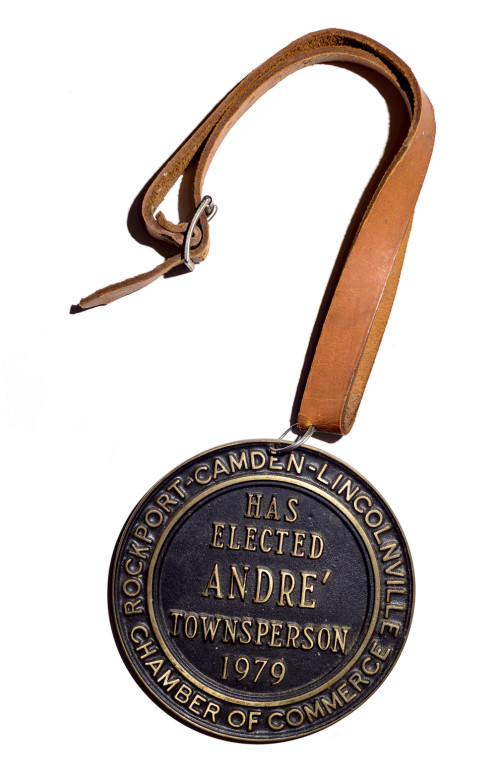
Trophies, old love letters, a wedding gown—these are the mementoes you’d expect a family to collect and save for future generations. But for Toni Goodridge, whose family happens to have included the world’s most famous harbor seal, the collection takes a quirkier turn. Tucked away in her Lincolnville, Maine, home is the hollowed-out, neoprene-covered log that her father, Rockport harbor master Harry Goodridge, used to wean the seal pup he rescued and named Andre back in 1961. Two filing cabinets stuffed with news clippings, books, and letters from schoolchildren attest to Andre’s eventual status as a Rockport celebrity—as does the Townsperson of the Year medallion pictured here, which was presented to Andre in 1979 (along with a congratulatory telegram from the governor). Toni and her siblings have lately begun talking about entrusting the Andre collection to someplace like a museum, since the legendary “seal who came home” is still capturing the public’s imagination more than three decades after his death. “Just when we think everything has settled down,” she says, “we get another email from someone, somewhere around the world, who has connected with Andre’s story.” —Jenn Johnson
To Stretch a Shoestring | Knowledge & Wisdom
Useful stuff from 81 years of Yankee
Credit: yinyang/istock
When my husband and I decided we wanted a summer home on the family farm on Great East Lake in Maine, my mother-in-law’s only comment was: “I have heard of folks doing things on a shoestring, but you two haven’t even got the money to buy lacings for your shoes!”
Not to be deterred, we bartered and swapped for everything we could. We cut trees from a neighbor’s woodlot “on shares” and took them to a local sawmill with our brother’s truck; in return we helped with his haying. The mill owner kept a third of the logs we brought him in exchange for cutting our logs into whatever lumber we needed.
Work was traded with summer people for nails and cement, and we salvaged windows for 50 cents apiece from a house that was being razed. The fireplace was made of native fieldstone (there was no shortage of that on our rocky building site) at a total cost of 5 cents—the price of a government pamphlet titled “How to Build a Fireplace.”
The project took five years to complete and cost us exactly $33.95 in cash. The major portion of that went for asphalt roofing shingles. Not a bad price for a house that’s stood for almost 50 years through countless winter storms and two hurricanes.
—Adapted from “How to Build a House for Under $40,” by Ruth Langley Hill (April 1981)
Katharine Hepburn Quote | Knowledge & Wisdom
We were right all along
Credit: mgm/superstock
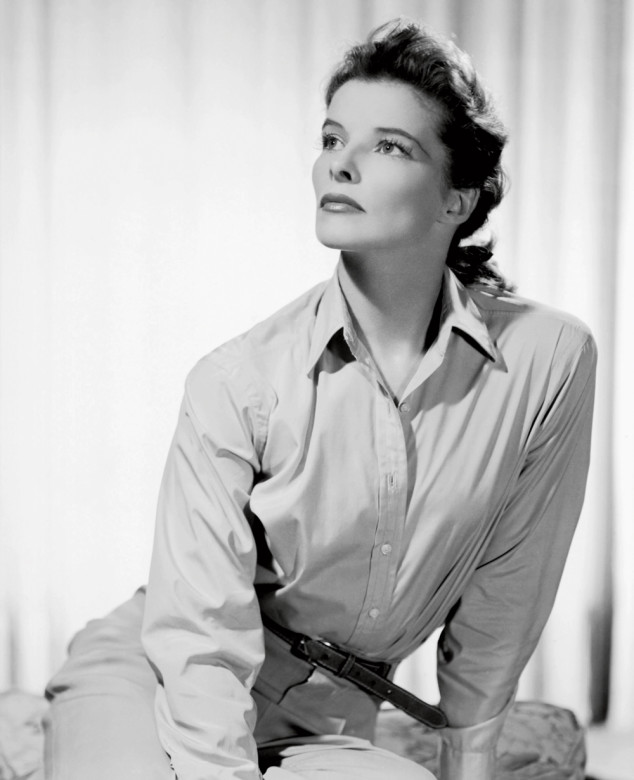
“As one goes through life, one learns that if you don’t paddle your own canoe, you don’t move.”
—Katharine Hepburn (May 12, 1907–June 29, 2003). This fiercely independent four-time Oscar winner wasn’t the sort to tie her fate to anyone else’s. But the Connecticut native did maintain a decades-long bond with her family’s beloved seaside retreat in Old Saybrook, where she spent the last years of her life. In 2009, the town repaid that devotion by debuting the Katharine Hepburn Cultural Arts Center, affectionately nicknamed “the Kate.”
Emily Dickinson | New England by the Numbers
by Julia Shipley
1830Year of Dickinson’s birth, in Amherst, Massachusetts
10Number of her poems published before her death, at age 55
69Number of years between her death and the publication of the first complete volume of her work
3,507Number of poems and letters she’s known to have written
24Number of years Dickinson corresponded with her mentor, Thomas Higginson, editor of The Atlantic Monthly
twoNumber of times she and Higginson met in person
100,000+Number of visitors to Amherst’s Emily Dickinson Museum since it opened in 2003
$100Cost for a museum visitor to spend a solitary hour in the bedroom where Dickinson wrote
TWONumber of words in her last known letter, from May 1866 (“Called back”)
sixNumber of Irish laborers she requested carry her casket to the family grave site
How to Give a Great Speech | Ask the Expert
In honor of college commencement season, we ask communication guru Jay Heinrichs for help channeling our inner Cicero.
by Jenn Johnson
Even in New England, the birthplace of scores of celebrated public speakers—Daniel Webster, Susan B. Anthony, JFK, and so on—it can feel as if the art of oratory is withering away these days, one tweet at a time. But college commencement season brings reason to take heart, as our region’s unmatched collection of universities invites everyone from scholars to actors to, yes, politicians to take the dais and speak their mind.
Credit: J.P. Schmelzer
True, few of us have a backstory as inspiring as J.K. Rowling’s (Harvard, 2008) or a wit as pithy as Nora Ephron’s (Wellesley, 1996). However, we can all polish our oratorical skills just in case our alma mater—or, OK, our local church group—comes calling for a keynoter. For some insight, we turned to New Hampshire consultant Jay Heinrichs, author of Word Hero, a guide to becoming a better writer and speaker, and the New York Times best-seller Thank You for Arguing.
Tap into the Classics
Heinrichs’s own interest in the power of words was sparked years ago, when in a cobwebbed corner of the Dartmouth library he stumbled upon a collection of lectures by John Quincy Adams from his tenure as a Harvard professor of oratory and rhetoric. Heinrichs was immediately hooked, and he set out to read all the classics that Adams mentioned. “What blew me away about that was although I loved literature, I always suspected that words ought to do more than sit around looking pretty,” he says. “I knew they had a certain power.”
Tell ’Em a Tale (but Not a Joke)
In drafting a speech, remember that the surest way to connect with an audience is to tell a story. In his outline for persuasive speaking, ancient Rome’s Marcus Tullius Cicero (“who according to Cicero was the greatest orator in history,” Heinrichs quips) calls this the narratio, and every speech should have one.
But resist the temptation to lighten up your speech with humor, since one lame joke can turn off half your audience (or more). “Humor is impossibly hard,” says Heinrichs. “Don’t do it. Unless you’re sure you’re funny. Even then … don’t.”
Ditch the Index Cards
Rather than reading from notes, try committing your talk to memory. “That’s what the ancients did, pre-Teleprompter,” says Heinrichs, who recommends writing out the speech, breaking it up into PowerPoint slides, then reciting it while showing yourself the slides. Bonus: Memorizing a speech forces you to make it short enough to, you know, memorize.
Get to the Point
When you step up to the microphone, suppress the urge to stray from your talk. “Don’t apologize, or ask if people can hear you, or say how nervous you are,” Heinrichs advises. “Begin your speech the way Ira Glass does on This American Life, by jumping right in.”
Wrap Up Quickly
Don’t draw out your closing thought. “The ancients believed that the patterns of the brain work in concert with the rhythms of the body,” Heinrichs says. “A memorable thought therefore is best expressed in the length of a human breath—about 12 seconds.”
Know Your Audience
“Every great orator speaks to the beliefs, feelings, and expectations of his audience,” says Heinrichs. For example, if you do happen to deliver a commencement speech, you arguably could do worse than reading from Goodnight Moon. “Not all students are feeling 100 percent positive about their future,” Heinrichs says. “They may just want to curl up with a book about a rabbit and some kittens.”
Embrace Those Butterflies
For most of us, jitters are inevitable when getting up to speak in front of a crowd. But instead of trying to calm your nerves, Heinrichs says, focus on faking confidence. “The single best way to do this is talk louder—it actually gives you breath control.”
And take consolation, he adds, from the greats who have gone before: “In his first time up as a lawyer, Cicero actually threw up before he had to speak. Then he couldn’t even get through his speech without running away in terror. And that gives me hope, personally.”
A She-Shed of One’s Own
“She-sheds” are the latest in the tiny-house phenomenon. On Cape Cod, they do it their own way.
by Kate Whouley
Just as the last century turned into this one, I found a tiny cottage in the classified ads. It was only $3,000, but it was also cash-and-carry. I called the number listed, and suffice it to say: Adventure ensued. So much adventure, in fact, that I wrote a book about that cottage-moving year, the title echoing the original headline: Cottage for Sale, Must Be Moved.
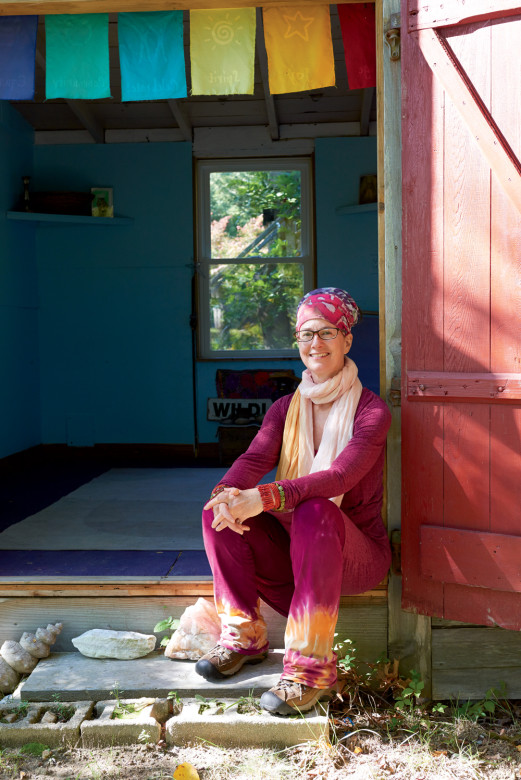
Deer Sullivan’s simple, colorful shed is a place for her to unplug from daily life—literally, since she’s ditched the shed’s electrical hookup. “I don’t need it here,” she shrugs.
Credit: Hornick/Rivlin
Deer Sullivan’s simple, colorful shed is a place for her to unplug from daily life—literally, since she’s ditched the shed’s electrical hookup. “I don’t need it here,” she shrugs. Credit: Hornick/Rivlin
During one of my early conversations with Bob Hayden, a seasoned second-generation building-mover, he referred to my project as a “shed move.” I took offense. I’d already hired an engineer, met with a crane operator, applied for a building permit, appeared before the conservation commission, and cleared two hillsides. The pending 16-by-25-foot addition to my three-room home was most decidedly not a shed.
In those days, sheds were stocked with shovels and spades, wheelbarrows and lawn mowers, bicycles and off-duty air conditioners. And some still are. But now there’s a revolution afoot. Across America, women are taking to their backyards to reclaim, repurpose, and create new rooms of their own. Introducing: the she-shed.
Search the term online, and you’ll fall through the looking glass into a land of tiny, tricked-out backyard buildings. You may want them all. You may also note that a lot of these lovely spaces are in places with not much, well, weather. And you may wonder: What does a New England she-shed look like? And perhaps you will embark on a different kind of domestic adventure, as I did, crisscrossing Cape Cod in search of real-life seaside she-sheds.
The Sitting Shed,Brewster
“I didn’t want my shed to become a project,” says Deer Sullivan, lowering herself into a faded blue beach chair. Deer has lived on this property overlooking Griffith’s Pond in Brewster for 13 years. The shed was here when she and her spouse bought the place; she needed only to clear it out and claim it.
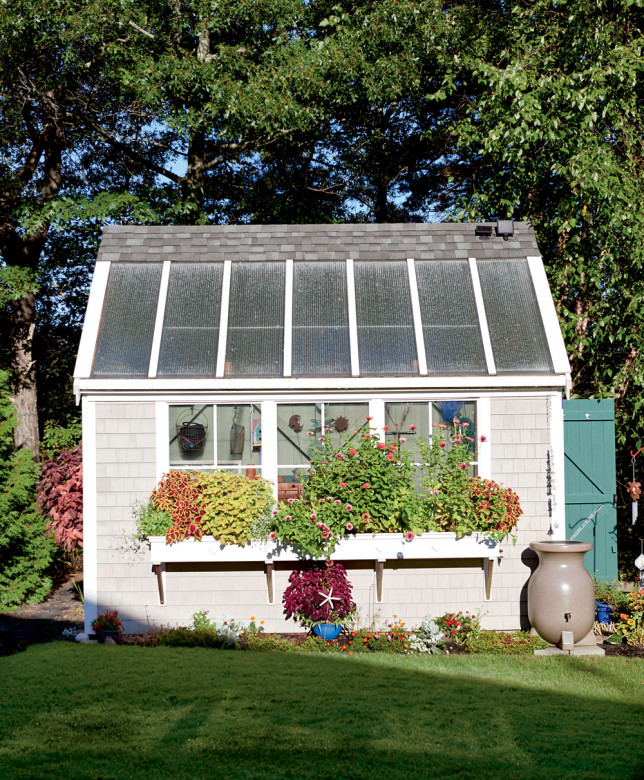
Linda Colgan gives her green thumb free rein in her East Sandwich shed, which is flooded with natural light thanks to translucent polycarbonate panels incorporated into the roof.
Credit: Hornick/Rivlin
Linda Colgan gives her green thumb free rein in her East Sandwich shed, which is flooded with natural light thanks to translucent polycarbonate panels incorporated into the roof. Credit: Hornick/Rivlin
Casting aside the Pinterest boards filled with dream house she-sheds, I admire the simplicity of Deer’s 10-by-12-foot structure: minimalist
seating, an overturned wooden crate for a table, a large gong (yes, she uses it) hanging by the oversize barn door, open wide to a woodsy view. The pale blue walls hint at the serenity Deer seeks in her shed, while the bold purple floor suggests this she-
shedder is also a woman of action. “I am really a doer,” she tells me, confirming my color-borne inference. “And I am an artist, so I’m usually making something, or writing something, or reading something, or creating something with my hands. So I like to have a place where I can just sit.”
Deer takes sitting seriously, especially on Mondays—“mindfulness Mondays, I call them.” She is director of children and youth services at First Parish Brewster Unitarian Universalist Church, where, I’m thinking, mindfulness is pretty much a job requirement. In Deer’s case, this is work she takes home from the office. And she’s created a space that helps her connect to her personal spiritual practice.
Linda Colgan’s shed with natural light thanks to translucent polycarbonate panels incorporated into the roof.
Credit: Hornick/Rivlin
Linda Colgan’s shed with natural light thanks to translucent polycarbonate panels incorporated into the roof. Credit: Hornick/Rivlin
Sipping fresh-brewed ice tea, she tells me that she’s always had a shed. “I’ve been lucky that way. Even when I rented places, they always had a shed, and I would turn it into a little sit spot. For me, it’s more necessary to have an outbuilding to hang at than to have a place to put tools.”
We watch three wild turkeys stroll past the shed. “That’s my neighbor’s property,” she says, motioning in the direction of the birds. When Deer is sitting in the shed, she can’t see her own yard or home. This outward orientation is intentional. “Sitting here,” she says, “I can’t see all that needs to be done. I can just be right here—in this little spot that could be anywhere—and breathe in, and breathe out.”
The Passion ShedEast Sandwich
You have to get up early to join Linda Colgan in her shed. “I like to sit here in the morning, have a cup of coffee, and plan my day,” she says. And a good day for Linda includes some time in the dirt.
En route to Linda’s backyard refuge, I notice a small Eden on the roof of her house. Veggies and herbs, she tells me, fed by a gutter watering system. “I don’t have to worry about bunnies or groundhogs up there,” she explains. We pass a half-moon bed of rose bushes before we reach our destination: a 12-by-14-foot silver-shingled shed, graced with overflowing window boxes and filled with light.
The day before I visited, Linda hosted 80 guests as part of the Cape Cod Hydrangea Festival. “A lot of people noticed the shed,” she says, showing me the map she handed out to visitors. “One woman told me she had shed envy.” I get it. For me, it’s the perfectly level stone floor—a pattern of muted reds and grays, squares and rectangles. It’s a floor that could be in a Tuscan courtyard, and I want to take it home with me.
“This is the reason for the shed,” she says, directing my attention to a handsome potting bench. The surfaces are pine, bathed in a reddish stain; the supports are glossy green. The bench has a built-in soil tray with a screen. The cubbyholes in the attached hutch hold small pots and tiny treasures. “My son built this and gave it to me as a gift. When I laid eyes on it, I knew I couldn’t let it stay outdoors.”
I turn toward the door, where I see a small array of tools, some on hooks and some leaning against the wall. “My husband’s corner,” Linda says. “That’s as far as I let him in.” She smiles to let me know she’s joking. But this shed is clearly Linda’s space in form and function. Here, she feeds her passion—sifting soil at her handmade potting bench, poring over seed catalogs, sipping coffee, and deciding when it’s safe to move the tomatoes outdoors. So I have to ask: “Just one chair?”
“Yes.” Linda flashes me a conspiratorial grin. “That’s on purpose.”
The He-Built She-ShedDennis Port
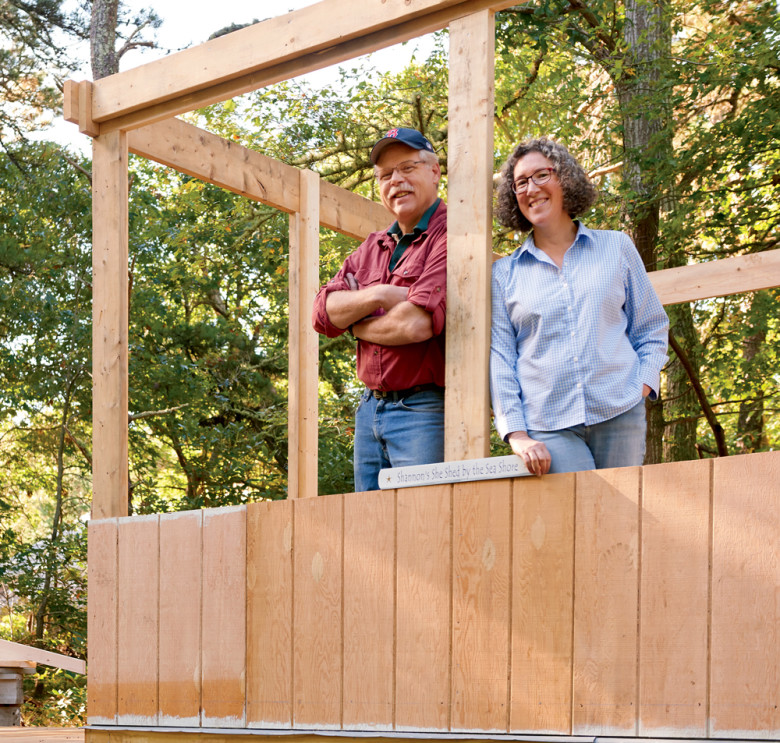
Shannon Goheen’s birthday greeting from her husband, Tom Huettner, was an illustrated promise. Happy She-Shed by the Seashore, it read, beneath a sketch of two sheds he planned to build for her. Shannon, a landscape designer who co-owns Second Nature Garden Works with her husband, says they had been talking about an outdoor structure for a while. “I wanted a space of my own,” says Shannon, pointing out that Tom already has a couple of sheds for “his stuff” on their 1-acre wooded property in Dennis Port.
Shannon Goheen’s birthday greeting from her husband, Tom Huettner, was an illustrated promise. Happy She-Shed by the Seashore, it read, beneath a sketch of two sheds he planned to build for her.
Credit: Hornick/Rivlin
Shannon Goheen’s birthday greeting from her husband, Tom Huettner, was an illustrated promise. Happy She-Shed by the Seashore, it read, beneath a sketch of two sheds he planned to build for her. Credit: Hornick/Rivlin
“I love the night,” says Shannon, whose online persona, the Evening Gown Gardener, dons vintage formal wear to dispense planting and growing advice under the cover of darkness. “I love to work at night, and garden at night, and just be outdoors at night. But my backyard is too buggy. I wanted a place where I could be outdoors—but also feel protected.” The answer? A sophisticated screen room, where Shannon plans to sit, think, and listen, especially at night. But what about space for Shannon’s plant tapestries—beautiful framed weavings using natural materials like seaweed, wheat, and eelgrass—or those large-scale garden designs? Walk across the wooden deck to enter her 10-by-12-foot work shed.
This two-shed labor of love is also a lesson in thrift and reuse. The steps to the central deck were recycled from a client who upgraded to stone, and a large bundle of remnant boards from Mid-Cape Home Center ($100) will provide most of the framing. Shannon and Tom found French doors at the Habitat for Humanity ReStore, where they are also hunting windows. “I feel incredibly fortunate to be the recipient of not one shed but two,” says Shannon. “I can’t wait to see them!”
The Social ShedBrewster
When Stephaine Meads began dreaming of her she-shed, she wasn’t seeking solitude. “I love to entertain,” she tells me, as we cross a smooth stone expanse that hugs an elegantly curved swimming pool. Her bulldog, Lulu, tags along. Stephaine nods in the direction of another bulldog, this one cast in cement and standing guard at the edge of the pool. “That’s Lulu II.”
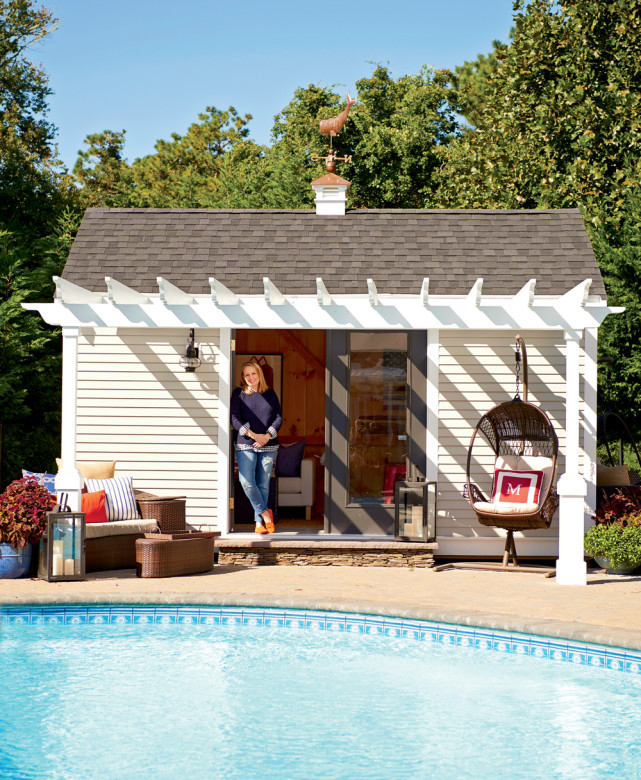
It would be easy to be distracted by this lovely outdoor living space, but ahead the gray clapboard shed beckons. Today the copper whale atop the custom cupola is unmoving, and the French doors beneath the attached pergola are closed, conserving the cool air inside. The family business is heating and cooling, and Stephaine’s 12-by-14-foot poolside retreat is climate-controlled.
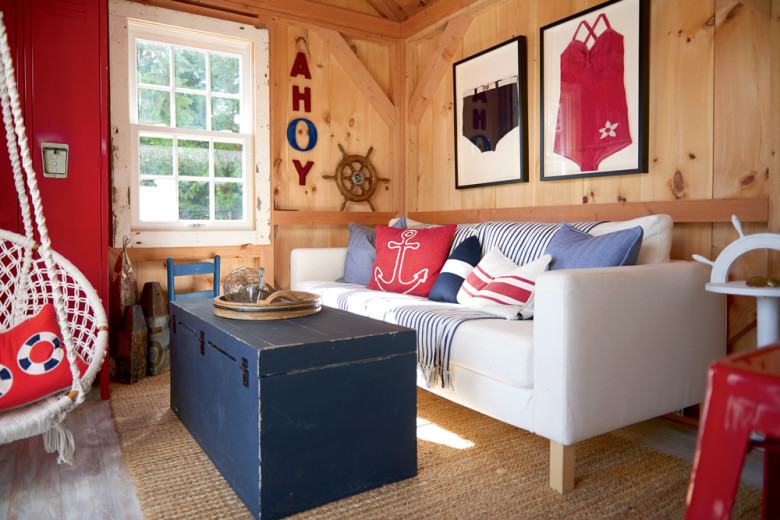
The inside of Stephaine Meads’s she-shed.
Credit: Hornick/Rivlin
The inside of Stephaine Meads’s she-shed. Credit: Hornick/Rivlin
That’s not the only creature comfort. Inside Stephaine’s she-shed you’ll find a fully stocked bar, a comfy couch, and a wall-mounted TV that connects to Netflix. But make no mistake: This is not a man cave. The small, welcoming space has been painstakingly planned and assembled by a female decorating mastermind, a woman who thrills to the hunt of desired objects.
In her shed, Stephaine seeks to achieve what she describes as a “vintage nautical feel.” On one wall, “AHOY” is spelled out in a vertical arrangement, with a small ship’s wheel resting nearby. “Some things, like these letters—I saw them several years ago and bought them—I never had a place for in the house,” she says. Other decorative elements in the shed are more recent acquisitions, like the two vintage bathing suits that she found on Etsy and framed side-by-side on the wall behind the couch.
Thinking of my own cottage, I feel a kinship to this woman who scours flea markets, antiques shops, and websites in search of what she needs to transform vision into reality. I’m betting that when Stephaine gathers girlfriends in her shed, they want to stay awhile to learn the story of the resonant iron bell (a replica of the last-call bell in a Provincetown bar, and a gift to her husband from his mother) or the porthole window (discovered at one of Stephaine’s favorite haunts, Buddha & Beads). “I love a treasure—something with a story, or with character,” she says. Stephaine is talking about her favorite finds, but it seems to me she could just as easily be describing her very
own she-shed.
In her Brewster backyard, Stephaine Meads has created a she-shed that’s meant to be shared. The inviting retreat is outfitted with modern conveniences (streaming TV, climate control) as well as comfortable and eclectic furnishings.
Credit: Hornick/Rivlin
In her Brewster backyard, Stephaine Meads has created a she-shed that’s meant to be shared. The inviting retreat is outfitted with modern conveniences (streaming TV, climate control) as well as comfortable and eclectic furnishings. Credit: Hornick/Rivlin
She-Sources
“A few years ago we built a lot of man caves,” says Lynne McGrath of Pine Harbor Wood Products in Harwich, Massachusetts. “They were all about electronics: wide-screen TV, big speakers. The she-shed is more of a quiet getaway.” But whether a small building is destined to be a he-shed, she-shed, their-shed, or stuff-shed, Lynne has noticed that “whenever a couple comes in looking to build a shed, the woman is the driving force as to design, style, and use.”
Lynne operates Pine Harbor with her husband, Jamie, whose father started the business back in the 1970s. Today, Pine Harbor offers sheds in a range of sizes and styles (Stephaine Meads’s and Linda Colgan’s sheds are both customized Pine Harbor buildings). “We cut all the lumber here and then build on-site,” Lynne says. “A basic shed can be installed in a day.” Through a partnership with Walpole Outdoors, Pine Harbor offers delivery and installation across New England.
Here’s a sampling of other New England companies offering standard and customizable small buildings and ready-to-build shed kits:
New England Outdoor Sheds & GazebosMethuen, MA. 978-705-6480; neoutdoor.com
Pine Harbor Wood ProductsHarwich, MA. 800-368-7433; pineharbor.com
Reeds Ferry ShedsHudson, NH. 888-857-4337; reedsferry.com
Do you know a house with an irresistible story? Contact Yankee home and garden editor Annie Graves, with photos, at annieg5355@yahoo.com.
‘Old Gray Ancients’ | Open Studio
The venerable barns of Connecticut come alive in Stephen Ray’s vibrant artwork.
by Annie Graves
Stephen Ray is a man with 45 barns, give or take.
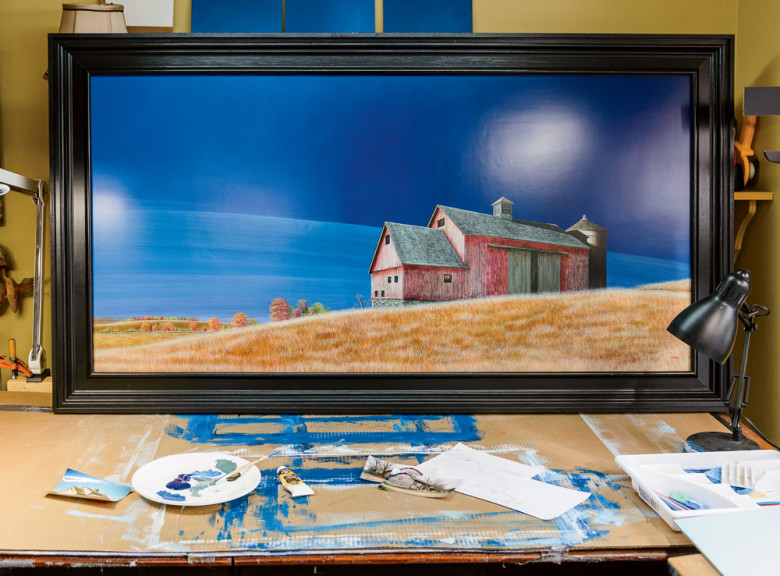
And each morning as he sits down to paint, Ray works to bring forth, from tubes of acrylic, another one of the “old gray ancients,” as he calls the spare, iconic barns that shimmer under his brushes. With an estimated 10,000 barns in Connecticut alone, he’ll never run out of subjects; however, “I tend to concentrate on the northeast and northwest corners of the state, where they’re most plentiful,” he says. Worn and dusky, melancholy but dignified, they stand like sentries on the hillsides, looking over the land. “Sky, grass, barn—that’s what I paint,” he says, with a smile.
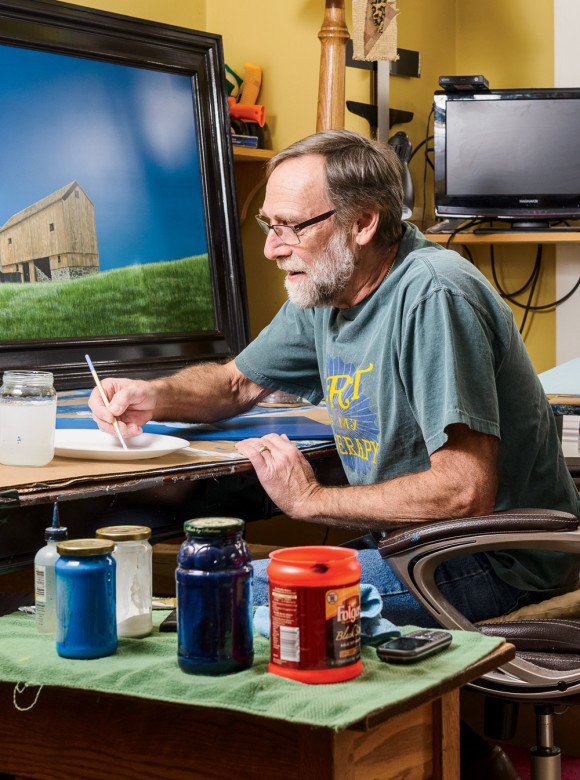
Stephen Ray jokes that his affinity for barns comes partly from a belief that “when I was born I went home with the wrong parents—city folks—instead of my farm family.”
Credit: Mark Fleming
Stephen Ray jokes that his affinity for barns comes partly from a belief that “when I was born I went home with the wrong parents—city folks—instead of my farm family.” Credit: Mark Fleming
Like the orderly world within the barn of a conscientious farmer, Ray’s studio, just off the kitchen of his Waterbury, Connecticut, home, is a study in practical organization. Today, the large draft table he works on is almost bare except for a few Masonite panels painted a deep shade of blue—the kind of blue that makes you want to go outside, lie down beneath it, and listen to tall field grass blowing. “New England sky is the most incredible blue sky you’ll ever see,” Ray says.
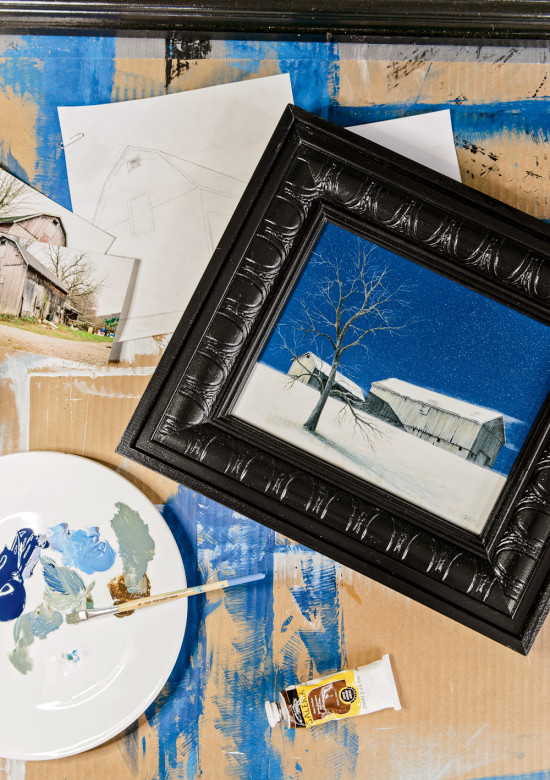
Sky this blue doesn’t come easy. Ray builds layers and layers of color, but quickly, as acrylic paint dries fast. Four, five coats go on, and by the time he’s finished you can’t see a single brushstroke—the surface is smooth as glass, just waiting for the next barn. Ray chooses his model from a stack of photos he’s snapped from miles of travel, then does a pencil sketch. A sheet of white carbon paper behind the drawing allows him to trace the outline directly onto the Masonite. “People used to ask me, ‘Why no trees?’” Ray says. “I didn’t know how to paint trees in the beginning!”
Behind Ray’s main work area, a standing easel holds the occasional painting he feels like tackling vertically. The gentle warbling of four tiny finches accompanies quiet classical music—Vivaldi, Mozart—or public radio. Beside the birdcages, a door opens to a deck overlooking the small suburban backyard dotted with bird feeders.
Stephen Ray in his studio.
Credit: Mark Fleming
Stephen Ray in his studio. Credit: Mark Fleming
“Birds are definitely my thing,” Ray says. “It’s a nice soft sound in the background when I work.” On cue, from the living room, comes the insistent cooing of Jolie, a white dove that marked Ray’s wedding to his wife, JoAnn, in 2004. The sweet, mournful sound conjures an old-time farmhouse feel. “When Steve comes home, she won’t stop,” says JoAnn. “She’s addicted to him.”
And here is another barn echo: rows of multicolored show ribbons strung over the north-facing studio window, but representing art shows, not livestock competitions. Off to the side of Ray’s work desk, massive crates are stacked along the wall, evidence of the latest exhibit, a wildly successful show in Atlanta.
But before he painted barns, Ray built stairways, lots of them. A skilled woodworker, he spent decades in the building industry, first installing kitchen cabinets, then stairs, all over the state. How did he make the leap from carpenter to fine artist?
Ray points to a crucial influence when he was 8 or 9, growing up in Monroe, Connecticut: his family’s proximity to and friendship with artist Gary Barsumian, who also painted barns. At 18, Ray reconnected with the Barsumians and saw how Gary’s work had changed. “I was blown away by it—so clean, crisp, just the feeling it had,” he recalls. “I thought, Someday I’m going to paint like him.”
So here and there, as years went by, Ray picked up a paintbrush, and once or twice got semiserious. Whenever he did, he painted barns. “It was the feeling they had, of solitude,” he says. “I had that feeling all my life. I’d struggled with addiction until I got sober in 1999. I could understand them—out in the field, getting no upkeep, taking the weather, not falling down. And that’s how I felt. That I was going to take life, and not fall down. And as a woodworker, I respected how they were built.”
But in 2008, the market crashed. Construction dried up, and, at 53, Ray was laid off. At that point, JoAnn told him, “You always wanted to be an artist. This is it. It’s time to paint.”
During the winter, Ray usually paints six days a week here in his home studio, but when it’s time to hit the road for the art shows, he moves operations to a 20-foot trailer he tows behind his van.
Credit: Mark Fleming
During the winter, Ray usually paints six days a week here in his home studio, but when it’s time to hit the road for the art shows, he moves operations to a 20-foot trailer he tows behind his van. Credit: Mark Fleming
“I drew and painted every day that year,” he remembers. “I was really enthusiastic, but it was scary, too. We had bills and a mortgage. But my work was to teach myself to mix, draw, and paint. And at the end of the year I had a dozen really crummy paintings, but one or two that were pretty good.”
The next year, Ray started doing shows. The first was a homecoming of sorts, in Monroe. “Since then, it’s been my full-time job,” he says, the wonder still surfacing in his voice. But there’s confidence, too, when he speaks of his work. “My colors have gotten brighter. There’s a panoramic look to my paintings. And something else—I don’t know why some of them work, but there’s an internal light, and I don’t know how I do it.”
He points to the painting of an “old gray ancient” in Cheshire, a barn that’s no longer there, being rebuilt somewhere else. This one has that light. “I chase it in every painting.”
Prices range from $400 for an 8″x10″ painting to $6,500 for a 30″x60″. For more information, call 203-565-6315 or go to barnsbystephenray.com.
The Most Famous House in New Hampshire | House for Sale
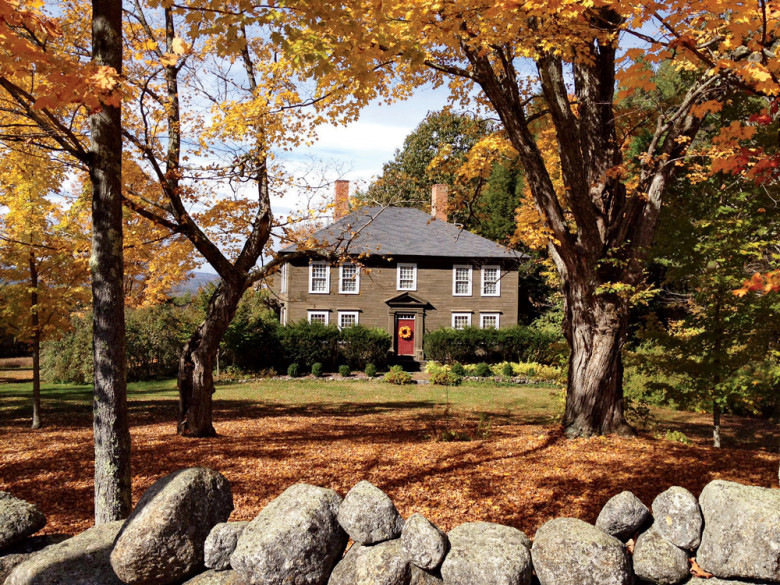
It’s a spectacular 1784 Georgian built house for sale on 141 stunning acres in Henniker, NH—but that’s not why it’s so well known.
Maybe you New England historians have already identified it from the photograph herewith. Yes, we’re writing about the famous Ocean-Born Mary House in Henniker. Our files here at Yankee are full of magazine and newspaper stories about the Ocean-Born Mary House. We’ve even done a few ourselves, in 1972 and again in 1996. But when we learned it was for sale this spring (asking $1 million)—the house now fully restored, with those 141 gorgeous acres, a four-car garage, a carriage house, and a sugar shack, plus a rather new screened-in porch with spectacular views across the valley through which the Contoocook River flows—well, we couldn’t resist bringing you the Ocean-Born Mary House once more.
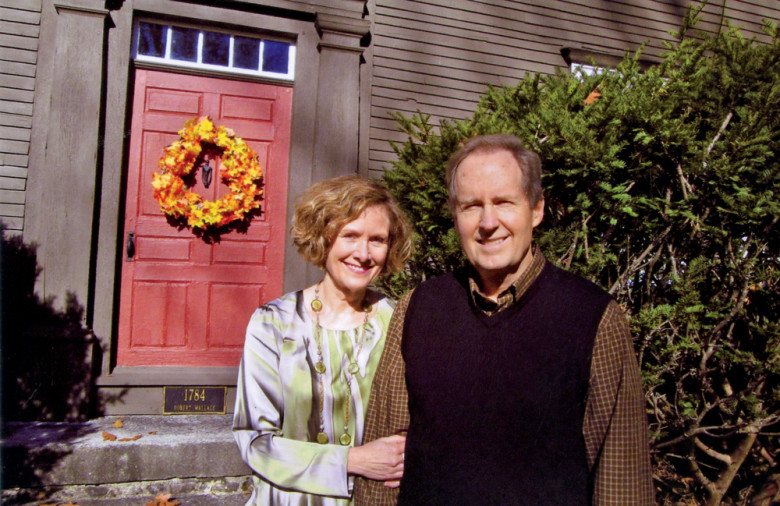
Terry and Bob Stamps in front of the Ocean-Born Mary House, which first appeared in this column 45 years ago. The owner’s stated asking price then? “Somewhere in the vicinity of $100,000.”
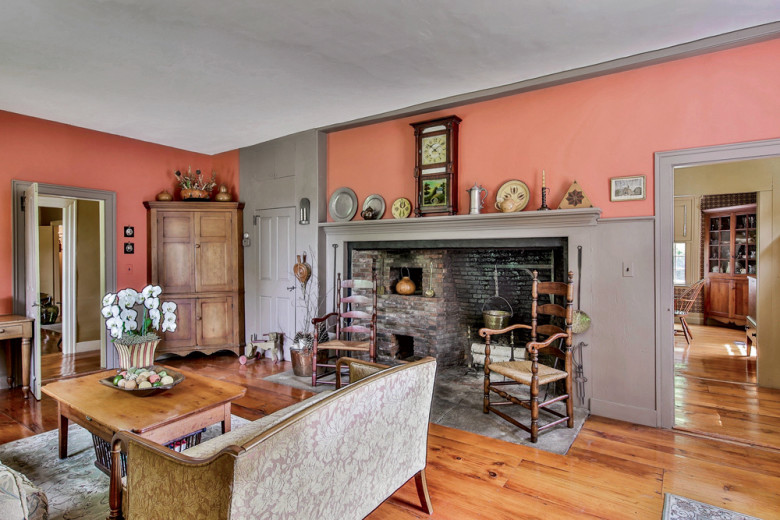
So a couple of months ago we drove over to Henniker and visited with the current owners, Terry and Bob Stamps. Bob is originally from Nashville, Terry from San Francisco, but they had always yearned to live in an authentically old house in New England. When they both retired from many years at Hewlett-Packard in California, they began house-hunting trips, and in 2000 they found the Ocean-Born Mary House. “We knew this was what we were looking for the minute we walked in the door,” said Bob, as we settled into the family room in front of one of the biggest brick fireplaces we’ve ever seen (and there’s another, just as gigantic, in the adjoining room!). The restoration and renovation work they’ve done in the years since (including a brand-new “period” kitchen and a brand-new master bedroom suite, which has one of the house’s six fireplaces) is all listed, one thing after another, on three sheets of paper Bob gave us—single-spaced.
“The previous owners did much of the heavy lifting,” Bob said modestly, referring to Bob and Mary Gregg, who’d purchased the place in 1972 (after seeing our article) and raised their four children here. In other words, due to the work done by the Greggs and particularly the Stamps, every inch of the Ocean-Born Mary House today is in pristine condition. So why are the Stamps selling? Well, because with advancing age they’d like to be where the winters are a little milder. We can understand.
Of course, during our chat with Bob and Terry that morning, we had to clarify why the Ocean-Born Mary House is so famous. No, it’s not because it’s more than 230 years old. And no, it’s not because it’s said to have been visited by the likes of General Lafayette, Daniel Webster, and President Franklin Pierce. Rather, it’s because of two legends: one mostly true and one, unfortunately, not. So for those of you unfamiliar with either tale, here goes…
The mostly true legend: On July 28, 1720, the Wolf, on its way from England to Boston, was captured by a pirate by the name of Don Pedro (though some say that was not his real name). Among the passengers were James Wilson and his wife, Elizabeth, who had just given birth on the ship to a baby girl. When Don Pedro heard the baby cry, his pirate heart melted. He said that if the Wilsons named the baby Mary, after his mother, he would spare everyone and allow the ship to proceed. He even gave the Wilsons enough silk for a dress Mary could wear at her wedding. (On our recent tour of the house, we were fascinated to see a framed piece of that silk hanging on a wall in the den.)
Originally sited on 6,000 acres, the house has retained 140-plus acres of its quiet country setting.
Credit: Courtesy of Ruedig Realty
Originally sited on 6,000 acres, the house has retained 140-plus acres of its quiet country setting. Credit: Courtesy of Ruedig Realty
Skip ahead to 1742, when the grown-up Mary, now living in Londonderry, where the Wilsons had settled, married James Wallace in a dress that some say was made from the pirate’s silk. They proceeded to have five children, one of whom, Robert, would go on to build what became known as the Ocean-Born Mary House in nearby Henniker, in 1784. Oddly enough, while Robert and his family lived there for years, Mary never did: After her husband died, she lived about a mile away with another of her sons.
Now, the legend that’s not true: The pirate, Don Pedro, actually built the house after retiring from the sea, eventually inviting Mary to live there too. Moreover, this version of the story says that Don Pedro buried treasure somewhere on the grounds and that he himself lies buried beneath one of the 3-ton hearthstones in front of those gigantic fireplaces. All of these fabrications were begun and promoted by a Mrs. Flora Roy, the house’s owner from the 1930s to the 1950s. She apparently enjoyed the attention her tale engendered; we’d bet that it also contributed significantly to the property’s fame.
The family room’s oversize hearth is among six fireplaces in all.
Credit: Courtesy of Ruedig Realty
The family room’s oversize hearth is among six fireplaces in all. Credit: Courtesy of Ruedig Realty
—
So there you have it: our third Ocean-Born Mary House story in 45 years. Maybe someone who appreciates its historical authenticity and beauty will take over for Terry and Bob Stamps this summer. Then perhaps in 20 or 30 years it’ll become available once again … in which case we’d hope to mosey on over to Henniker for the fourth time.
For more information, contact Barbara Ruedig at Ruedig Realty, 603-228-1947 or barbara@ruedigrealty.com.
Grilling 101 with Andy Husbands
Jump into cookout season with a live-fire grilling tutorial from a Boston pitmaster par excellence.
by Amy Traverso
Let’s start with the basics:
Grilling and barbecuing are not the same. In casual conversation, this distinction doesn’t matter much. “We’re having a barbecue!” is a fine way to describe your burgers-and-dogs cookout. But if you’re talking about technique—and this story is all about the essentials of live-fire cooking—the definitions matter.
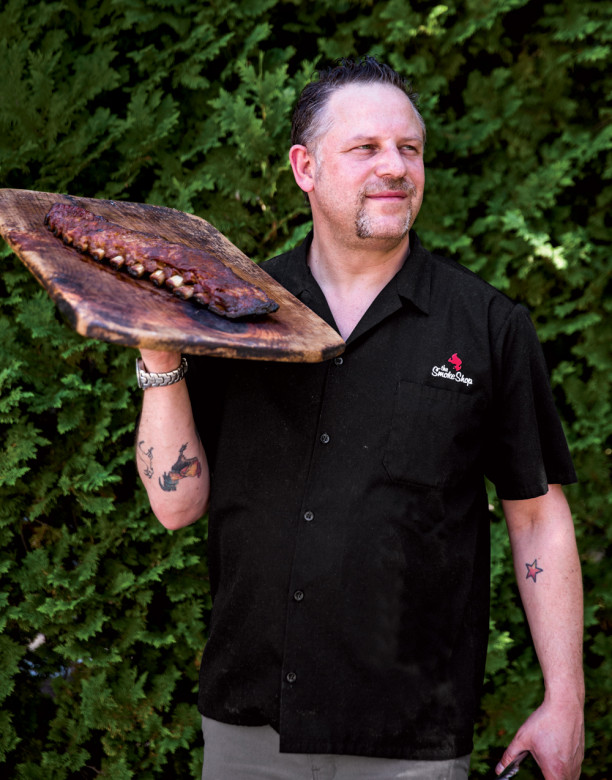
Boston restaurateur and world champion barbecue pro Andy Husbands hefts a slab of ribs with tangy maple basting sauce.
Credit: Keller + Keller
Boston restaurateur and world champion barbecue pro Andy Husbands hefts a slab of ribs with tangy maple basting sauce. Credit: Keller + Keller
Grilling is a way of cooking smaller cuts of meat such as burgers and chicken thighs (or vegetables or fruit or pizzas) quickly and directly over high heat. Barbecue is a “low and slow” approach for larger cuts such as pork shoulder, brisket, and ribs. To barbecue is to turn tough cuts tender through long applications of time and heat, breaking down connective tissue, rendering fat. Grilling is a way of cooking already-tender foods while searing the outside to crispy browned deliciousness.
Grilling is about making dinner. Barbecue is a labor of love.
Andy Husbands knows both the obsessive love and the day-to-day craft of grilling and barbecue. He earned his stripes in the early 1990s cooking over live fire in the kitchen of East Coast Grill, Chris Schlesinger’s groundbreaking restaurant in Cambridge, Massachusetts. Later he opened Tremont 647 and Sister Sorel in Boston, and, most recently, the Smoke Shop in Cambridge’s Kendall Square. In 2007 his barbecue team, IQue, took first place out of 510 teams in the brisket category at the American Royal barbecue competition, and three years later IQue became the first New England team to win the Jack Daniel’s World Championship Invitational in Lynchburg, Tennessee. But Husbands is quick to credit his team leader, Chris Hart, saying that “his relentless practicing, research, and tenacity is the reason for our success.” Husbands shares some of his and Hart’s combined wisdom in a new cookbook, his fifth, called Pitmaster: Recipes, Techniques, and Barbecue Wisdom (Fair Winds Press, 2017).
Even without “relentless practicing,” you can still become a deft backyard cook by understanding the principles of live-fire cooking. For instance, cook smaller, thinner things for less time and at a higher heat than you would when cooking, say, a whole chicken. “Grilling is inherently about speed,” Husbands says. “Barbecue is about time. You can’t cook over high heat for more than two to three minutes per side or it’s going to burn. So that’s burgers, steaks, and boneless chicken thighs. By the time a bone-in chicken thigh center would cook through on high heat, it’ll be burned on the outside.”
Credit: Keller + Keller
We asked Husbands to demonstrate these basic principles as he prepared home cook–friendly recipes for meat and vegetable dishes, each chosen to illustrate a different technique. But there’s one line on which he holds firm: the benefits of charcoal grilling over gas. “Everybody wants to make really good food, which is fantastic,” he says. “And here they have this opportunity to use live fire and develop really great flavors, and they use a gas grill because it’s easier. But grilling over charcoal brings your food from good to great.” Why? “Charcoal burns hotter than propane,” he says. “With both grilling and barbecue, you’re caramelizing the amino acids in your meat, and that happens better and faster with charcoal or hardwood.” Not to mention it lends the flavor of that particular kind of smoke.
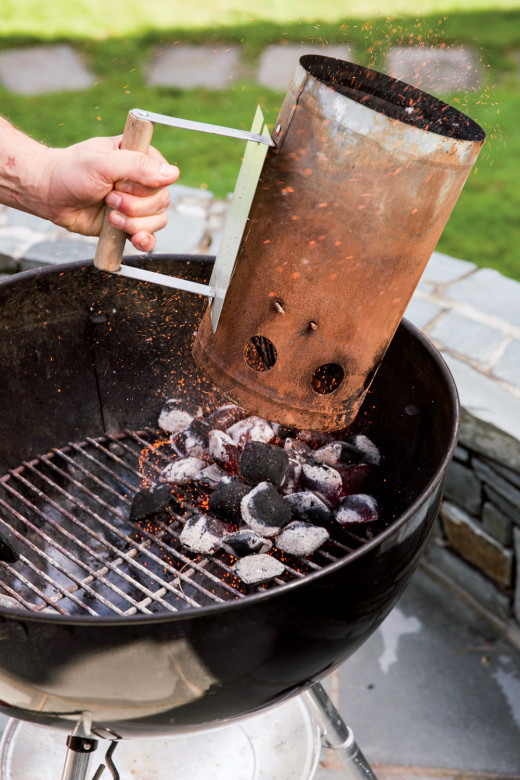
And it doesn’t have to be difficult, Husbands says. “Once a week, I go out and clean my grill. If you have a chimney to light the coals, which is the best way, you’re talking about 10 minutes. [Ed. note: In our experience, it’s closer to 15 to 20 minutes.] And honestly, if you’re going to heat a gas grill, that’s going to take five to 10 minutes. Plus, you need time to prep your ingredients. It’s OK to have a drink and relax for a second.”
Still, we can’t deny the appeal of being able to cook with the turn of a knob, so we’ve provided specific instructions for both gas and charcoal for each of the following recipes. Review “Setting Up the Grill | Charcoal Grilling Tips” before starting to ensure you’ve got the perfect grilling temperature.
How one Vermont hamlet saved the heart of its community—and got the world’s best pancakes in the bargain.
by Amy Traverso
This is the story of a small Vermont town that lost its general store—its primary marketplace and social heartbeat for 180 years—and how determined citizens came together to bring it back. Lest you find yourself immune to Capra-esque tales of underdog pluck, it’s also the story of a crumb coffee cake that would put any New York deli to shame. And the pancakes! But let’s not get ahead of ourselves.
Childhood sweethearts who first came to Vermont for college, Jillian Bradley and Joe Minerva bring
a combined two decades’ worth of grocery experience to running the Barnard General Store.
Credit: Mark Fleming
Childhood sweethearts who first came to Vermont for college, Jillian Bradley and Joe Minerva bring a combined two decades’ worth of grocery experience to running the Barnard General Store. Credit: Mark Fleming
Back in 2012, after nearly two centuries of operation, the Barnard General Store did the unthinkable and closed down. The small town north of Woodstock, population 947, was left reeling. Longtime operators Carolyn DiCicco and Kim Furlong had been hit hard by an anemic post-Irene foliage season followed by what came to be known as “the winter that wasn’t.” They had poured their lives into the venture, but in the end the numbers just didn’t work. And so went Barnard’s only local grocer, its community hub and ice cream counter, a fueling stop for snowmobilers on the Corridor 12A trail, and a core piece of its identity.
Numbers were crunched, and a remedy was proposed: If a newly formed nonprofit, the Barnard Community Trust (BCT), in partnership with the Preservation Trust of Vermont, could raise half a million dollars, the store’s landlord would be willing to sell the building at a loss. People donated what they could, some larger donors pulled through, and within a year the BCT owned the building, ready to lease it out to new operators.
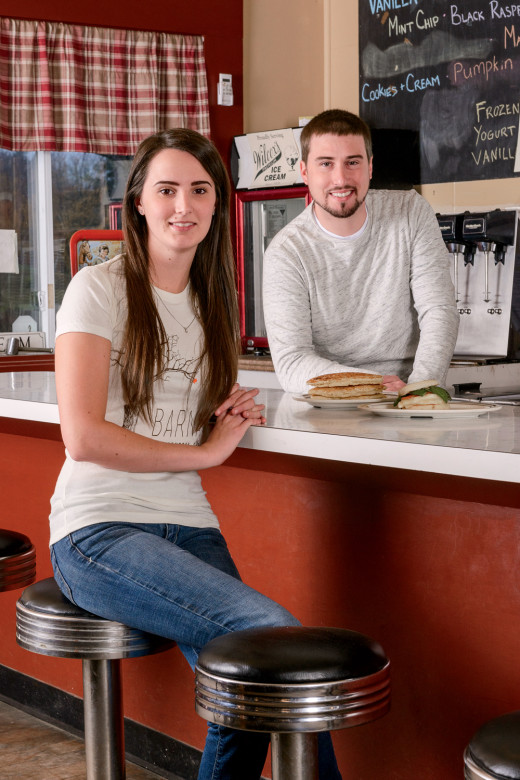
Enter Joe Minerva and Jillian Bradley, fresh-faced 20-somethings already schooled in the small-town grocery business from stints at the local market in Richmond, near Burlington. Residents were thrilled to have their store back. And then Bradley revealed her secret superpower: In addition to the fact that she and Minerva were willing to work 80-hour weeks, she’s a legitimately gifted cook. In her hands, staples like BLTs and home fries sing with zingy extras like sriracha mayo and sharp cheddar. The crumb coffee cake (her grandmother’s recipe) is as tender as cotton candy, with a thick streusel topping perfumed with cinnamon and—what’s that flavor?—love. On weekends there are buttermilk pancakes, served plain or with chocolate chips or blueberries or pumpkin-chai spice. Pancakes may not be a complicated endeavor, but Bradley has mastered the perfect ratio of leavening, buttermilk, and butter, so they reach ideal richness and height without a hint of bitterness.
Bradley’s famed pancakes, topped with—what else?—Vermont maple syrup.
Credit: Mark Fleming
Bradley’s famed pancakes, topped with—what else?—Vermont maple syrup. Credit: Mark Fleming
Now the store is chugging along, riding the rhythms of slow and busy seasons. Bradley and Minerva have trained a solid staff, which allows them to take the day off now and then. Summer people vacationing on Silver Lake, just across the street, boost the ice-cream-and-grocery business. On hot days, children with hair still damp from swimming line up at the window next to the soda fountain for a scoop of cookies-and-cream. Tourists pop in for a bottle of maple syrup with a side of rural authenticity; locals get quinoa, canned corned beef hash, and prepared meals of elevated comfort fare (as in apple-stuffed pork chops or coconut-pecan twice-baked sweet potatoes).
Bradley and Minerva say they’ll measure their progress in terms of decades. “Our number one goal wasn’t to make as much money as possible,” Minerva says, and gestures to the entrance of their store. “It was to make sure that door never
locks again.”
Barnard General Store. 6134 Rte. 12, Barnard, VT. 802-234-9688; friendsofbgs.com
Strawberry-Rhubarb Coffee Cake | New Vintage Cooking
Returning to the garden to remake a favorite family recipe, Strawberry-Rhubarb Coffee Cake.
by Amy Traverso
Plant a rhubarb patch in your garden, and witness nature’s capacity for second, third, and fourth acts. Winter hardy, drought resistant, and seemingly immune to the errant weed whacker, this humble vegetable-that-acts-like-a-fruit seems to bounce back from any affront. Yet for all its vigor, it cooks down to silken tenderness in pies, cobblers, and cakes.
Strawberry-Rhubarb Coffee Cake
Credit: Mark Fleming
This Strawberry-Rhubarb Coffee Cake recipe dates back nearly 40 years, to the kitchen of my grandmother Mary. The daughter of Lithuanian immigrants, she married a first-generation son from Emilia-Romagna and dutifully applied her kitchen talents to his heritage as much as hers. So it was her fried dough recipe—not my fully Italian nonni’s—that yielded the best frittelle on Saint Joseph’s Day.
But of all her standouts, there are two dishes I hold most dear, and the fact that they are both desserts probably says more about my predilections than it does her cooking. Her apple crisp, which we have published in these pages, remains my go-to dessert for fall dinner parties, for comfort, for a visceral memory of her. And then there’s her rhubarb bread, which is tender, sweet-tart, and moist (it’s made, midcentury-style, with vegetable oil instead of butter), with a crunchy sugar topping that always leaves me wanting more.
I still love that rhubarb recipe, but I longed to pretty up its brown-on-brown color palette and add more of that addictive topping. So I doubled the latter, and I added strawberries to both batter and topping for flavor and a pop of color. Switching the baking vessel from a loaf pan to a cake pan increased the surface area, making the results crunchier, not to mention prettier.
Cruising Lake Champlain in a houseboat is an adventure like no other.
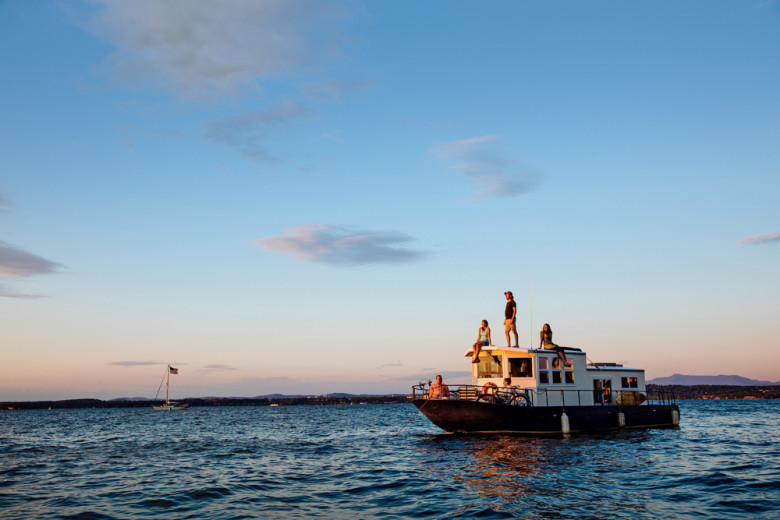
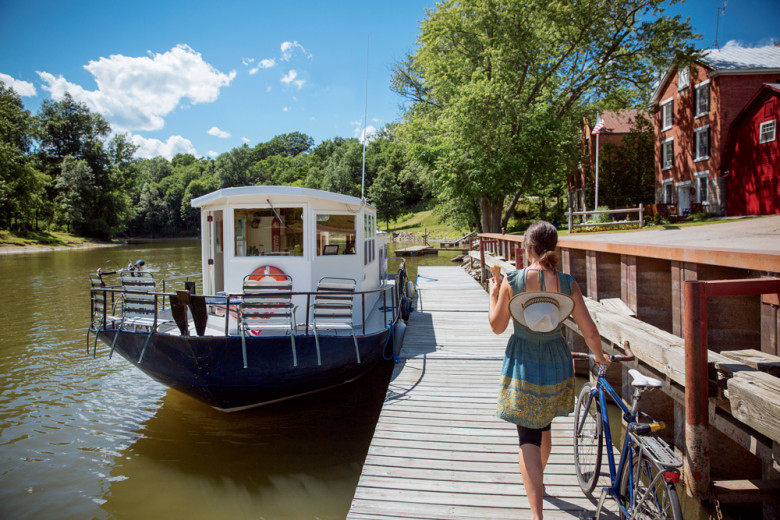
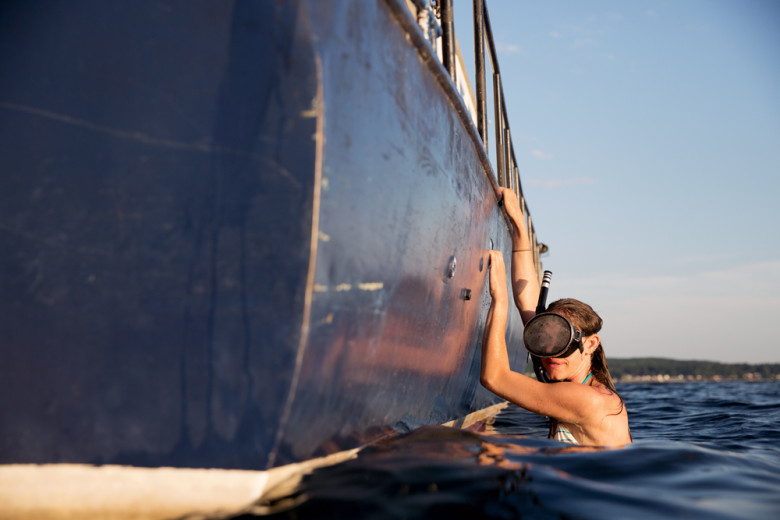
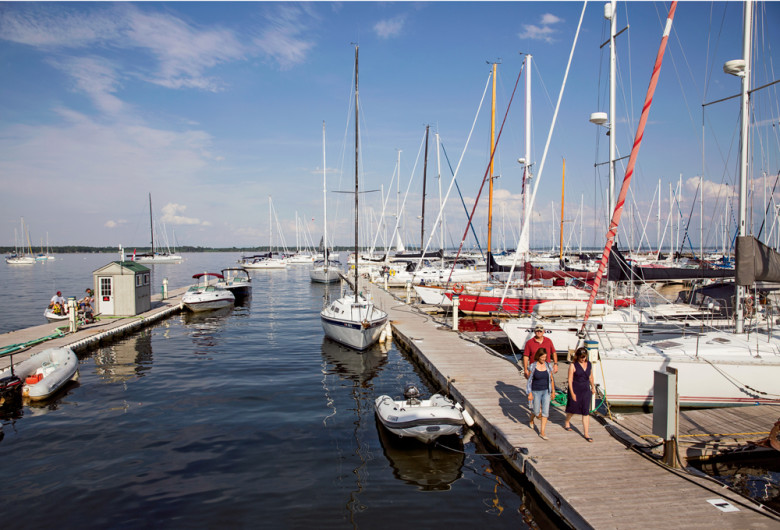
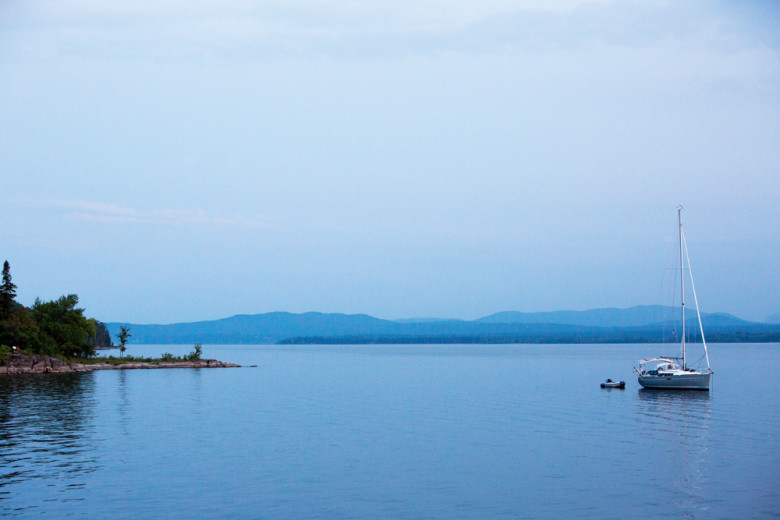
On an early Saturday morning last July, a houseboat left Chip Taube’s marina in Orwell, Vermont, near the southern end of 120-mile-long Lake Champlain, and began chugging its way north at 8 mph. Steering the boat—and decidedly “out of our comfort zone”—were Jarrod McCabe and Dominic Casserly, a pair of Massachusetts photographers known as Little Outdoor Giants. They, along with a few friends, had rented the floating home from Taube; it’s one of two he maintains for intrepid travelers. Previously for Yankee, Little Outdoor Giants had followed Thoreau’s wilderness paddle in Maine and hiked across New Hampshire’s Presidential Range. This time the plan was simple: to see what would happen during one summer week on a houseboat on New England’s biggest lake. At the end of each day, they wrote and drew in one of their signature leather-bound journals. It’s funny how on all trips I feel anxious that by the end of the trip I still haven’t relaxed, muses one of the entries. Here I find what I was looking for. All the adventure, the natural beauty, the opportunity for a one-of-a-kind New England vacation….
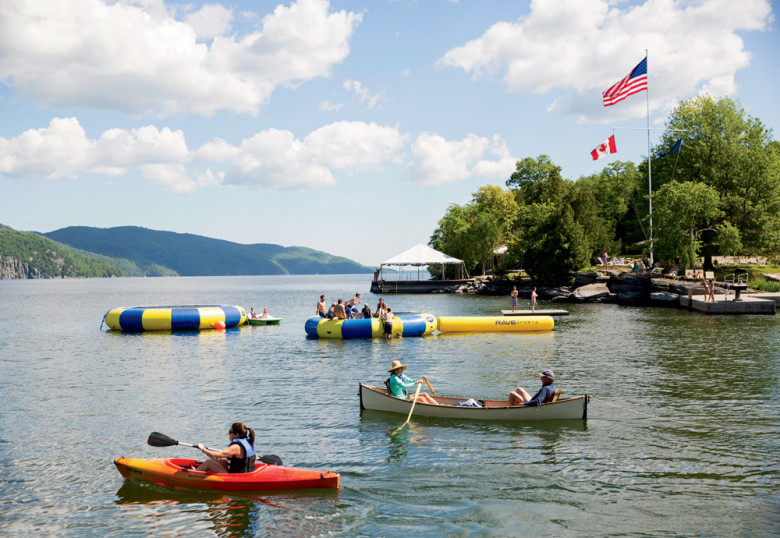
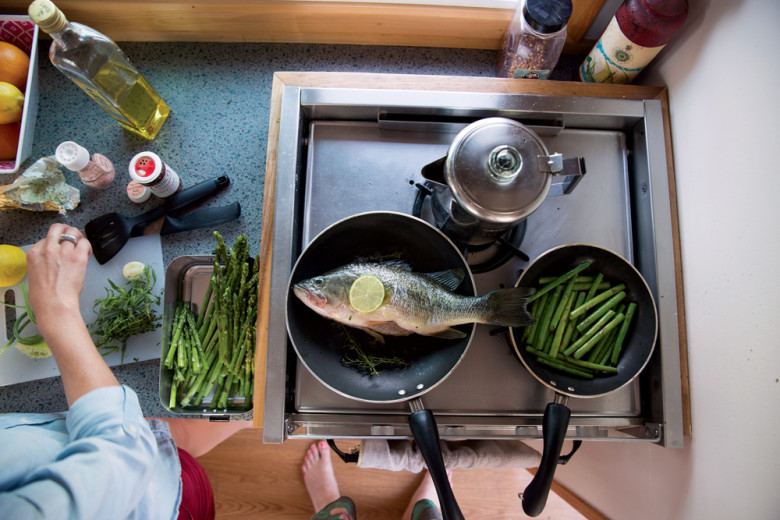
There were some tense moments during the trip—when winds made the waves crest as if at sea, and when throngs of pleasure boats required both patience and attentive steering—but the days proved largely carefree. The travelers learned to navigate coves and narrow streams, chatted with people from around the country, snorkeled, fished, ate well and often, lazed on beaches, walked and biked on shore (and, yes, swatted mosquitoes), and discovered that when you make a slow boat your home, it can take you places you never knew you could find. —Mel Allen
Little Outdoor Giants and friends aboard the 38-foot houseboat they floated from the southern end of Lake Champlain to its northern islands, exploring coves, lakeside villages, and local farms along the way. They began as boating
novices, but “when we got back we definitely had sea legs.”
Credit: Little Outdoor Giants
Little Outdoor Giants and friends aboard the 38-foot houseboat they floated from the southern end of Lake Champlain to its northern islands, exploring coves, lakeside villages, and local farms along the way. They began as boating novices, but “when we got back we definitely had sea legs.” Credit: Little Outdoor Giants
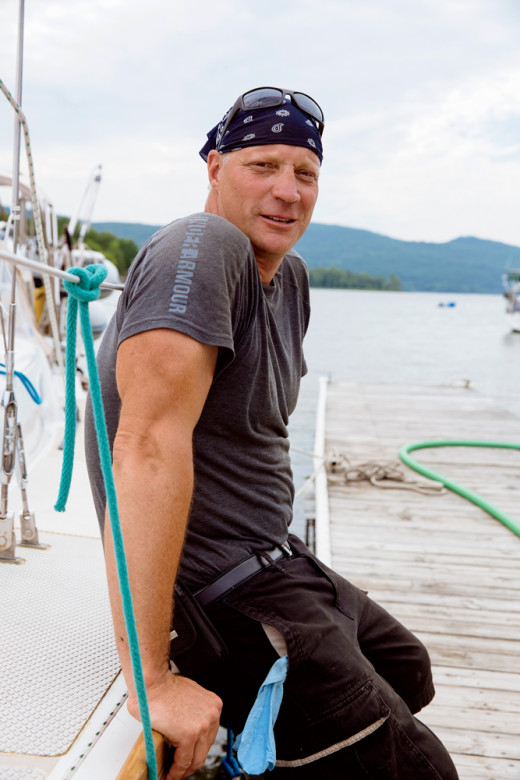
Chip Taube has rented houseboats for more than two decades from Chipman Point Marina in Orwell, Vermont. After an hour’s orientation with Little Outdoor Giants, “he pulled us out of the slip and into the small channel. He warned that the winds might make high seas, said ‘good luck,’ and sent us on our way!”
Credit: Little Outdoor Giants
Chip Taube has rented houseboats for more than two decades from Chipman Point Marina in Orwell, Vermont. After an hour’s orientation with Little Outdoor Giants, “he pulled us out of the slip and into the small channel. He warned that the winds might make high seas, said ‘good luck,’ and sent us on our way!” Credit: Little Outdoor Giants
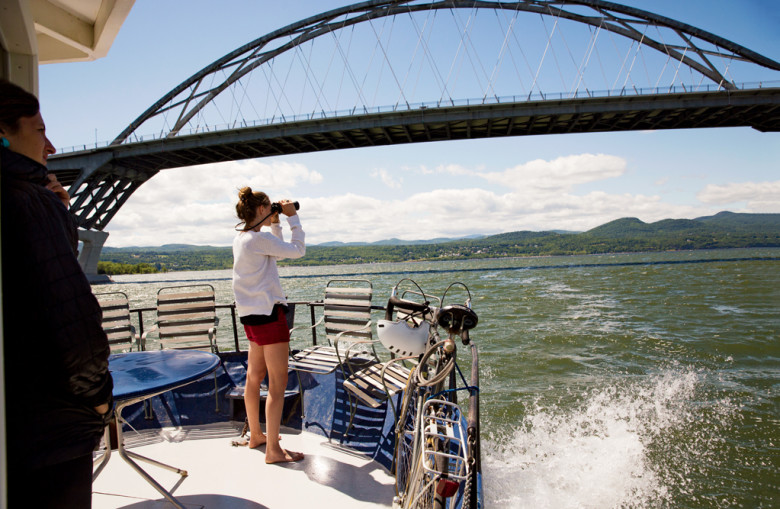
As the houseboat passed
beneath Lake Champlain Bridge, which connects Vermont to New York, Elizabeth Yon kept
an eye on watercraft sharing the narrow southern part of the lake.
Credit: Little Outdoor Giants
As the houseboat passed beneath Lake Champlain Bridge, which connects Vermont to New York, Elizabeth Yon kept an eye on watercraft sharing the narrow southern part of the lake. Credit: Little Outdoor Giants
The first day’s anchorage
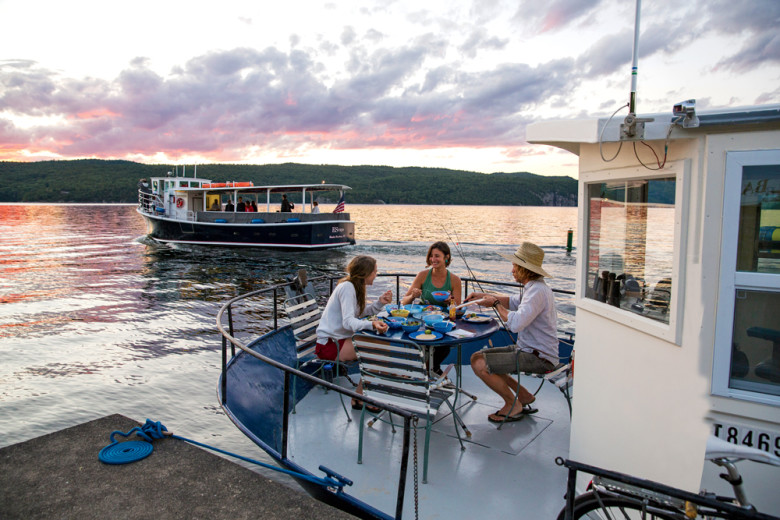
at the historic Basin Harbor Club, about 30 miles into the journey. “A killer spot,” according to that day’s journal entry.
Credit: Little Outdoor Giants
The first day’s anchorage at the historic Basin Harbor Club, about 30 miles into the journey. “A killer spot,” according to that day’s journal entry. Credit: Little Outdoor Giants
“Eating on the deck, watching the sun set over the green hills. Not a bad way to start a trip.”
Credit: Little Outdoor Giants
“Eating on the deck, watching the sun set over the green hills. Not a bad way to start a trip.” Credit: Little Outdoor Giants
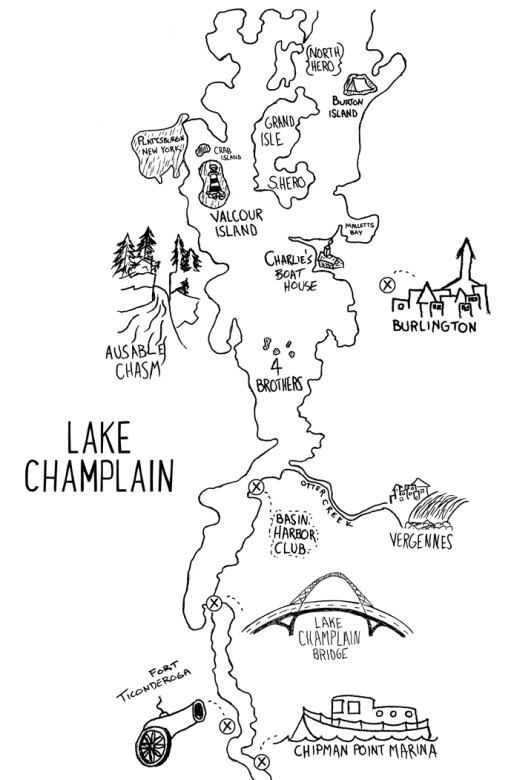
Map of Lake Champlain
Credit: Little Outdoor Giants
Map of Lake Champlain Credit: Little Outdoor Giants
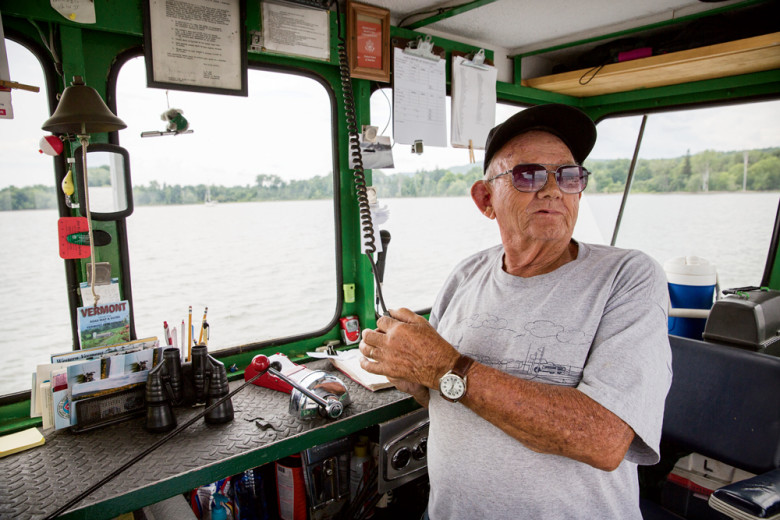
Jon Porter has been at the helm of the Fort Ticonderoga Ferry for 50 years, taking passengers on a seven-minute shuttle between Shoreham, Vermont, and the famous Revolutionary War battle site in Ticonderoga, New York.
Credit: Little Outdoor Giants
Jon Porter has been at the helm of the Fort Ticonderoga Ferry for 50 years, taking passengers on a seven-minute shuttle between Shoreham, Vermont, and the famous Revolutionary War battle site in Ticonderoga, New York. Credit: Little Outdoor Giants
After leaving Basin Harbor, the houseboat had entered Otter Creek to reach the center of Vergennes, docking here. “I felt like Samuel Clemens piloting a riverboat through a narrow and shallow river. It was nerve-racking but successful, as we came out in a lovely cove, with a short walk up to the main street and awaiting ice cream.”
Credit: Little Outdoor Giants
After leaving Basin Harbor, the houseboat had entered Otter Creek to reach the center of Vergennes, docking here. “I felt like Samuel Clemens piloting a riverboat through a narrow and shallow river. It was nerve-racking but successful, as we came out in a lovely cove, with a short walk up to the main street and awaiting ice cream.” Credit: Little Outdoor Giants
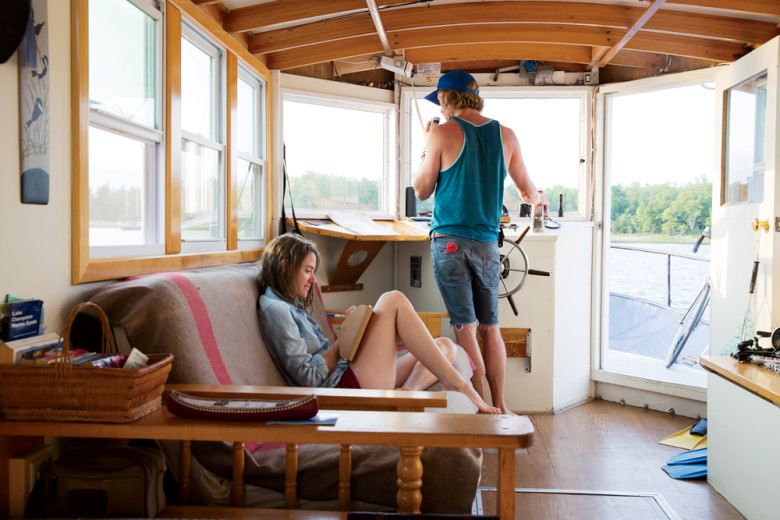
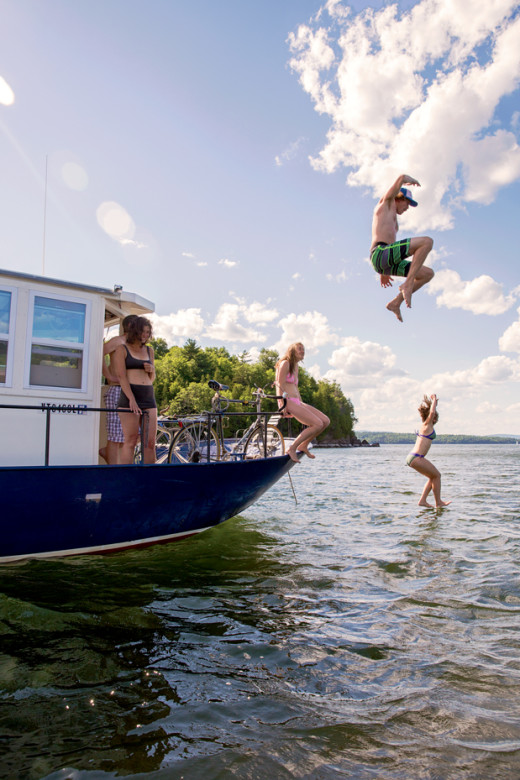
“Lake life is good. I haven’t checked the time in quite a while. The boat has the feeling like it belongs somewhere with cypress trees and Spanish moss. As we wind up our shenanigans at Kingsland Bay State Park (fishing, jumping off the boat, inner tube floating), the low summer sun is shining into the dining room window, and reflections off the water dance on the ceiling. The boat sways with swell. The New York mountains are silhouetted against a pale blue sky with a few lone clouds. The boat swings around the anchor, giving us varying views of 20-foot cliffs and the distant lake.”
Credit: Little Outdoor Giants
“Lake life is good. I haven’t checked the time in quite a while. The boat has the feeling like it belongs somewhere with cypress trees and Spanish moss. As we wind up our shenanigans at Kingsland Bay State Park (fishing, jumping off the boat, inner tube floating), the low summer sun is shining into the dining room window, and reflections off the water dance on the ceiling. The boat sways with swell. The New York mountains are silhouetted against a pale blue sky with a few lone clouds. The boat swings around the anchor, giving us varying views of 20-foot cliffs and the distant lake.” Credit: Little Outdoor Giants
Credit: Little Outdoor Giants
Houseboat Life Credit: Little Outdoor Giants
Credit: Little Outdoor Giants
Fun on Lake Champlain Credit: Little Outdoor Giants
“Our anchorage on the north side of Malletts Bay (where Elizabeth snorkeled in crystal waters at sunset) is a dream. We caught sunnies for dinner. Watched a movie we brought: Fool’s Gold. A terrible movie, unless you’re sitting on the bow of a boat anchored for a beautiful evening. Then it’s great.”
Credit: Little Outdoor Giants
“Our anchorage on the north side of Malletts Bay (where Elizabeth snorkeled in crystal waters at sunset) is a dream. We caught sunnies for dinner. Watched a movie we brought: Fool’s Gold. A terrible movie, unless you’re sitting on the bow of a boat anchored for a beautiful evening. Then it’s great.” Credit: Little Outdoor Giants
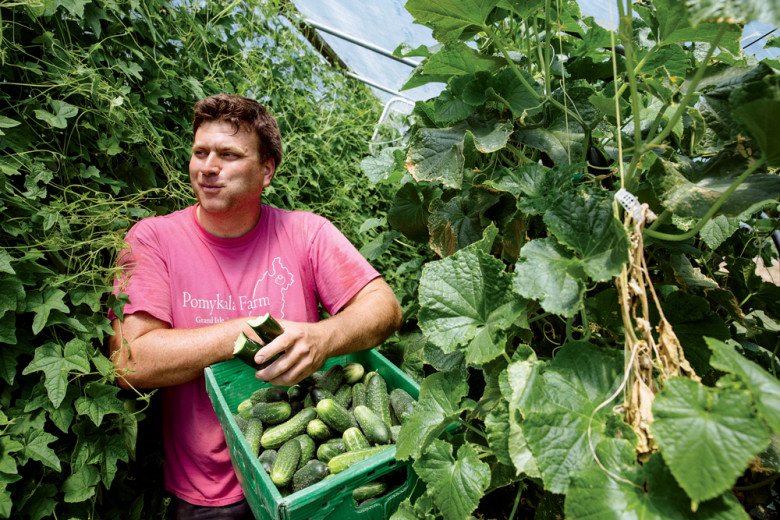
In North Hero the crew docked at Hero’s Welcome General Store, where they fortified themselves with doughnuts, then rode bikes to Pomykala Farm. There to greet them was Ben Pomykala, gathering cucumbers.
Credit: Little Outdoor Giants
In North Hero the crew docked at Hero’s Welcome General Store, where they fortified themselves with doughnuts, then rode bikes to Pomykala Farm. There to greet them was Ben Pomykala, gathering cucumbers. Credit: Little Outdoor Giants
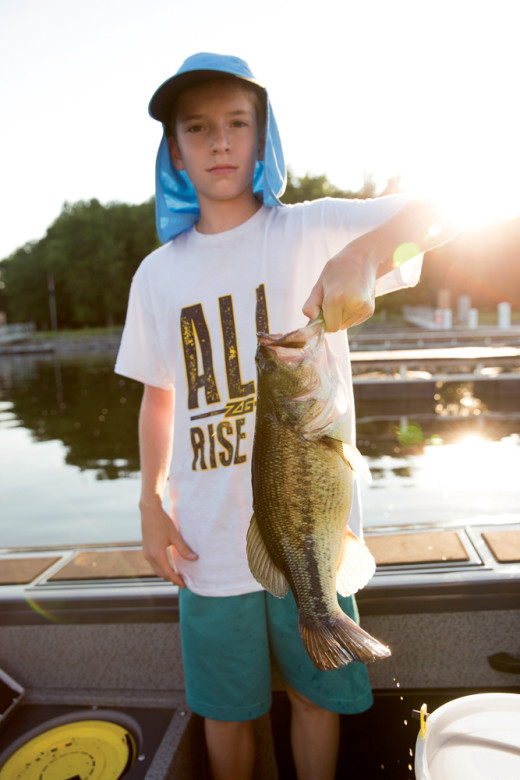
Back on the water and heading to Grand Isle, they approached the drawbridge in a section of the lake known as the Gut, where bass fishermen often have good luck casting their lines.
Credit: Little Outdoor Giants
Back on the water and heading to Grand Isle, they approached the drawbridge in a section of the lake known as the Gut, where bass fishermen often have good luck casting their lines. Credit: Little Outdoor Giants
Charlie’s Boathouse, owned by the Auer family and located on the Burlington Bike Path, was a memorable stop. “Charlie’s is on lake time. It was so dark inside— not a single light on. I ordered a cheeseburger, and Charlie’s sister, Christine (pictured), told me to ‘sit on the swing outside and enjoy the view.’ She told that to every person. Most things on the wall or on the shelves seem like they’ve been there for 50 years. There were vintage life jackets and bamboo fishing poles, and Charlie’s beagle looking for snacks. If Christine and Charlie aren’t around, just ring the bell that’s on the counter. She said it’s been there since her grandmother’s time.”
Credit: Little Outdoor Giants
Charlie’s Boathouse, owned by the Auer family and located on the Burlington Bike Path, was a memorable stop. “Charlie’s is on lake time. It was so dark inside— not a single light on. I ordered a cheeseburger, and Charlie’s sister, Christine (pictured), told me to ‘sit on the swing outside and enjoy the view.’ She told that to every person. Most things on the wall or on the shelves seem like they’ve been there for 50 years. There were vintage life jackets and bamboo fishing poles, and Charlie’s beagle looking for snacks. If Christine and Charlie aren’t around, just ring the bell that’s on the counter. She said it’s been there since her grandmother’s time.” Credit: Little Outdoor Giants
Summer sailors crowd the slips and moorings at Plattsburgh Boat Basin, where the houseboat crew came ashore and set off for a day of tubing at Ausable Chasm.
Credit: Little Outdoor Giants
Summer sailors crowd the slips and moorings at Plattsburgh Boat Basin, where the houseboat crew came ashore and set off for a day of tubing at Ausable Chasm. Credit: Little Outdoor Giants
After North Hero it was time to seek out some of the smaller islands of Lake Champlain. Off the tip of St. Albans Point, Burton Island State Park beckoned—and proved to be a great spot for a quick dip.
Credit: Little Outdoor Giants
After North Hero it was time to seek out some of the smaller islands of Lake Champlain. Off the tip of St. Albans Point, Burton Island State Park beckoned—and proved to be a great spot for a quick dip. Credit: Little Outdoor Giants
“The cruise to Burton Island was magical. The weather has been insanely good. I fished the docks with the local gang of kids. Peter Jolley (pictured) reeled in a whopper of a bass on a rubber worm. We loved the seclusion we found on the island.”
Credit: Little Outdoor Giants
“The cruise to Burton Island was magical. The weather has been insanely good. I fished the docks with the local gang of kids. Peter Jolley (pictured) reeled in a whopper of a bass on a rubber worm. We loved the seclusion we found on the island.” Credit: Little Outdoor Giants
“How have we never heard of nor visited Ausable Chasm?! Our boat adventure has been filled with all sorts of amazing swims, but this was on another level!
We docked on the New York side, in Plattsburgh, then took a taxi to Port Kent. The chasm does not disappoint. We walked on paths, boardwalks, and trails carved into the rock, 100 feet above the water. The canyon winds and bends on the hike toward the float launch. We floated, relaxing, swimming, and cooling our way through a twisty-turning natural wonder. On a hot summer day, floating down a lazy river, smelling the pine forest, and having a cheeseburger at the snack shop at the end—
can’t get better than that.”
Credit: Little Outdoor Giants
“How have we never heard of nor visited Ausable Chasm?! Our boat adventure has been filled with all sorts of amazing swims, but this was on another level! We docked on the New York side, in Plattsburgh, then took a taxi to Port Kent. The chasm does not disappoint. We walked on paths, boardwalks, and trails carved into the rock, 100 feet above the water. The canyon winds and bends on the hike toward the float launch. We floated, relaxing, swimming, and cooling our way through a twisty-turning natural wonder. On a hot summer day, floating down a lazy river, smelling the pine forest, and having a cheeseburger at the snack shop at the end— can’t get better than that.” Credit: Little Outdoor Giants
Credit: Little Outdoor Giants
Island Lighthouse Credit: Little Outdoor Giants
The houseboaters’ final day and night was spent on Valcour Island. “A state park of New York, it is a tiny island with a pristine cove, south of Bluff Point, where we anchored for the night. We explored a picturesque sandy beach with tropical-looking foliage and tall grass coming right up to the sand. There was a hiking trail ringing the island, and we followed it to a picture-perfect lighthouse. We watched ospreys nesting in a radio tower, and walked barefoot for miles around this paradise of an island. We made a feast and a fire on the beach, watching night come on over the cove and our houseboat anchored offshore. This is the kind of quiet, adventurous, beautiful, and natural vacation I imagined you’d have to go to the Caribbean or Australia to find. This is why I love New England: paradise in our own backyard.”
Credit: Little Outdoor Giants
The houseboaters’ final day and night was spent on Valcour Island. “A state park of New York, it is a tiny island with a pristine cove, south of Bluff Point, where we anchored for the night. We explored a picturesque sandy beach with tropical-looking foliage and tall grass coming right up to the sand. There was a hiking trail ringing the island, and we followed it to a picture-perfect lighthouse. We watched ospreys nesting in a radio tower, and walked barefoot for miles around this paradise of an island. We made a feast and a fire on the beach, watching night come on over the cove and our houseboat anchored offshore. This is the kind of quiet, adventurous, beautiful, and natural vacation I imagined you’d have to go to the Caribbean or Australia to find. This is why I love New England: paradise in our own backyard.” Credit: Little Outdoor Giants
Credit: Little Outdoor Giants
Lake Champlain at dusk. Credit: Little Outdoor Giants
IF YOU GO: Champlain Houseboat Charters rents 38-foot houseboats for cruising Lake Champlain in the summer and early fall. Each boat is built to sleep six, but can accommodate eight, and costs $250 per day plus fuel and a cleaning fee. Booking well in advance is highly recommended. For more information, go to champlainhouseboatcharters.com.
The Audacity of Liz Putnam
Liz Putnam’s story is a story for anyone who wonders whether a single person can change the world.
by Mel Allen
You may not know her name. You might never have heard of the groundbreaking conservation group she founded 60 years ago, or met any of the thousands of young people she’s inspired. But if you’ve ever been in a national park, you’ve stood in Liz Putnam’s shadow.
Among the many mementos Liz Putnam has accumulated in her 60-year crusade to preserve public lands.
Credit: Mark Fleming
Among the many mementos Liz Putnam has accumulated in her 60-year crusade to preserve public lands. Credit: Mark Fleming
Like most origin stories, this one begins at the intersection of chance and destiny.
Liz Titus Putnam is telling it to me on a soft summer morning in South Shaftsbury, Vermont, about five miles north of Bennington, as we sit outside on a patio with her husband, Bruce, looking out at West Mountain. The peaceful farmstead, called Manatuck Farm, has been in her family since 1951, when her parents detoured to Vermont to see a friend while on their way to scout coastal properties for a second-home retreat from New York City. The friend showed them a once-sturdy 18th-century farm that had fallen into disuse, and to their surprise they fell in love with the possibilities and the views that took their breath away. For years they pulled up boulders, repaired buildings, planted gardens, breathing new life into a farm that today is graced with elegant tall maples and a broad meadow laced with bluebird houses that rolls toward the woods. There are outbuildings and a horse barn, and standing across the narrow country road is the white house where Liz’s daughter, Phebe, lives. When Liz talks about the farm—how she learned to handle a team of horses to cultivate corn, to drive the John Deere tractor that still stands in the barn after nearly seven decades of use, the way storms light up the sky, her many dogs that lived and died here—her eyes sparkle, and then at times they close, as if she’s in a reverie of memories. And there are moments when tears well up. “I get leaky,” she says.
she especially treasures the simple gift of a park ranger’s hat from the National Park Service.
Credit: Mark Fleming
She especially treasures the simple gift of a park ranger’s hat from the National Park Service. Credit: Mark Fleming
Liz Putnam is full of bounce and vigor at 83, as befits someone who has hiked endless miles on some of the most beautiful trails in America. Bruce has a few years on her, but he, too, looks as if he could hop onto the tractor that at this moment a farmer is steering as he cuts hay in the meadow. It’s late August, and on many farms it should be the third cutting, but this is the first—“to the dismay of the farmer,” Liz says. She won’t allow a single cutting until the bobolinks have finished nesting in the fields and coaxed their babies to flight. Out in the field, we see five wild turkeys pecking at the soil.
The origin story Liz tells is about her Student Conservation Association (SCA), which you may never have heard of, although it’s the reason that anyone who’s stepped foot in a national park has walked in her shadow. When only in her early twenties, she wedged her way into the male-dominated world of park rangers and superintendents and created what had never existed before in America: a youth volunteer conservation movement. Years later, Roger Kennedy, former director of the National Park Service, praised SCA as contributing “more to the national parks than any private volunteer partner in the parks’ history.” Today more than 10,000 youth from all backgrounds apply to fill some 4,000 SCA openings, and they fan out each year to work in national, state, and city parks.
The cofounders of what would become the Student Conservation Association are shown here in 1958, when they were still two recent Vassar graduates named Liz Cushman, left, and Marty Hayne. “Our goal when we started was just not to be in the way,” Liz jokes today.
Credit: courtesy of the Student Conservation Association
The cofounders of what would become the Student Conservation Association are shown here in 1958, when they were still two recent Vassar graduates named Liz Cushman, left, and Marty Hayne. “Our goal when we started was just not to be in the way,” Liz jokes today. Credit: courtesy of the Student Conservation Association
SCA began in 1957 at just two sites, Grand Teton National Park and Olympic National Park. But by the time this photo was taken—showing young volunteers at Rocky Mountain National Park in 1971—the program had become widely established in parks and forests at the national, state, and local levels.
Credit: courtesy of the Student Conservation Association
SCA began in 1957 at just two sites, Grand Teton National Park and Olympic National Park. But by the time this photo was taken—showing young volunteers at Rocky Mountain National Park in 1971—the program had become widely established in parks and forests at the national, state, and local levels. Credit: courtesy of the Student Conservation Association
This is an auspicious day for me to be here. News has just come that Maine has gained a new wilderness park—some 87,000 acres of mountains, forests, and waterways—to be named Katahdin Woods and Waters National Monument. Tomorrow marks the centennial of the National Park Service, and while the occasion is being celebrated across the country, we are here, talking about one of its most important and little-known stories while watching a farmer haying a meadow.
Liz is telling me about chance. It was one evening in October 1953, and Elizabeth “Liz” Sanderson Cushman, then a 20-year-old college junior, had settled into a chair at the Vassar College library in Poughkeepsie, New York, and begun thumbing through the latest issue of Harper’s Magazine. A provocative headline caught her eye: “Let’s Close the National Parks.” The article was written by historian Bernard DeVoto, who argued that America had neglected its most precious landscapes. Beneath his simmering anger was an urgent plea for help. He wrote that Yellowstone, Yosemite, the Grand Canyon, and Rocky Mountain National Park, among others, had become “slums,” overrun with tourists hungry for adventure after the war. He told of parks with fewer summer rangers than in the 1930s, but with 12 times as many visitors. He described rangers who worked 16-hour days, seven days a week, many living with their families in tar-paper barracks built years earlier, and whose morale, he said, was “eroding.” His solution: Until Congress cared enough to properly fund the parks and restore their standing as “priceless” resources, it needed to “close and seal them, assign the Army to patrol them and so hold them secure till they can be reopened.”
Who knows how many people may have read DeVoto’s story, sighed, and then went about their lives? And this is where Liz’s story turns to the role that destiny plays. It was as though she had been raised to act on DeVoto’s plea, when going about her life meant one thing: Go and help those beleaguered rangers. “And I felt there were other young people,” she adds, “who would love the opportunity to do work that needed to be done. The idea seemed so obvious and simple.”
Obvious and simple, perhaps, to someone whose childhood was spent on Long Island when it was still a verdant landscape of forests and fields; growing up, Liz kept animals and even walked with her pet goat to the post office. “We all need adventure,” her father would say, and he’d tell her about his cavalry days riding after Pancho Villa. He led his family on wilderness expeditions in northern Quebec, which began with their boarding a train in Montreal, then stopping long after midnight “in the middle of nowhere.” Following native guides, they paddled and portaged three days deeper, until they reached a cabin so remote that Liz remembers the sounds of moose grazing in the underbrush, trout splashing, the howl of wolves in the night. She would always say, “The stillness, the quietness, the beauty stayed with me forever.”
But she also knew her father had nearly died from gas attacks in World War I, and her mother had been a miracle birth, a 1-pound preemie whose twin sister did not survive. Her mother, whose New England roots stretched back to the Mayflower, would tell Liz, “We are fortunate to have been given life. But along with that gift should come the question, Why am I here? What can I do with my life that is positive?”
Liz pauses. “They were so resilient. They ingrained in my brother and me that if you need to do something, you do it. You simply do it.” And one other thing, she adds, perhaps the most enduring lesson of all that her parents passed along: “All things are possible.”
The road to possible led Liz straight to the office of A. Scott Warthin Jr., her academic adviser and head of Vassar’s geology department. Warthin had recently established a new interdepartmental conservation major, one of the first of its kind in the country. She had this idea, she told him. She wanted to become a conservation major and write her senior thesis on how to create a student conservation corps modeled after the New Deal’s Civilian Conservation Corps. But she didn’t want just to write a paper—she wanted to bring the idea to life.
SCA volunteers clear downed trees in Florida’s Big Cypress National Preserve in an effort to protect the nesting sites of red-cockaded woodpeckers against wildfires.
Credit: Erica Barker
SCA volunteers clear downed trees in Florida’s Big Cypress National Preserve in an effort to protect the nesting sites of red-cockaded woodpeckers against wildfires. Credit: Erica Barker
Liz Putnam embraces SCA crew members at a youth conference at Vermont’s Marsh-Billings-Rockefeller National Park in 2015.
Credit: courtesy of the Student Conservation Association
Liz Putnam embraces SCA crew members at a youth conference at Vermont’s Marsh-Billings-Rockefeller National Park in 2015. Credit: courtesy of the Student Conservation Association
After much interdepartmental pushing and pulling to get her idea approved, Warthin prevailed and found a way for her to get the required credits. Her voice becomes emotional when she describes how they stood together at the Department of the Interior in 1986 to receive conservation awards: Liz and Marty Hayne Talbot, her partner in the Student Conservation Corps (its earliest name) when it was starting out, and her teacher, now ill and frail. “It was the greatest day for me,” Liz says. “It was just before he went into hospital, and he could hardly talk. He just patted the award.” She pauses. “Thank God for that man. He had faith in his kids.”
On this day Liz has just returned from a western tour, during which she met (and hugged) nearly 200 student workers at the Grand Canyon and then traveled six hours south to Saguaro National Park. Over the years she has hugged thousands of student volunteers—many now parents, even grandparents. “When you see these kids and their hopes, you feel great on every level,” she says.
Liz, whose title with SCA is founding president, has 60 years of stories to tell. They trace how SCA grew from its tenuous grass roots—when her “office” was often the trunk and back seat of her car—into a $35 million nonprofit with a national operations center in Charlestown, New Hampshire, and headquarters in Arlington, Virginia. Her voice carries a hint of hoarseness, left over from the trip, but her hands dance in the air as she punctuates SCA milestones along the way. When she closes her eyes in the telling, it’s as though she again is tramping through a forest, stepping lightly on mosses, climbing a mountain. Memories always seem to circle back to chance and destiny—she wonders at the fortuitous meetings with environmental leaders who encouraged her at a time when it would have been easy for her to be daunted. (For instance, at the start she signed fund-raising letters “E. Sanderson Cushman,” aware that women were not yet regarded as strong enough to go into the wilderness and hold their own.) “So many people rescued us,” she says. “Miracle people kept appearing.”
The student corps’ trial run began in the summer of 1957, when Grand Teton National Park and Olympic National Park greeted a few dozen volunteers with hard backcountry work and cabins to live in; Liz had raised just enough funds to give these pioneers room and board. “We went by the seat of our pants that first year,” Liz says. “Marty and I were just two girls figuring things out.”
Family photos share space in Liz’s den with awards and reminders of her long career. At left is a relief of Liz created by sculptor Larry Nowlan, an SCA alum. On the table, the large photo left of center shows Liz’s father, Edward Sanderson Cushman, who helped instill in his daughter a love of wild places.
Credit: Mark Fleming
Family photos share space in Liz’s den with awards and reminders of her long career. At left is a relief of Liz created by sculptor Larry Nowlan, an SCA alum. On the table, the large photo left of center shows Liz’s father, Edward Sanderson Cushman, who helped instill in his daughter a love of wild places. Credit: Mark Fleming
But a few dozen students became a few hundred, then a few thousand, word spreading across the country, from park to park, volunteer to volunteer, that here was an opportunity where need met youth, and the youth came through. Since the first students picked up shovels and axes, more than 80,000 SCA volunteers have worked millions of hours clearing trails, building cabins, fixing bridges, restoring wildlife habitats—whatever needs to be done. And while they are working and exploring, the natural world grabs many and won’t let go: SCA says seven out of every 10 program alumni are now working or studying in an environmental field.
The walls and tables of the Putnam house are lined with Liz’s awards and citations from nearly every notable conservation agency in the country. There’s a photo of President Obama hugging her in 2010 after awarding her the Presidential Citizen Medal. But the memento she might hold most dear is the humble wide-brimmed hat of a park ranger, given to her by the National Park Service, which to her says she is one of them.
One of her proudest accomplishments, though, is not on any wall. For three months in the summer of 1988, wildfires raged through Yellowstone National Park. The next year Liz, at 55, applied to join an SCA crew that, with the need in Yellowstone so great, was taking volunteers of all ages. When she was accepted, she says, “I skipped down the driveway.” The rest of the crew did not know she was SCA’s founder as they worked on a burned-out bridge across a creek, replacing destroyed sections, hauling them away, building it anew. She was covered in soot, sore, tired, and elated.
Morning has turned into afternoon. The tractor has stopped its work in the field. When the conversation turns from the past to today, Liz grows somber for a moment. It’s a feeling she does not easily tolerate in herself—“It’s always better to be hopeful than hopeless,” she says—but she fears for the future of public lands if climate-change deniers and anti-environmentalists sweep
into power.
She tells a story that, for her, represents everything she has worked against. A man she once met in Arizona told her that environmentalists were killing America. “He said he had the right to do whatever he wanted, whenever he wanted. He didn’t care about climate change because he wouldn’t live long enough to worry about its destructive potential. I said, ‘Don’t you have children?’ He told me it would be their problem, not his.” She sighs at the memory. “Anger does not do you any good,” she chides herself. “If you let anger get control, then everyone gets hurt.”
Instead, she steers her thoughts to what she knows best, and believes in: the power of young people to do good, heading into forests and lakes and streams. “SCA has always given me the feeling of hope for the future,” she says. “When I see the kids in action, it puts life back in me again.”
Liz once had visions of a house full of children (six, to be exact) and a pasture and a barn full of animals. She has the pasture and the barn, and there have been many animals. What life gave her was “one daughter, four stepchildren, and seven stepgrandchildren.” She also has some 80,000 men and women of all ages who connect back to that young woman reading a magazine and deciding to do something that had never been done before.
This June, Liz Putnam will return to Grand Teton National Park for the 60th anniversary celebration of the first student volunteers who reported to work there, back in that summer of 1957. Liz will have turned 84 in April, and she acknowledges there may not be endless milestone anniversaries ahead. She will speak and there will be hugs aplenty. Her message will be the same as it was in 1957, as it has been in all the years that followed: Don’t just look at the trails the kids fix up, or the wildlife habitats they improve, or the bridges they build. The work is just the starting point. The important stuff happens later, when a kid finds out that after a bridge is built you don’t just put the tools away and leave. After a bridge is built, you can walk across and find what waits on the other side.
A Place to Get Away | Maine Summer Camp
A summer camp is not about place. It’s about time, and time slows down at a Maine summer camp.
by Wayne Curtis
My wife and I own a Toastmaster Automatic Popup Model 1B14, which was made by the McGraw Electric Company in the late 1940s or early 1950s. We got it with the camp we bought in eastern Maine nearly two decades ago. It makes toast. Perfectly. Every time. You put in two pieces of bread. You press the Bakelite handle down. The toast pops up less than three minutes later, and the bread is crisply and evenly browned on both sides. Apparently it’s been doing this for longer than I’ve been alive. This strikes me as a small miracle, given that every new toaster I’ve ever bought has been flawed in one or more ways: striated toasting, requirement of repeated down-clicks, passive-aggressive rebellion against the repeated down-clicks, far too much standing around and fingertip drumming. And still these often make toast that somehow fails to match the replicable standard of being crispy on the outside and pliable on the inside. Also, the new toasters that I buy invariably stop working after a few years, and require replacement. I understand we are in a golden age of technology, yet it appears we’ve lost the ability to produce machines that can consistently make toast.
Credit: William Lloyd Duncan
Maine Summer Camp Credit: William Lloyd Duncan
There are other things at our camp that impress me similarly—our place is essentially a museum of Darwinian technology. Anything that failed was discarded, and items that have proven themselves over the past half century remain. (Also, a camp year is approximately four months, so things wear out less rapidly.) Our electric range, I’m guessing, dates to the late 1950s, the outboard engine to the early 1970s, and the avocado-green rotary-dial phone in the kitchen is clearly mid-1970s. All work just fine. The cherry-red living room carpet was likely installed in the 1960s, yet it has not faded where the sun hits it. The carpet probably should be in the Smithsonian, an artifact of when America knew how to make synthetics that can last forever yet still offer comfort when the shirtless choose to repose on the floor on a warm afternoon.
We bought our camp in Maine’s Washington County for many of the reasons people buy camps. That is, to have a place to get away when the weather is warm, a place so quiet you can hear moose crashing through the underbrush on the ridge above, or a squally wind rising in the pines a mile away down the lake. When we bought it, it seemed a matter of simple geography, of finding a place with less pavement than soil, with more quadrupeds than bipeds.
But after 20 summers, I’ve come to realize that the essence of a camp is more complicated than that. A summer camp is not about place. It’s about time.
My camp clock starts each summer with a quick survey of our property. Even before unlocking the door, I walk once round the house, figuratively sniffing, like a dog sussing out an unfamiliar place. Our camp is surrounded by a dozen or so towering hemlocks and white pines, and I first check for winter casualties. Once inside, I insert a brick-size fuse that allows the electricity to flow again. Then I literally sniff. There’s a spot between the coat closet and the fuse box where mice often host what appears to be their own annual Coachella; if I can smell it from four or more feet away, I know to put nest extrication and space sterilization on the list of chores for that afternoon. I also inspect the interior to see if our winter bandit has made off with anything substantial—usually not, although this bandit is crafty and knows to take things that might not be missed right away. One year it was a braided carpet. Another year it was a tent. And one year it was a half-dozen bandanas in my sock drawer. Who steals a half-dozen bandanas? I assume it’s someone who doesn’t want to make the 45-minute drive to the nearest Walmart.
Afterward, I walk the trail through the pines and down to the water to see what the ice has moved around. Usually, the alder-covered point and the small pebbly beach next to it have shifted almost imperceptibly. Ice is slow, but it’s steady. It took me almost a decade to even notice that the land was creeping away. But now the fact that the point shortens and the sand migrates each by a few inches every winter strikes me as a dramatic change. I know there’s nothing that can be done about it, and it seems that eventually—although not in my lifetime—we will no longer have a beach, and my neighbor will. The movement of the sand puts me in mind of sand clocks.
Our camp, like so many on Maine lakes, was originally built thanks to a society-wide realignment of people’s relationship with time. For centuries, only the wealthy had the capacity to cease working for extended periods, often in the summer, when the weather was agreeable. Everyone else worked nonstop to raise livestock and grow produce to survive (especially in the summer), or made handcrafted objects to be sold, affording them little luxury of time. “Before the 1830s, everything was made individually,” says Steve Pinkham, who has been researching Maine sporting camps for years. “With the industrial revolution came mass-produced stuff, and it also created a middle class.”
Built in the 1950s and left largely unaltered, the author’s camp preserves the simplicity and ease of those pre-high-tech days.
Credit: William Lloyd Duncan
Built in the 1950s and left largely unaltered, the author’s camp preserves the simplicity and ease of those pre-high-tech days. Credit: William Lloyd Duncan
That middle class found itself with some unaccustomed free time and a bit of cash. What to do with it? The sporting life was in full flower by the end of the 19th century—former Civil War soldiers had returned to civilian life, and many brought with them outdoor skills and a fondness for activities like baseball, boxing, horse racing, camping, and fishing. America set off into the woods en masse, including the Maine woods, which were convenient by train and steamship to many eastern seaboard cities.
The rise of the sporting life had a coconspirator: the improvement of the window screen. The woven wire industry had been around since the early 19th century, but rust was an endemic problem, and not until galvanized wire became widespread around 1900 did practical, inexpensive window screens emerge. At the same time, there arose an increased awareness of mosquitoes serving as vectors of diseases—Walter Reed made the connection with yellow fever in 1901—and suddenly screens were everywhere. Screens were “no longer a luxury but a necessity of modern life,” insisted Sears Roebuck in its ads. They meant one could spend time relaxing rather than attending an involuntary festival of swatting.
Sporting camps were built for these newly affluent sportsmen, and many later bought lakefront land and built their own places. Those who already lived here went deeper into the woods. In the more remote parts of Maine, mill workers often acquired their own camps—it was part of the social contract. They worked hard making paper and two-by-fours; in return, they received not only a decent salary and vacations but also access to waterfront property on company timberlands. It was common practice for these workers to pay a lease fee of about $50 a year for 50 feet of lakefront, and in exchange they were allowed to pitch a tent or build a lean-to so they could spend their weekends fishing and hunting.
As savings allowed, they’d boat in some lumber and nails to build a basic cabin, and then they’d bring their family, and eventually their kids would grow up and move away to Connecticut. But the kids would come back in summer, and with their improved incomes they might build something bigger and more ambitious. Then the next generation—the grandkids who grew up in Connecticut and then moved to New York City—would lose interest in the Maine woods and sell the camp after it was passed down to them. And so a retired insurance agent from Boston who loved to fish could buy it, and the intergenerational process would begin anew.
As best I can tell, we are the third owners of our camp, which dates back to the early 1950s. The man who built it was evidently a paper mill executive; when he took up hammer and nail the only access was by boat. He later sold it to a nearby pharmacist, who spent nearly 40 summers with his family here, along the way adding some small buildings and widening a logging road to allow access by car.
We bought the place fully furnished, down to sheets and towels, from the pharmacist in 1998, after hearing through a mutual friend that he was thinking of selling. The day we purchased it we went by his house in Calais and sat in his living room. We gave him a down payment, and we agreed on an interest rate and monthly payment. (We never once visited a lawyer or a bank.) He then gave us keys and a brown paper bag with a set of antique nature identification guides, two rolls of toilet paper, and a new steel brush for cleaning the barbecue grill. He apologized for having forgotten to clean the grill when he was last there.
Camp is an elusive noun, and subject to many gradations with regional variations. Essentially, it’s a subset of summer home and a sibling to cottage, another slack term that resists efforts to tone up. In Maine, camp usually means a place that’s not inhabited year-round and tends to be inland. (Cottages tend to be coastal, although not always.) A camp can be a fishing camp or a hunting camp or just a camp, although none of these should be confused with children’s summer camps, which proliferated in the early 20th century and in the Internet age survive only through nostalgia and institutional momentum.
The vague vocabulary can be confusing to outsiders, who look at real estate ads and see no difference between a “vacation home,” a “camp,” a “cottage,” or, for that matter, a “house.” (Confusing matters more, what would be called a camp in Maine is often called a cottage in Canada.)
According to The Oxford English Dictionary, the term cottage has been used in North America since at least the 1880s to describe “a summer residence (often on a large and sumptuous scale) at a watering-place or a health or pleasure resort”; its first recognized use was in reference to resorts in Bar Harbor. In her book Country Cottages: A Cultural History, Karen Sayer, an Englishwoman, defined a cottage as being of “small size,” with an “organic unevenness shaped by time and weather” and an “unpretentious interior.” That definition works quite well for a camp, although perhaps a more encompassing definition would be this: A camp is a small, nonpolluting manufactory at a remove from others, where, with the application of time, memories are crafted.
After I return each summer, I spend about two days sweeping up mouse pellets and tacking screens back into place. It’s part of a seasonal cadence, an annual ritual, but at a certain point, usually after about a week, the sense of occupying a calendar composed of months fades, and I start to notice again the daily, short-cycle rhythms of summer life.
The ultimate camp sound is that of a slightly rusty screen door being stretched as someone in a camp down the lake heads outside, and then slamming shut with a brief thunderclap that, two or three seconds later, echoes across the lake.
Camp owners or renters often come for a week at a time around our cove, generally arriving on a weekend afternoon. That’s when I hear the distant sounds of tires slowing on gravel, and doors slamming—pompf! pompf! pompf!—and then the shouts of excitable children, soon followed by the repeated shrieks that punctuate leaps into a cold lake. This excitability slackens by the second day and becomes a more measured performance, with only the occasional glissando. By the next-to-last day you’re hardly aware anyone is around—I like to believe a concerted effort is under way to complete a 1,000-piece jigsaw puzzle before departure, although maybe they’re just napping. Then comes the final day, and new door-slamming rhythms signal imminent departure. Soon will come the distant hum of a vacuum cleaner, followed by shouted riffs on the theme of “I said now!”
Nobody wants to leave. But finally the last car door slams, more hesitantly now. Arrival slams are like exclamation points, where departure slams are like closing parentheses. Then the fading sound of tires on gravel. Then silence, until the next arrival.
Of course, I have my own personal ebb and flow throughout the summer. I spend much of my time here alone—until my wife gets away from her job and arrives for three or four weeks and we load tents and sleeping bags into the canoe and head up the lake to camp out on islands and forested points.
Friends steadily filter in throughout the summer, with regular, longtime visitors arriving on “their weeks,” and newcomers fitting in between. I always welcome this, particularly when I can entice my nieces and nephews to come north to visit. Youth is pleasingly allergic to the complacency of camp life, and prefers at least the illusion of hazard and escapade. So we explore mossy ledges, and always detour by a large glacial erratic in the lake that’s ideal for leaping and diving into clear water. Each time a niece now asks me, “Aren’t there any higher rocks?” I recall the terror in their faces when they refused to jump off when younger.
We also have two couples, friends from college, who have been coming with their respective pairs of kids every summer for more than a dozen years. So the kids have grown from 6-year-olds into hulking teens who play board games until late, sleep until noon, and then spend the day consuming the entirety of the refrigerator.
All eight were visiting three summers ago when a powerful nor’easter blew in late at night. A large maple tree fell across the road, blocking us in, and our water started to fail after the winds churned up hemlock needles, which got into the intake pipe. The kitchen sink and the toilet failed, one after the other. Then the power went out.
It resulted in one of the more memorable visits, mostly in a good way. Like generations before us, we found that when chores have purpose and meaning, teens are good for hauling water and firewood; the sullen grousing fades. The rains passed by, and we moved the kitchen outdoors for a couple of days—cooking over open fires, which also served to heat water for cleaning dishes. In the evening, we played board games by candlelight.
Upon leaving, one of the parents commented that most summers we went out looking for adventure. That summer, the adventure came to us.
Our town, which has a year-round population well into the low three digits, got a grant and installed an 80-foot tower a few years back in order to bring in high-speed Internet. The town felt this was essential to prevent the population from dipping into the low two digits. Many residents installed pizza box–size receivers that allowed the Internet to come into their homes in torrents. We haven’t been able to do this at our place; there’s a hill between our camp and the tower, so the Internet company tells us that we’re in a shadow that blocks us from accessing the cloud. Also, there are the trees—the technician who came out to investigate wrote on his form “1,000 feet of trees” as another reason for our being an involuntary informational hermitage. I used to have positive associations about summer and clouds and shadows and trees, but now our relationship is more complicated.
In truth, I’m a bit relieved we don’t have Internet access at our place. The Internet is to time what a vending machine is to nutrition: always there, always tempting, always full of empty calories. I actually work from our camp most of the summer and need to be periodically connected to the world so editors can yell at me and send me emails in all caps. The avocado-green rotary-dial phone is helpful, as cell service here is also nonexistent—except on days of high cloud cover and low atmospheric pressure and if the phone is propped up in the second window from the front, near the dining room table.
To collect email, I usually walk three-quarters of a mile through the woods into town, where I can tap into the Wi-Fi aquifer. I used to do this at the post office, and it brought me a small amount of joy to tell people I had to walk to the post office to collect my email. But the post office closed down three years ago, and our postmistress was replaced with roadside high-density mail clusters, steel boxes that bring to mind Soviet-era housing developments. Now I often get email at the general store, which also has Wi-Fi and where I can eat potato chips as I respond to shouting editors.
So in lieu of frantically clicking around Facebook and Twitter, I read books in the summer. Around the first of each year, back in my winter stomping grounds, I’ll start to fill a milk crate with books. Then I spend summer mornings and evenings on the screened-in porch, reading. It takes a while to get back into that rhythm—I’m not ashamed to admit that more than once I put my finger on a word and hoped for a window to pop up and define it. Though reading in print feels a little retro at first, I find I can slip into the habit easily. Canoeing rapids is fun, but so is paddling across a wide and placid lake, slowly, with measured strokes, with plenty of time to enjoy the view.
Closing up for the season is much faster than opening up. I nail up the shutters and drain the pipes and hide shiny things that might catch the eye of our winter bandit. And if there’s bread left, I’ll scatter it in the yard for the birds and squirrels. I’ll save one slice to make a last piece of toast.
And then I’ll get into my car and pull out without looking back, because to do so is too sad. I leave the camp to the woods—to the mice and squirrels and the winter bandit and the towering trees that in the snows may come crashing down expensively.
And so I plunge back into the nattering, quickening torrent of everyday life. Until next year.
The Island Doctor | Tim Lepore
In the Nantucket practice of Tim Lepore, medicine and caring are dispensed in equal doses.
by Ian Aldrich
From the ferry, it’s only a short walk before the Nantucketness of Nantucket comes into view. Up Broad Street you go, past the bike rental shops, a few restaurants, and the whaling museum. Swing a left onto Beach, where the crowds thicken, the traffic too, as beat-up trucks jockey for position with pricey SUVs and uncertain pedestrians. Different lives, different destinations.
Doctor Tim Lepore.
Credit: Mark Fleming
Doctor Tim Lepore. Credit: Mark Fleming
Some are headed to the stores that line wide, cobblestoned Main Street; others to the big homes just beyond, symbols of the island’s privileged lineage. It’s a mix of classes and backgrounds, heritage and fortunes. Here is a carpenter. There is a hedge fund manager. Here is a schoolteacher. There is a Fortune 500 CEO.
Beyond the draw of the island itself, the single biggest connection that the local, the visitor, and the rich and famous all share can be found about a mile from downtown, on the campus of Nantucket Cottage Hospital. There, in a small gray-shingled building, you can find the island’s only surgeon and primary care physician. The one place, the one person that Nantucket residents, whether a former secretary of state or a land squatter everyone calls “Underground Tom,” go to when they’re injured or sick.
It is the office of Dr. Tim Lepore.
Lepore in his early years on Nantucket (c. mid-1980s), peers at x-rays with the hospital’s radiologist, Dr. Kenneth Seagrave.
Credit: courtesy of Nantucket Cottage Hospital
Lepore in his early years on Nantucket (c. mid-1980s), peers at x-rays with the hospital’s radiologist, Dr. Kenneth Seagrave. Credit: courtesy of Nantucket Cottage Hospital
On a Thursday morning, around 8, in early September, that office is starting to fill with patients. Lepore, who is dressed in beige pants, a blue button-down, and sneakers, is in the back part of the building, shaking his head.
“Doris!” he barks, addressing a woman in her seventies who’s sitting in front of a computer. “The penguin.” He gestures toward a large plastic bird on the floor near the refrigerator. “You were supposed to put it outside. What happened?”
Doris, who is working her way through a stack of patient documents, is not having any of it. “I didn’t have time,” she shoots back, continuing to work. “I’ve got a lot to do.”
Lepore, who may stand 6 feet on his tiptoes, has a cleanly shaved head, a neatly trimmed gray mustache, and glasses. He lets out a single-note high-pitched laugh and grabs the bird by the neck. “You’re disappointing me, Doris,” he says. “You know that.”
He pushes open the back door, steps outside, and places the penguin next to his other plastic pets: a chatty frog, a set of pink flamingos, and a big goose. They face out toward the hospital’s main building, allowing them to both greet new visitors and poke at his bosses, who don’t always share his levity. “There,” he says, looking proudly at the collection. “Now we’re ready to start the day.”
For the 72-year-old Lepore, it’s a day that will put him at the center of the 49 lives that stream through his office. He’ll clip out stitches from a dog-bitten hand, remedy an ingrown toenail, inject steroids into a pair of beat-up knees, clip off cancer splotches, and deliver some good news to a man with a collapsed lung. He’ll discuss with a young mother his work to combat her heroin addiction, and he’ll ease the worries of a nervous older man about an upcoming hernia operation. The less urgent moments will come too, like conversations with patients about the delicacies of Filipino cuisine, prized dog breeds, and this year’s high school football team. He’s a small-community doctor in the most important sense: part physician, part advocate, part friend.
“I like to take care of people,” Lepore is fond of saying. “Treating them is my thing.”
Just what form that takes is as varied as the patients who come to him.
Lepore’s path to medicine followed a straight line. His father, John, a trained surgeon, ran a family practice out of a second-floor garage space at the family home in Marlborough, Massachusetts, 30 miles west of Boston. Lepore shared few interests with his father except one: medicine. John Lepore also served as chief of surgery at Marlborough Hospital, and every New Year’s Day he brought his son to work. There, the young Lepore shadowed his dad in the OR and looked over his shoulder as he operated.
Lepore graduated from Harvard in 1966 and Tufts medical school four years later. Following his surgical residency, the newly married doctor relocated to Providence in 1975 to take a job in the emergency room at Roger Williams Medical Center. But city life and the rigid job structures that came with working at a big hospital felt confining. Lepore couldn’t simply bound outdoors to go birding or long-distance running; hospital hierarchy relegated him to just being a surgeon.
Nantucket was a happy accident. In August 1981, Lepore landed a monthlong stint in the island’s ER, which was often understaffed during summer. He and his wife, Cathy, a trained nurse, returned the following year. On the ferry home at the end of that second summer, Lepore looked at Cathy and said, “Why are we going back?”
As it happened, the island’s lone surgeon was retiring. Lepore applied for the job, and on January 1, 1983, he started his new position. “My bosses [in Providence] refused to believe I was leaving until my last day,” says Lepore. “‘You won’t like it,’ they kept saying. ‘You’ll get bored and won’t grow.’”
The Lepores became enmeshed in the Nantucket community. They built a house within walking distance of the hospital and raised three children. Cathy became the high school nurse and, later, counselor. Lepore served on the school committee and stepped in as both the high school football team’s doctor and the island’s medical examiner. He opened his private practice in 1984 and eventually expanded his titles to include chief of surgery and medical director. Over the past three decades, his work on Lyme disease has made him one of the country’s leading researchers on tick-borne illnesses; more recently, he’s taken ambitious steps in helping patients fight through drug and alcohol addictions.
“I can indulge in a lot of interests,” he says. “I can do what I want to do. If I’d stayed in Providence, I’d have only done surgery and I’d probably be retired by now.”
Lepore’s office is like a personal archive, a showcase of his history, hobbies, and opinions. Large framed photos show the doctor in 1968 running his first Boston Marathon (he would go on to run it 47 more times), and competing in a 100-mile race out west in 1986. Smaller shots memorialize his favorite dogs, and there’s a black-and-white of a shirtless 16-year-old Lepore standing next to his 1955 Chevy. The waiting area has two large glass cases that display human skulls, arrowheads, knives, and a Civil War medical kit.
“It’s like a bad museum,” says Diana Hull, a nurse who’s worked with Lepore for 15 years. “Every time I look, I see something stranger. I think it’s because his wife doesn’t want the stuff hanging around their house.”
Wrapped around the whole scene is Lepore’s love for guns. Framed posters and old advertisements for firearms share wall space with the other pictures. Two of the examining rooms are named “Colt” and “Smith & Wesson.” The staff bath is referred to as the “P-Shooter Room.” In a nurse’s filing cabinet he keeps a pair of antique pistols given to him by a patient; in the cleaning supply cabinet there’s a set of old rifles.
The decor is in part a reflection of Lepore’s renegade streak, a defiant personality carving out some independence in a field that’s predisposed to a love of rules. But the collection serves another purpose: It underscores Lepore’s wish to make those who come to his office feel welcome. This is not a place of cold, blank walls or impersonal doctor visits. His history here stretches across lives and generations. Beyond his patients’ files, he knows their stories, where they’ve come from, what they’re sometimes up against. He’s hunted, fished, and worked out with them. He’s gone to their weddings, celebrated their birthdays, and attended their funerals.
Not far from those running photos and gun posters hang the most telling evidence of Lepore’s connection to the community: pictures of patients he’s lost over the years. The elderly couple whose weekly appointments were often just an excuse to see their good friend. A young woman he’d known since she was a little girl who lost her battle to cancer. A middle-aged man who finally found love just before cancer took his life, too. Those experiences will change a doctor.
“Rough edges get ground down,” Lepore says. “Dealing with patients who are desperately ill, you learn something from them. I’ve learned to be more patient and caring, and that things aren’t always as they seem to be. I listen to people more.”
This bobblehead in Lepore’s image was a gift from one of his patients. “There are only two of these in the world, and she has the other one—I think it’s part of her shrine to me,” Lepore jokes.
Credit: Mark Fleming
This bobblehead in Lepore’s image was a gift from one of his patients. “There are only two of these in the world, and she has the other one—I think it’s part of her shrine to me,” Lepore jokes. Credit: Mark Fleming
Lepore chats with patient Kenneth Bidlack during a checkup. The room’s institutional decor isn’t Lepore’s style, but his own office was being renovated at the time.
Credit: Mark Fleming
Lepore chats with patient Kenneth Bidlack during a checkup. The room’s institutional decor isn’t Lepore’s style, but his own office was being renovated at the time. Credit: Mark Fleming
That kind of experience has given him a sense for when to be gentle and when to hold people accountable. At one point, as a patient tries to feign ignorance over how traces of cocaine could have shown up in his blood tests, Lepore waves him off. “Come back next week,” he says. “And don’t give me any more of that crap about the cocaine fairies, OK?”
His history, this approach, is why a number of items in his office—artillery shells, a stuffed pheasant, some of the old handguns—are gifts from his patients. After so many years, the caring has come to work both ways.
“I don’t view payment as an impediment to care,” Lepore explains. “That’s not my interest.” He motions toward a large black-and-white photograph taken in Nepal that hangs at the end of the hall. “This guy came about 20 years ago. Was a high-end photographer and had a hernia. But he couldn’t pay for it. I did it for one of his pictures. Others have brought in lobsters, quahogs, and littlenecks. At one point I wanted to put out a sign that said, ‘If you’re not going to pay, good. Just tell me so I don’t spend $3 sending you a bill.’” He shrugs. “But my business manager thought that was a
bad idea.”
In a darkened lab room, Lepore kneels on the floor in front of a big monitor. On the screen is a chest x-ray, taken this morning, that reveals a pair of broken ribs and a collapsed right lung. The patient, a local painter in his early fifties, fell off a ladder earlier in the week, and Lepore, who saw him right after the fall, is concerned that if the man hasn’t healed enough he may have to stick a temporary feeding tube in him. As he’s prone to do when deep in thought, Lepore leans forward and places his left hand on his forehead.
Lepore runs three to four times a week, almost always in the wilderness of Nantucket’s moors. He ran a 50-mile course here to celebrate turning 50, but now that he’s 72, he says, “I’ve had to change the rules.”
Credit: Mark Fleming
Lepore runs three to four times a week, almost always in the wilderness of Nantucket’s moors. He ran a 50-mile course here to celebrate turning 50, but now that he’s 72, he says, “I’ve had to change the rules.” Credit: Mark Fleming
“OK,” he says, pointing to the lung, “it’s not as bad as when he was first in here.”
He jumps to his feet and goes to the hallway outside the waiting area, where his patient, a man with a full head of brown hair and a white beard, greets him, his body leaning heavily to the left.
“How we feeling?” Lepore says with some enthusiasm.
“Feeling good,” the man says. His wife, who is standing nearby, turns to look at him and laughs.
“Feeling good?” she asks.
“Well, I’m wearing one of those Velcro vests,” the man says. “If I take it off, I can take a full breath.”
“That vest keeps your ribs from moving,” Lepore says.
“At least I don’t seem to be searching for air,” he says.
The doctor nods his head. “I’m gonna want another x-ray on Monday to see where you’re at.”
“How did this one look?” the man asks.
“A little better,” says Lepore. “I’m not going to have to stick anything sharp or pointy in you,” he adds with a laugh.
From there, it’s a brisk walk back to the office, where he pounds the phones to find a doctor on the mainland to correct a patient’s failed back surgery. As he does, Diana Hull comes through the door of the waiting room, which is filled with voices.
“It’s like Old Home Day back there,” she says. “Summer’s over and we have the island to ourselves again. Everybody is catching up.”
Lepore soon puts the physician search on hold to tend to another patient, who’s staving off a pair of knee replacements through steroid injections she receives every few months. The woman, who wears a pink blouse and has thick round glasses and long red hair, is already sitting on the examining table when Lepore walks into the room. “You’re keeping my knees alive,” she says with a chuckle. Like many Nantucket residents, Lepore’s patient does a lot of different things to pay the bills. She’s a cleaner and a cabdriver, and she manages the local VFW. She was up at 3 this morning to clean the island’s basket museum.
“What’s that place like?” asks Lepore, gently inserting the Novocain needle into her right knee. “A lot of baskets?” he teases.
The woman clenches her face.
“You need my hand?” asks Hull.
She winces again. “I’m OK. Besides, I might squeeze it too hard.”
Lepore looks up. “It’s perfectly OK to hurt the nurses,” he deadpans.
There’s a little more uncertainty with his next patient, a woman in her early fifties who has an infected right index finger and a fever. She had Lyme disease six years ago and is worried that it’s come back. “It’s the worst case of the flu you could imagine,” she says.
Lepore puts his fingers to his mouth and draws in a deep breath. “That’s not what’s making you sick.”
“Well, something is.”
“I know, and we’re going to find it,” he says calmly as he cradles her finger, which has a hard, red bump on its tip. He then asks Hull to look at the results of the blood test he ordered during the woman’s visit to the ER yesterday.
“I had a dog bite about 20 years ago, and I felt something similar,” the woman says. Then, as a quick aside, she mentions that her brother breeds hunting dogs. Lepore, who owns four canines himself, smiles.
“You know, all hunting dogs derive from falconry,” he says. “I have a red-tailed hawk but she hates dogs. You might know Tommy Mahoney in ’Sconset? He’s got a beagle and a red tail.” And off Lepore goes. There’s an easiness to the doctor’s conversation, and it settles in over his patient.
From there he sits down with an elderly Filipino woman who has stage-4 lung cancer. And it goes like this for the remainder of the day. Lepore doesn’t have his own office. He just roams, grabbing a seat when he can on a stool at the nurses’ station, where he fields questions from his staff or sorts through a box of old medical equipment he wouldn’t allow the hospital to throw out. Throughout the workday the only thing he consumes is a mug of black coffee and a small bowl of potato soup.
At a little before 3, he’s informed that his friend Paul Thompson, a cardiologist at Hartford Hospital who’s in town to give a talk tonight, has arrived and needs a lift from the ferry.
“I’ll do it,” says Lepore.
“No, you won’t,” says his 30-year-old business manager, Libby Maynes. “You need to stay here. We’ll figure it out.”
Lepore shrugs. “Let me just run down.”
“You’re already behind on your patients,” she says, taking a seat in an office chair in front of her boss.
“I’m almost done.”
“No,” says Maynes, sharply. “You’re not almost done. You don’t have time for this.” She sticks her right leg out to block him from going to the door.
“I know,” says Lepore in a soft voice. “But he’s my buddy.”
He nudges her shin and looks at her. “Come on,” he says. “I have to do this.”
Maynes shakes her head. “Fine,” she says, pushing herself out of the way.
Lepore bounds out the door.
“Drive really fast,” she shouts after him. “Hurry!”
As the doctor passes by his plastic toys, the frog lets out a deep croak. Lepore laughs.
If he wanted to, Lepore could work any hour of the day. After so many years on Nantucket he has little anonymity. There are no “quick” trips to the hardware store or the market. There’s always a rash to look at, a prescription to call in. It’s why Lepore prefers to go running in the woods rather than in town. Even dinners out with Cathy are hard. At an expensive restaurant last year, the doctor was interrupted in the middle of his meal by the chef, who discreetly asked if Lepore could look at his hemorrhoids.
Lepore smiled. “Let’s take a look.” While Cathy quietly steamed, he examined his patient in the kitchen.
“He literally can’t go anywhere,” says Hull. “We were at a funeral and a patient of his leans over and says, ‘I know this isn’t an appropriate place to ask you about this, but I have a few questions about Lyme disease.’ A funeral! Can you imagine?”
But Lepore isn’t working in just a small community; he’s working on an island, where weather sometimes determines when a patient can receive treatment. Nantucket Cottage Hospital isn’t resource-heavy Massachusetts General, with teams of residents and nurse practitioners. When the ferry or the planes can’t go, neither can patients, no matter the emergency. During a big storm several winters ago, Lepore phoned his cardiologist friend Paul Thompson to be walked through how to implant a pacemaker.
“We can do anything for 12 hours,” says Lepore. “After that, we run out of staff, we run out of everything. But on those dark and stormy nights when the Coast Guard isn’t available and MedFlight isn’t flying, we can do anything.”
You get the sense, however, that the challenges that come with an island practice fuel Lepore. He’s still the same doctor who left Providence all those years ago because he feared doing the same thing every day. He relishes being pushed to learn what he doesn’t know, to find answers to difficult questions.
Five years ago, Lepore saw how the island’s resources were desperately failing the community’s growing issues with drug and alcohol addiction. He eventually became a licensed prescriber of Suboxone, which inhibits the effects of opioid medication, and now focuses his Fridays exclusively on those trying to get sober. But that work can go only so far, and in the past year he’s started a small nonprofit to launch a full-time treatment and therapy center.
“If I allow myself to get cynical, I can look at somebody and let myself think, He’s just a drug user,” Lepore says. “But then you stop and think, and you realize that 15 years ago he was a kid who went to our school. Maybe he played football. He’s got parents, maybe a kid of his own. So that makes me want to do everything I can.”
It’s just past 4:30 and Lepore is gearing up to go. He wants to head home for a stretch with Thompson, grab a bite to eat, then listen to his friend’s talk this evening. As he’s about to leave, though, he notices something.
“Wait, wait, wait—I almost forgot.” He opens the back door and begins hauling in his collection—the flamingos, the penguin, the goose. He stands them on the floor near a desk except for the goose, which he holds up for a few long seconds to admire. He smiles and gives it a look of approval, as if he’s seeing it for the first time. He then places it on the desk by the window.
“I want them looking out, so they can see what’s going on outside,” he says.
Best of New England | 2017 Editors’ Choice Awards
Our 2017 editors’ picks for the best dining, lodging, and things to do in New England.
Where are the most beautiful places, the most delicious dishes, and the coziest spots to spend the night in New England? Read on for our 2017 picks for the best New England attractions, dining, lodging, and more!
Best of New England | 2017 Editors’ Choice Awards
Best New Hampshire Beaches | Wallis Sands State Park
Credit: Aimee Tucker
Wallis Sands State Beach | Best of New Hampshire Credit: Aimee Tucker
Our 2017 picks for the best dining, lodging, and things to do in Vermont.
The Day Our Ship Came In | Timeless New England
Sixty years ago, the Mayflower II turned back the clock to New England’s Pilgrim era.
The scene in Plymouth Harbor on June 13, 1957.
Credit: Peter J. Carroll/Ap Images
The scene in Plymouth Harbor on June 13, 1957. Credit: Peter J. Carroll/Ap Images
To the faithful few keeping watch on the Plymouth, Massachusetts, waterfront on June 13, 1957, the first sighting of the Mayflower II was of “a ghostly shape emerging out of the early morning haze,” as a local reporter put it. It was a fitting debut for the replica of a ship that Plymouth hadn’t seen for more than three centuries.
Word soon spread, and by the time the Mayflower II—which had drawn a flotilla of some 300 local craft—was moored in the harbor, more than 25,000 thronged the shore. Hundreds of journalists were on hand, too, to record the end of the ship’s 54-day, 5,500-mile trip from England; Jack Chase of Boston’s Channel 4 could be seen reporting in Pilgrim garb. Vice President Richard Nixon and Senator John F. Kennedy would join in the two weeks of celebrations, as would members of New England’s Native American tribes.
It was a triumph for a ship that some said would never make it. A gift to the U.S. from England, the Mayflower replica was built using 17th-century techniques and set sail without the benefit of a trial run. It almost capsized on launch, and its rolling and pitching in waves—“like a wild little bronco,” in the words of Captain Alan Villiers—tested even the most seasoned of its 33-member crew. In the voyage’s final days, the ship had to furl all its sails to ride out a howling gale that drove it 70 miles off course.
Even after its successful landing and transition into a popular floating museum, however, the challenges weren’t over. Last November, its seaworthiness in peril, the aging ship was towed to Connecticut’s Mystic Seaport for a 30-month rebuild. Part of the goal is to have it ready for the 400th anniversary of the original Plymouth landing, in 2020—when faithful fans might see the MayflowerII, sails flying, emerge from the haze of history once again. —Jenn Johnson