Lost and Vintage Recipes: Breakfasts and Breads from the Editors of Yankee Magazine
These recipes come to us from the era when breakfast was designed to fuel a day’s worth of work and bread was something you made, not bought. Today, we toss back cereal or grab a yogurt on our way out the door, and we celebrate the folks who do the kneading and baking for us. But weekends are the time to savor homemade creations like crumb coffee cake, an updated red flannel hash, lingonberry pancakes, sticky buns, and potato doughnuts. Potato doughnuts, you might ask? Yes, and they may well be the most tender and delicious you’ve ever had.
SCOTCH EGGS
The first recorded recipe for Scotch eggs is from an 1807 book, A New System of Domestic Cookery, Formed Upon Principles of Economy, and Adapted to the Use of Private Families by Maria Eliza Rundell, a British domestic expert, the Martha Stewart of her day. It was (and remains) popular pub fare, but we think it makes a wonderful breakfast served with toast. How long the eggs need to fry in oil depends on the kind of sausage meat used: Turkey and chicken cook through faster than pork.
TOTAL TIME: 45 MINUTES • HANDS-ON TIME: 20 TO 25 MINUTES • YIELD: 6 EGGS
8 large eggs, divided 1/2 cup all-purpose flour Kosher or sea salt and freshly ground black pepper, to taste 1/2 pound sausage meat, bulk or removed from individual link casings 1/2 cup panko breadcrumbs 1/2 cup freshly grated Parmesan cheese Vegetable oil (for deep-fat frying)
Par-cook 6 eggs: Put in a small pot, cover with water, and set over high heat. Bring to a boil. Turn off heat, keep covered, and let eggs sit for 7 minutes. Transfer to an ice-water bath to cool. Peel; then set aside.
Beat the 2 remaining uncooked eggs in a small bowl.
Mix the flour, salt, and pepper together on a piece of wax paper. Divide the sausage meat into 6 equal parts; then press the sausage down into thin patties. Dip each of the 6 cooked eggs into the beaten eggs, roll in the flour mixture, and wrap with sausage, pressing firmly to adhere. You’ll use roughly half the beaten eggs for this step.
Combine the panko and grated cheese on a plate.
Brush the remaining beaten egg equally over the sausage-coated eggs and then roll each egg in the panko/cheese mixture.
Meanwhile, heat 2 to 3 inches of oil in a deep frying pan to about 375 degrees. Deep-fry the eggs in the oil until golden brown, turning the eggs for even cooking, 5 to 7 minutes. Drain on paper towels and serve.
RED FLANNEL HASH CASSEROLE
This beloved New England staple, traditionally made with the leftovers from a boiled dinner, takes on new life with the addition of a goat’s-milk cheese custard on top. Pancetta, Italian bacon now widely available in many supermarkets, makes an easy substitute for traditional bacon. But you can substitute 6 slices of bacon instead, if you choose.
4 ounces diced pancetta (or 6 slices bacon, chopped) 1 large onion, finely chopped 2 medium-size cloves garlic, minced 3 cups diced cooked roast beef and/or corned beef 2 cups diced cooked potatoes 2 cups diced cooked beets 2 large eggs, beaten 1 cup whole milk 4 ounces fresh goat cheese (chevre), at room temperature Kosher or sea salt and freshly ground black pepper, to taste
In a medium-size (10- to 12-inch) skillet over medium heat, cook the pancetta until it begins to brown, 4 to 5 minutes. Stir in the onion and garlic and cook until onion is soft, 6 to 7 minutes. Remove from heat.
Preheat the oven to 350 degrees.
Combine the beef, potatoes, and beets in a 3-quart ovenproof casserole. Stir in the pancetta/onion mixture. Transfer casserole to the oven and bake, uncovered, for 30 minutes.
Meanwhile, in a mixing bowl, stir the eggs with the milk. Add the goat cheese, mashing it into the milk and eggs. Season with salt and pepper. After the beef/potato mixture has baked for 30 minutes, pour the goat-cheese mixture over the hash and return to the oven. Bake until the top has crisped, 15 to 20 minutes longer. Remove from oven and let rest a couple of minutes; then slice and serve.
SHIRRED EGGS & HAM
Recipes for eggs seasoned and baked in an earthenware dish were popular in 19th-century cookbooks, including Fannie Farmer’s original Boston Cooking-School Cook Book. The name for this recipe comes from the flat-bottomed dish, or “shirrer,” in which they were traditionally cooked. These days, shirred eggs are usually baked in ramekins. But in this fantastic brunch variation, we line muffin cups with thin slices of ham and then drop in the eggs before baking. It’s a fast, pretty, and delicious way to serve breakfast for a crowd.
12 pieces thinly sliced ham 12 medium-size eggs 12 teaspoons heavy cream 2 tablespoons grated Parmesan cheese Zest of 1 lemon 6 teaspoons pimentos, drained (optional) Freshly ground black pepper, to taste Garnish: 4 strands fresh chive Boiling water
Preheat the oven to 325 degrees and bring a kettleful of water to a simmer. Mist 12 muffin cups with nonstick cooking spray. Line each cup with a slice of ham. Into each cup crack 1 egg; add 1 teaspoon cream, a sprinkling of Parmesan cheese, a pinch of zest, and teaspoon pimentos. Add pepper to taste (the ham and cheese provide enough salt). Using scissors, snip a little chive over each cup.
Set a baking dish (large enough to hold the muffin tins) on a rack in the middle of the oven, and pour 1 inch of the simmering water into the dish. Set the muffin pan into the water bath and bake eggs until whites are opaque, 12 to 15 minutes. Serve warm.
Shirred Eggs and Ham
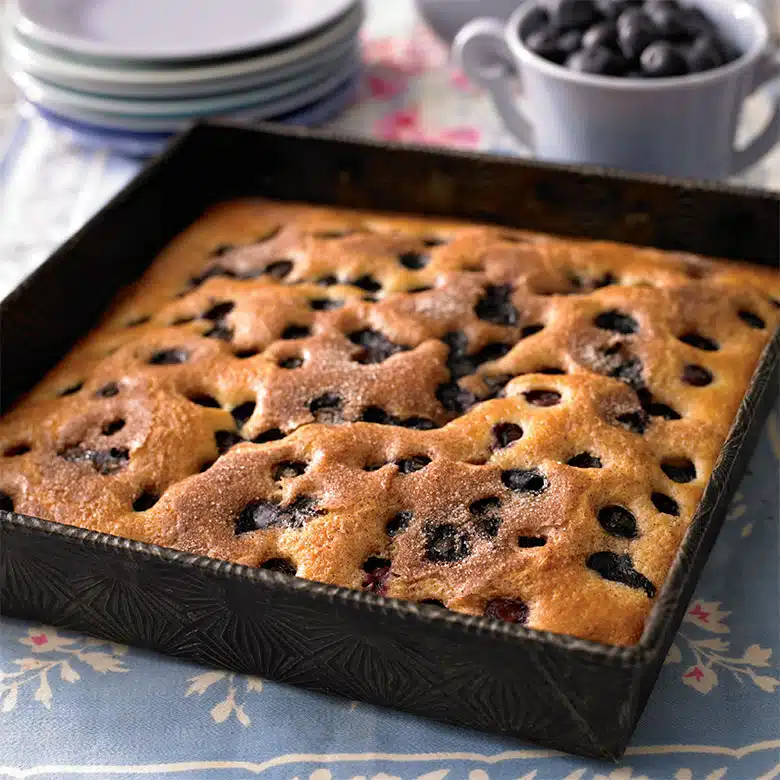
BLUEBERRY BOY BAIT
In 1954 a 15-year-old Chicago girl named Renny Powell submitted a blueberry coffee cake recipe to the “Pillsbury $100,000 Recipe & Baking Contest” (precursor to today’s “Pillsbury Bake-Off ”). Renny took second place in the youth division for her creation, named in honor of its powers with the opposite sex. The recipe has been in circulation for nearly 60 years now, including on YankeeMagazine.com, where our adaptation is one of the most popular recipes in our archive.
FOR THE CAKE: Butter (for the pan) 2 cups all-purpose flour 1 cup granulated sugar 2 teaspoons baking powder 1/4 teaspoon table salt 2/3 cup vegetable oil 1 cup milk 2 large eggs 3 cups blueberries, fresh or frozen
FOR THE TOPPING: 3 tablespoons granulated sugar 1 teaspoon ground cinnamon
Blueberry Boy Bait Credit: Heath Robbins
WORLD’S BEST STICKY BUNS
Everybody loves sticky buns. These beauties, bolstered by rolled oats and energized by a couple of shots of maple syrup, are hard to beat. While they’re beloved for breakfast, there’s no reason you can’t serve them warm, with a scoop of vanilla ice cream or a dollop of whipped cream, for dessert.
TOTAL TIME: 3. TO 4 HOURS • HANDS-ON TIME: 35 TO 40 MINUTES • YIELD: 1 DOZEN
FOR THE DOUGH: 1/4 cup warm water 1 package (scant tablespoon) active dry yeast 3/4 cup rolled oats 1/3 cup granulated sugar 1-1/4 cups whole milk, heated 2 large eggs, at room temperature 2 large egg yolks, at room temperature 1/4 cup unsalted butter, softened, plus more for bowl Finely grated zest of 1 lemon 2 teaspoons vanilla extract 1 teaspoon maple syrup 2 teaspoons kosher or sea salt 4-1/2 cups unbleached all-purpose flour, divided, plus more for work surface
FOR THE SYRUP AND FILLING: 1/2 cup (1 stick) plus 3 tablespoons unsalted butter, melted, divided 1-1/4 cups light-brown sugar, packed, divided 2 teaspoons cinnamon 2 tablespoons maple syrup 1 cup chopped walnuts, lightly toasted and cooled
Pour the water into a small bowl and sprinkle the yeast over it. Set aside.
Combine the oats and sugar in a very large bowl. Pour in the heated milk, stirring to dissolve the sugar. Set aside for 5 minutes.
Whisk eggs and egg yolks together in a small bowl; then add them to the oat/sugar mixture. Add . cup butter, along with the lemon zest, vanilla, 1 teaspoon of maple syrup, and the salt. Gently stir in the dissolved yeast. Add 3-1/2 cups of the flour; beat vigorously 100 strokes. Set aside for 10 minutes.
After the dough has rested, gradually add the remaining 1 cup flour until a soft, kneadable dough forms. Turn the dough out onto a lightly floured surface and knead for 5 to 6 minutes. Use just enough flour to keep the dough from sticking.
Place the dough in a lightly buttered bowl and cover with plastic wrap. Set aside in a warm, draft-free spot until it doubles in bulk (at least 90 minutes, and up to 2 hours).
Next, make the syrup: Brush 1/2 cup melted butter over the sides and the bottoms of two 10-inch round cake pans or ovenproof skillets. Sprinkle each pan with 1/2 cup brown sugar. Set aside.
Pour the remaining 1/4 cup brown sugar, cinnamon, maple syrup, and walnuts into the bowl of a food processor and pulse a few times.
Dust your work area with flour and turn dough out onto it. Don’t punch it down. Roll the dough into a 12×18-inch rectangle, keeping the long side facing you. Push it down lightly. Brush with the remaining 3 tablespoons melted butter and spread half the brown sugar/walnut mixture over the dough, leaving a 1-inch border at the top; set aside the remaining brown sugar/walnut mixture. Starting with the long side facing you, roll the dough up snugly.
Using a sharp knife, cut the dough into 12 slices and lay them in the prepared pans or skillets, spiral side up. You’ll fit 6 in each pan, with 1 in the center and 5 in a circle all around. Gently pat down the spirals. Cover the pans or skillets with plastic and set aside in a warm area until the buns have almost doubled in size, about 45 minutes.
Preheat the oven to 375 degrees. Bake for 25 minutes. Top each bun evenly with the remaining brown sugar/ walnut mixture; then return to the oven and bake for 5 to 6 more minutes, or until golden brown. Remove from the oven and turn the buns out onto a baking sheet to cool for 10 to 15 minutes. Serve warm or at room temperature.
World’s Best Sticky Buns
SOUR CREAM COFFEE CAKE
As food historian Lynne Olver notes on her wonderful site, FoodTimeline.org, coffee cakes like these weren’t invented—they evolved. Sweet cakes made to be served with coffee first began to appear in the 17th century, when coffee was introduced to Northern Europe. But this style of cake, enriched with sour cream and bisected by a layer of streusel, became especially popular in the United States in the 1950s and 1960s and remains a favorite today.
1/3 cup chopped walnuts 1/3 cup firmly packed light-brown sugar 1 teaspoon ground cinnamon 2 cups sifted all-purpose flour 1 teaspoon baking powder 1 teaspoon baking soda 1/2 teaspoon table salt 1/2 cup salted butter, softened, plus more for pan 1 cup granulated sugar 2 large eggs 1 teaspoon vanilla extract 1 cup sour cream
Preheat the oven to 350 degrees and grease a 6-cup tube pan. Set aside.
Make the topping: Stir together the walnuts, brown sugar, and cinnamon, and set aside.
Whisk the f lour with the baking powder, baking soda, and salt until well combined. Cream the butter with the granulated sugar until the mixture is fluffy and light, 3 to 4 minutes; then beat in the eggs and vanilla. Add the flour mixture in alternating thirds with the sour cream, beating well after each addition.
Spoon half the batter into the pan and sprinkle with half the topping; then add the remaining batter and sprinkle on the rest of the topping. Bake for 40 minutes without opening the oven; then test for doneness (a toothpick should come out clean) and bake for 5 to 10 more minutes, if needed.
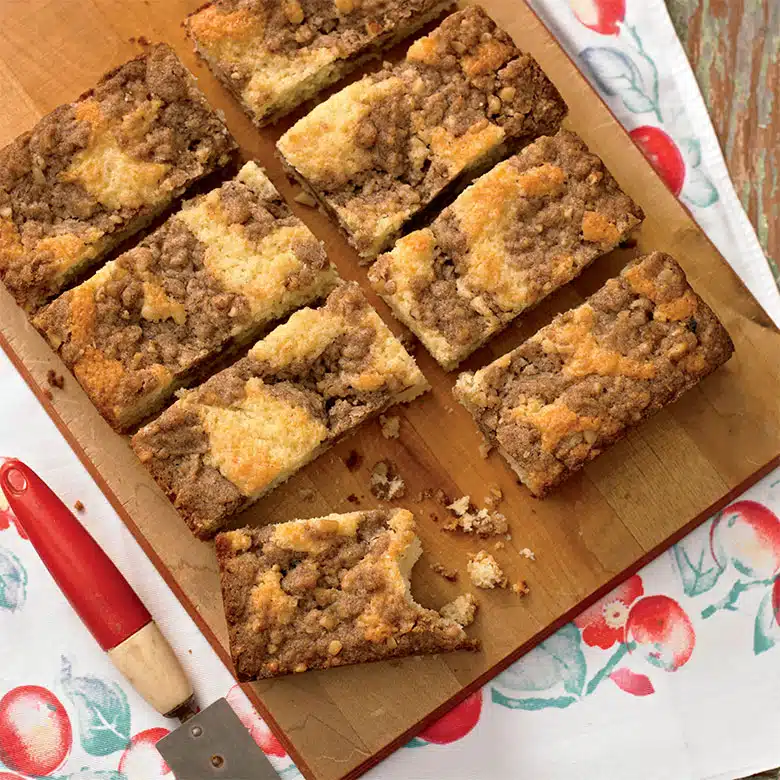
CRUMB COFFEE CAKE
Like sour cream coffee cake, crumb cake was a Northern European invention, originally prepared with a yeast-raised dough but simplified in the 20th century with the use of chemical leaveners such as baking powder. It’s generally thought of as a New York specialty, but it’s found all across New England as well.
FOR THE CRUMB TOPPING: 3/4 cup all-purpose flour 1/2 cup packed light-brown sugar 1/3 cup chopped walnuts 2 teaspoons ground cinnamon 1/2 cup (1 stick) salted butter, melted
FOR THE CAKE: 1-1/2 cups all-purpose flour 3/4 cup granulated sugar 1 tablespoon baking powder 1/2 teaspoon table salt 1/4 cup (1/2 stick) salted butter, melted, plus more for pan 1 large egg 1/2 cup milk 1 teaspoon vanilla extract
Preheat the oven to 375 degrees and grease an 8-inch square baking pan.
Make the crumb topping: Combine the flour, brown sugar, walnuts, and cinnamon. Add the melted butter and mix with a fork. Set aside.
Next, make the cake: In a large bowl, whisk together the flour, sugar, baking powder, and salt. In a medium-size bowl, whisk together the butter, egg, milk, and vanilla. Add the wet mixture to the dry ingredients and fold with a rubber spatula until just combined. Spread the batter evenly in the prepared pan. Top with the crumb topping. Bake until a toothpick inserted into the center comes out clean, 25 to 30 minutes.
Crumb Coffee Cake Credit: Heath Robbins
JOHNNYCAKES
In the earliest days of the American colonies, ground cornmeal was used as a substitute for harder-to-find wheat flours. Native Americans taught the Europeans how to combine it with boiled water to make a simple batter, and they, in turn, added milk, molasses, and butter for various cakes and puddings. Johnnycakes (also spelled johnny cakes and jonnycakes) were one of those variations. Every October, Kenyon’s Grist Mill in Usquepaugh, Rhode Island, hosts a festival celebrating this heritage food.
TOTAL TIME: 25 MINUTES • HANDS-ON TIME: 25 MINUTES • YIELD: ABOUT 12 CAKES
NOTE: For thin, crisp cakes, omit the boiling water, increase the milk to 1-3/4 cups, and reduce the cooking time to 3 to 4 minutes on each side. Whitecap flint cornmeal, made by Kenyon’s and by Gray’s Grist Mill in Westport, Massachusetts, is available in many stores around New England. You may substitute regular yellow cornmeal (though the results aren’t quite as authentic).
1 cup whitecap flint cornmeal (see “Note,” above) 1/2 teaspoon kosher or sea salt 2 teaspoons granulated sugar 1-1/2 cups boiling water 3 tablespoons whole milk 3–4 tablespoons unsalted butter, divided
In a medium-size bowl, whisk together cornmeal, salt, and sugar. Whisk in boiling water until mixture has the consistency of loose mashed potatoes. Whisk in milk. The batter will thicken as it cools.
Melt half the butter on a skillet over medium-high heat. Pour large spoonfuls (about 3 tablespoons each) of batter onto the skillet and brown, about 5 minutes on each side. Repeat with remaining batter and butter. Serve hot with maple syrup.
STUMP JUMPER’S BUCKWHEAT CAKE
Looking for something different and delicious for breakfast? Try this cake that stands in for bread, bagels, or muffins, and craves a swirl of local honey or maple syrup. The origin of the name isn’t readily known, but we suspect it may refer to New England’s venerable logging tradition.
TOTAL TIME: 50 TO 55 MINUTES • HANDS-ON TIME: 15 TO 20 MINUTES • YIELD: 1 LOAF
1/2 cup granulated sugar 1/2 cup all-purpose flour 1 teaspoon baking soda 3/4 teaspoon table salt 1-1/4 cup buckwheat flour 1 cup buttermilk 5 tablespoons unsalted butter, melted 1 large egg, beaten Butter (for baking pan), plus more for serving Honey or maple syrup (for serving)
Preheat the oven to 425 degrees.
Sift sugar, all-purpose flour, baking soda, salt, and buckwheat f lour into a large mixing bowl. Gradually stir in the buttermilk; then stir in the melted butter and beaten egg. Using an electric mixer, beat at medium speed until smooth.
Grease a 9-inch cake pan or 8-inch square baking pan with butter. Pour the batter into the pan.
Transfer to oven and bake for 35 minutes, or until a toothpick inserted into the cake comes out clean. Serve with butter and honey or maple syrup.
LINGONBERRY PANCAKES
Interest in Scandinavian culture, design, and cooking ran high in the 1960s, and these crepe-like pancakes filled with lingonberry preserves were a popular brunch or dessert item. The fruits themselves resemble small cranberries, and they’re wonderfully tart.
NOTE: Lingonberry preserves are available at Ikea stores, gourmet shops, and most supermarkets with a good international aisle. You may also substitute currant jam, sour-cherry preserves, or raspberry jam.
4 large eggs, lightly beaten 3 tablespoons granulated sugar 3/4 cup heavy cream 2-1/4 cups milk 1-1/4 cups all-purpose flour 1/2 teaspoon table salt 4 tablespoons unsalted butter, melted, plus more for skillet 3/4 teaspoon vanilla extract Lingonberry preserves (see “Note,” above) Garnish: powdered sugar
In a 6-cup blender, whir eggs briefly. Add sugar, cream, and milk, and blend. Add flour and salt, and blend 5 seconds. The batter will seem loose; don’t worry. Add melted butter and vanilla, and blend, first on low, then going up to medium, until emulsified, about 30 seconds. Let batter rest at least 30 minutes (or up to overnight).
Melt about 1 teaspoon butter in a heavy-bottomed skillet over medium-low heat. Ladle . cup batter into the pan and swirl to form a thin circle. Cook until pancake is lightly browned on bottom and cooked through on top, 3 to 5 minutes (no need to flip).
Spoon preserves down the center and roll the sides up and over, like a crepe. Sprinkle with powdered sugar. Repeat with remaining batter and preserves.
Lingonberry Pancakes
DANISH CHRISTMAS WREATHS
We’ll admit it: This recipe is a project, a special-occasion treat you may make once in your life, or once a year at Christmas. (Or maybe never—but isn’t it still fun to learn how it’s made?) If you have the patience to follow along, you’ll be rewarded with one of the most delicious pastries you’ll ever eat—a buttery, flaky dough filled with sweet almond paste. Interestingly, Danish pastries aren’t really a Danish invention. The Danes call them “Wienerbrod,” or “Viennese bread,” and they do closely resemble the signature yeast pastries of Austria. But for some reason, the Austrians associated the pastry with Scandinavia and the name stuck.
FOR THE DOUGH: 3/4 cup whole milk 1/2 cup granulated sugar 1-1/2 teaspoons kosher or sea salt 1-3/4 cups unsalted butter (3-1/2 sticks), divided 1/4 cup lukewarm water (105 degrees to 115 degrees) 2 packages (scant tablespoon each) active dry yeast 3 large eggs, beaten, at room temperature 4-1/2 cups flour, divided, plus more for dusting
FOR THE ALMOND FILLING: 7 ounces almond paste 3/4 cup crushed zwieback (available in the baby-food aisle) or similar cookie 1/2 cup salted butter, melted 1 large egg, beaten 1/2 teaspoon almond extract
FOR THE GLAZE: 1 cup confectioners’ sugar 2 tablespoons water Garnish: candied fruits (optional)
First make the dough: Combine milk, sugar, salt, and 1/4 cup (1/2 stick) butter in a small pot over high heat. Bring just to the simmering point; then remove from heat and cool to about 110Åã. In a large bowl or standing mixer, dissolve yeast in lukewarm water. Add the cooled milk mixture, the eggs, and 1 cup flour; beat well. Gradually add the remaining flour and continue to mix until a smooth dough forms. Transfer the dough to a large greased bowl and f lip to coat; then cover with plastic wrap and chill 2 hours.
While dough is chilling, let 1. cups (3 sticks) butter soften to room temperature; then roll out into a 10×12-inch rectangle between two sheets of parchment or waxed paper. (You may find it easier to first cut each stick into fourths lengthwise and lay the pieces in a row at the center of the parchment, before rolling.) Refrigerate until ready to use.
On a f loured surface, roll dough out into a 10×20-inch rectangle (approximately). Peel the parchment or paper from the chilled butter and cover the bottom two-thirds of the dough with the butter; then fold into thirds, folding the unbuttered third of the dough toward the center first. Rotate the dough 90 degrees; then roll out and fold into thirds again. Wrap loosely in parchment paper and chill for 1 hour.
Roll out again, fold into thirds, and chill briefly. Repeat this process twice more. After the fourth “turn,” chill at least 3 hours, or overnight. As long as the dough is well wrapped, it can keep up to 1 week in the refrigerator. Note: When working with this dough, make sure the room is cool. If the butter starts to ooze, sprinkle the work surface with more flour and chill the dough periodically.
Next, make the filling: Mix ingredients together until smooth, and set aside, keeping cool.
Divide dough in half and return one half to the fridge, loosely wrapped in parchment. Roll out the first batch of dough into a rectangle 8×22 inches and cut into 3 long strips. Transfer 1 cup of almond filling to a large, heavy-duty zip-top bag and snip off one corner. Pipe a thick line of almond filling down the center of each strip. Pinch the edges of the dough together over the filling, rolling the dough seam-side down as you go, to keep the filling sealed.
SALLY LUNN
This delicate tea cake has been in existence since the late 18th century, but its exact origins are a matter of debate. Some records state that Sally Lunn was a real person, a baker in Bath, England, whose cakes brought her wide acclaim among the tourists who took the waters in that spa town. Others say the name derives from the French soleil et lune, or “sun and moon” cake. It’s a puzzle. In the earliest recipes, yeast was used as the leavening agent, and the dough was baked in the form of small, individual cakes. Our recipe is much simpler, as the batter is made with baking powder and poured into a single loaf pan for baking.
2 large eggs, separated, at room temperature 2 cups all-purpose flour 1 tablespoon baking powder 1/2 teaspoon table salt 1/4 cup granulated sugar 2/3 cup milk 1/2 cup salted butter, melted, plus more for pan
Preheat the oven to 375 degrees and grease a 9×5-inch loaf pan.
In a clean bowl, beat the egg whites to firm peaks and set aside. Whisk together the dry ingredients and set aside.
In a small bowl, whisk together the milk and egg yolks. Add to the dry ingredients, stirring until just combined. Stir in the melted butter; then fold in the stiffly beaten egg whites.
Pour into the prepared pan and bake until a toothpick inserted into the center comes out clean, about 45 minutes. (Tent the pan with foil after 30 minutes if the top is browning too fast).
POTATO DOUGHNUTS
Potato doughnuts reached the status of food fad in the 1940s, when Al and Bob Pelton of Salt Lake City, Utah, launched the “Spudnut” bakery craze, with chains in more than 30 states. Meanwhile, in Maine potato country, home cooks had developed their own doughnuts, a popular way to serve potatoes for breakfast. A few Spudnut shops remain in Southern and Western states, and The Holy Donut Shop in Portland, Maine, serves more than a dozen flavors, all made with potatoes. But if you can’t get there, it’s worth making your own.
NOTE: For best results, pass the potatoes through a ricer or food mill. It makes the texture fluffier.
1 pound russet potatoes (about 2 large potatoes) 1 cup milk 2 cups granulated sugar 4 large eggs 4 tablespoons salted butter, melted 6 cups all-purpose flour, plus more for work surface and as needed 2 tablespoons baking powder 1 teaspoon ground nutmeg 1/4 teaspoon ground cinnamon 1/2 teaspoon table salt 1-1/2 quarts vegetable oil (for frying) Garnish: cinnamon sugar
Peel the potatoes; cut into large chunks. Put potatoes in a medium-size pot and cover with water. Set over high heat and bring to a boil; then reduce heat to a simmer and cook until tender, about 30 minutes. Drain, then pass potatoes through a ricer or food mill, and cool to room temperature.
In the bowl of a standing mixer or, if using a handheld mixer, in a large bowl, beat potatoes with milk. Add sugar and beat well; then add eggs one at a time, beating well after each. Add butter and beat.
In a separate bowl, whisk together flour, baking powder, spices, and salt. Add to wet ingredients and stir with a spatula, just until dry ingredients are evenly moistened. Dough should be moist but workable. If it doesn’t come together, add more flour, 1/4 cup at a time. Turn dough out onto a well-floured surface and knead two or three times. Press out to a .-inch thickness. Dust with flour, cover with a towel, and let sit for 15 minutes.
Meanwhile, in a Dutch oven or another large, heavy-bottomed pot, heat the vegetable oil to 370 degrees.
Using a well-floured 2.-inch doughnut cutter or two concentric biscuit cutters, cut out 36 doughnuts, gathering and re-rolling dough as needed. Fry, 4 to 6 at a time to avoid crowding, until golden brown on both sides and cooked through, 2. to 3 minutes each. Sprinkle with cinnamon sugar.
Potato Doughnuts Credit: Heath Robbins
VERMONT APPLE-CIDER DOUGHNUTS
It’s a cider maker’s tradition to use some of the freshly pressed juice to make lightly tangy, apple-scented doughnuts like these. The cider adds more than flavor, though; its acidity makes the doughnuts more tender.
TOTAL TIME: 1 HOUR 45 MINUTES • HANDS-ON TIME: 1 HOUR 30 MINUTES • YIELD: ABOUT 18 3-INCH DOUGHNUTS
NOTE: Boiled apple cider gives these doughnuts a rich, slightly tangy flavor. You can buy boiled cider at some gourmet and Whole Foods stores; from Wood’s Cider Mill in Springfield, Vermont (woodscidermill.com); or from the King Arthur Flour catalogue. Alternatively, you can boil your own by simmering 1. cups of fresh apple cider down to 1/3 cup in about 25 minutes; it just won’t be as concentrated as the commercial product.
1 cup granulated sugar 5 tablespoons unsalted butter, at room temperature 2 large eggs, at room temperature 3-1/2–4 cups all-purpose flour, plus more for work surface 1-1/4 teaspoons table salt 2 teaspoons baking powder 1 teaspoon baking soda 1-1/2 teaspoons ground cinnamon 1/2 teaspoon freshly grated nutmeg 1/2 cup low-fat buttermilk 1/3 cup boiled apple cider 1 tablespoon vanilla extract Canola or safflower oil (for frying) Cinnamon sugar (1-1/2 cups sugar mixed with 3 tablespoons ground cinnamon) or confectioners’ sugar
In a large bowl using a handheld or standing mixer fitted with a whisk attachment, beat together sugar and butter until mixture is pale and fluffy, 4 to 6 minutes. Add eggs, one at a time, beating a minute after each. Set aside. In a medium-size bowl, whisk together 3. cups flour, salt, baking powder, baking soda, cinnamon, and nutmeg; set aside.
Pour buttermilk, boiled cider, and vanilla into sugar/butter/egg mixture. Mix well, and don’t worry if the mixture looks a bit curdled; it will smooth itself out. Add flour mixture and combine gently just until fully moistened. If dough seems loose, add additional flour, 2 tablespoons at a time, until it’s firm enough to work with.
Line two baking sheets with waxed paper or parchment paper and dust generously with flour. Turn dough out onto one baking sheet and pat gently into 3/4-inch thickness. Sprinkle dough with additional flour, cover with plastic wrap, and place in the freezer for 10 minutes to firm up. Remove dough from the freezer; use a lightly floured 3-inch doughnut cutter (or two concentric biscuit cutters) to cut out about 18 doughnuts with holes. (Gather the scraps and roll again as needed, but you may need to chill the dough more to firm it up.) Place cut doughnuts on the other baking sheet as you go; then transfer to the freezer for 5 minutes to firm up again.
Line a plate with a few layers of paper towels and set it nearby. In a Dutch oven or large pot, heat 3 inches of oil to 370 degrees (test with an instant-read thermometer). Drop 3 or 4 doughnuts into the oil, being careful not to crowd the pan. Cook until browned on one side, about 1 minute; then flip and cook until browned on the other side, about 1 minute longer.
Repeat with the remaining dough. (If you find that it’s getting too soft as you work your way through the batches, pop it into the freezer again for 10 minutes.) When doughnuts are cool enough to handle but still warm, sprinkle all over with cinnamon sugar or confectioners’ sugar. Serve immediately.
ANADAMA BREAD
The name “anadama bread” first appeared in print in 1915, but it was undoubtedly baked in many New England hearths before then. What distinguishes anadama from other breads is the inclusion of cornmeal and molasses. Both were common ingredients in Northeast cooking, but they truly shine in this bread. So what does “anadama” mean? Local legend overwhelmingly credits a Gloucester fisherman with coining the term as a not-so-loving tribute to his wife, Anna. It seems Anna wasn’t blessed with talent in the kitchen, and after numerous bowls of molasses and cornmeal porridge for supper, the fisherman angrily tossed in some flour and yeast one evening and threw the mixture into the oven. While it baked, he sat muttering, “Anna, damn her!” and the name was born. Fortunately, so was this delicious bread. The molasses and cornmeal make for a sweet and nutty aroma while it bakes, which carries over into the flavor.
2 tablespoons vegetable oil (for bowl), plus more for pans 2 packages (scant tablespoon each) active dry yeast 1/2 cup lukewarm water 2 cups milk 1 cup yellow cornmeal 2/3 cup molasses 3 tablespoons salted butter, melted 1-1/2 teaspoons table salt 7–8 cups bread or all-purpose flour
Grease a large mixing bowl and set aside. Grease three 9×5-inch loaf pans and set aside. Dissolve the yeast in water and set aside. In another large bowl, combine milk, cornmeal, molasses, butter, and salt. Add 4 cups f lour and the yeast mixture and stir to form a dough. Add remaining flour a bit at a time, stopping when the dough becomes stiff enough to knead. Turn dough onto a lightly floured surface and knead until it’s smooth and elastic, about 10 minutes.
Place the dough into the greased bowl, turning to coat; then cover with plastic wrap and let it rise until it doubles in bulk, about 1. hours. Gently punch the dough down; then let it rest for 10 minutes. Shape the dough into 3 loaves; then place them into three greased 9×5-inch loaf pans. Let them rise until just about doubled.
Preheat the oven to 350 degrees then bake until browned and cooked through, 35 to 45 minutes. Invert loaves onto a wire rack to cool; then enjoy a slice warm.
MARTHA WASHINGTON’S POTATO ROLLS
Many recipes are attributed to the nation’s first First Lady, but it’s unlikely that she was making devil’s food cake and chocolate-covered cherries in the 1700s. She was, however, in possession of a manuscript of old family recipes that had been handed down from one generation to the next and eventually came to be published under the name Martha Washington’s Book of Cookery and Book of Sweetmeats. This recipe doesn’t appear in that manuscript; still, the name remains, if only to honor a woman who added much to our nation’s culinary heritage.
TOTAL TIME: 4 HOURS • HANDS-ON TIME: 1 HOUR • YIELD: 4 DOZEN SMALL ROLLS
2 large russet potatoes 3/4 cup milk 1 teaspoon table salt 2 tablespoons granulated sugar 3 tablespoons salted butter, plus more for baking sheets 1 package yeast 5–7 cups all-purpose flour 3 tablespoons vegetable oil
Peel the potatoes; cut into large chunks. Put potatoes in a medium-size pot and cover with water. Set over high heat and bring to a boil; then reduce heat to a simmer; cook until tender, about 30 minutes. Meanwhile, put milk in a small pan and bring to a simmer over high heat. Remove from heat.
When potatoes are tender, drain, reserving the cooking water.
Mash the hot potatoes. Add the salt, sugar, and butter and beat well; stir in 1. cups of the reserved potato water and the hot milk; then cool until lukewarm.
Add the yeast and stir in 4 cups of the flour, beating well; then add enough of the remaining flour to make a dough stiff enough to knead (the exact amount will depend on how moist the potato mixture is). Knead on a floured board until smooth and elastic.
Brush a large bowl with the vegetable oil; then transfer the dough to the bowl. Turn to coat; then cover and let rise in a warm place until the dough has doubled in bulk, 1. to 2 hours.
Preheat the oven to 400 degrees and grease two large rimmed baking sheets. Punch down the dough and turn it out on a floured board; then pat out to a thickness of about 3/4 inch. Divide the dough into 48 portions and shape them into rolls. Arrange on greased pans and let rise until very light and more than doubled in bulk, about 45 minutes. Bake until nicely browned, about 20 minutes. Serve warm.
CONNECTICUT DABS
Here’s another variation on the cornmeal cakes first made by Native Americans and then adapted for European tastes. This version is similar to a recipe for “Dodgers, Dabs, or Corn Meal Puffs” from an 1884 cookbook called Mrs. Lincoln’s Boston Cook Book: What to Do and What Not to Do in Cooking, by Mary Johnson Bailey Lincoln. Here, small dabs of dough enriched with sour cream are dropped on a hot baking sheet and baked until golden brown. Serve with soup, chili, or stews, or slather with butter and honey for breakfast.
TOTAL TIME: 30 MINUTES • HANDS-ON TIME: 15 MINUTES • YIELD: 12 TO 15 DABS
1 cup cornmeal 3/4 cup boiling water 1 tablespoon salted butter, softened 1 large egg, lightly beaten 3 tablespoons sour cream 1 tablespoon granulated sugar 1/2 teaspoon table salt Vegetable oil (for baking sheet)
Preheat the oven to 450Åã and place an ungreased baking sheet on the middle rack. Close the door and let the oven and the baking sheet get hot.
In a large bowl, beat together the cornmeal and boiling water. Fold in the butter, egg, sour cream, sugar, and salt until just combined. Don’t overmix.
When the sheet is hot, brush with oil; then drop the batter by spoonfuls onto the sheet and bake until the bottoms are golden brown, about 15 minutes.
MAPLE CORNBREAD
Cornbread is an American adaptation, a necessity food invented by early European settlers who had a shortage of wheat flour and an appetite for bread. Early versions were heavy and dense, but over time, cooks found that adding baking powder and now-plentiful wheat flour produced a bread worth craving. A bit of maple syrup in the mix makes it even more of a treat.
1-1/3 cups all-purpose flour 2/3 cup cornmeal 1 tablespoon baking powder 1/2 teaspoon table salt 2/3 plus 1/4 cup milk 1/3 cup pure maple syrup 1/4 cup (1/2 stick) salted butter, melted, plus more for pan 2 large eggs, slightly beaten
Preheat the oven to 425 degrees and grease an 8×8-inch pan or an 8- or 9-inch skillet.
In a large bowl, whisk together the dry ingredients; then add the milk, syrup, melted butter, and eggs. Stir until just combined—a few lumps are all right.
Pour the batter into the prepared pan or skillet and bake for 25 minutes, or until golden brown and a toothpick inserted into the center comes out clean.
FAN TAN ROLLS
These slightly sweet rolls, a.k.a. “New England buttermilk rolls,” are the match of any bakery dinner roll. The shaping is easy but looks fancy, and the texture is moist and firm.
TOTAL TIME: 3 HOURS • HANDS-ON TIME: 1 HOUR 45 MINUTES • YIELD: ABOUT 20 ROLLS
4–5 cups all-purpose flour 1/3 cup granulated sugar 2 teaspoons table salt 1/2 teaspoon baking soda 2 packages (scant tablespoon each) active dry yeast 1-1/2 cups buttermilk 1/2 cup salted butter, softened 2 tablespoons salted butter, melted
Preheat the oven to 400 degrees. In a large bowl, combine 2 cups flour, sugar, salt, soda, and yeast. Set aside.
In a saucepan, heat buttermilk and . cup butter until buttermilk is warm (butter doesn’t need to melt), around 120 degrees. Add to flour mixture. Blend with mixer at lowest speed until moistened; then beat for 2 minutes at medium speed.
By hand, stir in enough of the remaining flour to make a stiff dough. Cover and let rise in a warm place until light and doubled in size (about 1-1/2 hours). Gently def late dough; then turn onto a floured board. Roll out dough to a 15-inch square, brush with 2 tablespoons of melted butter, and cut dough into 1-1/2-inch-wide strips. Stack 5 strips together and cut into stacks 1. inches long. Repeat with remaining strips. Place 1 stack cut side down into each greased muffin cup.
Cover and let rise until doubled (about 30 minutes). Bake 15 to 18 minutes, or until golden brown. Serve warm.
Fan Tan Rolls Credit: Heath Robbins
ENGLISH MUFFIN BREAD
Yankee’s senior lifestyle editor, Amy Traverso, got this recipe from a friend’s mother, Sue Williams, who always had loaves of delicious homemade bread on hand to toast for breakfast. Because you let it rise only once, with a generous amount of yeast, it develops the rough texture of English muffins, with their signature nooks and crannies, and a wonderfully crisp crust.
Butter (for pans) 2 tablespoons cornmeal 5-3/4 cups all-purpose flour, divided 2 packages (scant tablespoon each) active dry yeast 1 tablespoon granulated sugar 2 teaspoons table salt 1/4 teaspoon baking soda 2 cups milk 1/2 cup water
Grease bottoms and sides of two 9×5-inch loaf pans and sprinkle with cornmeal; tilt and shake the pans to coat evenly.
In a large bowl, combine 3 cups flour with the yeast, sugar, salt, and baking soda. Combine milk and water and heat until quite warm (120 degrees to 130 degrees). Add to the dry ingredients and beat well. Add the remaining flour, about 1 cup at a time, and stir until smooth. Divide the dough among the two prepared pans.
Cover the loaves with a kitchen towel and set in a warm spot to rise for 40 minutes. Fifteen minutes before you’re ready to bake the loaves, preheat the oven to 400 degrees. Then bake until nicely browned, 25 to 30 minutes.
MONKEY BREAD
The first recipes for “monkey bread,” a sweet pull-apart bread glazed with a rich caramel sauce, appeared in American cookbooks in the 1940s, but there are 19th-century recipes for breads made from little balls of dough baked together in the same pan. Most contemporary recipes for monkey bread start with store-bought dough, but nothing beats homemade biscuits, and they’re very quick and easy to put together.
TOTAL TIME: 1 HOUR 15 MINUTES • HANDS ON TIME: 40 MINUTES • YIELD: ABOUT 10 SERVINGS
FOR THE BISCUIT DOUGH: 1 cup plus 1 tablespoon granulated sugar, divided 2 teaspoons ground cinnamon 1/2 cup buttermilk 1 large egg 3 cups all-purpose flour, plus more for dusting 2-1/2 teaspoons baking powder 1-1/2 teaspoons kosher or sea salt 1/2 teaspoon baking soda 8 tablespoons cold unsalted butter, cut into small cubes, plus more for pan 1/2 cup chopped walnuts (optional)
FOR THE SAUCE: 6 tablespoons salted butter, melted 1 cup firmly packed light-brown sugar
Lightly dust a large piece of parchment paper with flour and set aside. Pour 1 cup sugar and the cinnamon into a large zip-top bag; seal, shake, and set aside. Butter a standard 9-inch tube or Bundt pan and set aside.
Make the dough: In a small bowl, whisk together the buttermilk and egg; set aside. In a medium-size bowl, whisk together the f lour, remaining 1 tablespoon sugar, baking powder, salt, and baking soda. Sprinkle the butter over the f lour mixture and use your fingers to work it in. (Rub your thumb against your fingertips, smearing the butter as you do; Stop when the mixture looks like sand studded with little chunks.
Add the egg mixture and stir with a fork just until the dough begins to hold together. It will look quite ragged and not fully blended, but stop there. You want to prevent the butter from melting into the dough; those little chunks will create a flakier texture once baked.
Preheat the oven to 350 degrees and set a rack to the middle position. Dump the dough out onto the prepared piece of parchment paper and knead just enough to bring it all together into a ball. Use your hands to press the dough out on the parchment to a 1-inch thickness. Cut the biscuits into 1.-inch pieces. Put the pieces, about 8 at a time, into the bag with the cinnamon/ sugar mix. Toss to coat, then arrange them in the prepared pan. If using walnuts, arrange them in and among the biscuit pieces as you go. Repeat the process with the remaining biscuit dough.
Make the sauce: In a small saucepan over medium-high heat, melt the salted butter with the brown sugar; then bring to a boil. Boil for 1 minute; then pour over the biscuits. Transfer the pan to the oven and bake until firm and golden brown, about 35 minutes. Let the bread cool in the pan for 10 minutes; then turn out onto a plate. To serve, pull the bread apart with your fingers—no need to use a knife!
CHEDDAR–SCALLION BEER BREAD
With its raw ingredients of grain and yeast, beer is sometimes referred to as “ liquid bread,” so it makes sense that you can, in fact, make bread with beer. The brew adds flavor and helps the bread rise, making this one of the easiest loaves you’ll ever prepare: no kneading, no rising time. You’ll need an additional leavening agent in the form of baking powder, and we also added cheddar cheese and scallions for extra flavor.
Salted butter (for pan) 2 cups all-purpose flour 1 cup whole-wheat flour 1 cup finely grated sharp cheddar cheese 3 scallions (green onions), white parts removed, sliced very thinly crosswise 1-1/2 tablespoons granulated sugar 1 tablespoon baking powder 1 teaspoon table salt 1 12-ounce bottle dark ale or hearty beer, at room temperature 3 tablespoons salted butter, melted
Preheat the oven to 375 degrees. Grease a 9×5-inch bread pan and set aside. In a mixing bowl, stir together the flours, cheese, scallions, sugar, baking powder, and salt. Add the beer all at once, mixing only until just combined; the batter should be lumpy.
Pour the batter into the prepared pan and drizzle with melted butter. Bake until the top is golden brown and a toothpick inserted into the center comes out clean, 35 to 40 minutes. Turn out onto a rack to cool. Serve warm.
HOMEMADE GRAHAM CRACKERS
Sylvester Graham of Northampton, Massachusetts, was a 19th-century health reformer who advocated a bland vegetarian diet of whole grains, fresh fruits, and vegetables. He did invent a cracker made with his signature whole-wheat flour blend, but it was virtually unsweetened and bore only a glancing resemblance to these delicious treats. When making these crispy homemade graham crackers, the magic word is “chill.” Frequent trips to the fridge during the shaping and cutting process will keep the sticky dough cold enough to handle. Make traditional large crackers or use cookie cutters for fun shapes. The size of the cookies and thickness of the dough will dictate how long they need to bake, so keep a close eye!
3 cups unbleached all-purpose flour, plus more for work surface 1 cup dark-brown sugar, lightly packed 1 teaspoon baking soda 3/4 teaspoon kosher salt 1/2 cup (1 stick) unsalted butter, very cold, cut into 1-inch cubes 1/3 cup mild-flavored honey (such as clover) 5 tablespoons whole milk 2 tablespoons vanilla extract 3 tablespoons granulated sugar 1 teaspoon ground cinnamon
In a food processor or the bowl of a standing mixer with paddle attachment, thoroughly combine flour, brown sugar, baking soda, and salt. Add butter and pulse or mix on low, until mixture is the consistency of coarse meal.
In a small bowl, whisk together honey, milk, and vanilla. Add to flour/butter mixture. Pulse on and off a few times, or mix on low until dough barely comes together. (It will be soft and sticky.) Turn dough out onto a floured work surface and shape into a 1-inchthick rectangle. Wrap in plastic and chill until firm, about 2 hours, or overnight.
In a small bowl, combine sugar and cinnamon, and set aside. Divide dough in half and return one half to the refrigerator. On a floured work surface, shape dough into a long rectangle about 1/8 inch thick. (Dough may be a bit sticky, so flour as necessary or roll between two sheets of floured parchment or plastic wrap.) Trim rectangle so that it’s about 4 inches wide and 18 inches long; then cut into four 4×4-1/2 inch pieces. Gather scraps and set aside.
Place dough pieces on parchment-lined baking sheets and sprinkle with cinnamon/sugar mixture. Chill until firm, about 30 minutes.
Repeat with remaining dough. Gather all scraps into a ball and chill until firm. Dust work surface with flour and roll out dough for 2 to 3 more crackers.
Preheat the oven to 350 degrees. Mark a vertical line down the middle of each cracker, without cutting through dough. Using a toothpick or skewer, prick dough in 2 rows to mimic the look of a commercial graham cracker.
Bake 25 minutes, until browned and slightly firm to the touch, rotating sheets halfway through to ensure even baking.
POPOVERS
Popovers are an American invention, the offspring of British batter puddings. According to John Mariani’s Encyclopedia of American Food and Drink, “settlers from Maine who founded Portland, Oregon, Americanized the pudding from Yorkshire by cooking the batter in custard cups lubricated with drippings from the roasting beef (or sometimes pork) . . . The result is called Portland popover pudding, individual balloons of crusty meat-flavored pastry.” While it isn’t required, a popover pan’s deep, separated cups yield taller, grander results than its muffin-pan counterpart. To let the steam do its “pop” job, resist the temptation to open the oven at any time during baking, and you’ll be deliciously rewarded.
TOTAL TIME: 50 MINUTES • HANDS-ON TIME: 15 MINUTES • YIELD: 6 LARGE OR 12 SMALL POPOVERS
1 cup whole milk 3 large eggs, beaten 2 tablespoons salted butter, melted, plus more for pan and for serving 1 teaspoon kosher or sea salt 1 cup all-purpose flour Jam (for serving)
Preheat the oven to 450Åã. Grease the cups of a popover or muffin pan and place on the lowest rack of the oven.
In a large bowl, whisk together the milk, eggs, 2 tablespoons butter, and salt. Add the flour and whisk vigorously until smooth and frothy.
Pour batter into the preheated pan, filling each cup slightly more than halfway. Bake 20 minutes; then reduce heat to 350 degrees and bake an additional 15 to 20 minutes, or until tops are deep golden brown. Check their progress through the oven window; don’t open the oven door until popovers are done.
Remove from the oven and pierce each popover with a knife to let steam escape. Serve piping hot with butter and jam.
PARKER HOUSE ROLLS
Boston’s Parker House hotel is indeed the source of these delightfully soft and puffy dinner rolls, which were invented around the 1870s. Tales of its origin vary, but most center around a beleaguered chef who, in a fit of pique, threw some unfinished rolls into the oven and found that they turned out even better than his usual recipe.
1-1/2 cups milk 5-1/2 cups all-purpose flour, divided, plus more for work surface 1/3 cup granulated sugar 2 teaspoons table salt 1 package (scant tablespoon) active dry yeast 3/4 cup (1-1/2 sticks) salted butter, softened, divided, plus more for bowl 1 large egg
Grease a large bowl and set aside. In a small saucepan, heat the milk until warm, but not hot (120 degrees).
In a large bowl (or the bowl of a standing mixer with paddle attachment), combine 2-1/2 cups flour, sugar, salt, and yeast. Add 1/2 cup (1 stick) of the butter and beat well. With your mixer on low speed, gradually add the warm milk to the dry ingredients.
Add the egg and increase mixer speed to medium. Beat for 2 minutes, occasionally scraping the bowl with a rubber spatula. Gradually add in the remaining 3 cups flour, until the dough is tacky but not sticky. If you’re using a standing mixer, switch to the dough hook when the dough starts to get stiff.
Knead the dough until smooth and elastic, about 10 minutes by hand, or 5 minutes if you’re using a mixer. Shape the dough into a ball and place in the prepared bowl, flipping the dough to grease the top. Cover with a clean towel and let it rise in a warm place until doubled in size, about 1-1/2 hours.
Gently deflate the dough and turn onto a lightly floured surface. Knead lightly to make a smooth ball, and then cover for 15 minutes to let the dough rest.
Line two baking sheets with parchment and preheat the oven to 375 degrees.
In a small saucepan, melt the remaining 1/4 cup butter.
On a lightly floured surface with a floured rolling pin, gently roll dough out to a .-inch thickness. Using a 2-1/2 – to 3-inch round biscuit cutter dipped in flour, cut dough into circles.
Holding each dough circle by the edge, brush both sides with the melted butter. Lay each dough circle onto a baking sheet; then fold in half, pressing the edge to seal it shut.
Arrange folded dough circles in rows, each nearly touching the next. Cover with a towel and let the rolls rise in a warm place until nearly doubled in size, about 40 minutes.