Meet 7 New England Artisans Turning Wood Into Works of Art
See how New England artists and artisans are bringing the beauty of the woods inside.
By Courtney Hollands|Oct 23 2026|

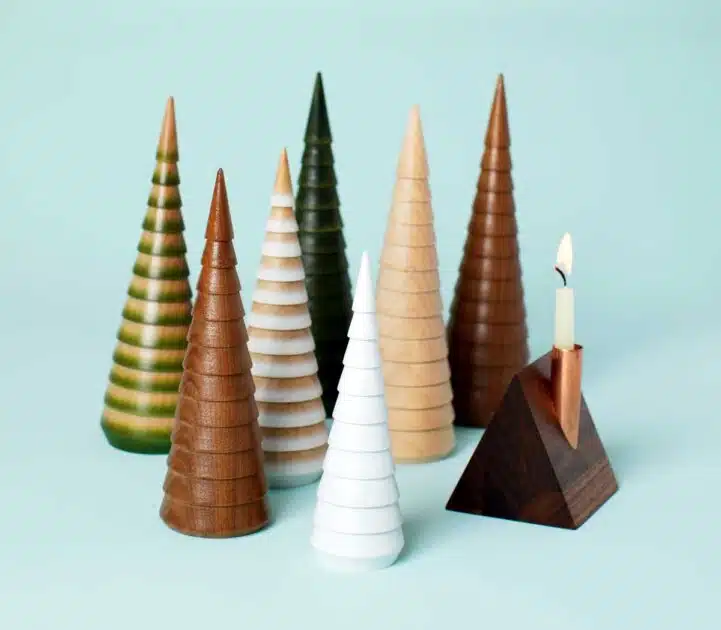
Each piece of Hauskaa’s wooden home decor is infused with Vermont design and craftsmanship.
Credit: Heather MarcusOnce a year, we welcome a bit of the woods inside, as evergreens of all shapes and sizes take up residence, offering their fragrant branches to hold both our ornaments and our memories. But trees have so many more gifts to give in our everyday lives. Meet seven regional artisans who are sharing the beauty of the forest all year long.
Ann Nygard | Hauskaa
Burke, VT

Credit: Brandon Heanssler
“It’s rooted in New England craft, made by local woodworkers, but overlaid with a Nordic sensibility,” Ann Nygard says of her home decor brand, Hauskaa. “It ties together two worlds—a shared language between New England and Nordic living.” (What’s more, the name comes from the Finnish word for “fun.”) The one-time director of the Center for Innovation and Entrepreneurship at Vermont State University, Nygard created her first petite wooden farmhouse with help from volunteer mentors at The Foundry makerspace in Lyndonville, Vermont, and had early success selling on Etsy. Fast-forward seven years, and Hauskaa’s minimalist hamlets now include barns, schoolhouses, A-frames, and Alpine chalets that all double as candleholders, as well as tiered fir trees shaped from reclaimed baseball bat blanks. They are charming and collectible—think Department 56 porcelain Dickens’ Village but for the hygge set.
Jonathan Glatt | O&G Studio
Warren, RI
Credit: Angel Tucker
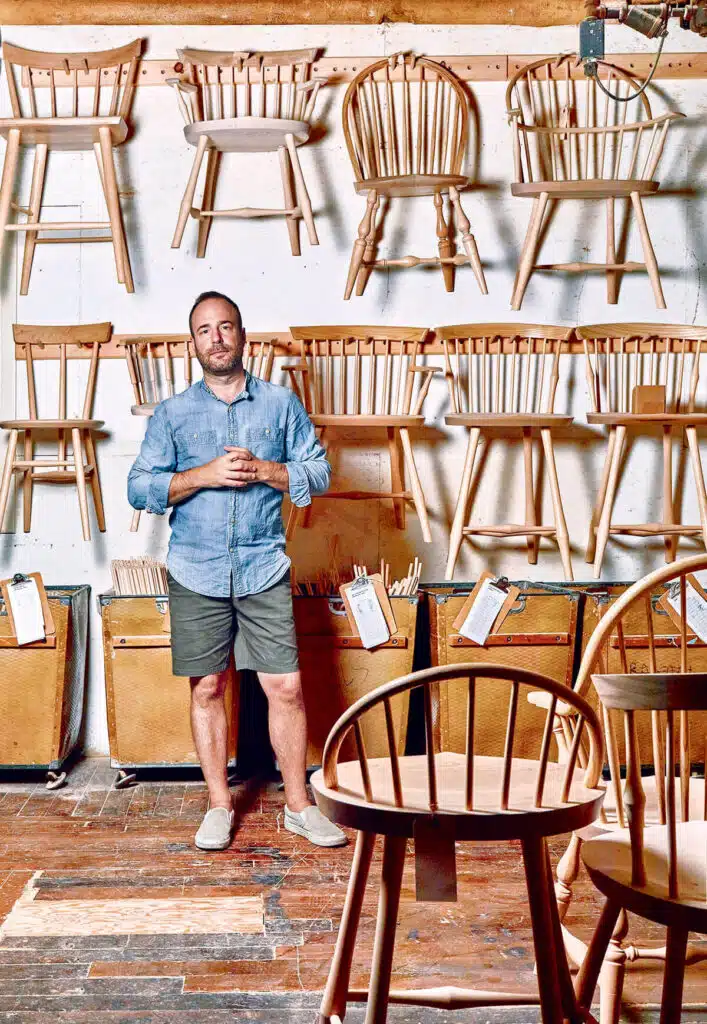
The Warren-based studio’s hardwood settees, tables, and beds come in a riotous rainbow of proprietary stains that highlight and allow each piece’s natural maple and ash grain to shine through—creative director Jonathan Glatt is partial to the kelp, a deep olive green. All the better to add flair to Glatt’s first love: the Windsor chair. The Rhode Island School of Design grad’s infatuation with the stick-and-socket British import began with an internship at Sotheby’s and led to his debut design, the Atlantic Elbow, an of-the-moment, low-backed seat with distinctive spindles. While Windsor chairs were decidedly “not cool” when the studio started in 2009, Glatt says with a laugh, his brightly colored reinterpretations delighted designers and put O&G on the path to becoming the ever-expanding furniture and lighting company it is today.
Katie Babic | Katie Babic Designs
Waitsfield, VT
Credit: Bear Cieri
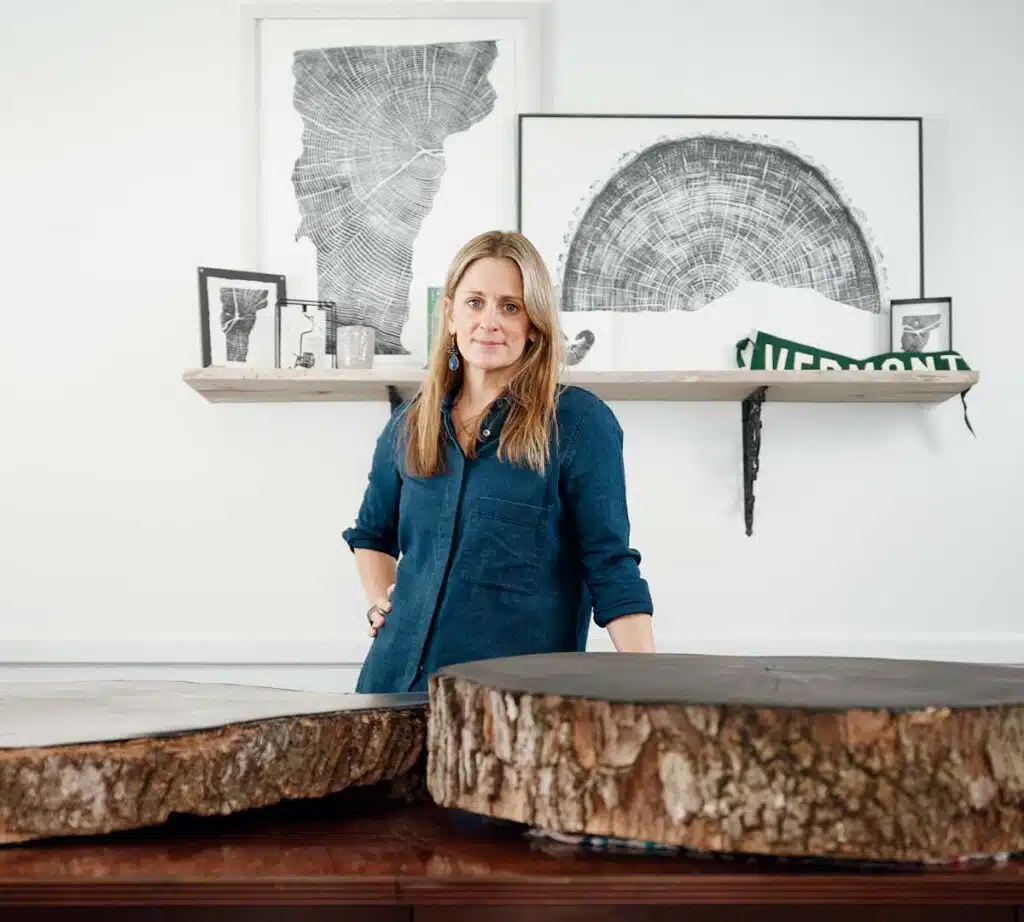
The origin story of Katie Babic Designs is deeply personal. Babic pulled her first tree-ring ink print from a cross section of a pine that had stood on her in-laws’ Vermont camp land for generations. Leaning into a trial-and-error process—which was inspired by a YouTube video of artist Bryan Nash Gill describing his approach to wood prints—the former school counselor taught herself how to sand, clean, and burn the wood’s surface to reveal the growth rings that create a defined, raised design. “It isn’t just an abstract form,” says Babic, whose prints can be seen in Hotel Vermont’s rooms and suites and at The Treehouse at Spruce Peak residences in Stowe. “It’s the story of a tree, and it’s intricately reflecting the rich arboreal memoir, revealing the journey through time and the ecosystem that nurtured it.” This nostalgic, eco-minded sentiment no doubt resonates with the customers who send Babic slices—also called “cookies”—of their own beloved felled oaks and maples for her to use in bespoke pieces.
Julie Morringello | Modernmaine
Deer Isle, ME
Credit: Dan Ratjer
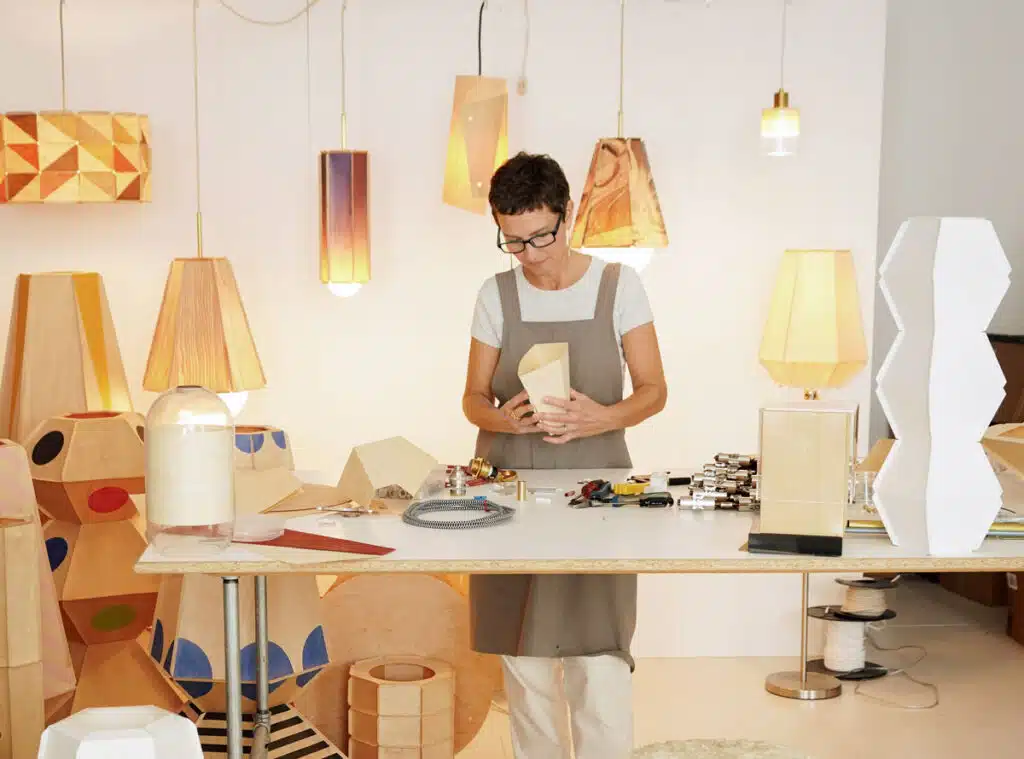
Self-imposed engineering challenges often spark ideas for Julie Morringello’s Modernmaine lighting fixtures. For the Pattypan, a large, round design that indeed resembles the squash of the same name, she was exploring flat forms that would open and find full expression with gravity. The curvy chandelier has become a signature piece for Morringello, a Rhode Island School of Design double graduate in industrial and furniture design who has been crafting pendants and sconces in her studio on Deer Isle since 2011. (Find her work installed at the Stonington Opera House and the 44 North café there, too.) Her creations have an organic-meets-modern vibe, mostly due to flexible wood veneer she uses in construction: “The warmth of natural materials is becoming even more important now that we’re a technological society,” she says. “They bring humanity to interiors.”
John Francis Welch | John Francis Designs
North Chelmsford, MA
Credit: Jenn Bakos
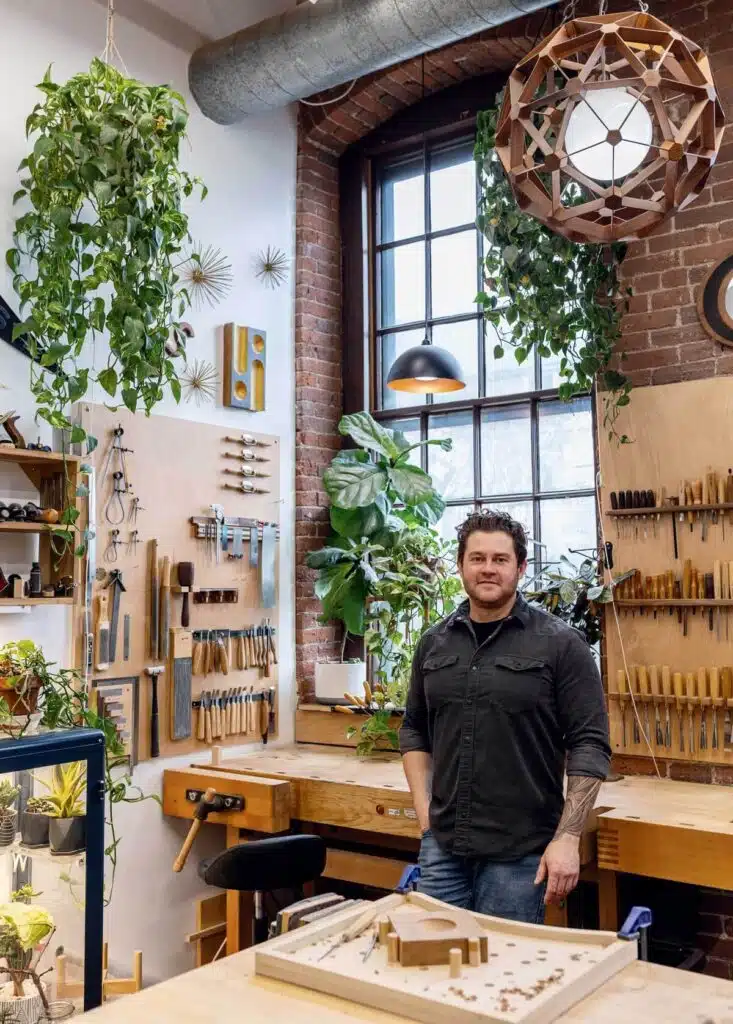
What do acclaimed chefs Tom Colicchio, Samin Nosrat, and Karen Akunowicz have in common? They’ve all purchased fanciful ravioli molds—mushrooms, hearts, and moons, oh my!—from Merrimack Valley–based John Francis Designs. While John Francis Welch started making wooden spoons in 2013, it wasn’t until the pandemic that he was inspired by the Ligurian stamped pasta corzetti to try his hand at carving pasta molds and later, gnocchi boards. (Welch also drew on his two decades working at a company that manufactures commercial pasta dies, where—claim to fame alert—he created the shapes for the Kraft Mac & Cheese SpongeBob SquarePants and Scooby-Doo varieties.) It takes a lot of trial and error to get the balance between intricate and durable right in his designs, he says, and his Instagram teems with videos of Welch filling, cutting, and cooking ravioli. “I don’t know if it’s my Yankee heritage, but I struggle to make things that don’t have a purpose,” he says. “It can be beautiful, but it needs to be functional.” Mission accomplished, deliciously.
Kai Kuwata | Kuwata Studio
Ridgefield, CT
Credit: courtesy of Kai Kuwata
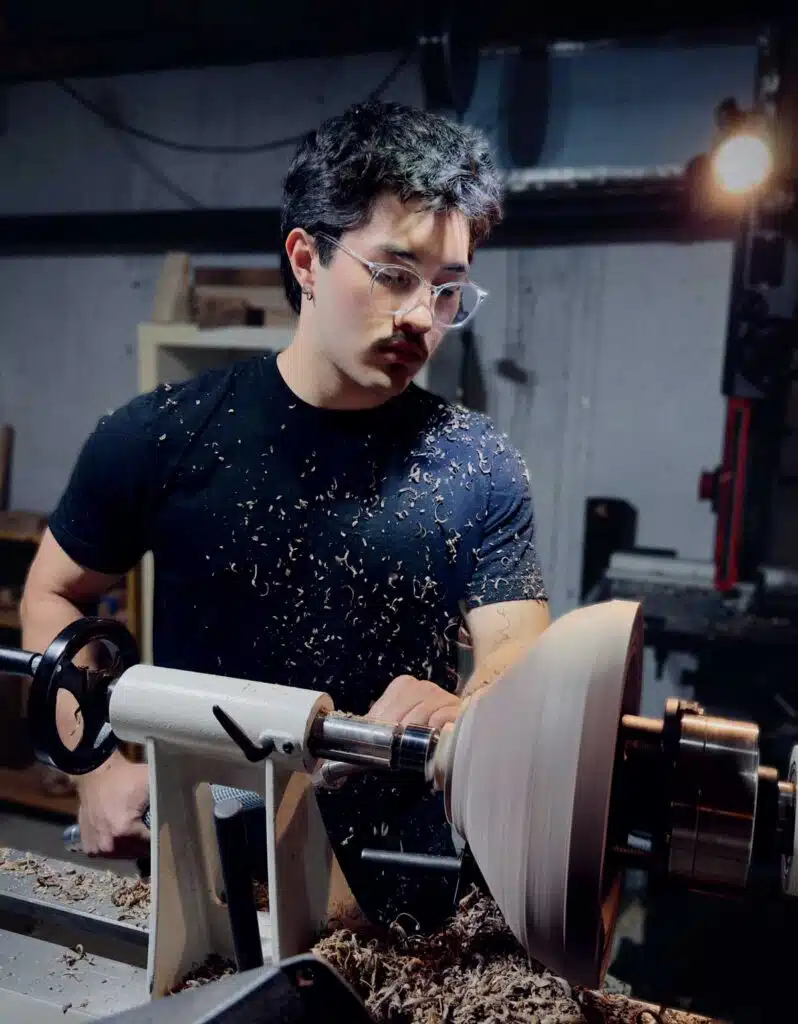
The kids, they say, are all right. Though still an industrial design student at North Carolina State University, emerging artist and wood turner Kai Kuwata already has a line of footed bowls and vases—all branded with his stylized “K” logo—sold at boutiques in western Connecticut (Olley Court, George). Kuwata grew up in Ridgefield, and during his first holiday break from college, he returned home to find that his father, a former carpenter, had purchased a lathe. “I literally took a piece of wood from the backyard and started to go at it,” Kuwata says. It wasn’t long before he was showing wares at the Made in Connecticut Expo and other markets and reaching out to stores he admired to carry his work. These days, Kuwata is experimenting with yakisugi, a traditional Japanese technique that involves deeply charring wood to make it impervious to rot, bugs, and fire—the resulting pieces are inky black and oh-so-chic.
Lincoln Pollock | Arcwood Jewelry
Warren, RI
Credit: courtesy of Lincoln Pollock
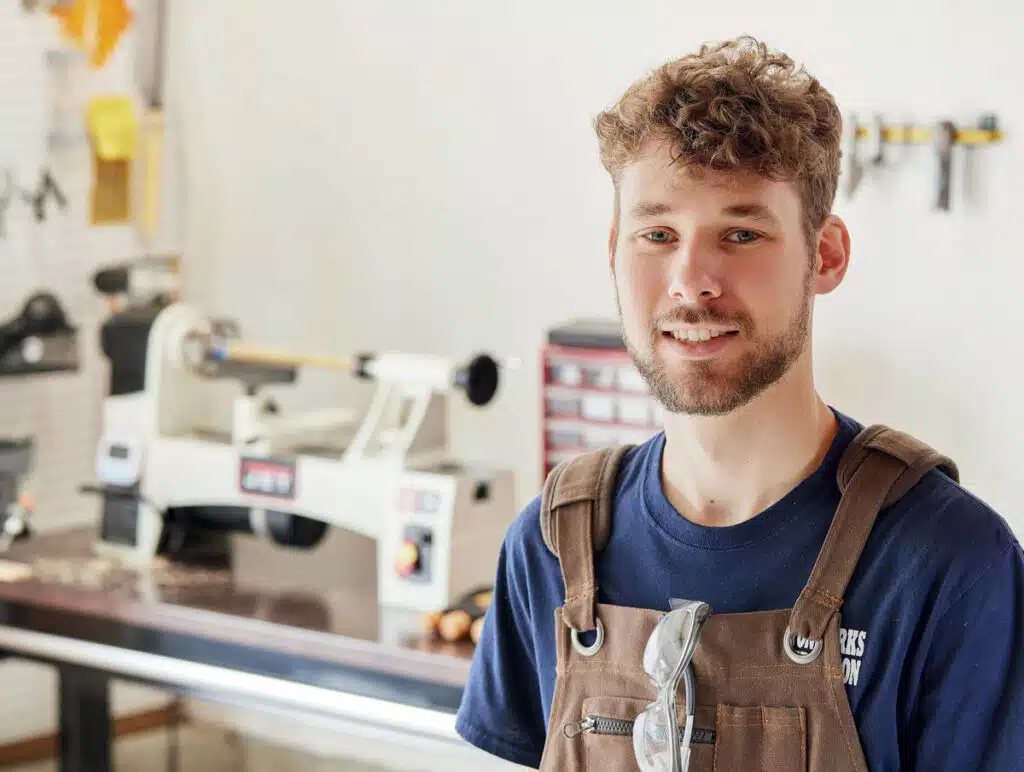
Lincoln Pollock’s current favorite material is grape wood. The self-taught jeweler recently created a white gold wedding ring incorporating grapevine from Sakonnet Vineyard in Little Compton for a customer who works there. “It’s just really, really cool-looking,” says Pollock, who launched his Arcwood Jewelry line three years ago. “And it has local significance.” Custom rings, often made with wood and totems provided by clients (glass broken in a Jewish wedding, pet ashes, guitar strings, sunflower petals from an engagement bouquet), are the bulk of his fledgling business, but he also fashions necklaces, earrings, and cuff links to sell at his Warren showroom and studio and other local markets. With its vertical slats of walnut, red oak, maple, and cherry accented by decorative grooves, the chunky “MCM I” pendant strung on black cord is a particular stunner—the design pays homage to a midcentury modern radio, according to Pollock.
This feature was originally published as “It’s All About the Tree” in the November/December 2026 issue of Yankee.