The Fantastic Forager: How Rhode Island Artist David M. Bird Turns Acorns Into “Becorns” Art
Harvesting materials and inspiration from the woods near his Rhode Island home, Becorns creator David M. Bird captures otherworldly images of wonder.
By Mel Allen|Dec 30 2025|

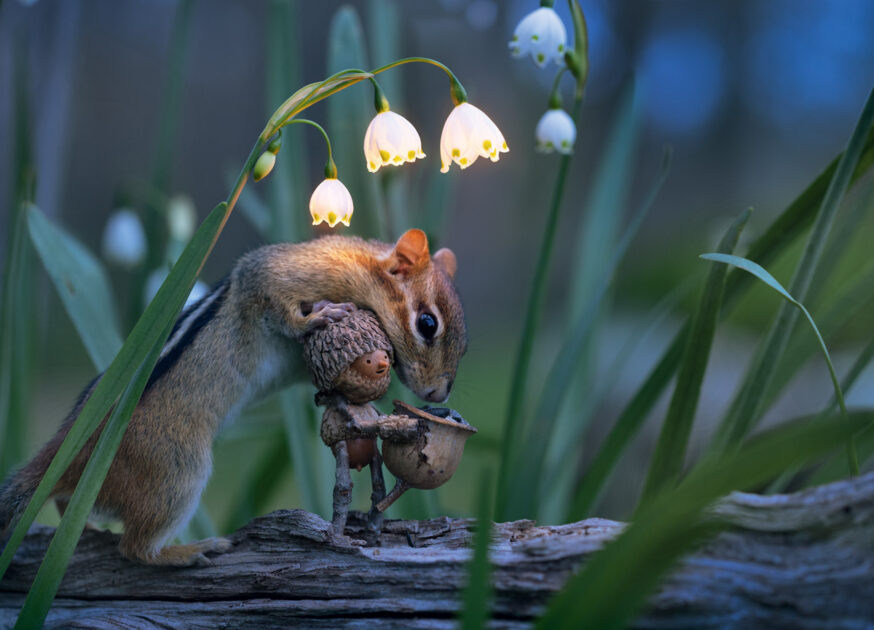
More than miniature works of art, Becorns are characters with their own personalities and ways of interacting with nature. Here, a chipmunk investigates seeds offered by Joonie, whom Bird describes as “a nurturer—she always seems to be feeding somebody.”
Credit: David M. BirdOn the day that would change his life forever, David M. Bird stood in his mother’s driveway, holding a broom. Just beyond, the Pennsylvania woods were littered with the remains of changing seasons: acorns, pine cones, seed pods, broken sticks and twigs. It was late summer in 2008 and Bird was nearly 30, standing at a career crossroads, uncertain what would come next.
Looking down at the tree nuts and other woodland debris he’d swept into a pile, he took in their textures and shapes. “Within the span of five seconds,” he recalls, “it went from Oh, that’s interesting, to I can create a world with this.”
And here is what Bird did next: He got a hot glue gun and made a bug from a stick, with leaves for wings and a pine cone abdomen. From that point onward, as he started going for walks in the woods, “everywhere I looked there were so many ideas. More than I could imagine.”
Gathering up bits of forest on his walks, Bird brought them back to his small apartment, where he had a workbench and tools, and began making—well, he wasn’t quite sure. But the tiny creatures that emerged, and who they might be and what adventures they might encounter, filled his mind.
Credit: David M. Bird
Credit: David M. Bird
Bird had returned to his small hometown 20 miles outside Pittsburgh, where his mother still lived, after five years working for Lego in Billund, Denmark. A Rhode Island School of Design graduate, he knew how to use the toymaker’s intricate interlocking components to design characters with storylines that kept children engrossed. But though he felt “I would never have a job I loved so much,” he decided to put down roots back in the United States and start a new life.
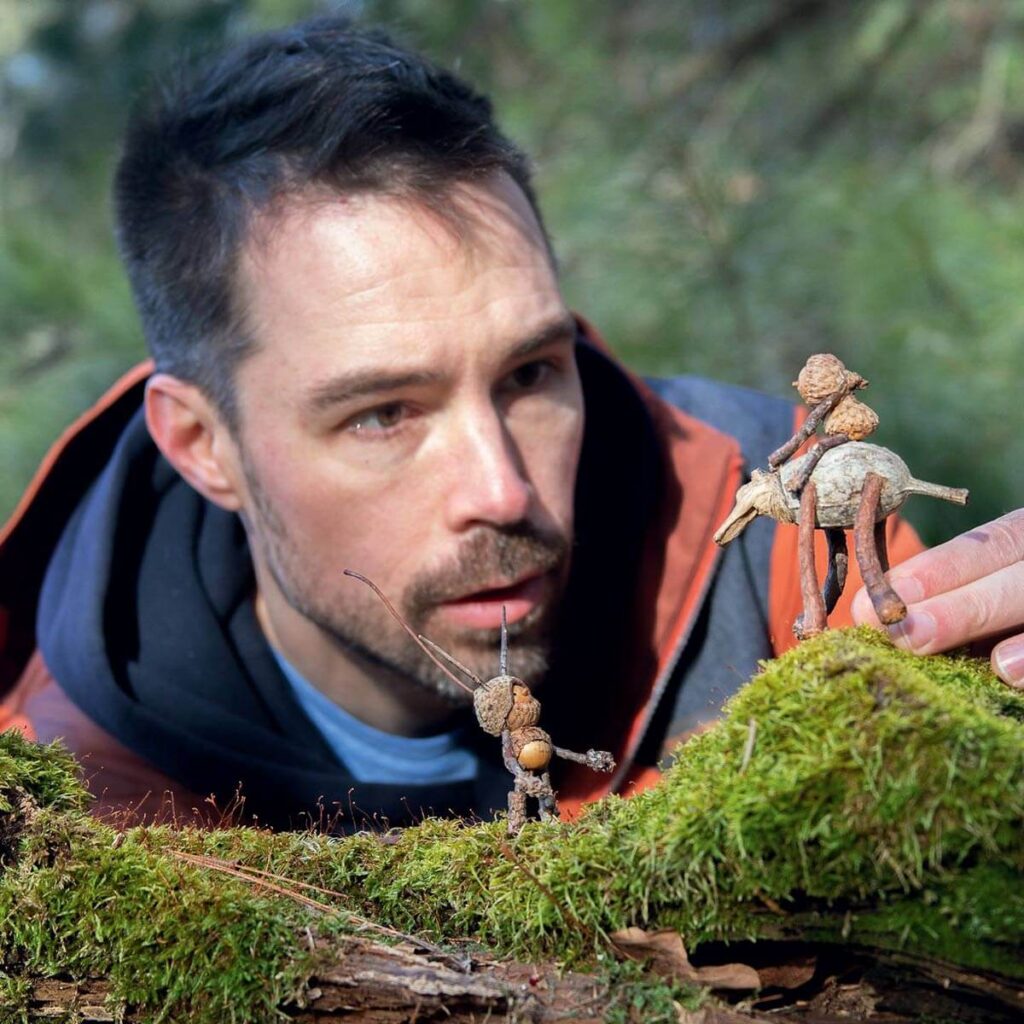
“One of my favorite parts of designing at Lego was thinking about what elements will make a picture and tell a story,” says Bird, a boyish 46 with tousled dark hair. “I knew, in that moment [of his first bug sculpture], I could do that with all this stuff everywhere in nature.”
Soon Bird quit his job at a local medical equipment design firm, and for a year he tried to write a children’s story with his little creations as the heroes. Called Becorns, they had names and personalities, and they always seemed to be on a quest of some sort. Bird knew from his Lego days that kids wanted stories about danger and adventure. He thought, What if these creatures grew from trees and from plants?
Credit: David M. Bird
“But I had no idea what I was doing,” he says of the writing project. “Every day I’d wake up and I’d try to make fleshed-out characters, and I’d fail.” Still, he went for long walks in the woods, eyes on the ground, conjuring stories from the forest floor, and he played with what he brought home. He told few people about his imaginings of tiny forest creatures, unsure of where his ideas might go.
* * * * *
Fast-forward to 2018. Bird had returned to the toy business, working in Rhode Island and living in Connecticut. He was married now, to Joy, a couples therapist, and she was pregnant with their first child. And that sparked something in him. “I knew I had a nine-month runway, so I did it: I left toymaking,” he says. “I felt people would like what I imagined. What I didn’t trust was that anyone would pay money to see it.”
Bird had no idea what would happen if he was wrong, if he was simply indulging in the fantasy life he’d found in the forest. But as he worked, he seemed to be imagining something completely new … yet familiar, too. In transforming acorns into faces and twigs into limbs, he was brought back to his childhood, a time when “I always loved wonder. I never wanted to grow up.”
Credit: David M. Bird
Credit: David M. Bird
Following his passion required close observation. He took photography classes and learned how to capture the Becorn scenes that were in his mind. He studied the habits of birds, squirrels, and other small animals around his home. He wandered through parks, scooping up what nature had dropped. He’d pull weeds and notice how the roots looked like tentacles. He saw hollowed logs and wondered, What if you were a woodland creature and the logs spoke to you?
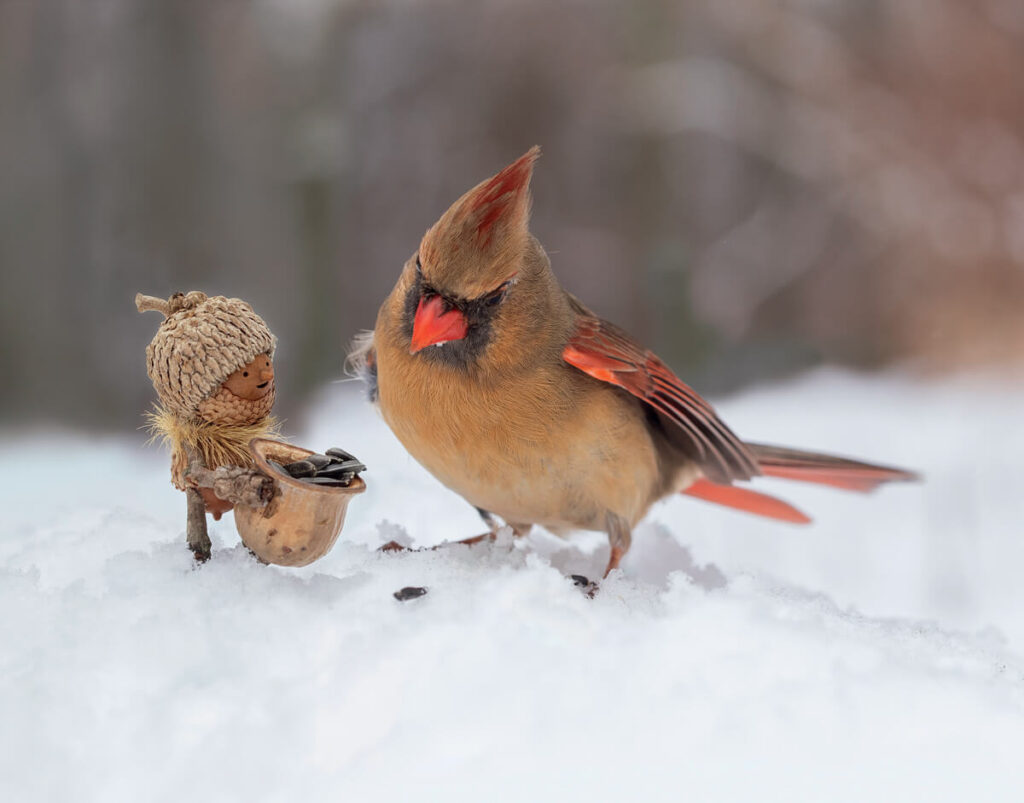
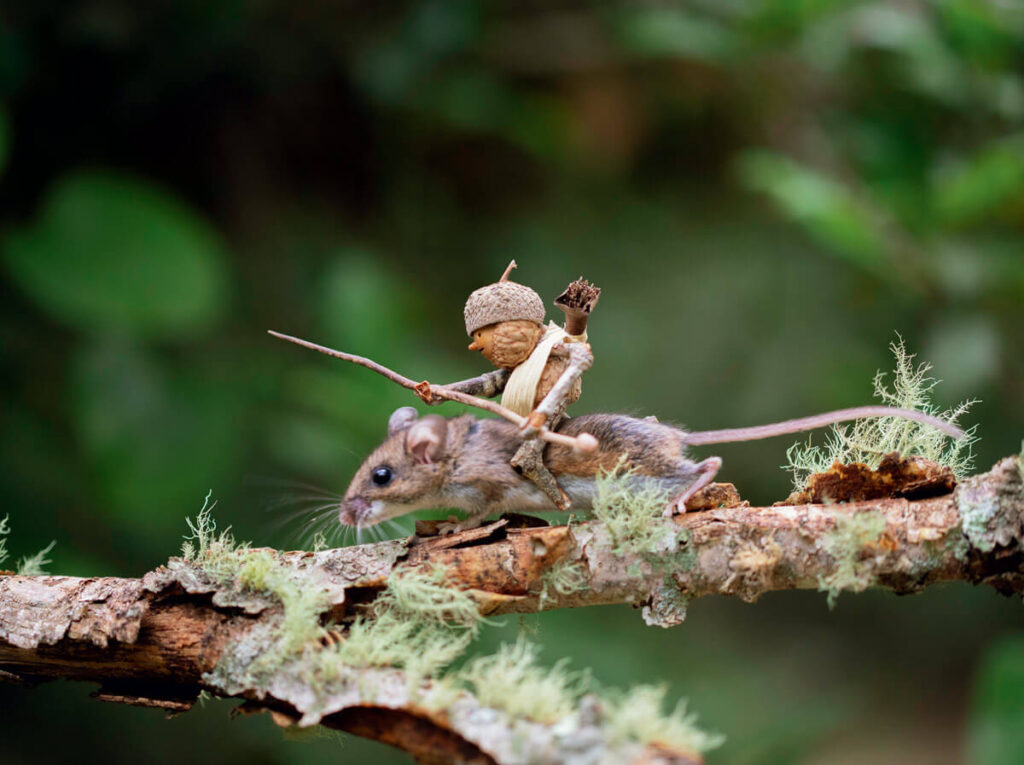
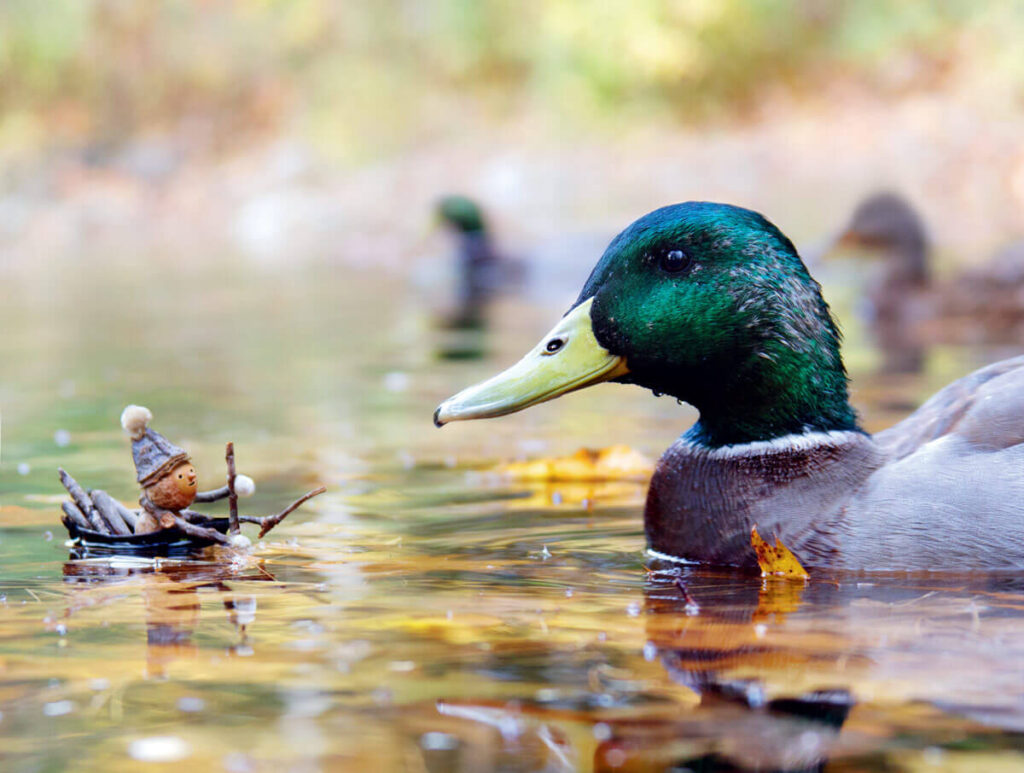
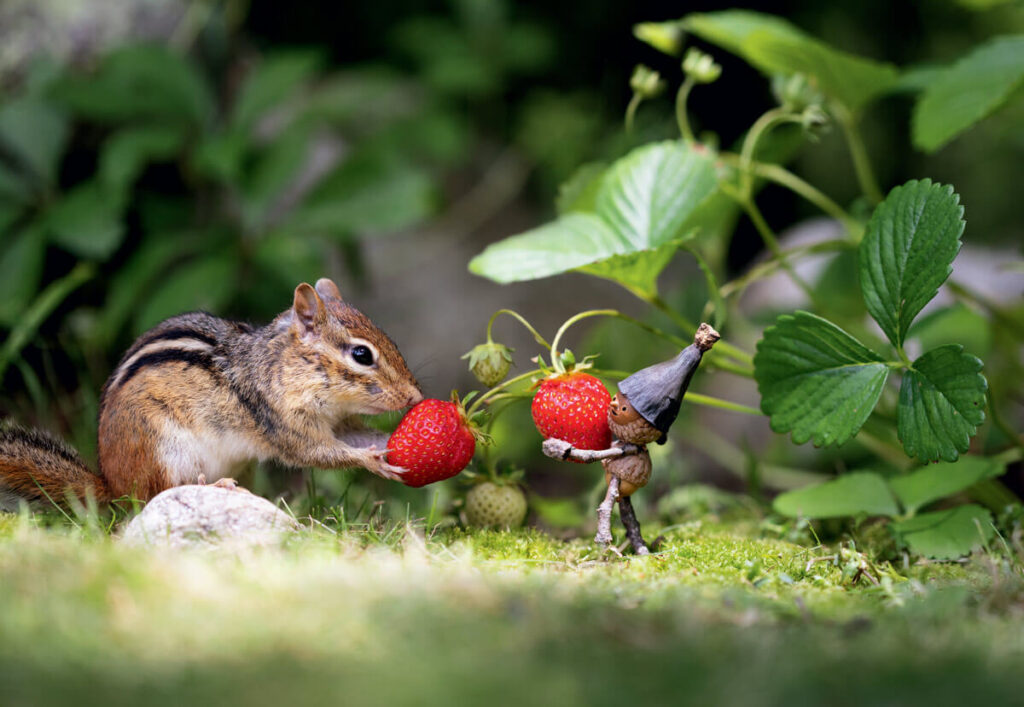
Bird took his Becorns into the woods just to see what would happen. Would any wild animals notice his creations—especially if he dabbed peanut butter around them? Sometimes, sitting for hours, he observed only stillness. Other times brought mishaps and misadventures (as when a squirrel bit the head off a Becorn). But there was also the rare thrill of seeing a bird alight on a Becorn’s cap or steal seeds from the pouch it carried, or perhaps a curious chipmunk stopping by—and nature, whimsy, and beauty would merge in a single moment.
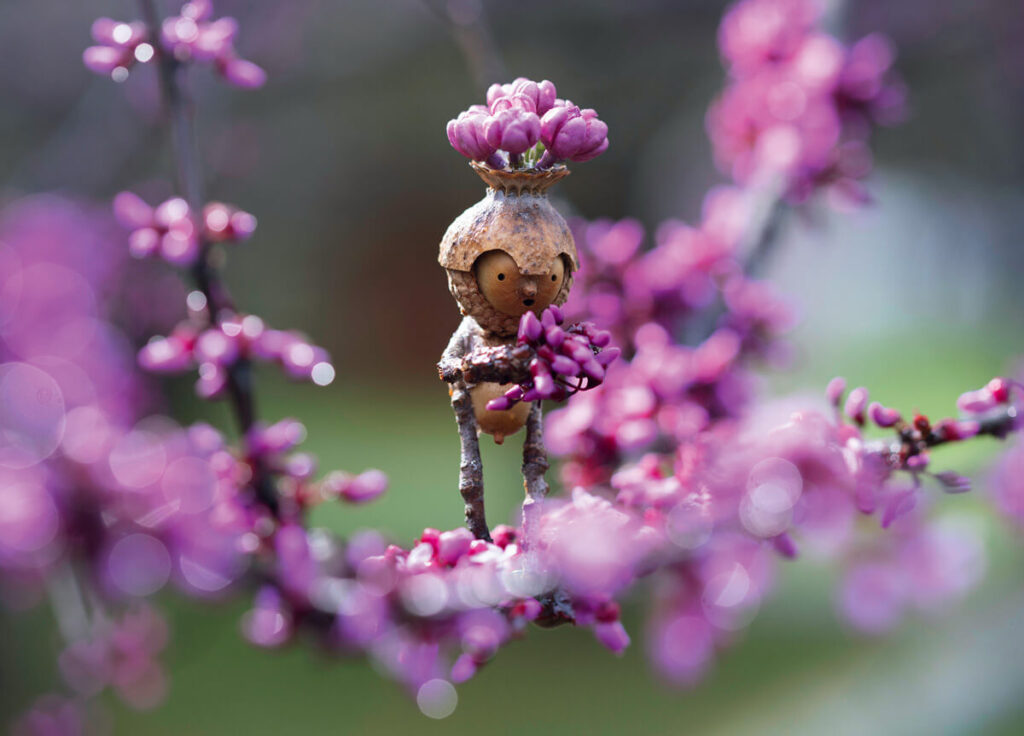
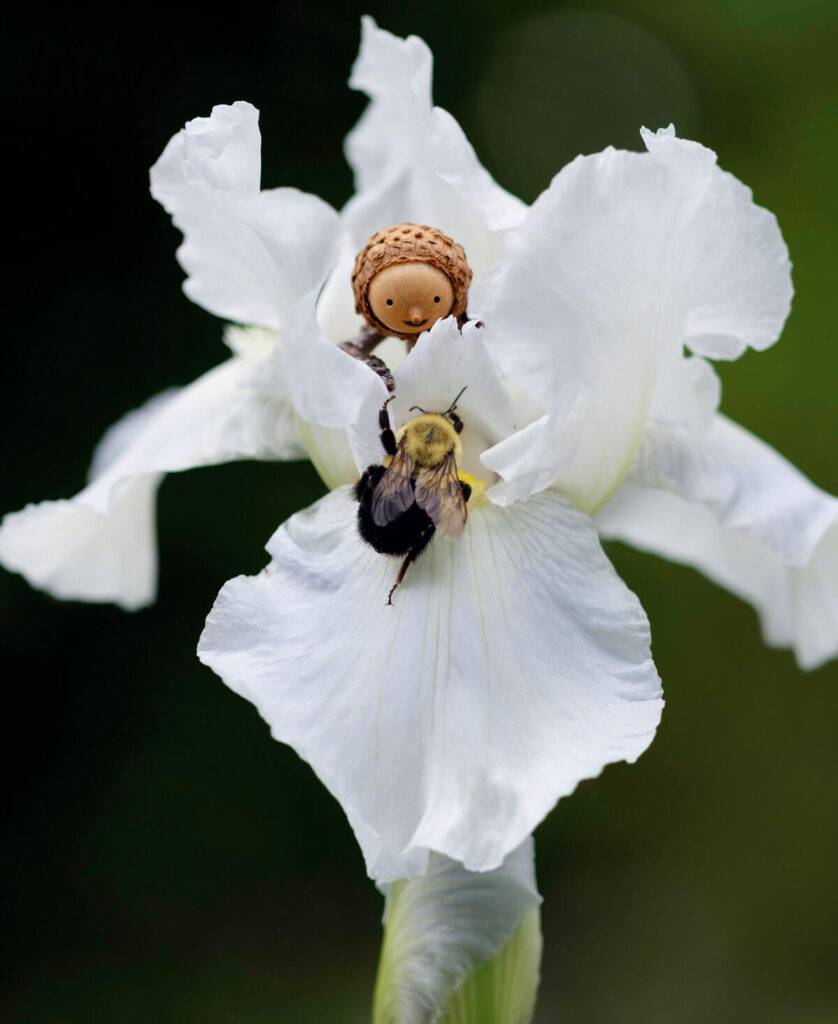
With the openness of a child and the discipline of an artist, Bird continued playing with the Becorns. He put them into different scenes—sitting on fruit blossoms, nestled in tree hollows—and waited out of sight for hours at a time, one hand on his camera’s remote control, to catch what happened. “I’ve learned everything about nature through Becorns,” he says.
Credit: David M. Bird
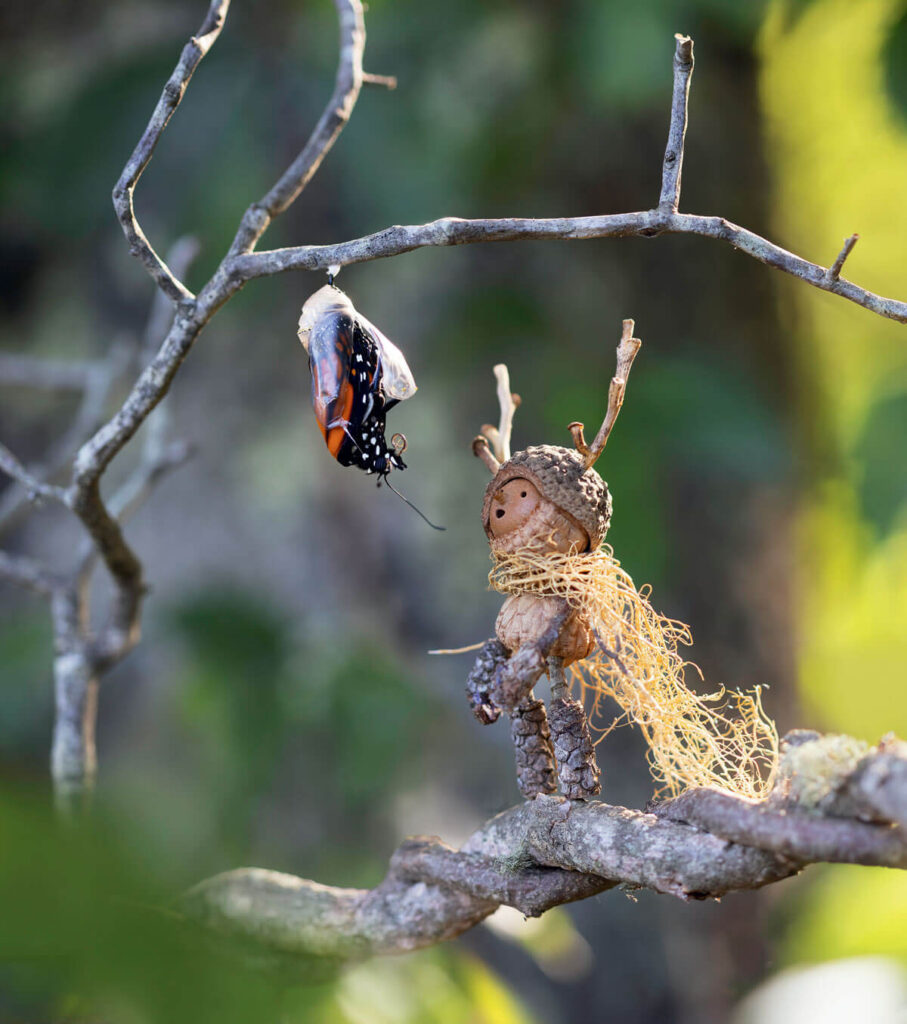
As his photographs climbed into thousands, Bird studied them to see which made his characters seem most alive. He discovered that a subtle tilt of a head, a slight twist of a twig, could make a still-life image feel animated. Personalities emerged: Dahlia, Dink, Pinkin, Bing … a dozen, then two dozen, then three. A miniature universe evolved, one that had never been seen before.
When Bird set up a booth of Becorn photos at a crafts fair in Putnam, Connecticut, in 2019, he was ready to share his secret. “This was the first time I’d showed what I’d imagined for years,” he says. “For the first time I heard people say, ‘This is amazing.’”
More crafts fairs followed, but the pandemic soon interrupted. Relocating with his family to Rhode Island, Bird began posting photos of Becorns on his website. He took a handful of orders a day for cards and photos and gradually built an online audience of 4,000 followers. Then, in early January 2022, he posted a short Instagram Reel of favorite Becorn moments set to music he’d composed and played. People watched it, and sent it to friends, who sent it along to their friends. And David M. Bird woke up one cold morning to another day that changed his life.
Credit: David M. Bird
“My phone ran out of batteries because it was constantly vibrating from Instagram notifications,” he remembers. “The numbers kept growing. The orders for prints poured in. I couldn’t keep up.”
Within a week, Bird had 400,000 Instagram followers. And among the comments from around the world that were posted to his account, one summed up a universal sentiment:
I hope that you are told every single day how freaking brilliant you are! Your work is breathtaking. It makes my whole day. Thank you.
* * * * *
On a summer day in 2025, with his followers closing in on two million, Bird leads a visitor through the basement workshop where his Becorn family resides; his wife and two young children are out enjoying a blue-sky day.
Bird’s tools—scissors, hot glue gun, pliers, drill, soldering iron—sit on a workbench. The stacked trays that typically hold bolts and nails are instead filled with hickory nuts, twigs, acorns, fern fronds, sticks, feathers.
He picks up a box of Becorns, piled like clothespins. Some need cosmetic repair, awaiting their return to the Becorn world. “Very unceremonious,” he says. “But they’re safe here. That’s the important thing.”
Credit: David M. Bird
Much of Bird’s creativity has its roots in loneliness, he tells his visitor. He talks about his years in a private school where he never fit in and spent all his free time in the art room. Just wanting to connect. And knowing what it is like to feel “so alone.”
But in the Becorn universe there is solidarity, community, compassion. And it clearly connects to an audience hungry for the same connection. With a dash of joy and humor. Who wouldn’t want more?
And indeed, there is always more. Bird says the Becorns might start growing their own houses, and he indicates a collection of small gourds that he wants to play with. He leads his visitor outside, and points to a cluster of blossoms. “Look at how the bees go inside the flowers. They like to sleep in them. I look and see little bee hotels.” He points to an oak tree. “Look at how that limb comes out. There’s a story to it!
“Every time I come outside, I get ideas. And I say, ‘I gotta do it!’”