



Yankee Classic: When Jaws Came to the Vineyard
To mark the 50th anniversary of Jaws in June 2025, we surfaced an unforgettable fish tale.
By Yankee Magazine|Jun 01 2025|

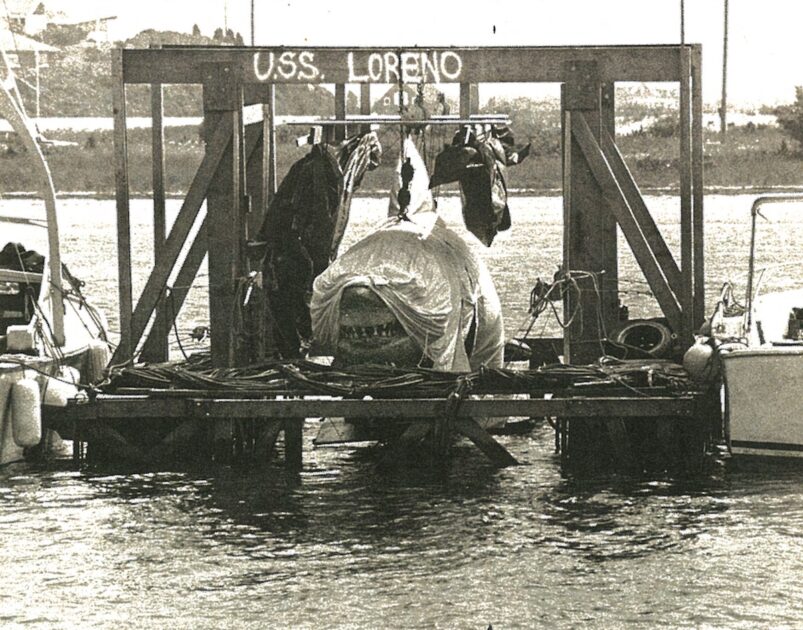
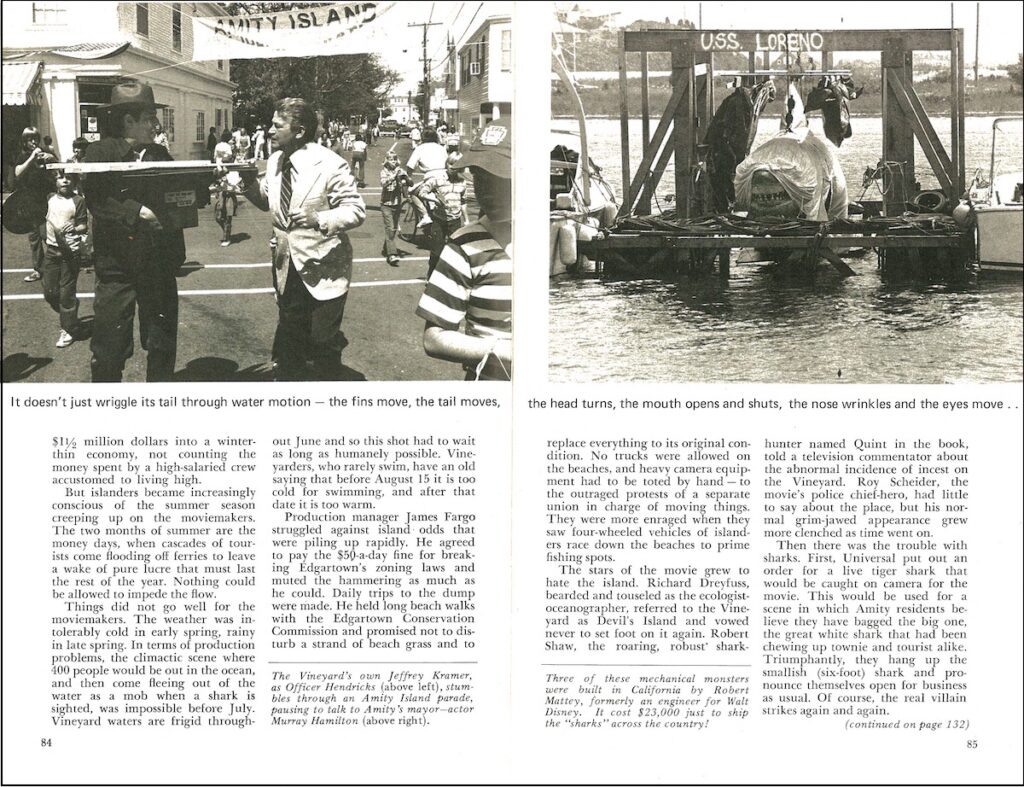
From “How to Spend a Million and a Half Dollars in One Summer on Martha’s Vineyard,” Yankee, May 1975: “Three of these mechanical monsters were built in California by Robert Mattey, formerly an engineer for Walt Disney. It cost $23,000 just to ship the ‘sharks’ across the country!”
Credit: Edith BlakeThis story appeared in the May 1975 issue of Yankee under the headline “How to Spend a Million and a Half Dollars in One Summer on Martha’s Vineyard.” The subhead was equally memorable: “What goes wrong when a Universal Studio movie production team tries to produce a highly complicated film starring a mechanical shark during the heart of the heaviest tourist season on record on Martha’s Vineyard? Practically everything.”
By Gerald R. Kelly
Residents of Martha’s Vineyard will suffer massive cultural shock when the Universal movie Jaws is released this spring. A great many of them have been in the movie from time to time, but they may not expect to see themselves transformed by cunning cutting and ingenious juxtaposition into the danger-be-damned burghers of Amity Island who foil attempts to protect the public by widespread warnings of the great white shark lurking just off the Island’s sunny beaches.

Vineyarders will have trouble, too, with orientation as they watch Jaws. The six towns of the Island have been chopped up in the movie and recycled as the single tourist town of Amity. Characters in the movie will get off the ferryboat in Vineyard Haven, walk directly onto an Edgartown street and into an Oak Bluffs store. A billboard erected on the far tip of the island, on the cliffs of Gay Head, will appear, in the movie, to be just outside the main town.
The beaches of Amity Island are peopled with thousands more oiled, steaming bodies than Vineyard beaches are accustomed to, with hot dog stands and garishly striped cabanas that could be an overdeveloped vision of the Vineyard ten years hence.
Hollywood invaded the Vineyard in April of ’74 after the art director, Joe Alves, had searched the eastern seaboard for the precise spot to film the bestselling novel by Peter Benchley. Director Steven Spielberg agreed with the choice. The quiet dignity of Edgartown whaling captains’ houses, the raffish elegance of the Oak Bluffs summer resort hotels and houses, gabled and gingerbreaded like old-time Mississippi steamboats, and the stunning visual impact of Gay Head cliffs would all be fed into the film as background.
The hitch was that the movie people came at the wrong time of the year. Cooler heads advised them to wait for September, but back in Hollywood the moguls insisted on starting in early spring and racing to finish before July 1. They missed their mark, reset their schedule, and tried to be off the island by August. In September, the last of the movie people were still out at sea, manfully filming the great battle between man and shark. They had run head-on into the heaviest tourist season on record and had suffered for it.
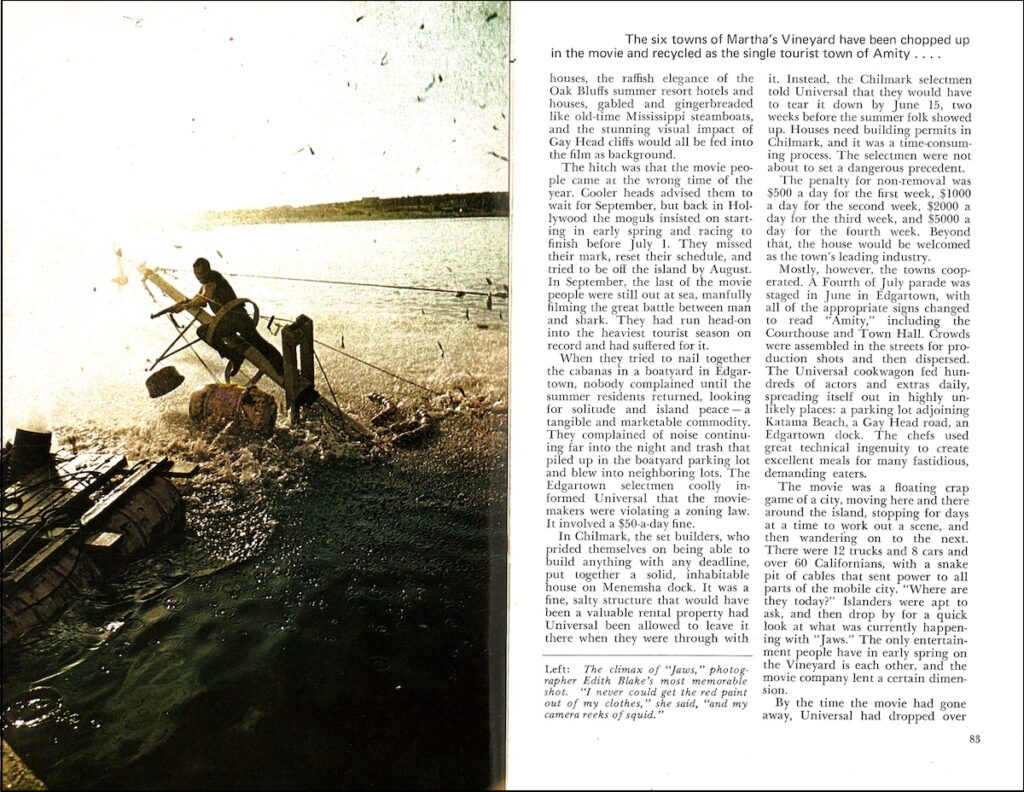
When they tried to nail together the cabanas in a boatyard in Edgartown, nobody complained until the summer residents returned, looking for solitude and island peace—a tangible and marketable commodity. They complained of noise continuing far into the night and trash that piled up in the boatyard parking lot and blew into neighboring lots. The Edgartown selectmen coolly informed Universal that the moviemakers were violating a zoning law. It involved a $50-a-day fine.
In Chilmark, the set builders, who prided themselves on being able to build anything with any deadline, put together a solid, inhabitable house on Menemsha dock. It was a fine, salty structure that would have been a valuable rental property had Universal been allowed to leave it there when they were through with it. Instead, the Chilmark selectmen told Universal that they would have to tear it down by June 15, two weeks before the summer folk showed up. Houses need building permits in Chilmark, and it was a time-consuming process. The selectmen were not about to set a dangerous precedent.
The penalty for non-removal was $500 a day for the first week, $1000 a day for the second week, $2000 a day for the third week, and $5000 a day for the fourth week. Beyond that, the house would be welcomed as the town’s leading industry.
Mostly, however, the towns cooperated. A Fourth of July parade was staged in June in Edgartown, with all of the appropriate signs changed to read “Amity,” including the Courthouse and Town Hall. Crowds were assembled in the streets for production shots and then dispersed. The Universal cookwagon fed hundreds of actors and extras daily, spreading itself out in highly unlikely places: a parking lot adjoining Katama Beach, a Gay Head road, an Edgartown clock. The chefs used great technical ingenuity to create excellent meals for many fastidious, demanding eaters.
The movie was a floating crap game of a city, moving here and there around the island, stopping for days at a time to work out a scene, and then wandering on to the next. There were 12 trucks and 8 cars and over 60 Californians, with a snake pit of cables that sent power to all parts of the mobile city. “Where are they today?” Islanders were apt to ask, and then drop by for a quick look at what was currently happening with Jaws. The only entertainment people have in early spring on the Vineyard is each other, and the movie company lent a certain dimension.
By the time the movie had gone away, Universal had dropped over $1½ million dollars into a winter-thin economy, not counting the money spent by a high-salaried crew accustomed to living high.
But islanders became increasingly conscious of the summer season creeping up on the moviemakers. The two months of summer are the money days, when cascades of tourists come flooding off ferries to leave a wake of pure lucre that must last the rest of the year. Nothing could be allowed to impede the flow.
Things did not go well for the moviemakers. The weather was intolerably cold in early spring, rainy in late spring. In terms of production problems, the climactic scene where 400 people would be out in the ocean, and then come fleeing out of the water as a mob when a shark is sighted, was impossible before July. Vineyard waters are frigid throughout June and so this shot had to wait as long as humanely possible. Vineyarders, who rarely swim, have an old saying that before August 15 it is too cold for swimming, and after that date it is too warm.
Production manager James Fargo struggled against island odds that were piling up rapidly. He agreed to pay the $50-a-day fine for breaking Edgartown’s zoning laws and muted the hammering as much as he could. Daily trips to the dump were made.” He held long beach walks with the Edgartown Conservation Commission and promised not to disturb a strand of beach grass and to replace everything to its original condition. No trucks were allowed on the beaches, and heavy camera equipment had to be toted by hand—to the outraged protests of a separate union in charge of moving things. They were more enraged when they saw four-wheeled vehicles of islanders race down the beaches to prime fishing spots.
The stars of the movie grew to hate the island. Richard Dreyfuss, bearded and touseled as the ecologist-oceanographer, referred to the Vineyard as Devil’s Island and vowed never to set foot on it again. Robert Shaw, the roaring, robust shark-hunter named Quint in the book, told a television commentator about the abnormal incidence of incest on the Vineyard. Roy Scheider, the movie’s police chief-hero, had little to say about the place, but his normal grim-jawed appearance grew more clenched as time went on.
Then there was the trouble with sharks. First, Universal put out an order for a live tiger shark that would be caught on camera for the movie. This would be used for a scene in which Amity residents believe they have bagged the big one, the great white shark that had been chewing up townie and tourist alike. Triumphantly, they hang up the smallish (six-foot) shark and pronounce themselves open for business as usual. Of course, the real villain strikes again and again.
To get even a tiger shark in the cold northeastern waters was impossible, and a shark had to be flown in from Florida after a half month of fruitless fishing. An attempt was made to transport it alive, by keeping a constant flow of water running past the shark to simulate the constant motion that a shark needs to keep afloat and oxygenated.
This was an ingenious effort, but the shark died. It was rich when it arrived on the Edgartown dock, rank when filmed, reeking when refilmed, and rotten when no longer needed. Efforts to keep it fresh by storage in a freezer each night had failed, and the cameramen were happy to see it pass into oblivion.
Later in the year, local fishermen were asked to bring in more sharks for a scene in which a shark would devour its own entrails, having been set up for this by the shark-hater, Quint. It was a shocking and effective scene in the book, but the movie people wisely decided against duplicating it in the movie—not, however, before the sharks for the scene had been collected.
Finally, the Boston Herald American put out a false alarm by telling its readers that a live tiger shark had been released into Vineyard waters by Universal, thus creating a swimming hazard to match that of Amity Island itself. Editorial columns in other papers denounced the sloppy journalism and noted that the story had originated in the publicity department of Universal Studios.
Meanwhile, the real great white shark was being filmed off the coast of Australia by Rod and Valerie Taylor, who also filmed “Blue Water, White Death.” They used a midget actor in one scene to make an undersized shark look as large as the great white shark of the book.
Secretly, three huge mechanical white sharks were constructed in California by Robert Mattey, a Walt Disney engineer for 17 years, who saw the three sharks as his masterpiece. Each one had a different section cut away to leave exposed the wires, pistons, and air hoses that cluttered the interior. The shark had to be able to leap out of the water and then dive instantly, and no solidly constructed shark could do that. The cutaway parts allowed water to drain out and refill rapidly. Three sharks were needed so that the whole, un-cutaway side of the shark could present itself to the camera from the left, the right, and head-on.
When Mattey finished the sharks, they were loaded aboard trucks and shipped to the Vineyard, followed by an anxious transportation manager. It cost $23,000 to get them to the island, where they were hustled under cover of darkness, to the upstairs loft of the boatyard. There, by order of the producers, Richard Zanuck and David Brown, they were placed under a 24-hour guard so that no one could photograph them. The producers felt that the shock of the shark on screen would be diminished if the public knew some of the shots taken were of mechanical sharks.
In the dim light of the boat loft, the sharks looked huge and ominous; each was 24 feet long – the size of a hefty whale boat. Their gaping mouths, filled with soft, plastic teeth, could easily hold a large third-grader.
Robert Mattey was proud of his creations—the hardest job he had undertaken, including the Victorian submarine for 20,000 Leagues Under the Sea. A heavy-duty air rammer worked the sharks’ jaws, and it had to be powerful enough to make them close properly. “We tried to make the jaws work fast enough to be realistic,” said Mattey, “but they had to be slow enough so that we could control them and not hurt somebody. There were going to be live people in there. We would have liked to cut the thing way down so that any resistance would have stopped the jaws entirely, but we couldn’t do that because of the construction.
“We had to use really strong springs to hold the shape of the shark. When the jaws close, the mouth goes from round to egg-shape, which is what the real shark does. Somewhere in this monster, the change in shape had to be absorbed, and this made the jaws very hard to shut. We had to get the necessary power to open and shut them. We have had one problem after another. We had them built practically before the plans were drawn for the movie. So we’ve got our neck out about four miles, and if anything should happen, we’re reserving cabins in Alaska.”
One at a time as needed in the script, a shark would be mounted on the end of an underwater crane which would propel it through the water and into the air. Mattey explained the operation:
“There’s a control barge where a lot of people who work under water can change clothes. And of course there is a big gasoline-operated compressor that will be running the shark. It all runs by air going to different rams and motors operating the shark. It doesn’t just wriggle its tail through water motion.
“We have to put power in so that the fins move, the tail moves, the head turns, the mouth opens and shuts, the nose wrinkles, and the eyes move. There’s a lot of action and it needs a lot of rams and motors to achieve it.”
In actual practice, the shark shirked its duties. The metal parts of the sharks and rams corroded in the salt water and had to be completely cleaned off each day. The skin of the shark had to be replaced each day too. Still the sharks would not work, and tales of despair and doom filtered through the Vineyard as the sprawling movie crew set out to sea from Oak Bluffs each day to try to finish the filming.
Finally the technical problems were all solved and the shooting went on, utilizing a boat called the Orca and its exact twin, except for the lack of a bottom. The Orca had to sink repeatedly so that the exacting director could get the exact shot he wanted. He sometimes spent six hours on the filming of an eighth of a page, where he might have filmed 9 to 11 pages a day for the television productions of Night Gallery. Spielberg is a movie-fan/director who grew up on the Hollywood fare and who created a great and classic chase movie in Sugarland Express. He sees “Jaws” as an epic of another sort, a sprawling, horror set piece designed to terrorize.
Robert Mattey, unaware that Spielberg was keeping the ending of Jaws a top secret (He told one writer, “I will save that as a gift for the American people.”), gave away the action: “We’re working on one shark that will be photographed underwater, weighty enough so that it will sink, and as he goes down to Davey Jones’ locker, he will be photographed. He falls on the rear deck of Quint’s boat (the Orca), and some diving bottles (compressed oxygen) roll down the deck and go into his mouth. Police Chief Brody, in the rigging, shoots the bottle and it explodes and blows the shark’s head off.”





John D Hancock was the original director and co -writer of Jaws 2 . His wife actress /writer Dorothy Tristan was a co- writer on the film as well. If they had remained on the project, their version would have ended up darker than the film did. They were fired by MCA/Universal head Sidney Sheinberg so he could hire his wife actress Lorraine Gary to be the heroine that saves the children. Dorothy used to take her two children to the Cape for sailing lessons and to visit her “Aunt” Mabel Nichols. John would go to the Cape every year to have a reunion with his Harvard classmates.