Window on an Island Soul: Inside the World of Jamie Wyeth
For Jamie Wyeth, the ability to create art relies on being left alone. Yet at 79, he continues painting masterworks in the company of his family legacy, his muses and memories, and his dreams.
By Yankee Magazine|Aug 26 2025|

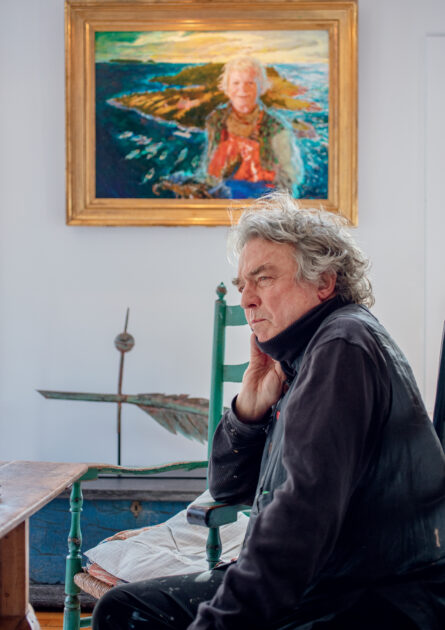
Jamie Wyeth at his house in Tenants Harbor, Maine. In the background is his 2024 portrait of the late Linda Bean, granddaughter of L.L. Bean and a devoted collector of work by Jamie; his father, Andrew Wyeth; and his grandfather, N.C. Wyeth.
Credit: Peter RalstonBy Philip Conkling
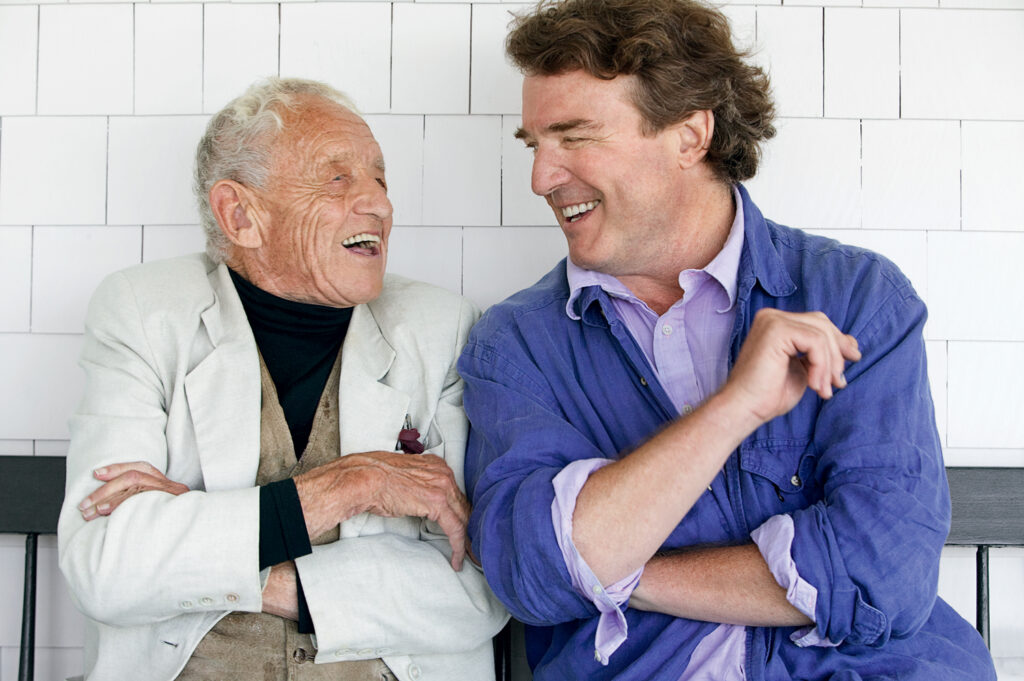
A two-lane country road winds along the eastern edge of the St. George River peninsula, where three generations of the Wyeth family have lived for more than a century. It’s mid-March, and the noted photographer and my longtime friend Peter Ralston and I are headed down this long peninsula to meet Jamie Wyeth as spring grasses are greening the banks of the blue river and the hardwoods and conifers show signs of new growth. I have known Jamie for more than 30 years, Peter for more than twice as long, and Jamie has agreed to a wide-ranging conversation about his life in Maine, his art, and his family.
N.C. Wyeth, widely considered the greatest illustrator of his time, was a gregarious promoter of art—both his own and others’. His son Andrew Wyeth was intensely private and insular, and Jamie, Andrew’s son, is much the same. He especially hates interviews, because he fervently believes that if you want to paint, you simply need to be left alone to work. His perpetually paint-stained fingernails are a testament to that focus. But he has made an exception for two old friends.
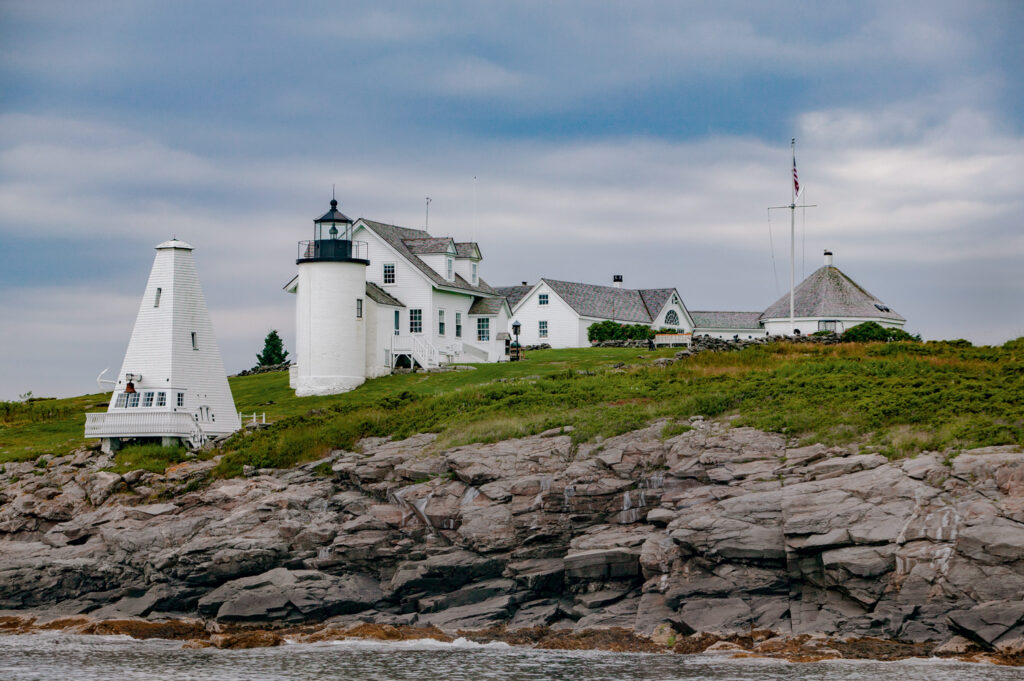
We are meeting Jamie most of the way down the peninsula at what he calls Inshore House, in Tenants Harbor. In the raw spring air, Jamie has motored in from his studio on Southern Island at the mouth of the harbor. Jamie and his late wife, Phyllis, bought and renovated Inshore House in order to have a mainland base that offered easy access to the studio on Southern and to their outermost aerie on Monhegan, where, following his first, and hugely successful, show in New York in 1965, Jamie bought Rockwell Kent’s house.
We sit around a small dining room table, which is surrounded by Jamie’s paintings and sketches, old and new. Hanging on the wall over his shoulder is his portrait of the late Linda Bean, granddaughter of the founder of L.L. Bean; she was an island neighbor and an energetic collector of Wyeth paintings, especially those of N.C. Both in appearance and in his art, Jamie more closely resembles his grandfather than his father. Like N.C., Jamie paints in oils, not tempera, and he dresses in the kind of midcalf trousers that his grandfather wore, albeit with sly updates featuring mismatched multicolored stockings and assorted buttons sewn on his vest. His early preference for N.C.’s work over his own father’s was straightforward: “The Knights of the Round Table were more exciting than dead crows,” he explains.
Although Jamie built a studio out on Southern Island that may have been inspired by Thomas Jefferson’s architecture, he bristles at the notion of maintaining a studio as such, or any kind of dedicated workspace that might confine his painting. He simply works with fierce energy and attention wherever he goes. But islands, surrounded by wind-whipped seas that are often in turmoil, “give me focus.”
Credit: Peter Ralston
Now approaching his eighth decade, Jamie Wyeth cannot escape his place among his family’s three generations of primacy in American art. His paintings are part of the collections of the National Gallery of Art, the Fine Arts Museum of San Francisco, the Museum of Fine Arts in Boston, and Crystal Bridges Museum of American Art, among others. In 1963, at age 17, Jamie painted Portrait of Shorty, an astonishingly haunting depiction of loneliness. He followed that a few years later with Draft Age, a portrait of a young man looking defiant, the embodiment of rebellion, then gained wide recognition with his posthumous Portrait of John F. Kennedy (1967).
Jamie’s early portraits were followed by Portrait of Andy Warhol (1976) and the panther-like Rudolf Nureyev (1977). These paintings became icons, too, because they captured not just their subjects, but also the times and sentiments embodied by the lives of these two remarkable figures. Lincoln Kirstein, the arts impresario and a founder of the New York City Ballet, called Jamie the finest American portrait painter since John Singer Sargent—a statement initially greeted with derision by the New York art world, but now generally well accepted.
In all families, death is a marker: the irrefutable punctuation point of a before and an after. N.C.’s death at a railroad crossing in 1945 sent a bolt of lightning through the family. In more recent years, Jamie has weathered other significant losses. The passing of his father and best friend, Andrew, in 2009; his wife, Phyllis, in 2019; and a year later his mother, Betsy, following a long and debilitating illness.
In Greek mythology, the muses were nine sister-goddesses who were the stewards of the arts, science, and literature—and they were worshipped at places called museums. As surely as Betsy Wyeth was Andrew Wyeth’s muse, so Phyllis was to Jamie. Nevertheless, Jamie is quick to point out the difference between these two indomitable Wyeth women. “With Phyllis, the great thing she did for me was to give me complete freedom,” he said. “She had certain things she liked and disliked about what I was doing, but it never was on a level of ‘remove this’ or ‘do that,’ which was the case with my mother and father.”
Unlike Phyllis, Jamie’s mother, Betsy James Wyeth, for whom he was named, was intimately involved in every aspect of Andrew’s artistic career. She immediately established herself in family lore as the 18-year-old raven-haired beauty who married 22-year-old Andrew and released him from the domineering grip of his father. For this, N.C. would never forgive his daughter-in-law. “He hated her,” Jamie says, “for taking the chosen one away,” a family tragedy that was sadly never resolved. But then in the next breath, Jamie expresses wonderment that his mother, Betsy, “ends up devoting many years of her life to N.C. Wyeth” by painstakingly collecting, editing, and footnoting his voluminous letters and then publishing them in 1971 as The Wyeths: The Letters of N.C. Wyeth, 1901–1945.
As much as Andrew adored—even hero-worshipped—his father, his “whole drive was not to use a lot of color, not to use flashy effects. He was fighting against that view of art,” Jamie says. He mentions a favorite family story about Andrew’s early tempera Turkey Pond (1944). The painting features a lone man, back to the viewer, striding through a field of dried grasses painted in a palette of dark green-black shades, dry browns, and muted gray-blues. When Andrew showed it to his father, “N.C. said, ‘Put a gun in the man’s hand and have a dog bounding beside him. Put some clouds in the sky, for Christ’s sake.’” Although Jamie understands that his grandfather was naturally worried his favorite son might not survive as an artist with such austere painting style, ironically Turkey Pond was soon recognized as the precursor to Andrew’s most famous tempera, Christina’s World (1948). “N.C. Wyeth completely missed what his son was trying to do,” observes Jamie. “And this 18-year-old girl [Betsy] caught it and said, ‘Stick to it.’”
Betsy became Andrew’s frequent model, the mother of his two sons, and his business partner. Jamie marveled that his mother “was my father’s editor right up to the very end. I flippantly said one day that Betsy Wyeth should have also signed his paintings, but now I really believe it. I mean, really, she was that much of an influence on him.” Looking at Andrew’s final tempera, Goodbye (2008), which shows a sloop trailing a slight wake, sailing away from a small harbor, Betsy told her husband: “Take the boat out of it.” Jamie agrees with his mother’s assessment. “He should have,” he says.
Credit: Peter Ralston
After Jamie’s own wife, Phyllis, died, “people from museums came to me and said, ‘Can we do an exhibition of paintings you did of her?’ And I said, ‘Well, I don’t think I did that many.’ I thought maybe there were ten or something, but I had done hundreds.” He was shocked when he began sifting through the many studies and portraits of her, beginning with Portrait of Phyllis Mills (1967), which he painted several years after they had first met and followed with scores more over their five decades of marriage.
Even as a young teenager, Jamie says, he was obsessed with his future wife. She was beautiful; she came from Wilmington, Delaware’s du Pont clan; she was an accomplished equestrian; and by the age of 20 she was working in the Kennedy White House, commuting to Washington from her home in Virginia. In 1962, Phyllis’s life changed irrevocably when she suffered a broken neck in a car accident, after which she had to rely on crutches or a wheelchair to move around.
“I first met Phyllis when I was 15 or something,” Jamie recalls. “I remember going to their house, where there was some dancing. I finally got up the courage and asked her to dance. That’s kind of where it started.” A bit later, Jamie went to a fancy horse race called the Maryland Hunt Cup hoping he might see her. He borrowed binoculars from somebody and spent the whole afternoon staring at her with his back to the track. “She had this elusive quality,” he recalls. “She always was a bit detached from what was going on around her. She was fascinating.”
Jamie goes on: “Phyllis hated ‘the du Pont thing.’ She couldn’t bear that, which I always felt was a loss for her, because they’re a remarkable family. The interesting thing to me, reading about them, is that most of the women were the strong ones in that family. After the family came to this country, it was the women that really pushed the men. Phyllis was like that—she was a driven person. Her attitude was that you’ve got to leave a mark; you have to make a difference. It’s just beyond me how she came out of the same womb as her sister and brother—they had none of that.”
After her injury, Phyllis endured many operations to improve her mobility and alleviate chronic pain. As a younger person, “she was very athletic, skied like mad, jumping horses, racing horses, and so forth. That gave her at least a knowledge of the motor skills she needed to use after the accident,” Jamie says. He remembers visiting Phyllis at a rehabilitation center in Chicago after one of her most serious operations. “They said, ‘There is no physical way she should be walking. How is she propelling herself? She physically does not have the ligaments and the muscles to do it.’ But it was really through sheer determination that she got around. If she fell and somebody wanted to help her, she would say, ‘Please don’t touch me.’
“Phyllis was a huge inspiration to me,” he continues. “There was always something that was firing her up and then firing me up.”
Two of Jamie’s early celebrated portraits of Phyllis, Looking South (1977) and Parasol (1979), both depicting her sitting on the porch of the Kent house on Monhegan looking out at the endless expanse of the sea, are filled with a sense of deep longing. Most moving of all, though, is his painting of Phyllis in Southern Light (1994), which captures her in the doorway of the island’s bell tower with a far-off look of pride in her eyes and a roiling sea behind her. “That painting was precipitated by a terrible operation that she didn’t want to have and thought would be fatal,” Jamie recalls. “Her look was like, I can’t believe I survived this. I immediately stopped what I was working on and ended up doing lots of drawings. It only lasted for a few days, but it was the look of rebirth.”
During the past few decades, many of Jamie’s paintings seem to have gotten more dreamlike. Nightmares, we need not be reminded, are also dreams. Some of his darker dreamscapes have keyed into the ravenous appetites of gulls, the artist’s constant companions on both Southern Island and Monhegan. In a series of paintings created between 2005 and 2008, he depicted the atavistic behaviors of herring gulls as the seven deadly sins in works titled Anger, Gluttony, Lust, Envy, Sloth, Greed, and Pride. The series began after he woke up from a night of feverish dreams. “There were all these papers scattered all over the bedroom floor with scratchings on them,” he says. “They looked like hieroglyphics, but then I realized they were gulls. And I had written the name of one of the deadly sins on one. That’s why I keep paper with me all the time in my bed. That dream was very real.”
Last year Jamie spent much of the fall and winter months on Monhegan, which “to me is an amazing place,” he says. “It has a primeval quality, particularly on the cliffs where you’re urged to want to fly out. It is a feeling that upsets me.” His most recent painting, Leap, completed during the winter of 2025, followed a vivid dream triggered by a tragic event on the island. The painting is of a single figure, ambiguously androgynous, launching themselves into the air off the dark cliffs of Monhegan. Is the figure jumping toward death, or is this an ecstatic leap of freedom—a rebirth?
The leaping figure is reminiscent of one of Jamie’s early models, Orca Bates. Three decades ago, he painted at least four remarkable portraits of a teenaged Orca, who grew up with his family as the sole inhabitants on Manana Island, on the other side of Monhegan’s small harbor. Jamie used Orca as his model for a beautiful androgynous portrait, Orca Bates, 1990, in which the young man sits in profile, naked, in front of the jaw of an enormous whale. A dozen years earlier, in 1978, Jamie had painted Phyllis in front of that same enormous jaw, with giant shadows of its weathered bone lengthened in the reflected light. There will be those who see in Jamie’s most recent painting, Leap, the figures of both Orca Bates, strong and graceful, and a vibrant Phyllis Wyeth, reaching out to the infinitely receding horizon that rounds a circle back to its beginning.
As we finish our visit with Jamie, I am always reminded of how much of a pleasure it is to be in his company. He is intimate, mannered, discursive, and deeply learned. As we take our leave, we pass portraits of Phyllis and other paintings in a personal gallery off the back end of Inshore House that leads to an exquisite lap pool where Phyllis used to swim. There is such history and depth in all of these paintings, which serve as screened windows into the imagination of an increasingly enisled artist. Although Jamie does not need to explain his work to anyone, those of us onshore see the ghosts of his past close by, and know his dreams are more vivid than ever as his widening wake follows him back to his island.
This feature was originally published as “Window on an Island Soul” in the September/October 2025 issue of Yankee.