Here in New England with Mel Allen
Few have explored the soul of this region quite like former Yankee editor Mel Allen, whose new collection of writing says as much about the author as it does about his subject.
By Yankee Magazine|Aug 26 2025|

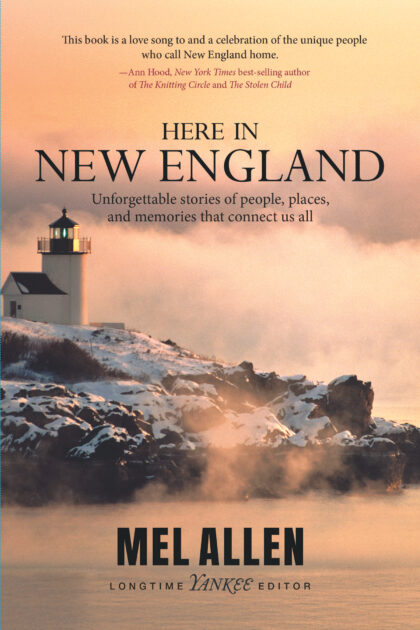
Here in New England: Unforgettable stories of people, places, and memories that connect us all.
Credit: Courtesy imageMel Allen’s New England origin story begins in an unlikely place. It was the summer of 1969, and the Pennsylvania-born Allen was in the final year of a Peace Corps stint on the sweltering equatorial coast of Colombia. One of the few places to find relief from the heat was the air-conditioned local movie theater—which is where, on one July night, Allen caught the film Camelot, and a flickering first glimpse of his future.
“I recall nothing else from this evening, except that seeing the snow—even if Hollywood fake—jolted me,” writes Allen in the introduction to Here in New England, a new anthology of his Yankee stories. “I knew then that I wanted to live where there was snow and changing seasons. Soon after, I was in a library where they had books from the United States, and I picked up a photography book, and there it was—a Maine winter landscape.”
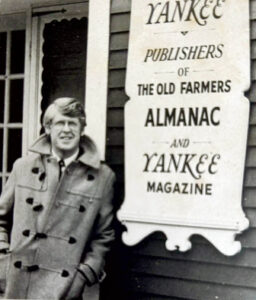
Just a few months later, there he was: newly married and newly arrived in Maine to start a life that eventually, unexpectedly, would make him one of the most identifiable and indelible chroniclers of life in New England. Much of that, of course, took place at Yankee, where Allen worked for 46 years, the last 19 as its editor.
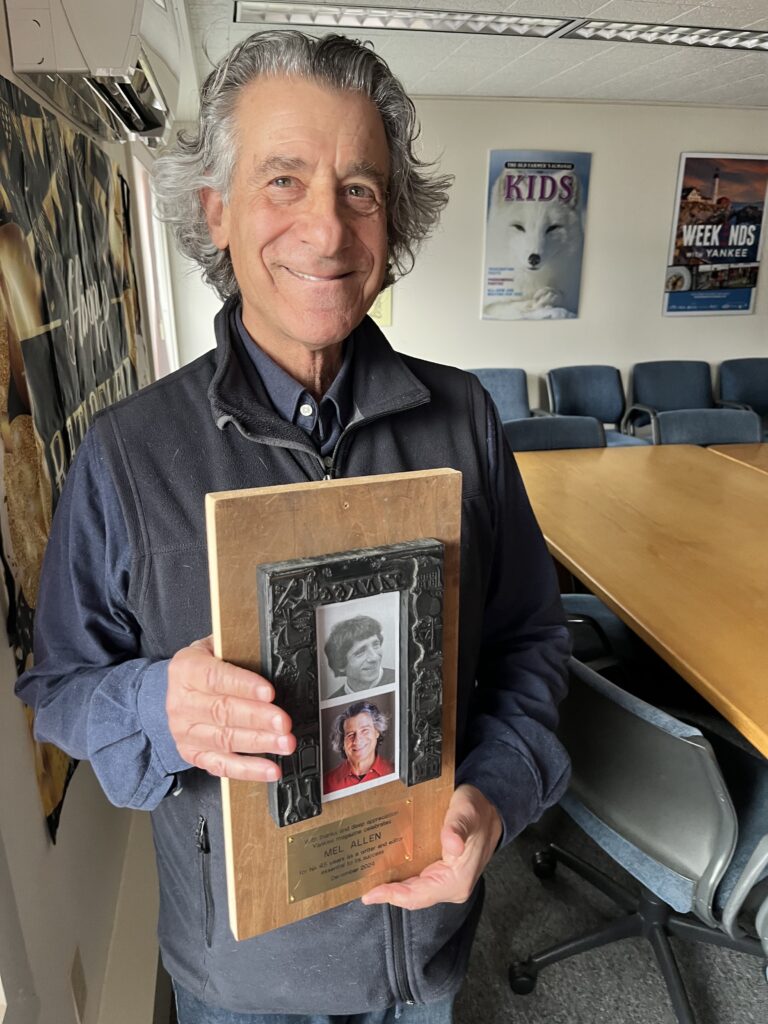
If you know Yankee, you certainly know Allen’s work, which includes many of this publication’s most memorable stories over the past half century. Portraits of famous and everyday New Englanders alike. Poetic odes to seasons and ways of life. And on it goes. The breadth and beauty of Allen’s writing can’t be fully captured in a single book, but the 45 stories in Here in New England make a respectable attempt.
“These aren’t my favorites, because I don’t have favorites,” Allen says. “They’re just stories I’m really proud of.”
Selecting them was no easy task. He reread his work, of course, but he also sifted through piles of old notebooks and tape-recorded interviews. (Among the treasures unearthed was the entire shoot that his first wife, Carole, a photographer, did of Stephen King and his family in the early 1970s.) “It was like watching old home movies,” Allen says. “I saw how people were. I heard how they talked.”
And something else emerged from his research, something his fans have already long since recognized: a portrait of a caring, careful writer who made people understand and appreciate New England and New Englanders a little better.
“I really respected the people I wrote about,” says Allen. “I liked being with them. I knew I wasn’t there to write their stories; I was there for their stories to be told to me. I wanted to know what it felt like to be them and to see the world through their eyes.”
Through this book, Allen was once again able to do that. And now we can, too. —Ian Aldrich
Editors’ note: The NewEngland.com Store is offering a limited number of signed copies of Here in New England, which also can be ordered from the publisher, Earth Sky & Water LLC, or your favorite local bookstore. For more information, including a schedule of author appearances, visit melallennewengland.com.
Excerpts from Mel Allen’s Here in New England
To mark the fall 2025 release of Here in New England, the September/October issue of Yankee featured a number of excerpts from the book, including a 1979 profile of Stephen King and a 1981 visit with the family of hockey star Mike Eruzione. Three of Allen’s shorter pieces—all essays, a format that makes the most of his storyteller’s voice—appear below.
When the Red Gods Call
Putting this classic foliage essay in context, Mel Allen observes, “In fall we use active verbs to describe what nature gives us: We say the foliage explodes, erupts, pops, bursts, blazes—and sometimes it is hyperbole, but every autumn there is that week, sometimes two at most, when it is not.”
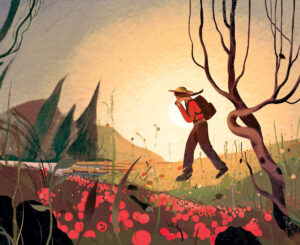
. . . New England is an understated region. We have no special festive weeks, no Mardi Gras, no Kentucky Derby. What we do have to set us apart has always been with us—fall. The color marching up the hillsides, the morning snap of cold that gives way to warm afternoon sun, the startling sight of leaves blowing across our path, giving bounce to our step. Feeling so alive, we enjoy spending money: hundreds of millions of dollars flow into our states in a few short autumn weeks. Our towns and villages have long prepared for the tourists. The inns are fully staffed. We hold harvest suppers and crafts fairs, pumpkin festivals and classic-car shows. Apple orchards, where we once came simply to pick fruit, have become family entertainment centers—a carnival of mazes, hayrides, and hot doughnuts fresh from the deep fryer. If summer days are carefree, autumn is when we feel most alive.
Many visitors are lured here because there is genius behind the marketing of our fall colors. To not be here, say the tourism campaigns, is to miss out on something rare and special. Every Columbus Day weekend, typically the season’s final hurrah of peak color, more than half a million visitors squeeze into New Hampshire. Locals call them “stall-and-crawl” leaf peepers. But we feel pride that so many people want to see what we live with every day.
Yes, fall foliage is hyped. But know this: All the hype is valid. There are hundreds of white-sand tropical beaches in the world, hundreds of ski mountains, many great cities. But nowhere on Earth can you duplicate the duration and the intensity of color we see in New England. We know the season is fleeting, we sense that urgency, our hearts race a bit faster driving northward into the color. Be there, our hearts say, or it will be gone. It is our most intimate love affair with nature, a few weeks each year when we can do nothing but admire what the sun and soil and cold offer to us. All of our technology cannot alter nature’s way with our leaves, and we love it all the more because of that. You never know exactly what you will see. Each tree, each bend in the road, each pond, each meadow—each brings the possibility of something new.
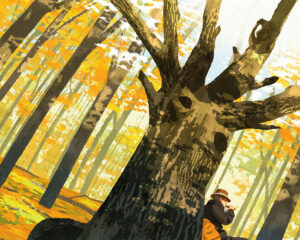
It is the time when we really notice what’s around us. When people ask me the secret to enjoying these weeks, my reply is simply notice. Pay attention. If one tree lacks fire-engine red—the prima donna of our colors—notice the variations of color: the russets, the pale purples, the soft yellows, the tinges of green. The magic of a New England fall lies in the shadings, all the colors in between the exuberant scarlets.
I write this in late October. The full foliage season in the North Country is gone. The vacancy signs have returned outside the inns. When I drive my sons to school in the early morning, I see more bare branches than I do trees with color. But there, in the heart of town, on the lawn of a bank, stands a sugar maple—with barely a leaf missing. It may be the most beautiful tree I have seen this year. Tomorrow it may be different, and I know that soon the leaves will lie in thick mats around its trunk; the gray threat of winter cannot be stopped by this single sugar maple in town. But as long as that single tree holds on, then I will, too. If you’re chasing after peak color, I’d say, come today. It’s all here, on this one tree by the bank in the center of town. (From Yankee’s special edition “Seasons,” 2003)
The Keeper
Though Allen’s work for Yankee saw him traveling to virtually every corner of New England, some of his most poignant stories were found close to home, giving readers a glimpse of a writer who was also a son, and a husband, and a father.
In my family I am the keeper. When loved ones die, I am compelled to bring them home, or at least their belongings. The odds and ends that cluttered their lives now clutter mine. I tell everyone to stay alive as long as possible; death enough already, and my house is too small.
Pushed against a wall by the stairway in my house is a white leather chair. Its size, color, and style are at odds with the rest of the place. In daylight I say it must go. At twilight I know it must stay. Every evening for 40 years my father sat in that chair, his feet on a hassock, turning the pages of his newspaper, taking his ease.
I do not play golf, but I keep his clubs in the attic, covered against dust, just in case. Beside them are boxes of textbooks from his college days and cartons of papers and documents. Sometimes at night I carry a light to the attic and pore over the papers like a scholar, looking, I suppose, for the man I never knew—Albert Allen—before my birth. I find the report of his army physical, dated February 27, 1942. He was 34. I hear echoes of my father’s pride that helped kill him nearly 40 years later: “Applicant states he has not consulted a physician in past five years.”
We took the same size, so I had to make room in my closet for nine shirts and two sports coats which in six years I have yet to wear. I wanted my younger brother David to take the clothes, but three years later he, too, was gone and there were more things to keep than I could bear.
I loaded his things into an 18-foot U-Haul and drove 1,500 miles north to New Hampshire. Sleeping in motels along I-95, I half-hoped that someone would break in and drive that cargo away; yet three times I’d wake in the night to peer out the window, afraid it was gone.
I should not have waited to give his records away. We had eight years between us, and a generation in musical taste. These albums, several hundred of them, I do not play, but for three years I have cared for them, making certain they would not warp. I have needed a friend to take them away, the way a friend will take your dog to the vet to be put to sleep. David’s bookshelf, still filled with his books, crowds the dining room; it would be easier to give them away if he hadn’t written his name in so many of them in that loopy scrawl I used to joke about.
Friends who are not keepers don’t understand why these things hang around, what with so many auctions and flea markets and Goodwills. I make no defense, for I don’t really understand myself why I have kept drawers full of T-shirts with rock stars emblazoned on the chest. A friend, a keeper too, said he gave away his mother’s furniture but kept everything that told a story: a knitted wool hat, a scarf, a miniature porcelain swan boat.
My son was born last September. In his room is a beige rug with patterns of flowers hooked by my father the year he retired; on the rug is my brother’s rocking chair. Late at night we sit in that chair, rocking; while he quiets, the past quiets too. I named my son for his uncle David and his grandfather Albert. He keeps them for me now in his eyes, in his smile, in his squawks of anger. When I have to move the memories I’ll just pack him up; today at least he weighs just 10 pounds. (Yankee, February 1986)
The Light We Love Most
Yankee celebrated its 80th anniversary in 2015 with a special issue called “80 Gifts New England Gave to America,” whose tributes included this essay on Maine’s Nubble Light. In a land of lighthouses, there may be no finer love letter.
Barely 200 feet from the shallows of Long Sands Beach, Cape Neddick Light perches so handsomely on its bony 2.8-acre nest of Nubble Island that we call it simply “Nubble Light.” Maine boasts more than 60 standing lighthouses, but Nubble Light may well be the one we love most.
In 1977, when the Voyager spacecraft blasted off for Jupiter and beyond in search of possible alien life, their capsules carried photos to show what we revered here on Earth. Among those photos: the Great Wall of China, the Grand Canyon, Nubble Light. The lighthouse and the keeper’s house are on the National Register of Historic Places and are engraved on York’s town seal, as if to say: Nubble belongs to the country, but here is its home.
The keepers of the light who lived here from 1879 until the last Coast Guardsman left in the summer of 1987 felt that this was their calling. They tended the French-crafted Fresnel lens as if it were a child, polishing its light until it shone like gold. Sometimes winter blew fog that blanketed the knoll for weeks. The keepers knew that the safety of ships depended on their keeping Nubble’s red light glowing 15 miles out to sea. At dawn, they’d extinguish the light, watch the sun creep over the water, and start their chores.
Nubble Light is at its finest on a blue-sky day when the ocean scent makes simply breathing worth the trip. Stop at tiny Sohier Park on Nubble Road. Ahead you’ll see the gleaming white tower reaching 41 feet high, and beside it the trim, red-roofed keeper’s house, a few outlying sheds, and a white picket fence, as if the lighthouse stood on a shady neighborhood street.
Lighthouses have become icons of our yearning, speaking to us of lives spare and romantic at the same time. We wish we lived there; we know we cannot. So we carry the light inside, no matter where we live. (Yankee, September/October 2015)
This feature was originally published as “Here in New England” in the September/October 2025 issue of Yankee.