Key Priority
How Yankee’s founder built a world of words, one clickety-clack at a time.
By Yankee Magazine|Aug 26 2025|

By Jamie Trowbridge
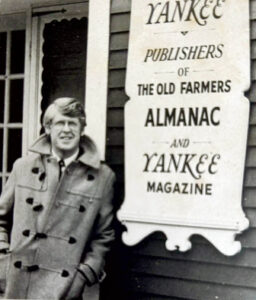
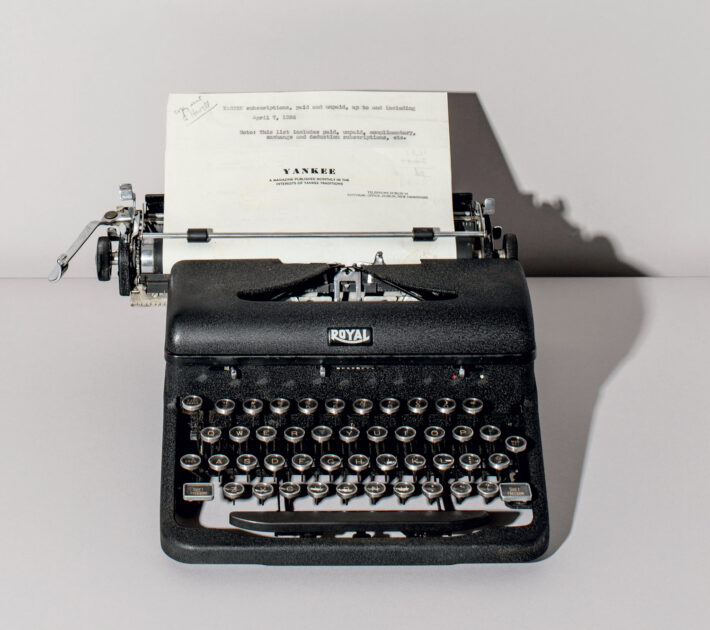
At its start in 1935, one man and one typewriter was all there was of Yankee.
Robb Sagendorph founded the magazine in an act of frustration. He wanted to write for his favorite publications, but his ideas for articles were rejected. So, he tore out the pages of those magazines and used them to insulate the walls of the one-room studio he built next to his home in Dublin, New Hampshire. And if he couldn’t write for other magazines, he’d sit down at his typewriter in that little building and start his own.
He had a good idea for a magazine. Sagendorph worried that the growing homogenization of life in America at that time would overwhelm the characteristics of New England he treasured—“its independence, its wisdom, its humor, and its resourcefulness.” Celebrating the values that make New England distinctive is what Yankee was and is all about.
There was a lot to type. Letters to friends and family, asking for support. Letters to local authors, inviting them to submit articles. Typing and retyping manuscripts, preparing them for typesetting. Volume 1, number 1 of Yankee featured works of fiction and poetry, articles about industries in New Hampshire, instructions for contra dancing (“General grace and willowness are to be sought after as the dances are anything but slip shod”), the script for a short play, and a rambling screed titled “Dreams and Observations” with “The Collector” as its byline.
Today, magazines are designed to be visually engaging. But in 1935 it was all about the words. Sagendorph needed more people—and more typewriters—to produce the second issue of Yankee. And after that, even more people and typewriters.
Business success was a long time coming. Sagendorph could never have made it without the family money provided by his wife, Beatrix, a talented artist who also produced Yankee cover art and illustrations. Yet it was still all about the words, pounded out on typewriters until one day in the mid-1980s when Yankee’s photo editor, of all people, brought the first word processor to the office. Yes, the computer age had arrived—but Sagendorph’s enduring vision would continue.
This feature was originally published in the September/October 2025 issue of Yankee.