Goodbye to a Grand Laker
It can be hard to let go of an old boat, especially when it’s a piece of Maine’s legendary sporting heritage.
By Wayne Curtis|Jun 28 2026|

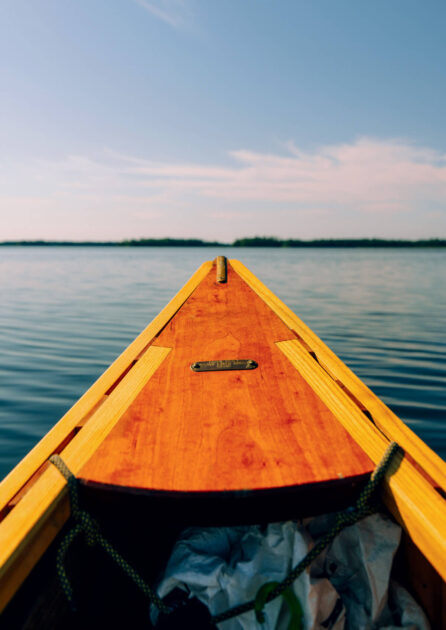
"Goodbye to a Grand Laker" by Wayne Curtis
Credit: Mat TrognerNo one is sure of the exact date, but just about a century ago, the very first Grand Laker canoe was built in the village of Grand Lake Stream, Maine.
This was a momentous occasion. Since at least the late 19th century, Grand Lake Stream, located in far eastern Maine near the Canadian border, had been a celebrated destination for sports fishermen. (“Grand Lake Stream is known in every corner of the country where there is an enthusiastic lover of the game fish,” reported an Oklahoma newspaper in 1912.) Tweed-wearing anglers arrived by train, boat, and buckboard, then hired local guides, who would take them uplake aboard wood-and-canvas canoes in search of elusive landlocked salmon and other prized catches.
Because the lake system was so vast—one could paddle more than 20 miles through various bays and narrows and past looming rocks before running out of lake—a steamship would tow the canoes a few miles north, then leave the guides and sports to disperse into remote coves to fish. At day’s end, everyone would meet back at the steamer to get back to town in time for dinner at one of the fishing lodges.
In the early 1900s the first commercial outboard motor came on the market. This was disruptive, especially if you operated a steamboat in Grand Lake Stream. It meant guides could now get up the lake with reasonable haste and without having to work around a steamship’s schedule. Of course, beamy motorboats weren’t as nimble as canoes, and guides still needed to put up the motors and paddle into the rocky coves in search of fish.
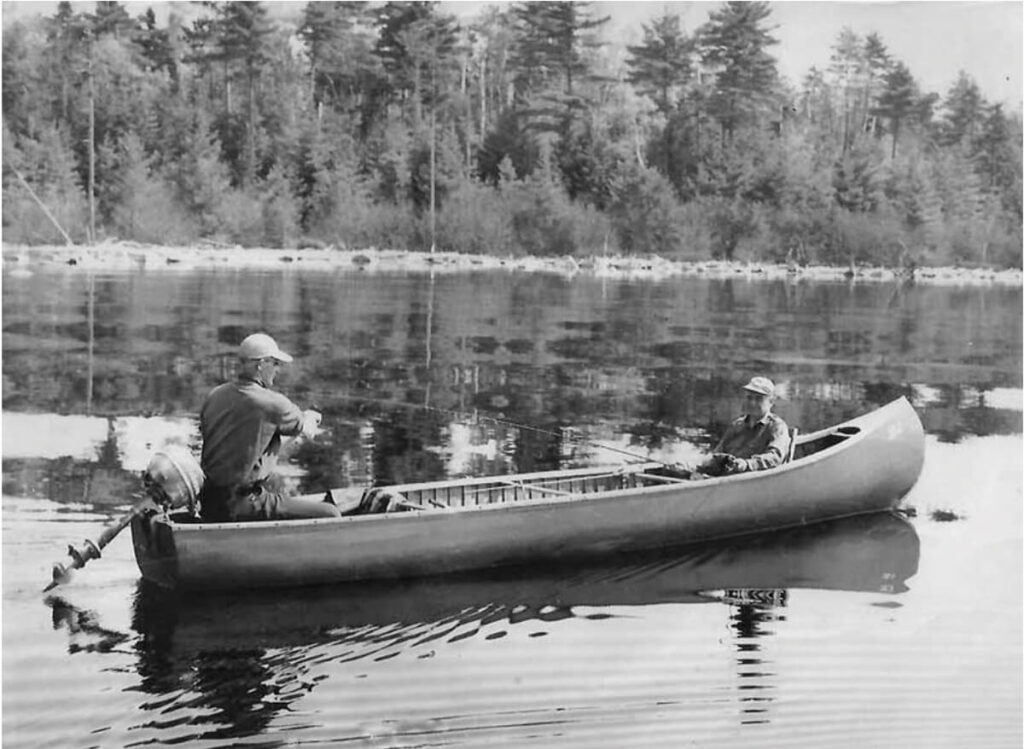
The Grand Laker was the result. One end of a traditional double-ended canoe was sawed off and a stern plate installed for mounting a motor. The first of these boats had a tiny stern, not much more than half a dozen inches across. These boats were exceedingly tippy. Then local canoe builders started building them with both big lakes and heavy motors in mind. They made them 20 feet long to handle the northwest winds and rolling swells that could arise unexpectedly. And they added a bit of girth for stability and to maintain a shallow draft. A Grand Laker could comfortably accommodate a guide at the stern, plus two sports up front, sitting low in the hull.
Grand Lakers developed a cult following among anglers, and a minor cottage industry producing them flourished in town. Guides would lead sports in the fishing season, then spend winters building boats, both to use and sell. Hundreds were produced in small woodshops and converted garages in this small village over the decades. Each canoe builder first created a mold on which to bend the ribs and set the gunwales, and over the course of years, subtle differences crept in: the upsweep of the gunwales, the width of the stern, the rocker of the hull. Not that an outsider could tell—they all looked pretty much the same to most people. But the folks in town knew one boat from another the same way you’d know your own children.
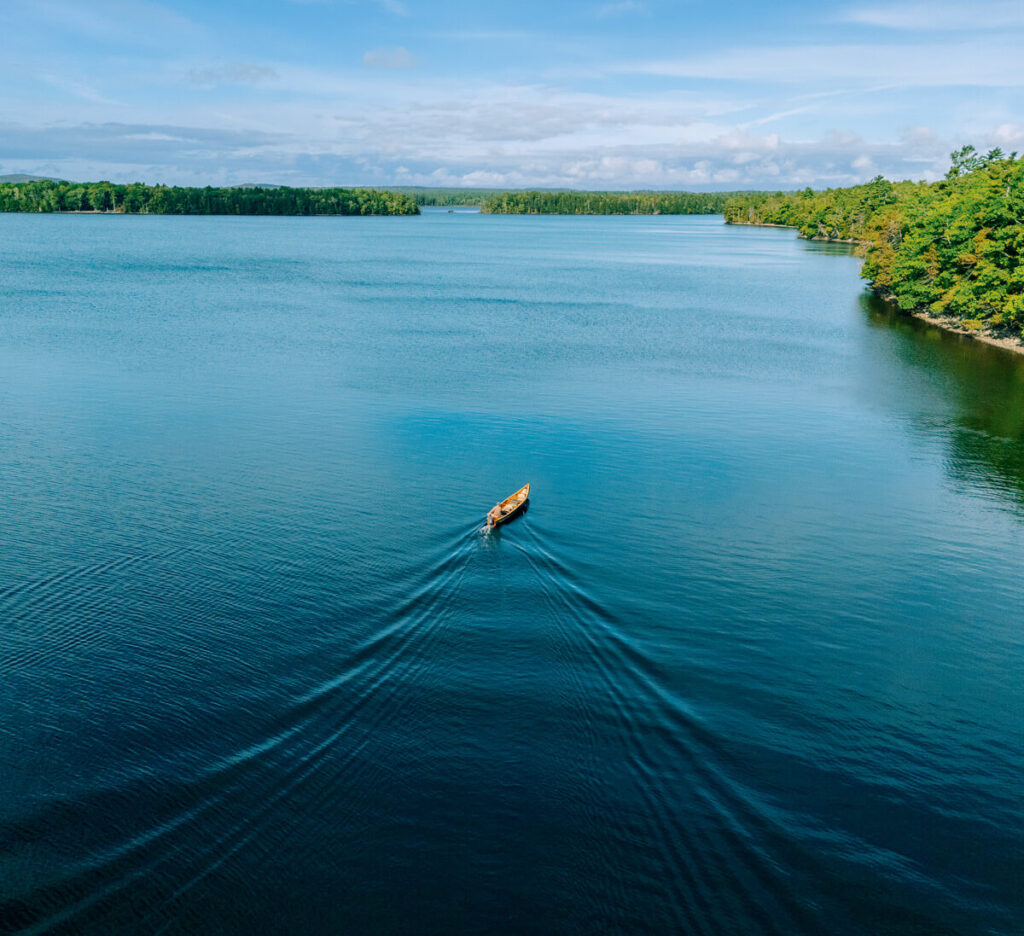
For a time, Grand Lakers were once pretty much all you saw on West Grand Lake. And they’re still out there, although they’re gradually being crowded out by fiberglass fishing boats and aluminum pontoon boats. Still, it’s a pleasing sight to see the Grand Lakers heading up the lake at dawn, guides in the stern and eager sports up front, ready for an adventure, whether it involves successful fishing or not.
*****
I acquired my first Grand Laker a couple of years after I bought a camp on West Grand Lake, which was nearly three decades ago. I was told the boat I owned was built in the 1970s by Ralph Beach, or maybe someone who worked with him, and it was made in Grand Lake Stream or possibly nearby in Princeton. I was informed of this by Bill Shamel, a local boat builder, who replaced a rotting stern for me a few years after I got it. When he completed his repairs he asked me, “Do you have any grandchildren?” I didn’t, but he suggested I should because this would be a good boat to give them to play around in. Left unsaid was the part about how it wasn’t much of a boat, and it probably wouldn’t be worth putting any further work or money into it.
The inside hulls of Grand Lakers are typically lustrous and smooth, like crème brûlée, the blond wood lovingly polished. Mine was not like that. It was stained dark, like a German chocolate cake, and not a particularly fresh cake at that. Apparently in the mid-1980s or thereabouts somebody in town bought a sand blaster and offered refinishing services at bargain rates.
Turned out there was a reason not to use a sandblaster. This messed with the wood, raising the grain, from which it never recovered. So, at a salvage store I bought a long carpet runner made of acrylic and designed to look like it came from ancient Persia. This was to ostensibly protect the hull from further wear and tear and to keep the small pebbles and sand out from between the ribs. But mostly it distracted from its appearance and made it look suitable for an outing with a Parthian queen.
I didn’t need a showpiece, but I did want a workboat. I used it a lot for camping, which meant navigating along rocky shores laden with heavy gear. Who doesn’t like to bring cast-iron Dutch ovens and other luxuries when camping? I used it to explore miles of densely wooded shoreline, pulling up on cobbles and ledges then bushwhacking into the forest in search of chanterelles or old bottle dumps or ledges overgrown with moss.
Getting the boat ashore often required employing ancient technology—I always brought along a couple of small, perfectly rounded logs to roll the boat up across rocks.
All this took a toll. For the first 10 years or so, the boat stayed dry and pristine no matter how long I ventured out on the water. Then some small inexplicable puddles started to appear in it, although this was easily manageable with an oversize sponge. The rate of seepage increased, and on one trip a friend pointed out miniature geysers spurting up between a few planks as we motored through chop. Later inspection revealed the planks had the consistency of cheese—not a nice hard block of aged Parmesan, but something closer to cream cheese.
Anyone who owns a wooden boat is aware of a critical ratio: the time you spend working on it versus the time you spend enjoying it. That ratio starts out at nearly 100 percent enjoyment, but it rebalances gradually over time. When it falls below 50 percent enjoyment, it’s time to reassess.
Credit: Courtesy Bill Shamel
Credit: Mat Trogner
That time came about five years ago. The boat was out of the water in summer more than in. I tried sanding and fiberglassing and painting. The leaks were wily and persistent.
My friend Steve Keith, a talented wooden canoe builder in town with decades of experience and two sheds full of boats, came at my request to examine my boat. He ran his finger down the low, spongy keel. We rolled it over, and he inspected some of the ribs. At length, he stood and nodded solemnly, then he asked me, “Do you have a chainsaw?”
“Yes,” I said.
“Then cut it into three pieces and take it to the dump.”
Maine humor can be hard to parse, so I just stood with a grave look on my face.
A chainsaw seemed overly violent and disrespectful, but I got the idea of filling the Grand Laker with rocks and towing it out behind my Royalex canoe to where the lake grew deep. There, I’d pull the plug and let the water swamp it and consign it to the depths. It could then forever rest in the lake that spawned it. This seemed poetic, and I also liked the idea of being able to snorkel out and visit it from time to time, and reminisce about the good times we had.
It was a still-early fall night, and a large moon was overhead. I paddled out with the Grand Laker behind me and a slow dirge in my head. I probed with a line and weight to make sure the water was at least 20 feet deep. I pulled the plug; the water flowed in. And in. And the boat refused to sink. It persisted in its floating, its gunwales above the water and gleaming in the moonlight, despite being nearly full. It had too much wood in the hull, or not enough rocks, or it refused to go down out of some sort of stubbornness. I envisioned a ghost ship destined to forever bob around the lake.
So, defeated, I paddled it back in, very slowly. The next day I drained it, emptied out the rocks, and hauled it into the woods for the winter.
When I returned last summer, I decided to rid myself of it through commerce, and advertised it online: $20 for the boat, leaks included. A half dozen people contacted me—Mainers can smell a deal from 50 miles away—and I ended up selling it to a woman named Darcy, who arrived with her 18-month-old child to tow it away. She thought it would make a good winter project with her dad.
It made me both melancholy and elated to see it roll out of the driveway behind Darcy’s pickup. I felt that it was headed to a good home and would one day emerge like a butterfly from its chrysalis to enjoy yet another life on the lakes.
Also last summer, my friend Steve called and asked me to save his marriage. His neighbor was having a moving sale, and she was selling an old Grand Laker that had been in her barn for years. If I didn’t buy it, Steve said, he would—and he was pretty certain his wife would then leave him.
Forty-five minutes later, the boat and trailer were in my driveway. I was told it was built by Kenny Wheaton, a preeminent boat builder back in the day, and it had a lustrous blond wood interior and a deep hull.
I put it in the lake a couple of days later. It sat elegantly in the water and it handled well. I discovered a small leak coming from somewhere, but I wasn’t concerned. I’ll deal with it next summer. I’m pretty sure this will be an easy fix.