Reading Lessons
In praise of small stories written on the snow, and the larger tale they tell.
By Yankee Magazine|Dec 30 2025|

By Susie Spikol
It’s a perfect day for tracking. The winter air on this early February morning is crisp and cold. There is no north wind, bright sunshine hangs overhead, and the ground conditions couldn’t be better—about four inches of sticky snow reside atop a frozen base, which means I’ll be able to make out the telling details of toes, claws, and hoofs.
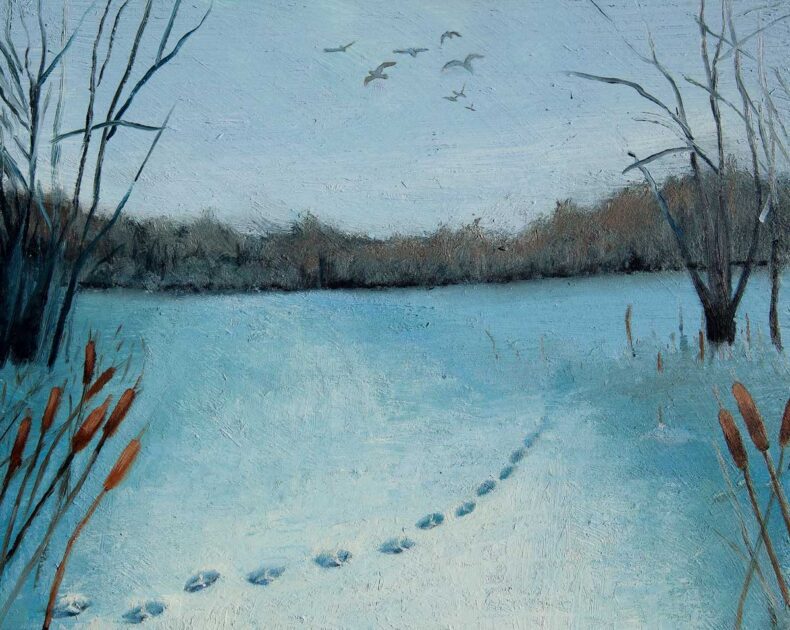
Along the cattail edge of Kempner Meadow, in my hometown of Hancock, New Hampshire, I follow a straight line of tracks. I recognize this pattern of movement. A perfect walker where the back leg slips neatly into the same spot as the front paw, leaving a tidy, tight trail. I’m investigating, collecting clues, and observing details. I don’t rush to conclusions. Instead, I linger and lean in closer. What wild secrets do these prints hold? What stories do they offer?
Many before me asked those same questions. Tracking is one of our most ancient human skills. Without it, our long-ago kin wouldn’t have survived. It would have been impossible for them to find the game they needed to hunt, and they would have fallen prey to larger, sharper-toothed predators that wandered our prehistoric landscape. Decoding trails and animal signs was our first and most important reading assignment.
As a kid, I wanted to be Marty Stouffer, the cowboy star of one of my family’s favorite shows, Wild America. I scrambled around my Brooklyn neighborhood, my long hair wrapped around my chin so I could have Marty’s beard. Instead of the grizzly bears and cougars my hero tracked, I searched for the squirrels, rats, and feral cats that roamed my city terrain. There were other differences, too. The animal trackers I knew as a kid were rugged leather-faced men who wore flannel shirts. They rode horses, camped out under the stars, chewed tobacco, and lived lives that didn’t seem to leave room for girls from Brooklyn.
It wasn’t until I was in graduate school in New Hampshire for environmental studies that I was shown another side of tracking. Meade Cadot, a geologist turned mammalogist, taught me how to read the trails and signs left behind by wild animals. We trailed bobcats together, following their rounded paw prints along the tops of stone walls, and we touched the damp, torn striped maple wood where moose had pulled up the bark to eat only hours before. It was in this mammalogy course that I learned a snappy rhyme that doesn’t apply just to tracking: When in doubt, follow it out.
In winter, the snow announces the everyday stories of wild animals, and if we take notice, our world expands. I am reminded of the time I woke to find an otter slide—a rounded trough—tobogganing through my neighbor’s field, so similar to my son’s own path of winter joy. Or how once I was on a fall birding trip with third-graders, and our attention was caught by some tracks in the early dusting of snow that coated downtown Hancock. Sturdy, large hind paws and bold, clawed front paws, moseying along the sidewalk on a thin skim of snow. Hot on the trail, we followed the prints to a crab apple tree. There, in the early morning hours, while people slept snug in their homes on Main Street, a black bear had helped itself to a crunchy snack. On the way back to the school, one of the girls, with cheeks as red as those little apples, grabbed my hand and said, “I’ll never forget this day, when a bear walked down Main Street, and only us and the bear knew it.”
* * * * *
Tracking is a bit like a magic trick, but behind it all, as with any good act, is a whole lot of skill and practice. Spending time outside observing, following trails, watching, listening, and smelling the air for feral scents are all a part of the ritual—a way to wake up your senses, engage your curiosity, stretch your deductive skills, and deeply connect to the wild world outside your back door.
My own trail, if tracked, wouldn’t be straight and clean like a bobcat’s. It would be messy and meandering, a jumble of twists and turns, something very human. But I have always had a north star drawing me forward. When you love animals, you willingly let yourself go wild. You give up comforts for the chance to see things like the swirl of little brown bats pouring out of an old barn on hot, mosquito-drenched summer nights. You collect scat and tuck it tidily into labeled jars in your grandmother’s jelly cabinet. You fall in love with star-nosed moles. And you find any way you can to catch a glimpse into the story of these wild lives. Tracking is how the door opens just enough for you to peek through and begin to understand a bigger, more beautiful world.
Credit: Illustrations by Lauren West
Whenever I’m on the trail, I’m reminded of something another tracking teacher recently shared with me during a late spring workshop. Jonathan Shapiro, a certified tracker and founder of the Fox Paw School in Hardwick, Vermont, told us: “Tracking is ecological storytelling. When we learn the observation and awareness skills necessary to start paying attention to the things that’re happening in the woods, we’re building a baseline story for all the behaviors of the other species that share this landscape with us. Once you start seeing those stories unfolding around you, it changes the way you look at the rest of the world. You are one member of a far greater community than only humans.”
The ancient skill of tracking is experiencing a resurgence, thanks to educators and mentors like Shapiro who have been trained by CyberTracker North America. Based on a program developed in the early 1990s between the San people of the Kalahari in southern Africa and Louis Liebenberg, a scientist, author, and associate of human evolutionary biology at Harvard, CyberTracker was initially designed to connect the generational knowledge and experience of Indigenous peoples to scientific and conservation needs. Since the San people’s oral tradition wasn’t based on written knowledge, Liebenberg created an image-based system using the available technology of the time, PalmPilots, for Indigenous trackers to record their animal sightings.
This is hard work, according to Shapiro, who holds two CyberTracker specialist certificates in track and sign identification and a professional certificate in animal trailing. He’s put in what he calls his “dirt time,” spending 15 years, in all seasons and in all kinds of weather, following the slightest trails and trickle of clues through diverse habitats. When he was in his early 20s, he developed a passion for being outside, hiking mountains in Arizona. It was all so beautiful, but as he later described to me, “I felt like a tourist, passing through the natural world.” He longed for something deeper, more connected and engaged, a way of knowing nature that wasn’t just about climbing the highest peaks or simply knowing the name of a bird or a plant.
So he returned to his native New England and sought out teachers like Dan Gardoqui, a naturalist, Registered Maine Guide, and director of education and outreach at the Center for Wildlife in York, Maine. Shapiro logged many years of experience with Gardoqui, CyberTracker, and other tracking professionals, out of which grew his school, Fox Paw. Specializing in teaching adults through long-term courses, Fox Paw embodies his belief that “humans are hard-wired to the rhythms of the living, breathing natural world,” he says. “Whether you call it neurobiology or spiritual connection, paying attention to what’s happening on the landscape around us is what makes us who we are.”
Tracking with Shapiro requires tuning in with full sensory awareness. We get down on our knees to sniff, cup our ears to amplify the surrounding sounds, and run our hands along browsed bark. He asks his students to consider what he calls “the raw, sensory input of the moment.” That’s how I once found myself with my nose merely inches away from a beaver scent mound—a place where a beaver piles up leaves, sticks, and mud from the pond and marks it with urine and an unctuous secretion called castoreum.
As I breathed in the earthy, sweet aroma that day in the field with Shapiro, something shifted in me. A field guide tracker for many years, I had been quick to interpret and draw conclusions, but with Shapiro’s guidance, I started becoming someone different. I am a slow tracker now, a full senses-on observer—a sniffy, touchy explorer—and I feel so alive in it all.
* * * * *
Out on my own, I’m practicing, putting in my dirt time. On this bluebird winter day, I feel spring on the horizon. I dial into the tracks before me. The snow cover is really an uncovering—a reveal, showing a secret world no longer hidden. I kneel beside the trail, letting my eyes wander. I count four toes with sharp nails like small exclamation points at each tip. There is a symmetry to this almost-two-inch oval track, and I see a distinct raised “X” where the snow pushed up between the toes and heel pad. I am compiling a list of clues and sorting out suspects.
Soon I catch a whiff of a strong, sharp, familiar odor, like a skunk’s, but more musky than usual. I stand up and look down the line of tracks, noticing how the prints veered off to a hummock of tall, dried grasses sticking up from the snow. I follow, letting both the trail and pungent scent lead on.
As I approach the hummock, the scent intensifies, and I see a yellow splash marking the highest point of the rise. Tracking is always more than just paw prints and trails: It is noticing the other subtle signs and evidence of animals. From nibbling on seeds and vegetation to burrowing and nesting, animals leave their mark on the landscape. These are more clues to observe and interpret, and I am a connoisseur of these other signs.
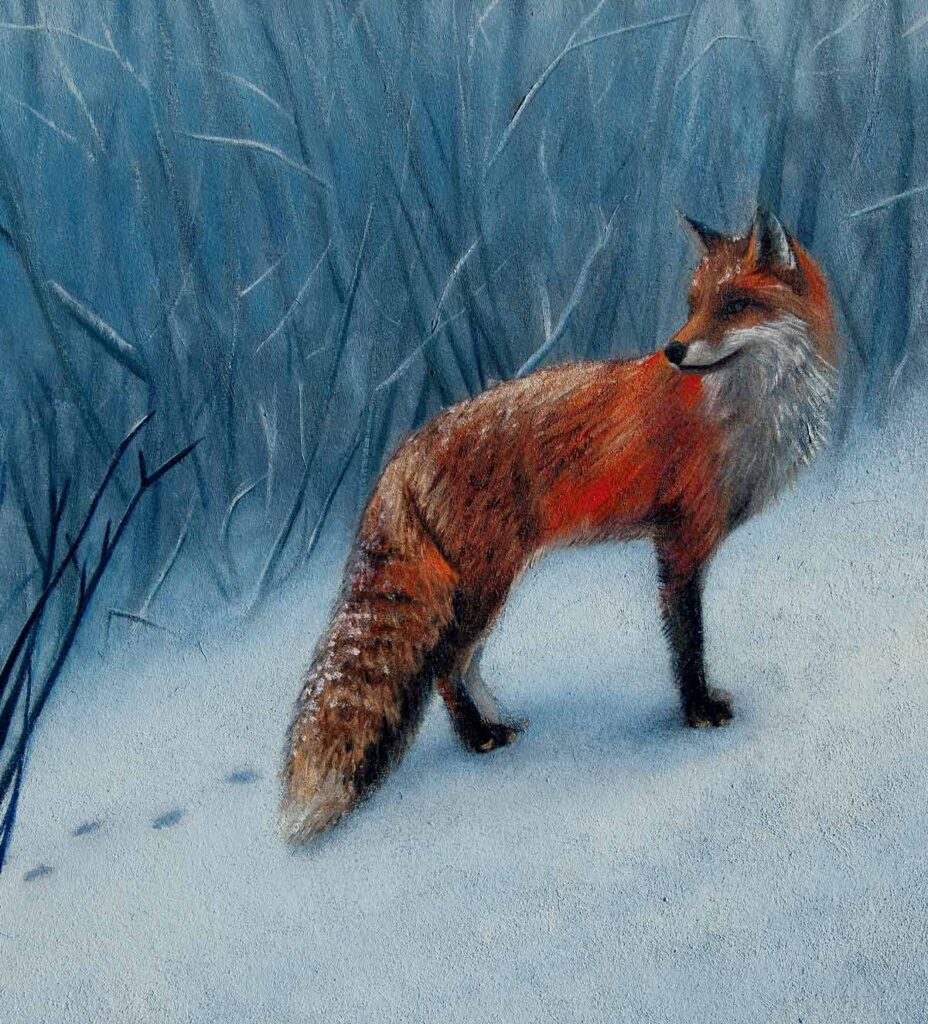
At last, I’m ready. I put all the pieces together and let my slow observations take me to the answer: red fox, a brilliant streak of orange against the snow-white field, like an ember. It walked through this field before dawn, after the snow stopped, leaving a scent-filled message at the hummock. February is the start of the red fox mating season, and I wonder if the skunky urine is a love letter, an invitation for an evening rendezvous.
I can’t help myself: I take my mittens off in the 20-degree cold and place my fingers into the track. Other trackers wouldn’t like this. My fingers may change the print, make it something unreadable, something that reflects my own track. But, like a butterfly, I let my fingertips flutter along the toe tracks, into the nails, and ever so gently, touch the heel pad where the red fox’s fur left a blurry impression. I’m tactile, but more than that, I want a bit of this wild red fox’s essence to go into my fingertips and travel up into my heart.
Picking Up the Trail
Five essential tips for would-be trackers.
1. Know Your Suspects: Familiarize yourself with the mammals in your region by visiting your state’s Fish and Wildlife agency website. Along with compiling a list of your critter neighbors, look for information on their natural history and habitat preferences.
2. Put In Some Dirt Time: Go outside. Look, listen, sniff, and touch. Make observations and take notes and/or photographs. Look for things like trails, scat, feeding signs, and, of course, snow prints, as well as burrows, nests, and tunnels.
3. Follow It Out: When you find tracks, look at more than just the prints: Follow the trail. What does it reveal? Where was the animal going, and why?
4. Get a Field Guide (or Three): Mark Elbroch and Casey McFarland’s Mammal Tracks & Sign (2nd ed.) is considered by many to be the definitive book. Other options include the Paul Rezendes classic Tracking and the Art of Seeing and Jonathan Poppele’s Animal Tracks of the Midwest, which offers essential reading on all Northeastern mammals and is small enough to fit in a coat pocket.
5. Find a Mentor or Community: Consider joining a tracking club hosted by the Northeast Wildlife Trackers, or see what your local nature organization is offering. And if you want to get serious about tracking, sign up for instruction at a place like Vermont’s Fox Paw School.