Life in the Kingdom | Winter, Fast and Slow
Finding that rare moment to pause in a season that urges us to hurry up, hurry up.
By Ben Hewitt|Nov 01 2024|

Life in the Kingdom | Winter, Fast and Slow
Credit: Illustration by Tom HaugomatWinter comes in its usual way, in fits and starts that begin as whispers of what’s to come, quiet enough that it’s tempting to pretend you don’t hear them. You’re up in the woods, cutting rounds off a big maple that you’ll burn down to ash and chimney smoke in another year, when you notice that the rain has changed over to snow. Or perhaps to something on the spectrum between rain and snow—and suddenly it seems to you as if there should be a name for this type of in-between precipitation, this stuff that’s not quite rain, and not quite snow, but also not sleet nor freezing rain, so you decide on the spot to call it snain. (This is how you amuse yourself when you’re cutting wood.)
The snain does not fall for long. Somewhere high above you, in whichever atmospheric layer determines exactly which flavor of precipitation will fall, circumstances change, and now it’s just plain rain again, a cold and drizzly sort that you’re pretty sure you can work through if you can only stay moving fast enough to keep warm. So you pick up the pace a little. There’s a lot of wood to be cut.
The next whisper is louder. This time, it’s snow for sure, though not much of it—barely a dusting, not even enough to hide the colors of everything that lies beneath it: the tawny-green hue of the last, frost-nipped pasture grass; the dark brown of the muddy ruts left in the tractor’s wake; the steely gray of the exposed ledge that juts through the forest soil in a long, proud ridge that serves as the primary demarcation line between the conifers below and the hardwoods above. It’s early November by now; you’d be a fool not to heed the warning half-hidden in that thin scrim of snow. So you pick up the pace a little. Because there’s still a lot of wood to be cut.
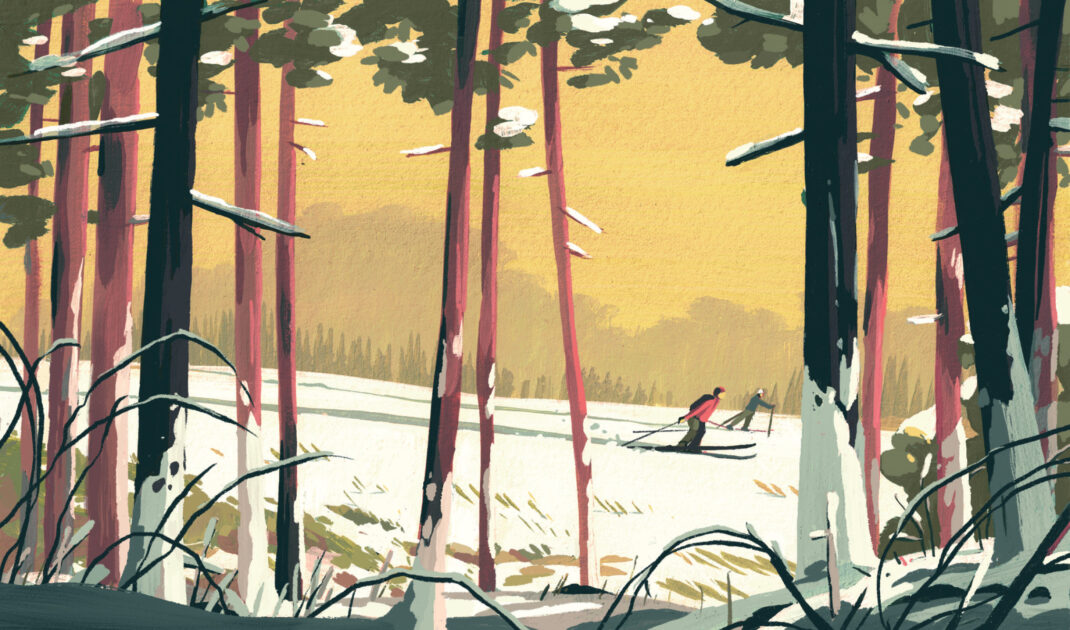
By mid-November, enough whispers have accumulated that the season has found its voice. The grass and muddy ruts are covered, though the ledge still pushes through where the stone has absorbed the heat of the sun. Soon, though, that will be covered, too—there’s not much sun to be had these days, not many shadows to be cast in a landscape that feels mostly like it’s all just one big shadow. You and your friend Dirk drive to the top of the mountain, where the snow is a bit deeper still. You strap on your skis for the first time this season, and the two of you skitter through the forest atop the loud, unforgiving rime. It’s not great skiing. It might not even be wise to be out here, with the daylight fading and the icy surface making it difficult to control your trajectory and pick your way between the unforgiving boles of maple and birch. So you make your way back to the untreed logging road and pick up the pace a bit. It’s time to get home.
You get a call from the boy. He’s off the road, nose down in a treacherous ditch: Can you come pull him out? You gather the chain off the tractor and get in the truck. Your route down the mountain is mottled into patches of half-frozen mud and sheer ice. The truck feels loose on the road. The sky is clear, and you spot stars between the outstretched tree limbs and you want to keep watching those but the road needs your attention. It’s barely 6 p.m. and pitch-black. You count the days until the solstice and then count that many again until you arrive at nearly the end of January. January 24, to be exact. That’s when you’ll see this much daylight again, and there’s something about this simple hard truth that makes you start to pick up the pace a bit, as if you could arrive at January 24 a little sooner. But the ice on the road says otherwise, so you don’t. You’ll just have to wait it out like everyone else.
Back in the woods. Coldest morning of the season thus far, though it’s well above zero, and only the topmost layer of soil is frozen. You split wood for nearly two hours, swing after swing after swing of your favorite long-handled maul. It’s nearly dark by the time you finish—these days, it seems as if it’s always nearly dark—and you stop to fill the tractor bucket with split wedges of wood. It’s so quiet up here. The air is still, and you stop for a moment just to feel what it’s like to be still, too. But the moment soon passes, and now, having taken it, you’ll need to work just a little faster to make up for lost time. You’re always making up for lost time, aren’t you?
The first storm of consequence arrives shortly after Thanksgiving, which this year happens to coincide with your birthday. You’re 52. You look in the mirror and mouth the numbers. Fifty. Two. You notice how your lips purse on two. You notice the lines at the corners of your eyes, the tuft of gray right at the height of your forehead, like a little prow announcing … what, exactly? Your impending decline, probably. Ha ha, you think, funny, funny. You step away from the mirror. The storm brings nearly 10 inches of moisture-laden snow. You plow with the bucket of the tractor and don’t get stuck even once, and this is pleasing to you. You’re 52 and yet here you are, still plowing the heavy snow with aplomb, old as you are, with that little gray prow atop your forehead and all those smile lines.
And you think: With any luck, there’s still plenty of birthdays to come. Still plenty of snow to plow. But definitely less than there was last week. Maybe I should just slow down and enjoy it.
This column was originally published in the November/December 2024 issue of Yankee.