Life in the Kingdom | Taking Stock
Keeping animals means endless chores, and moments of contentment.
By Ben Hewitt|Jan 01 2023|

Life in the Kingdom | Taking Stock
Credit: Illustration by Tom HaugomatIt occurred to me recently that we have now lived with animals for nearly 25 years, a habit that dates back to 1997, the year we bought our land. This was also when we built a chicken coop and populated it with hens before we broke ground on our own shelter. Since then, we’ve never not had livestock; shortly after the chickens we procured pigs, then cows, and before long the sheep came to live with us. Over the past quarter century, we’ve kept all the aforementioned species, plus a handful more: There were the cantankerous ducks and the boys’ endlessly bleating dwarf goats, a brief foray into rabbits, and a few flocks of turkeys. It feels as if I might be missing something, but it also seems as if I’m running out of likely species, so perhaps that’s a full accounting. Full enough, anyhow.
Right now, we have three cows and four lambs and two pigs, though by the time you read this, we’ll have only two cows, and we might or might not still have two pigs, depending on how they size up. The lambs for sure will have met the fate they were always destined for. I like the lambs. I like moving them to new grass every few days, a chore that almost invariably takes place in the half-lit morning just before the full onset of day, which is a very nice time to be outside. And I like how they gather around me when I step inside their fence. They nibble at my pants and, if I let them, on the tips of my outstretched fingers. But liking an animal—loving it, even—does not preclude the truth residing at the core of our relationship.
We’ve sacrificed a lot to keep livestock. There have been innumerable early departures from social gatherings, spontaneous trips not taken, leisurely mornings forsaken entirely. Tired? Chores. Raining? Chores. Sick? Chores. Cold? Chores. Dark? Chores. Really, really, really don’t want to do chores? Chores. Always, forever, unfailingly, chores. And always the quiet awareness that your life is not entirely your own; there are living creatures who depend on you for the very basics of their survival, and the recognition of dependence is a small, constant gnawing on your consciousness. Of course, the same is true of pets, but in my experience there’s something about the way that pets live alongside you that makes their care feel less distinct from your own. Besides, livestock simply require more attention than most pets—not merely food and water, but also shelter and fencing, and none of this within the comfort of a shared home.
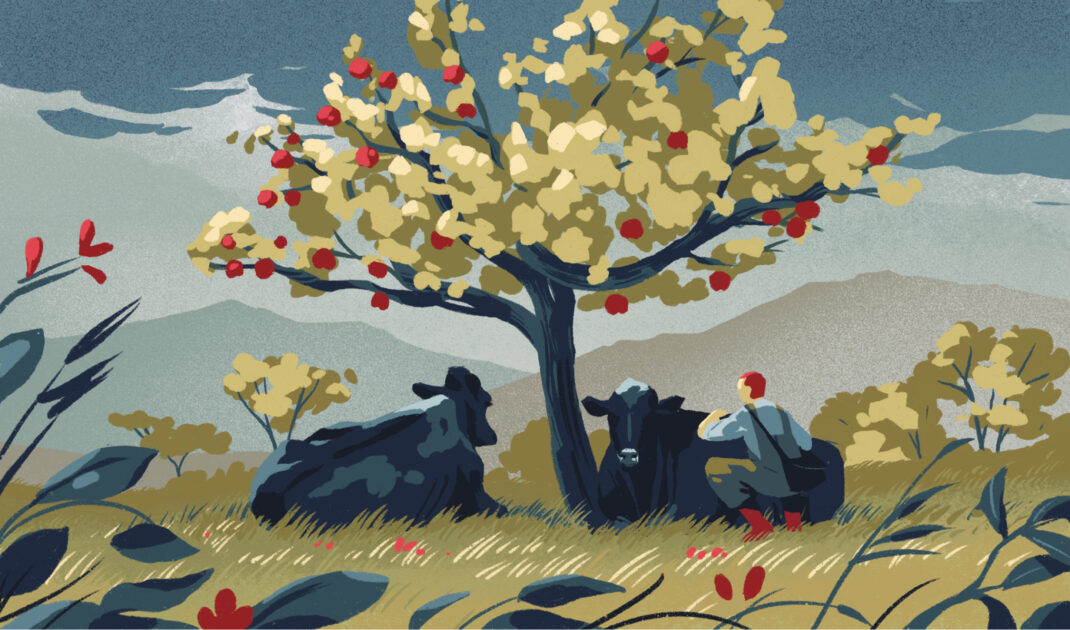
If I had to pick one species to live with, it wouldn’t even be close: I’m a cow guy, through and through. I think it’s because cows seem to embody a willingness to just let the world be as it is; their general attitude is one of quiet acceptance, and there’s a particular form of bovine contentment that I’m forever hopeful will rub off on me. So there’s that. I also love the smell of cows. Not the smell of their manure (which is the smell most people associate with cows and which, truth be told, I don’t mind in the least), but the up-close, nose-to-hide smell of them, the very essence of their cowness. I feel as though I should explain what it smells like, but the truth is, it just smells like cow. And maybe this is going to seem a bit shallow, but I like the way cows look. Specifically, I like the way they look when they’re grazing the knoll of pasture I can see from the table where I take my morning coffee. And I really like the way they look when I’ve been gone for the day and I come home to find them lying in the grass beneath the apple trees, resplendent in their bovine contentment. In those moments, I can tell that it’s actually working: It is actually rubbing off on me.
Despite the sacrifices, I consider it a privilege to keep livestock. Or maybe the sacrifices are part of the privilege, because isn’t it true that the things that demand some sacrifice are often the same ones that bring the most meaning to our lives? And I am grateful to live within an ecosystem that includes livestock, to see how the sun becomes the grass, the grass becomes the animal, and the animal becomes me. And then to spread their composted manure atop our garden or at the base of our blueberries, and watch all that life spring forth, too. Where, exactly, is the line between life and death? The longer I live among our livestock, the more porous that line becomes.
I used to imagine that we’d always keep livestock, but I’m old enough now to understand “always” is never as certain as we’d like to think. Besides, the boys are mostly gone, taking their insatiable appetites with them, and their absence is creating new possibilities for Penny and me. For the first time in many, many years, I can imagine that the sacrifices we’ve made to tend these animals over all these years could someday feel less meaning-making. This is not true now, and I don’t know if it will come to pass. I only know that I can’t say for certain that it won’t.
But that is the possible story of another day, not this one. On this one, I’m going to finish writing the next few sentences, and then I’m going to throw another log on the fire. I’m going to lace up my chore boots and shrug into my chore jacket. It’s not a sunny day, but I can see the clouds thinning. On this day, I’m going to first move the lambs, then I’m going to feed the pigs, then I’ll check on the cows, though they shouldn’t need much. They’re grazing the last of the rich orchard grass before winter, and just yesterday I filled their water trough. But I’m pretty sure that if I get down there early enough, they’ll still be lying beneath those trees, and the truth is, I just want to go have a look.
This column was originally published in the January/February 2023 issue of Yankee.