Life in the Kingdom | Shaped by Land
Some places we never leave, but instead carry with us all our lives.
By Ben Hewitt|Mar 01 2025|

Life in the Kingdom | Shaped by Land
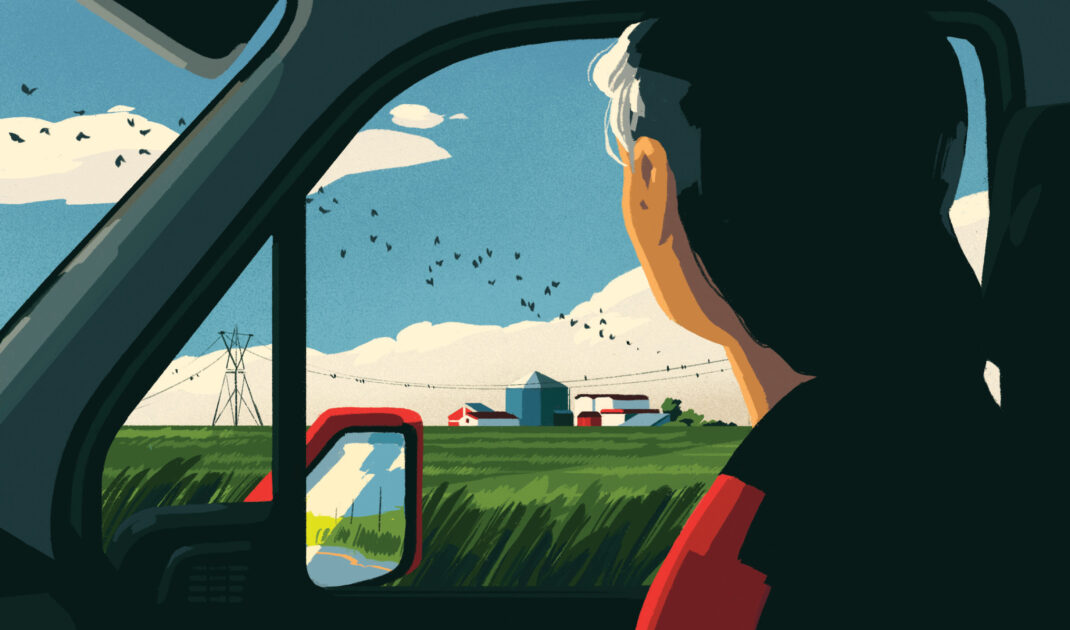
Credit: Illustration by Tom HaugomatMy mother was raised on a farm tucked into the southeast corner of Iowa, barely spitting distance from the Mississippi River to the east and the Missouri state line to the south. Her mother was one of 12, her father an only child, and she had two younger brothers with a proclivity for bolting engines onto homemade contraptions that seemed engineered to navigate directly to the nearest emergency room.
We traveled to my grandparents’ farm frequently when I was a child. Often, we’d stay for weeks at a time. I’ve written before of how much I looked forward to these visits: There were my cousins, three girls, all vaguely mysterious to me in the way girls are to a boy with more fingers on his hands than years in his lived experience. There were my grandparents—my grandmother eager to spoil me with a freezer full of Schwan’s ice cream push-ups and trips to the mall for new jeans at JCPenney, my taciturn grandfather offering rides in the combine and, if I was really lucky and our visit coincided with the annual harvest, the grain truck. There was also a color television (with a remote control!), and if it was winter and there was snow on the ground, my Uncle Jake would tow my cousins and me in a sled behind his Honda “Big Red” three-wheeler.
It’s astounding to realize that it’s been 45 years or more since I rode in my grandfather’s grain truck, or sledded behind my uncle’s ATC, or tore the paper off the top of a Schwan’s ice cream push-up. I’d last been to Iowa in 2006, following my grandmother’s death; my grandfather had died seven years before, my Uncle Jake would die nine years later, and somewhere in the midst of all that, the farm—or most of it, anyway—was sold. My Aunt Deanna built a house on the handful of acres she’d held on to, but my cousins had long since moved away, and my life had become the complicated thing that almost anyone’s life becomes, and so I’d not returned to my mother’s birthplace in the intervening years. Nor, in fact, had my mother.
Until this summer, when my mom, approaching 84 years of age, expressed her desire for one last visit. She is in fine health except for hearing loss that turns casual conversation into a cacophony of raised voices and comical misunderstandings. She also has declining cognition that mostly presents as short-term memory loss, but it seems likely to progress into something more challenging.
She had an uncomplicated and rather ordinary agenda: to visit the cemetery where her parents and brother lie, and to see the place that had shaped her so profoundly. Certainly, to walk the old lane that led down to the cropland that had provided for her family, and perhaps to drive the narrow roads she’d ridden thousands of times as a child—to school, to aunts’ and uncles’, to town, to church.
We landed in Iowa on a clear, cool day. My father, who at 81 is as terrifyingly nimble of mind as ever but arguably past his prime traveling years, had come along, and soon the three of us were speeding across that uniquely Midwestern landscape, where the horizon is forever receding, the sky and land meeting at some distant point that seems attainable but, try as you might, you can never quite arrive at, like trying to locate the end of a rainbow.
We stayed for three days and did all the things my mom wanted to do, and a few more besides. We drove to the Mississippi and stood at the edge of the water, and marveled at the sheer size of it, a mile wide in spots, forever coursing its way downstream. We tried to drive past her high school, in a two-road town a few miles east of the farm, but the building was gone and there was only grass, short and sparse. Beyond that, corn stood tall, ready for harvest.
One of my cousins came down from Chicago with her daughter for a day, and we passed many hours sitting around the kitchen table and talking, drinking endless cups of coffee, just the way it had been at my grandparents’ house a half century ago: endless pots of Folgers and reminiscing about nothing that would seem the least bit important to anyone but those who were gathered there. My mom, I could see, was ecstatic, and it occurred to me that the very ordinariness of the visit, and the many ways it resembled life on that farm all those years ago, was exactly what she’d wanted.
I think often about how a place shapes a person. What parts of my mom—what parts of anyone?—are the way they are simply because they were raised in a particular place? Of course, every place has its people, and those people make a culture, and there is always the influence of that. But what about the land itself? What might it do to a person to live where the horizon is forever receding, where in many places corn is all you can see for as far as you can see? Is this why my mother is always so curious, why her mind—even as it’s now shifting (perhaps especially as it’s now shifting)—remains so open, like the landscape of her childhood?
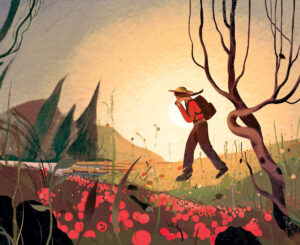
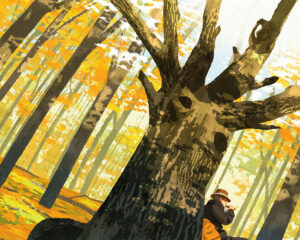
I think of my own love for the winding gravel roads of Vermont that have been central to my life since birth, and how they relax me. How they help me think. I think of the hardwood forests surrounding my home, especially the ones along the mountain ridge I can just catch a glimpse of through my kitchen windows. In the winter, I ski that ridge almost daily, and as inhospitable as it can be—10 below zero, the wind raw and unforgiving, the trees gnarled and hardened by age and weather—I think it might be the place I feel most at ease. I think it might be the place that, when I’m 84 and I can no longer pretend that my time isn’t nearing, I’ll ask my sons to help me visit one more time.
This column was originally published in the March/April 2025 issue of Yankee.