Life in the Kingdom | Seasonings
Each year winter and spring do their dance, until one finally lets go and the other one moves ahead.
By Ben Hewitt|Mar 01 2024|

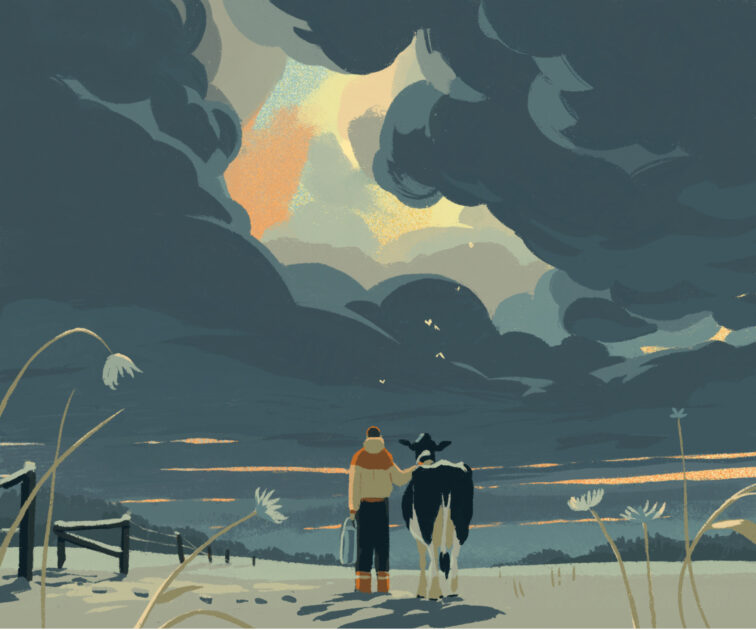
Life in the Kingdom | Seasonings
Credit: Illustration by Tom HaugomatWinter passes as winter does, in fits and starts of snow and cold; in the pages of one book after another, the cat dozing on my chest while I read in the evenings before bed; in early-morning forays into the high-elevation hardwoods at the top of the mountain road. There, I watch the sun rise through the leafless crowns of the maples and yellow birches, and eventually over the snowed boughs of spruce and fir, glad for the silence and the solitude and sometimes wondering how different my circumstances might be if it weren’t for snow and skis and cold and this big swath of land where I can so soon find myself beyond the range of human sound.
It’s good to wonder these things, I think, at least from time to time, just as perhaps it’s good to wonder how to be of use in a world that spirals further and further out of control with every passing day. Though it’s true the answers don’t come easy; it’s true I envy those who have any sort of answer, or who seem not to wonder in the first place. In the evening, I read again. The cat dozes, and I doze with him, stars visible in the sky through the window above my head. In the morning I head back to the woods, where it’s always clear I know nothing more than the last time I came here, or the time before that. But it’s also where knowing doesn’t seem to offer any kind of answer at all.
* * *
The narrow gravel lane we live on transitions between ice and mud and ice again, and Kyle tells me we’re going to need to increase the town’s budget for road material; he’s been waging an ongoing war against the ruts and potholes opened by the constant freeze/thaw/freeze cycle, and the big piles down at the town garage are disappearing fast. We’ve had two mud seasons already this winter, and we might be on the cusp of a third. I vacillate between bemoaning the weather and wielding my own peculiar brand of stoic philosophy, which basically involves making up pithy affirmations and then sharing them as broadly (and frequently) as possible, a pastime that has not entirely endeared me to my family. “Comfort is where growth goes to die” is my favorite so far, though I acknowledge it’s not the most obvious response to a weak winter. But still: Comfort is where growth goes to die. You gotta admit, it’s pretty damn good.
On Friday comes the biggest storm of the season thus far, the snow beginning in the evening hours and continuing unabated throughout the night. In the morning there’s a solid 10 inches on the ground, and snow still falls. Historically speaking, there’s nothing unusual about a storm like this in early March, but this winter has been so consistently warm and weak that it somehow feels like a breach of contract, the promise of an easy glide into spring rudely revoked.
It takes me nearly three hours to clear our drive, plus the two others I tend. By the time I’m done, the sky has stopped spitting and is breaking into intricate patterns. I park the tractor, haul water to the cows, then stand for a moment under that fracturing sky, watching it separate into more shades of gray than I would have thought possible. So many colors within the one; so many different ways of seeing something I thought I knew exactly how to see.
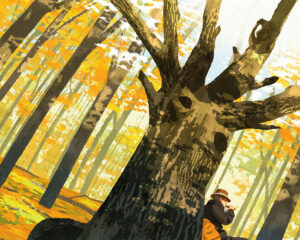
Later, after the storm is long past, I ski into the woods to a spot where the yellow birches grow so big they don’t even look like yellow birches anymore, the bark turned brown and roughened by age, the trunks thick and branches twisted in improbable ways. I think the birches are like very old people: hard to fathom but also strangely captivating, as if they’ve done something miraculous other than simply endure. As all of us must. As most of us do. When I tire of breaking trail through the new snow, I turn back, now gliding easy in my own tracks, back past the yellow/brown birches and through a long sweep of maples. Dark is coming on, but later than I’ve grown accustomed to, almost 6 o’clock and still plenty of light to see by. Spring is close at hand. I can smell it on the air.
* * *
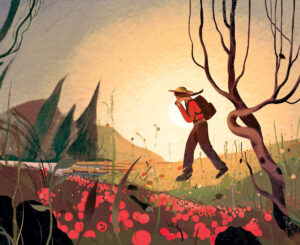
Spring. I awake to the distant sound of water rushing in the small creek that skirts the southern boundary of our land, and above that, the intermittent call of songbirds. I feel as if I should know which ones, but I don’t. Daylight coming on. It will rain soon. I can feel it even if I can’t quite see it yet. The floor creaks beneath my feet. After coffee and chores I pedal my bike up the long, steep climb to Cole’s Pond, the thawing road soft beneath my tires, beads of sweat amassing along my brow. I ride under a strand of wire strung from the outstretched branches of maples on either side of the road; a hot line to a fence containing a herd of Angus who watch my passing with that particular bovine breed of curiosity: interested, but not too interested. Like really if they had anything better to do, they’d be doing it. There’s no grass for them yet, but it won’t be long. Two, three weeks. Another few minutes of climbing, and there’s the charred remains of the house that burned last month. It’s stunning to see the fire’s rude work, everything black and twisted into gross approximations of its original form. I don’t know the family, but I heard they made it out OK. So that’s good, at least.
By the time I’ve made the top of the climb and ridden back down past the burned house and under the hot wire, the farmer who strung it is out fixing fence, lines in his face like a treasure map. He waves, I wave. Morning. Mornin’. I look for the cows again but they’re nowhere to be seen, and I guess they went and found something better to do after all.
* * *
A week of 60-degree days. Snow melts, rivers run, roads thaw. Sap flows, but the maple season starts late and looks to finish early, and the talk is that sugar makers down south have already pulled their taps, having made only a quarter crop.
I drive rutted roads to pick up loads of sawdust for the cows’ bedding. Yesterday we had rain that turned to snow overnight, and this morning the trees are newly frosted, there’s no sun, and we’re 25 degrees shy of 60. I shovel sawdust into the cows’ paddock, and there’s something about it that excites them; they run fast, short circles and fling sawdust into the air with their wide, wet noses. Later, maybe, I’ll see if I can shore up some electric wire and give them a little more room to roam, but for now I shovel and shovel as they run and fling, their whole world confined by a wood-slat fence they could breach in a heartbeat if only they knew how easy it would be.
This column was originally published in the March/April 2024 issue of Yankee.