Life in the Kingdom | Remote Learning
Thinking of moving to rural Vermont? Here are the 10 things you need to know.
By Ben Hewitt|Jul 01 2024|

Life in the Kingdom | Remote Learning
Credit: Illustration by Tom HaugomatThe influx of traffic into northern Vermont for the solar eclipse on April 8 was nothing short of mind-boggling. Living directly in the path of totality, I had the luxury of leaving my car parked for the day and thus avoiding the melee (albeit by all accounts a well-behaved melee) of an estimated 60,000 vehicles carrying an estimated 160,000 eclipse peepers.
It was a fine spring day: mid-50s, the sky as clear and blue as far as the eye could see, just enough chill to the breeze to warrant shirt-sleeves. The blackflies were still in winter remission, and after early thaws, the worst of mud season was already behind us. In short, it was about as perfect an early April day as one can reasonably expect in northern Vermont, with none of the season’s typical capriciousness on display.
I wondered: Having seen the best of Vermont, how many of those 160,000 visitors might now imagine themselves returning for an extended—or even permanent—stay? It’s not something that would have occurred to me in the pre-Covid era, but the pandemic, which saw the biggest influx of new residents to Vermont since the IRS began tracking state-to-state migration, has made me attuned to such things.
For the benefit of anyone who, for whatever reason, might be considering a relocation to rural Vermont, I thought it might be helpful to share a bit of what I’ve learned over more than a half century of inhabiting this place. I call them “rules,” but of course, they’re as unenforceable as they are arbitrary. (Which, I hasten to point out, doesn’t make them wrong.)
10 Rules for Moving to Rural Vermont
Rule #1: All-season tires do not exist. I mean, they exist, but only in the tortured marketing-speak of the tire industry, which has somehow managed to perpetrate the falsehood of the all-season tire for at least as long as I’ve been alive. Indeed, the very concept of an “all-season” tire is an affront to the six months spanning November 1 through April 30, and any attempt to run on them during this period is a provocation of fate right up there with mowing a hayfield the day before the forecast calls for a “chance of showers.”
Rule #2: You are not overpaying for firewood. This is not to suggest there are no unscrupulous firewood sellers, but assuming you’ve done your due diligence and asked the locals who to buy from: You. Are. Not. Overpaying. For. Firewood. If you’ve done your due diligence and still think you’re paying too much, please cut and split a cord for yourself. I promise that the next check to your firewood seller will be the easiest one you ever wrote.
Rule #3: Wood must be stacked and covered by June 1. No ifs, ands, or buts. Honestly, this isn’t even early enough, but I’m trying to be realistic. (I’m also trying to write rules I can actually follow myself.)
Rule #4: If you run out of firewood in, say, mid-March and find yourself scrambling to procure a cord of dry wood to get you through, well, yes, now you are paying too much. And yet it’s somehow still not enough.
Rule #5: You are not overpaying for maple syrup, unless you insist on buying it in those cute little leaf-shaped containers. In which case, well, yes, you are overpaying. (But aren’t those jars just the cutest?)
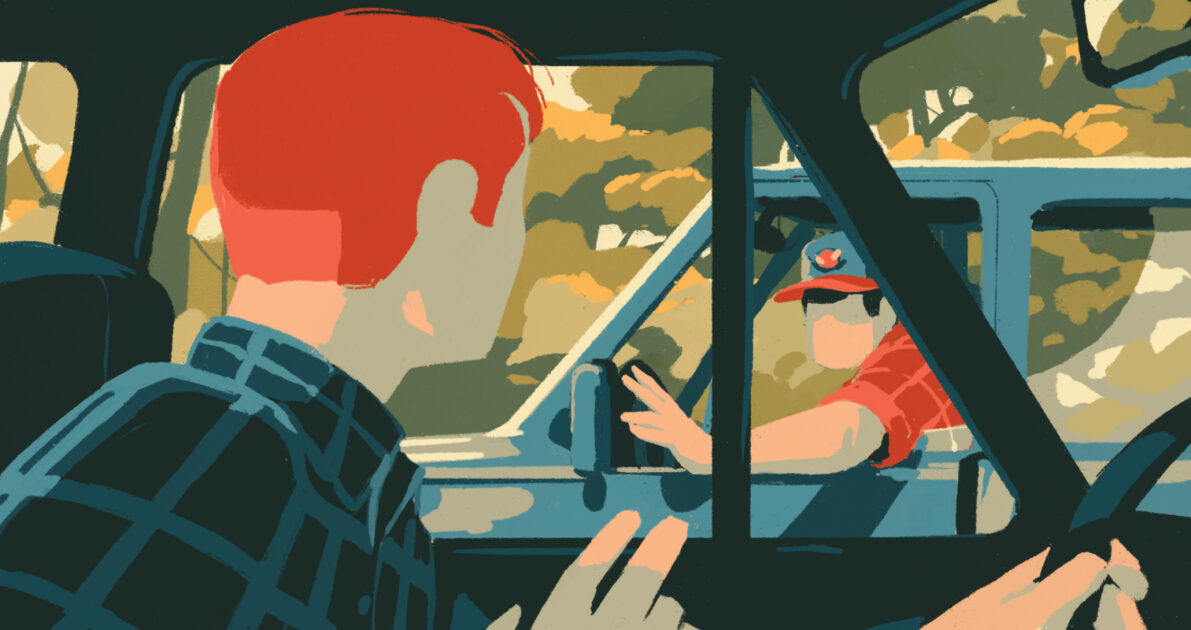
Rule #6: If you are driving on a slow-paced gravel road and you meet a neighbor coming the other way, you will wave by lifting your index and middle fingers off the top of the steering wheel. Two fingers, got it? No more, no less. And keep it brief: It’s a passing acknowledgment, not a reunion.
Rule #7: If you are driving on a slow-paced gravel road and you happen upon two vehicles—and they’ll be pickup trucks, most likely—that are stopped and idling, their drivers conversing through open windows, know that Rural Law allows them a full 40 seconds to conclude their conversation before slowly resuming forward motion. Rural Law also dictates that the driver of the vehicle headed in the direction opposite from yours shall demonstrate appreciation via the aforementioned two-fingered wave plus an additional nod in recognition of your patience.
Rule #8: Small towns in Vermont are typically run by two categories of people: woefully underpaid professionals (town clerks, treasurers, et al.) and a cadre of volunteers (selectpeople, zoning administrators, school board members, et al.). Just because these civil servants are either a) undercompensated or b) uncompensated does not mean that they never make mistakes or are above reproach. It does mean, however, that they are almost certainly deserving of as much grace and patience as you can muster, even when they make a misstep.
Rule #9: Speaking of civil servants, you should probably know that many—if not most—small towns in Vermont struggle to find enough volunteers to fill all positions within town governance. What does this mean for you? If you’re new to town and you’re willing to show your face at town meeting, you are very likely to be nominated for one position or another. Now, if you’ve always been dying to be, say, a constable or cemetery commissioner, go right ahead and accept the nomination, and try not to dwell on the fact that you’ve just been appointed to a role that no one else wanted.
Of course, you can refuse the nomination, and most people won’t think any less of you, since they’ve probably refused it themselves at some point. But you can say no only if you go. In other words: If you don’t attend town meeting, your chances of being nominated (and elected) to one of the town’s less coveted positions rise exponentially. (Indeed, in my small town, the current constable was nominated and elected while he was traveling in Africa. In fact, he’s been home for a solid month now and I’m still not sure he knows he’s the constable.)
And finally, Rule #10: You will probably find that life here is not much like where you moved from. The more completely you accept and even embrace that, the happier you will be. Which is to say: Welcome. We’re glad you’re here. Now, please, don’t go trying to change it.
This column was originally published in the July/August 2024 issue of Yankee.