Life in the Kingdom | Origins
Taking a parent back to her childhood home reminds us that every town is special to someone.
By Ben Hewitt|May 01 2024|

Life in the Kingdom | Origins
Credit: Illustration by Tom HaugomatMy maternal grandparents were born in southeast Iowa in the early 1900s, in a place and era that strongly suggested a life forever tied to the land. My grandfather was an only child, but my grandmother compensated by being one of 12, and you can be sure that each of those children knew what it meant to put in a day’s work. You can be sure that each of them knew the value of a dollar, and that no one complained about the patches on their clothing, or about sharing a room with their siblings. Or that if they did, it was the first and last time they complained.
When I was young, we would fly or take the train to visit my grandparents on their farm in Iowa, just a stone’s throw from the Missouri and Illinois borders. I preferred the train, though I sure did love the moment of takeoff, the thrust of the jet engines, the impossible speed just before the plane nosed into the air. But I loved those long Amtrak lounge cars even more. I loved sitting and watching the landscape blur by, all those fields and forests and little towns that can seem so insignificant to passersby, but which serve as a container for the minutiae of the complicated lives of the people settled within. I think that somehow even as a boy I understood this: No place is ever truly insignificant, because no one is ever truly insignificant. Perhaps no thing is ever truly insignificant, either.
I both loved those visits and found them excruciatingly boring. I loved seeing my cousins, who lived across the narrow, two-lane road from my grandparents, and whose lives seemed exciting, even exotic, to me. All three were girls, and they wore their hair in stylish ways and dressed in fashionable clothes from the mall. I didn’t know much about stylish hair or fashionable clothes. Malls, either, come to think of it. Of course, I loved seeing my grandparents, too, but I was young, and probably what I loved most was all the things that seeing my grandparents meant: a freezer full of ice cream sandwiches and creamsicle push-up pops, a TV (with remote control!), takeout from Kentucky Fried Chicken, a ride on the combine. Maybe even a visit to the mall, for new and fashionable clothes of my own. And I remember visiting in the winter, and how when it snowed, my uncle would tie a plastic sled to the back of his Honda three-wheeler and tow my cousins and me around the farm until we got too cold or someone fell out and started crying.
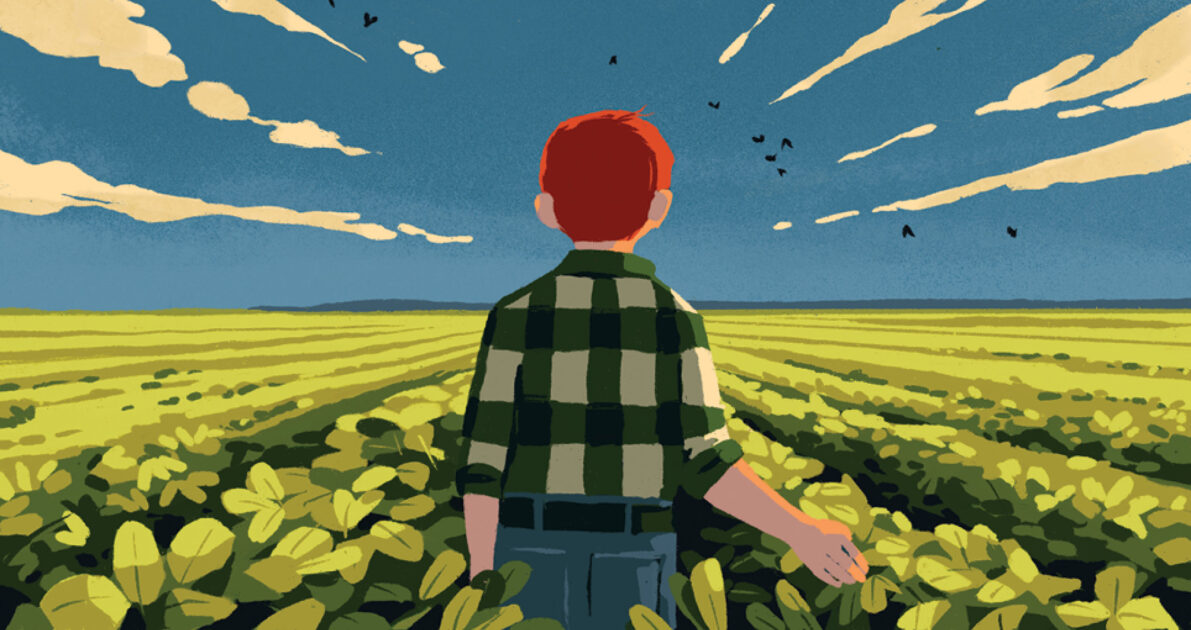
Sometimes we would stay for weeks, and that’s when I started to become bored, having gotten my fill of creamsicles and game shows (my grandmother particularly loved The Price Is Right and its effortlessly dapper host, Bob Barker) and 20-piece buckets of extra-crispy chicken with sides of slaw and mashed potatoes. Maybe I even got a little bored with my cousins, too (who must also have grown weary of me, an odd little boy with a bowl cut and secondhand jeans from an odd little place far, far away). And the landscape: To my young eyes, the topography was featureless and flat, fields of corn and soy everywhere you looked, all the roads laid out in a grid. It seemed to me you could drive for miles with your eyes closed and perhaps the worst that would happen is you’d end up in someone’s cornfield. So maybe I had not yet fully assimilated the truth that no place is insignificant. Maybe it’s just that with time, the significance erodes. Or we think it does, anyway. Maybe that’s what compelled my mother to leave her hometown after graduating from college, eventually making her way to Vermont, and to my father.
I haven’t been back to Iowa since my grandmother’s funeral, nearly 30 years ago. The farm has long since been sold. My uncle has died, my cousins moved away: Chicago. Omaha. Phoenix. My aunt has remarried, and she and her husband built a beautiful new home where my grandparents’ old house once stood. So much has changed, yet many of the fields my ancestors first cultivated still produce crops. The small towns I used to ride through in the back of my grandparents’ Buick (a Buick! of course) are still there, quietly enduring under that vast Midwestern sky, full of people whose lives are just as complicated, challenging, rich, rewarding, and uncertain as my own.
This summer, my mother and I are going back. She’s 83, and I think she knows this might be her last visit to the place where she was raised, and to the people she was raised among. Or the ones who remain, anyway. I have a fantasy that we’re going to drive: I’ll rent some behemoth SUV (in my mind, a Chevy Suburban), shiny black with tinted windows, and she can recline in the cavernous back seat while I take the wheel, the miles piling up behind us like so much cordwood. I like driving, and I have an unusual endurance for long stints (carrot sticks and black coffee—that’s my secret). We won’t talk much, because my mother doesn’t hear much, and we’ll stop only for gas and bathroom breaks. I’ve already Google-mapped it: 1,239 miles. Eighteen hours and 47 minutes. Hell, we can just about be there in time for dinner.
Or maybe we should take the train: We’ll reserve one those fancy sleepers, though we’ll spend our waking hours in the lounge car, eating salted peanuts and watching the world rush by. I know my mom won’t be able to hear a thing over the hum and clack of the train, so I’ll pass her notes and communicate in exaggerated charades.
Truth is, we’ll probably fly. And that’s OK, too. I still get a rush every time I feel those big engines kick in. I still marvel at the ingenuity of it all, and how in only a few hours you can trade one world for another. In this case, the hills and hollows of Vermont for the sweeping expanse of Iowa, and that sense of unlimited space, like now you can finally breathe in a way you didn’t even know you weren’t breathing before. And in between, far, far below us, all those cities and towns and people within them with so many stories of their own.
This column was originally published in the May/June 2024 issue of Yankee.