Life in the Kingdom | Hammer On
Sometimes the most essential thing in your tool kit is the willingness to learn and to try.
By Ben Hewitt|Jul 01 2025|

Life in the Kingdom | Hammer On
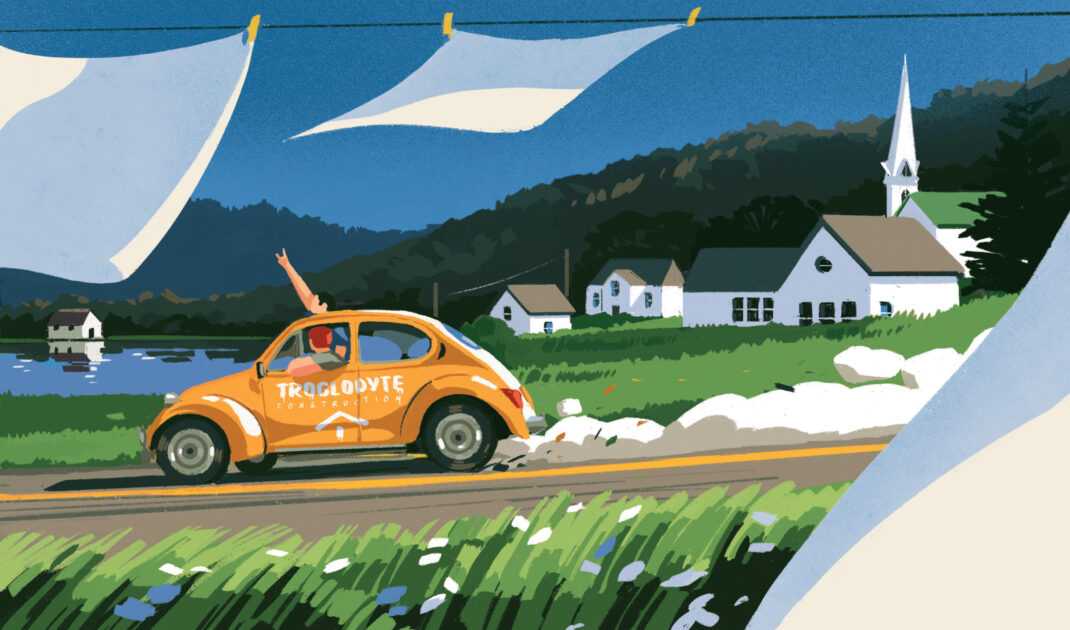
Credit: Illustration by Tom HaugomatWhen I was 16, my friend Trevor and I owned and operated a small residential construction business we called Troglodyte Construction. By “owned and operated,” I mean that we spray-painted “Troglodyte Construction” on the side of the yellow 1971 VW Bug I was driving at the time; by “small residential construction business,” I mean that we mostly puttered around the back roads of central Vermont, each with a farmer-tanned arm resting on the sill of an open window, summer breezes licking at our boyish faces as we intermittently sang along to the Beastie Boys and discussed the possibility that someone would someday hire us to build something. Which, if I remember correctly, my parents eventually did.
To be fair, even at such a tender age, Trevor already knew the rudiments of sound carpentry. If there was a true troglodyte among us, it was me, for I was in possession of 10 thumbs (perhaps 11) and ignorant of even the most basic tenets of building. But I had the unearned confidence of youth on my side, and this allowed me to envisage myself as capable of addressing any and all of my imaginary clients’ construction needs. Crucially, it also afforded me the assumption that there existed a pent-up demand for hiring a 16-year-old whose favorite album was titled License to Ill. How could I possibly fail?
Rather spectacularly, as it turned out. All the envisaging and assuming in the world proved insufficient in the face of my inexperience, and when Trevor moved on to bigger and better opportunities, Troglodyte Construction faded into even greater obscurity.
Still, my tenure in the building trades wasn’t over. Indeed, I went on to work for a number of legitimate builders. There was Tom, who was extraordinarily kind and gentle—a short, slight, middle-aged man who lived in the woods and wore a beret and was clearly navigating choppy emotional waters. Every so often, he’d disappear for a half hour or so, before returning to the job site with bloodshot eyes. Initially, I assumed he was smoking weed, until he explained that sometimes he just needed to sit in his truck and have a good cry. There was Ken, whose eyes were also bloodshot, though definitely not from crying. Then there was Will, who was foreman of a crew that Lee—a general contractor who specialized in period-correct restorations—had pulled together. Lee was—how to put this nicely?—batshit crazy. He talked incessantly while snacking on cloves of raw garlic that he pressed into chunks of extra-sharp cheddar cheese, and we counted ourselves lucky that he mostly left us to our own devices.
Will often rode his Harley to the job site, and he looked every bit the part: flowing gray beard, fading tattoos and even more faded blue jeans, bandanna knotted around his forehead, tattered work boots. He was a good guy, whose crudeness and rebel-without-a-cause aesthetic seemed like a flimsy cover for something far gentler and more thoughtful. Will was mostly willing to mentor me in the basics, except when he wasn’t, at which times he’d revert to bossing me around and making me the brunt of an enviable library of disparaging jokes that are unfit for the pages of a family magazine such as this one.
I hadn’t thought about most of these men for many years, but this summer I got it in my head that what I needed more than anything else in this world was a shed. My house is on the small side—about 1,100 square feet—and although I have a full basement, my only access to the basement is through the house. This meant that I needed someplace else for all the detritus of my rural life, including but not limited to: one off-road motorcycle (running), one on-road motorcycle (not running), eight truck tires with questionable tread, one lawn mower that I got for free and probably overpaid, the tailgate from my son Fin’s old Tacoma, two five-gallon buckets of undercoating material, one string trimmer, and a random assortment of lumber that I’ll almost certainly move at least a half-dozen more times before I decide I’m never going to use any of it and tuck it into various nooks and crannies around my property.
Now I don’t mind a bit of clutter, particularly when it’s composed of useful items, though I acknowledge the slipperiness of this particular slope, and all the ways in which useful is profoundly subjective. And I suppose that in the slow accumulation of my own clutter, I saw that slippery slope coming into focus, and I knew I had to act quickly before being swept over the edge.
Truth is, I’m not a great builder. I’ve never had the patience, eye for detail, or problem-solving abilities that are the hallmarks of all the good carpenters I’ve been fortunate enough to learn from. But despite my lack of innate talent—and largely thanks to those mentioned above, along with a few others—I’ve managed to accumulate just enough skill to have built three houses, one barn, and a handful of outbuildings. To be sure, you probably wouldn’t want me to build your house; on the other hand, all of the houses I’ve built are still standing, shortcomings and all.
In many ways, the shed was precisely the sort of building project I relish, lacking all the fussy details that creating a weathertight and well-insulated living space demand. Plus, I’d be able to make use of my random lumber and those old divided-light window sashes I’d been tripping over ever since I retrieved them from a free pile last summer.
As of this writing, the shed is approximately 80 percent complete. The walls are up, the roof is on; all that remains is to sheath the end walls, build frames for those salvaged window sashes, hang the door, and install a loft floor. Given a sufficiently relaxed approach, I should be able to consume the remaining summer and fall months picking away at these final details. Surely I could finish more quickly, but to what end? Even in its unfinished state, my new shed has already averted my looming detritus crisis. For now, anyway, the precipice of that slippery slope has faded into the horizon, though I must remain vigilant, for sheds are infamous for their ability to shrink over the years.
But perhaps most gratifying to me is the awareness that somewhere, deep in the recesses of my middle-aged self, that overconfident, marginally capable teenage boy lives on. Troglodyte Construction may not have been the world’s savviest business move. But in its own modest way, it has somehow managed to endure for nearly four decades. And I’d say that’s a pretty good run.
This column was originally published in the July/August 2025 issue of Yankee.