Life in the Kingdom | Force of Nature
What you can’t control, you have to survive.
By Ben Hewitt|Jan 01 2025|


Life in the Kingdom | Force of Nature
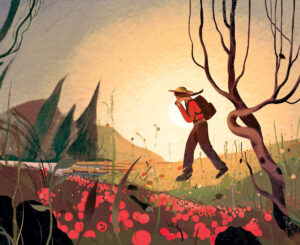
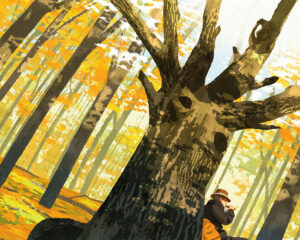
Credit: Illustration by Tom HaugomatExactly a year to the day since the great July flood of 2023, the rain rushes in again, hammering my roof for hours in the night. It pulls me from a deep, dreamless sleep, slanting sideways through the open window at the head of my bed, the cool drops freckling my face until I rouse myself enough to lower the sash. I lie there listening to its unrelenting roar, willing the already-saturated ground to absorb it all, willing the stream that runs along the Mountain Road to contain it, willing the culverts to remain clear of debris. Willing it to just stop.
At precisely 4 a.m. my phone rings, waking me again, and I know immediately that it has to be bad. Because who calls at precisely 4 a.m. when it’s good? No one, that’s who.
Indeed, it is bad. The bridge above the Riches’ is gone (again), the bridge at the bottom of the Mountain Road is gone, Silver Road is reduced to a single lane (again), the lower section of Gonyaw Road is unpassable (again), and the Mountain Road from just past the old Giles place and upward is at least half gone—all that remains is a narrow strip along its southern shoulder, unnavigable by car or even truck.
I drive what remains of the dangerous, diminished roads to the town garage, where I grab every Road Closed sign I can find and stuff them in the back of my car, then head back into the murky, liminal light separating night from day, windshield wipers slapping, window open to the thick air, rain slanting through the opening onto my arm, into my lap, freckling my face again. I don’t even try to stop it. There seems no point to it; the damage is already done. The water has already won.
At 5, I find Kyle at the end of Norway Road. I climb into his truck and we travel the remaining roads together, stopping every so often to chat with whomever we meet coming the other way, all men, all in pickups, all wearing baseball caps, all greeting us with a smile and a rueful shake of the head, because while there’s nothing funny about any of it—not a damn thing—there is a certain dark comedy at play. I mean, seriously: a year to the day of the previous flood, our little town left hundreds of thousands of dollars in debt from that storm, with the long-promised FEMA relief still dangling like a carrot at the end of the longest, twistiest damn stick you’ve ever seen? Are you kidding me?
As it happens, you are not.
Kyle and I park at the bottom of the mountain and walk that remaining narrow strip in silence, each of us in our own way reckoning with the hard truth of the hard circumstances that we suddenly find ourselves beholden to. His reckoning, I’m almost certain, involves a mental checklist: Who is available to start hauling material, who has an excavator available, which gravel pit to haul from? Mine leans financial: How much can this possibly cost, how will we afford it, and what are we going to do if this just keeps happening, year after year after year?
And I don’t know what gets me thinking about this, though maybe it’s just the vulnerability of the moment, the sense of being at the mercy of forces beyond my control—natural forces, bureaucratic forces, forces I cannot name and perhaps are not even nameable in any language I know—but as I walk, my thoughts turn from the matter at hand and I am thrust back in time to the moment exactly one week earlier, when I’d left my son Rye standing in the middle of the vast Montana valley where he now lives, on the vast Montana ranch where he now works, after a too-short visit that had seemed shorter still.
So even as I continue following Kyle up the Mountain Road in the misty half-light, stopping at intervals to peer over the edge into the deep mud-and-gravel channel where the road used to be, even faced with such stark and strangely beautiful devastation, I’m still back in Montana, now making the three-hour drive to the airport, where I’ll soon fly 2,500 miles in a direction pointing away from my 19-year-old son, feeling as if I might literally not survive. As if my love for him could break me into pieces too small, too numerous, too complicated and messy to ever be put back together into anything resembling their original whole.
And even though I think this might actually come to pass—indeed, I am nearly convinced that I am about to become the first parent to actually die from loving their child—and even though many times I think to turn back, I also know that I won’t, that his life and mine have diverged in the ways they were always meant to. Which is not to say that we are not still connected, or that our lives won’t intersect again, because surely they will. But it is to acknowledge that he himself has become like the rain that swept through my window in the night, like the water that has once again wreaked havoc on my community: a force beyond my control.
So instead of turning back, I keep driving under that ceaseless sky, putting mile after mile after mile between myself and my son. Waiting to see if maybe—just maybe—I’ll survive.
This column was originally published in the January/February 2025 issue of Yankee.