Life in the Kingdom | After the Rains
Another once-in-a-century flood hits home.
By Ben Hewitt|Nov 01 2023|

Life in the Kingdom | After the Rains
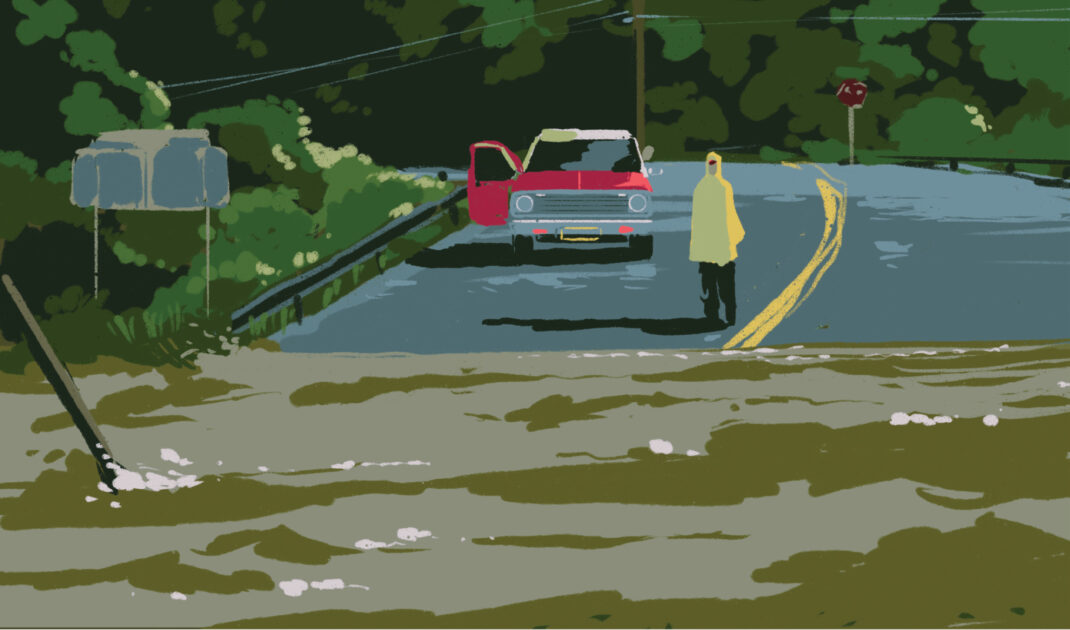
Credit: Illustration by Tom HaugomatI slept through much of the heavy rain that fell during the night of Monday, July 10. Partly this was because I’m an excellent sleeper, capable of slumber in all manner of adverse circumstances. And partly it was because it had already been raining for weeks. The constancy of the rain (and not merely the rain itself—its drumbeat on the roof, the way it soaked through my jeans every morning at chores, how it ensured that our line-dried laundry was never quite dry—but the idea of it) had inured me to its presence and, despite myriad warnings from state officials regarding the possibility of severe flooding, lulled me into a sense of complacency. After all, nothing truly awful had occurred over the previous month of incessant rainfall. How much damage could one more night of rain possibly inflict?
It was early on Tuesday morning when Kyle, who composes the entirety of our town’s road crew, pulled into our driveway in his big silver Ford pickup. I serve on our three-person select board, and in this capacity I have become Kyle’s main point of contact with our town’s administrative process, which includes occasional tours of the 16-ish miles of Class II and Class III gravel roads that fall under our purview. These tours are typically uneventful, an opportunity to assess which ditches might need cleaning out before winter, or if a culvert is due for replacement, or whether we should hire someone to mow alongside the roads.
It was light but yet not fully day when I climbed into the cab of Kyle’s truck, which means it was probably a bit after 5 a.m. I was drinking my customary cup of predawn coffee; Kyle was halfway into his customary predawn Mountain Dew. It was still raining, though only lightly. The air was dense with humidity, and I could hear a steady roar from the stream that runs alongside the Mountain Road from the height of the land down to the valley below, where it joins the Upper Lamoille River on its way to Lake Champlain. But even this was something I’d become accustomed to: The stream had been roaring for weeks now, and I liked that I could hear the sound of the water from the house. I found it soothing, almost meditative.
“Pretty sure we’re screwed,” said Kyle as we pulled out of our driveway, though of course he didn’t say “screwed.” Already that morning, he’d gotten reports from workers on neighboring road crews, and these reports were not hopeful. From the sound of it, large sections of road had been affected, and some were rumored to be impassable. Yet as we drove down the Mountain Road, alongside that roaring stream, the true consequences still seemed distant, even improbable. The Mountain Road itself had escaped relatively unscathed; sure, there were places where the stream (now a frothing river) had scoured its banks and undermined the roadway, and sure, there was the bridge that had sacrificed one of its wing walls to an earlier, localized storm a few weeks back, necessitating a detour. But by and large, things looked fairly normal.
I relaxed into the passenger seat of Kyle’s truck, all but certain that the rumors were overstated, and that the warnings from state officials, while justified as a precautionary measure, had been unnecessary. It was just another heavy rain event, requiring no more than the typical remediation: a few loads of material here, a new culvert there, and a bit more overtime for Kyle. Nothing we hadn’t seen before. Nothing we hadn’t dealt with.
All that changed when we turned onto Gonyaw Road, one of the main routes connecting our town to the paved north-south passage of Route 16. Because Gonyaw Road was, well, gone. Kyle parked a bit closer to the edge of the former roadway than I might have preferred, and we both clambered out. “Holy crap,” I said, though of course I didn’t say “crap.” I hopped down into the trench where the road used to be; what remained of the road surface was now at chest height. I was standing in what was effectively a riverbed that continued as far down the hill as I could see. I climbed out, and we drove to Schoolhouse Road; it, too, was a riverbed. Then to Hutchins Farm Road: another riverbed. Three of the primary roads connecting us to the wider world had been effectively erased. This was something we hadn’t seen before. This was something that would take months to fix.
Yet in comparison with neighboring communities, our town had fared remarkably well. We are settled on the flanks of a mountain, a topographical feature that has its share of drawbacks, to be sure, but all of which now seem to pale before one primary compensation: There are few places for floodwaters to gather. While many of our roads were essentially washed away, there was relatively little damage to personal property.
As we all know by now, the same cannot be said of many other communities in Vermont. Shortly after the flooding, I drove to Montpelier to help a friend finish moving out of her house, which lay in the lowest part of town, only steps from the river. By then, I had seen plenty of news coverage regarding the devastation to Vermont’s capital, yet I was entirely unprepared for the in-person reality of it: the towering piles of debris lining every foot of every downtown sidewalk, the silt that covered the ground, and perhaps most affecting to me, the acrid smell of diesel fuel mixed with the manky odor of river sludge. Everywhere I looked, people were hauling trash to those tall windrows. Many wore masks. Most looked very, very tired.
We filled Mollie’s car with what remained of her salvageable belongings. She would be staying with a friend for the time being; beyond that, she could not say, though she knew she wouldn’t be returning to the house she had rented for many years. After all, this was the second time in a dozen years that downtown Montpelier had been inundated by a so-called “100-year event.” Yet this sweet little city, nestled like so many Vermont communities into folds of land along the banks of a river, still felt like home to her. One day, she might return.
When I visited Montpelier three weeks later, much had changed. Many of the windrows of debris were gone, some stores were open, and overall the downtown felt more alive. People were out and about, not merely those engaged in cleanup but also those just going about their everyday business.
I parked at the end of State Street and walked to the edge of the Winooski River, which on July 11 had crested above 21 feet, a full 15 feet higher than it was today. The water burbled along, now placid. Upstream from me, some children were throwing rocks into the water for no reason I could discern but the simple pleasure of it. Maybe things weren’t back to normal—not yet, anyhow, and for some, not for a while—and surely there would be challenges ahead.
But for now, it seemed, the storm had passed.
This column was originally published in the November/December 2023 issue of Yankee.