Life in the Kingdom | About a Boy
A chance encounter on a country road brings back childhood memories.
By Ben Hewitt|Sep 01 2023|

Life in the Kingdom | About a Boy
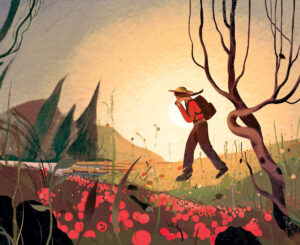
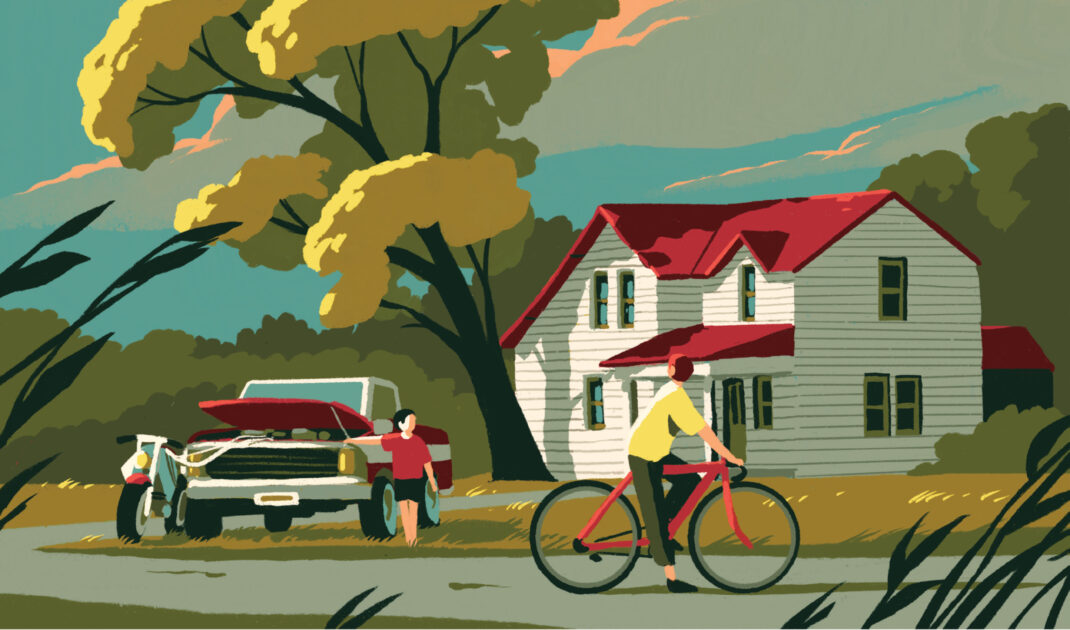
Credit: Illustration by Tom HaugomatEarly in the morning, with a touch of frost in the air and the leaves of the maples barely starting to turn, I ride my bike past the farm that sits on a brief plateau midway up a steep hill a few miles west of our home. It is sunny, and the sunshine—coupled with the steady exertion of my pedaling—makes the chill of the air bearable. Almost welcome, even. I love a lot of farms, but I love this one especially. I love the complicated angles of its roof, and how the milk house door is slightly askew in its frame and therefore always open an inviting inch or two. I love how there’s always a pile of children’s bicycles just outside the door, and I love the sign that reads “Ford Country,” an unassuming homage to the two big blue tractors parked alongside the bike pile. Or maybe it’s not the sign itself that I love, but rather the simple fact that someone hung it.
Just past the barn, the road kicks up again, a final steep pitch before leveling out, and I stand out of the saddle to coax the last bits of power from my legs. At the top of the hill, there’s an old farmhouse on my right: big, white, peeling paint, sagging porch. There are two cars, one truck, and a motorcycle parked in the driveway, and the nose of a tractor peeking from around back. It’s red, not blue, so I must have crossed the border of Ford Country. One of the cars is an ’80s-era Chevy IROC-Z, while the other is a ’90s-era Cadillac (I’m not sure which model specifically, because unlike the IROC-Z, I never pined over a Caddy in my youth) and the truck is a Ford F-150 of similar vintage. I can’t tell much about the motorcycle, but I can see that its seat has been removed to grant access to the battery, and that the battery of the bike is connected to the battery of the truck by a pair of jumper cables.
I have no idea how many times I’ve ridden past this house over the years, but this is one of my favorite routes, so I’m confident it’s no fewer than 100. And in all those times, I’ve never seen a human being. If it weren’t for the mowed lawn, the changing placement of the vehicles, and the appearance (and subsequent disappearance) of piled firewood, I might have assumed it abandoned.
But on this morning, there is someone outside. A boy. He’s 8, maybe 9. He’s standing at the edge of the driveway, right where it meets the road, in front of the motorcycle with its seat off that’s attached to the jumper cables. Like an umbilical cord. As I approach, he speaks. “I have a scooter,” is what he says. I pause my pedaling and coast a lazy circle in the road. “Oh yeah?” I reply. And then, because this seems an inadequate response to his overture: “Where do you ride it?” He points down the hill, toward the barn with the complicated roof angles and the slanting milk house door and the pile of bikes. “To the farm,” he replies, before adding, almost without skipping a beat, “I’m going to school.”
I’m unsure of what else to say, and I’ve already ridden two lazy circles in the road, and besides I’ve still got eight miles to ride with a very full day awaiting at the other end. So I give him a little wave and wish him a good day. He says nothing more but gives me a little wave in return, and soon I’m far enough up the road that even if I looked back (and I’m tempted to), I know he’d be out of sight.
Out of sight, perhaps, but not out of mind, because for the remainder of my ride—for the remainder of my day, truthfully, and even now, again—I think about the boy who lives in the old farmhouse with the old cars, and who rides his scooter down to the barn to … what? Do chores, presumably, though maybe just because it’s where the road flattens at the bottom of that final pitch, and therefore offers a convenient place to turn around.
And now I remember how when I was that boy’s age or thereabouts, my friend Trevor and I would push the rolling chassis of an old motorcycle up the hill from his house to mine, then climb on and ride down, faster and faster, and maybe the brakes worked and maybe they didn’t, but we never got hurt and I guess that’s mostly what matters. And I remember how when we lived next to Melvin’s farm, back when Melvin was still farming and we still lived there, my sons would hop on their bikes in the late afternoon and ride out across the grazed plain of pasture to drive the cows down to the barn for evening milking. I remember Penny and me watching from the height of our land, knowing even then that we wouldn’t forget.
And I think about what the world has to offer a boy like this, coming of age on the top of a hill along a back road in northern Vermont, in a house that looks like hardship, though of course I can’t really know, and besides there are many flavors of hardship, some of which may be exactly the flavors a person needs to thrive. There seems much in common with how my sons grew up, and it’s true that I don’t often worry anymore about what the world can offer them (though it’s also true that maybe I should). Yet even in the intervening decade, so much has changed, and I try to imagine how any of those changes might benefit this boy and others like him. But I cannot.
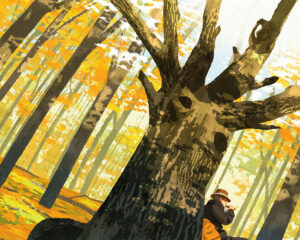
The next morning I ride the loop again, and although I pass the boy’s house within minutes of the same time, he’s not there. I pedal on, and soon I’m passing under a canopy of maples, and it’s hard to tell for certain, but I’m pretty sure the leaves have just a little more color than the day before.
This column was originally published in the September/October 2023 issue of Yankee.