Winter Lights at Shelburne Museum: A Vermont Holiday Light Display
Winter Lights at Shelburne Museum in Vermont lends an artful glow to the holiday season.
By Justin Shatwell|Oct 22 2025|

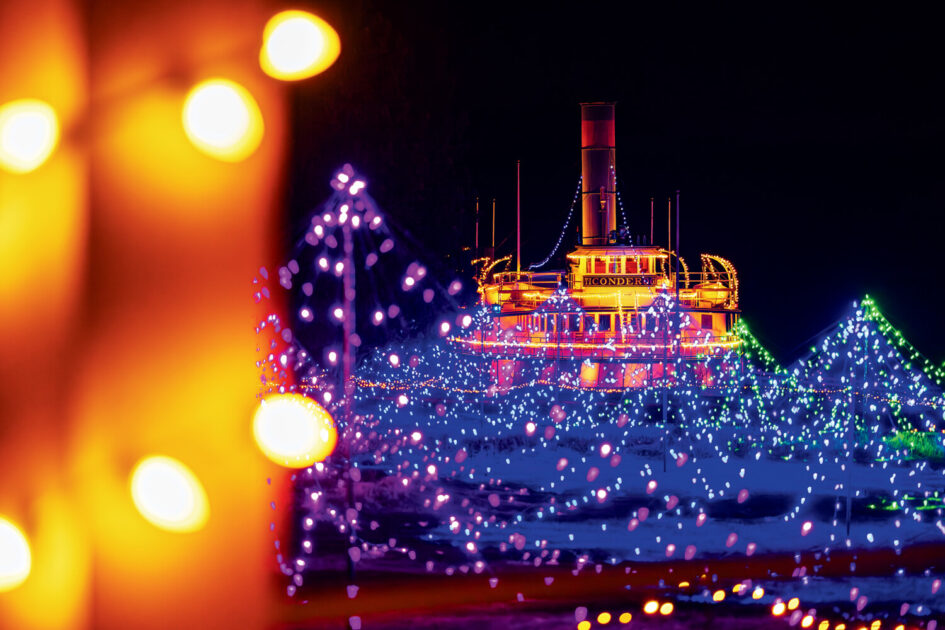
Among the most dazzling displays at Winter Lights at Shelburne Museum is the decked-out steamboat Ticonderoga, which marks the 70th anniversary of its arrival at the museum this year.
Credit: Adam SilvermanYour first glimpse of the light show is a deceptive one. From behind the row of buildings that obscures the view from the highway a warm light rises, sketching the rooflines against the night sky. The antique covered bridge that sits at the edge of Shelburne Museum’s campus in Shelburne, Vermont, has been traced in elegant white strands. It’s a simple and classic display, and it’s completely misleading. There is nothing else so understated or traditional in the spectacle that awaits you.
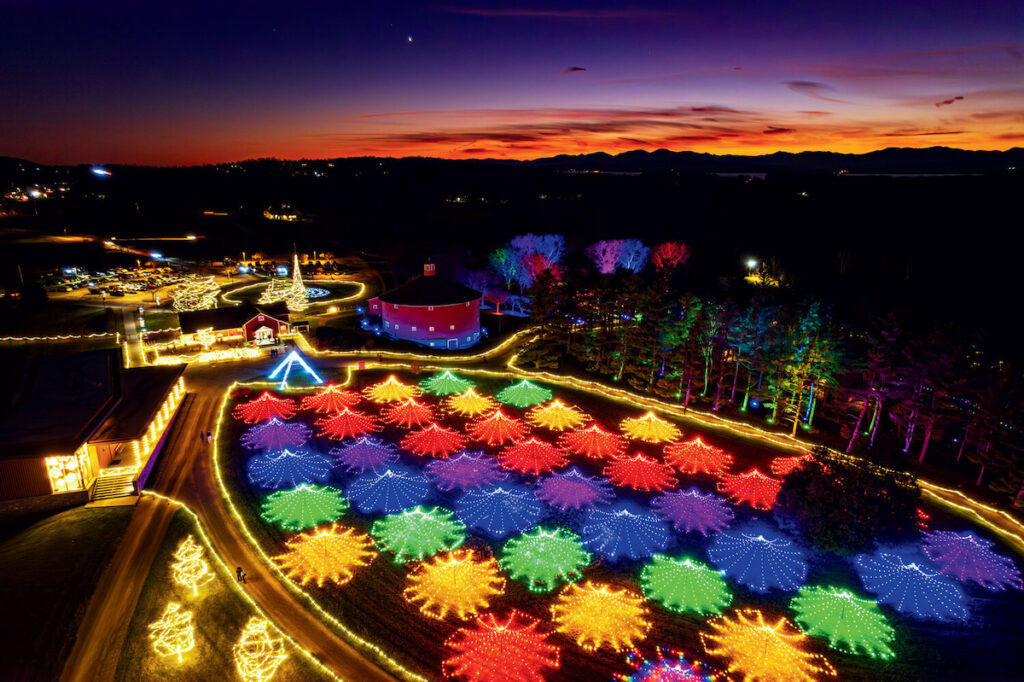
There’s no telling what will greet you as you push through the entrance gates, since the museum’s Winter Lights event is overhauled every year. Once, visitors emerged into a forest of trees made entirely of lights. Another year the lawn was like a field of radiant flowers, with long strands crisscrossing the ground, each bulb rising into the air like the head of a tulip. Here a swath of blue, there a ribbon of red. The view was dazzling from the ground, but from above it took on greater meaning: The lights formed the pattern of a quilt that might be found in the museum’s collection.
When Shelburne Museum first produced Winter Lights five years ago, organizers were determined to create more than just a pretty holiday display. They wanted the festival to say something about what Shelburne Museum is; they wanted to translate their collection into light. This task falls largely to Kory Rogers, the museum’s senior curator of American art, who works for months with a professional lighting company to plan the event. The assignment would be difficult at any museum, but capturing the essence of this particular collection takes a special kind of creativity because, frankly, the museum is hard to describe.
Shelburne Museum is built upon the personal collection of Electra Havemeyer Webb, a Gilded Age heiress to a sugar empire who passed her days accumulating treasures, much like Isabella Stewart Gardner in Boston. But where Gardner scoured Europe to build her trove, Webb stayed close to home, scooping up the works of American artists and craftsmen.
Credit: Adam Silverman
“She was a bizarre collector who latched onto anything that struck an emotional chord with her,” Rogers says. Beyond fine art, she bought barns, carriages, and a city jail. She acquired a blacksmith shop, a lighthouse, and a carousel. She filled her galleries with glassware, paintings, circus posters, and mechanical puppets. She boasted some of the world’s largest collections of trivets as well as mustache cups, drinkware with a built-in guard to separate one’s facial hair from the beverage within. (One such cup inscribed “Mother” raises more questions than answers.)
“[Webb] just had this sense of playfulness to her, which isn’t something you’d expect from a New York socialite,” says Rogers. “You never get bored with this collection.”
Winter Lights echoes the whimsical energy of the museum’s founder. The event is eclectic, exuberant, and sometimes surreal. Everywhere you look there are lights: They line the paths and hang down from the trees like glittering webs. The formal gardens that dot the campus are transformed into fairylike scenes, with each shrub and flower bed glowing brightly in the early winter chill. Joyous holiday music streams from speakers at one location only to be replaced a short distance down the trail by the ethereal tones of a live solo harpist.
Near one corner of the museum grounds, carnival music pipes from the carousel. Red and green lights reflect off the varnished eyes of the wooden horses. Strands of lights draped from a pole create a life-size circus tent, with re-creations of animals and acrobats frolicking under the big top.
Every year, the centerpiece of the show is the Ticonderoga, a 220-foot landlocked steamboat that is also the museum’s largest artifact. Time and again, Rogers breathes new life into the ship by returning it to the water. Thousands of blue and white lights fill the lawn around the Ticonderoga like a radiant Lake Champlain. The effect is never done the same way twice. One year, the lights extended from the ship in concentric rings, like currents breaking against the bow. Another time, the lights were laid out in grand, impressionistic swirls, making it look as though the ship were sailing through the sky of van Gogh’s Starry Night.
This year, Rogers is experimenting with attaching lights to the ship itself, using magnets to capture the energy of waves crashing against the hull. It’s just one more way the museum pushes the envelope every year. “You can’t do this kind of thing halfheartedly,” Rogers says. “You have to commit.”
There’s only one display Rogers leaves alone each year: the one for a log hunting cabin sitting in a small grove. “Every year people tell us not to touch it,” he says. “So we don’t.”
It’s not hard to understand why. The cabin isn’t far from other, bigger attractions, but the copse of trees provides a sense of seclusion. Gentle music emanates from hidden speakers as laser projections etch flakes onto the branches and then float them gracefully to the ground. After the grandeur of the rest of the show, it’s a perfect place to slow down and end your evening, lost in a peaceful snow shower of immaculate light.
Winter Lights at Shelburne Museum runs 11/21–1/4. For pricing, dates, and times, go to shelburnemuseum.org.
This feature was originally published as “Time to Shine” in the November/December 2025 issue of Yankee.