



Exeter, New Hampshire | Could You Live Here?
With memorable meals, antique homes, an elegant inn, and a great bookstore, the river town of Exeter, New Hampshire, feels like a coastal retreat without tourists or traffic.
By Annie Graves|Feb 22 2018|

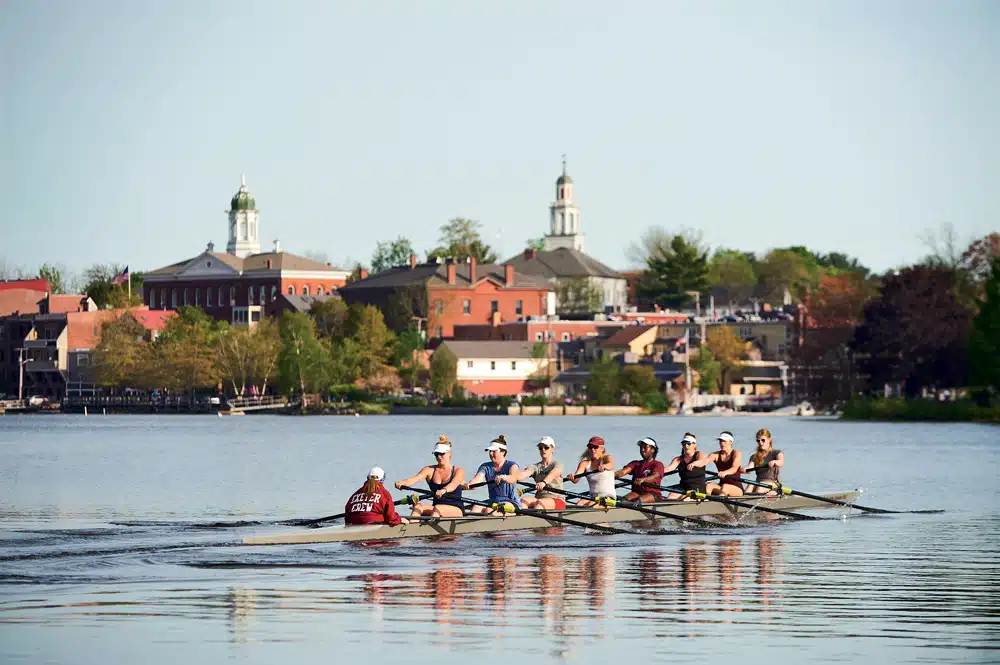
The Phillips Exeter Academy women’s crew team darts over the water within sight of downtown.
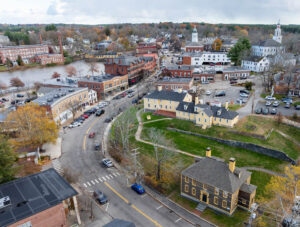
Credit: Mark FlemingSpring comes early to Exeter, New Hampshire. Maybe it’s due to the proximity to the sea (15 minutes) or possibly to an odd commingling of rivers—one sweet, one salty—behind the shops and cafés leaning into one another along Water Street. There, the Exeter and Squamscott rivers entwine, the ancient lifeblood of Exeter. With waterways leading to Great Bay and on to the Atlantic, the town, founded in 1638, became a thriving seaport without a sea, traversed by schooners and gundalows, bustling with shipbuilders.
There’s revolution in the air, too, centuries old. Exeter’s fine colonial buildings hint at the history churning just below the surface of this early township—one of the first four in the state. Where else might the local electrician (so the story goes) find an original printed copy of the Declaration of Independence stuffed between the floorboards of an old house (the 1721 Ladd-Gilman House, now the American Independence Museum)?

Credit: Mark Fleming
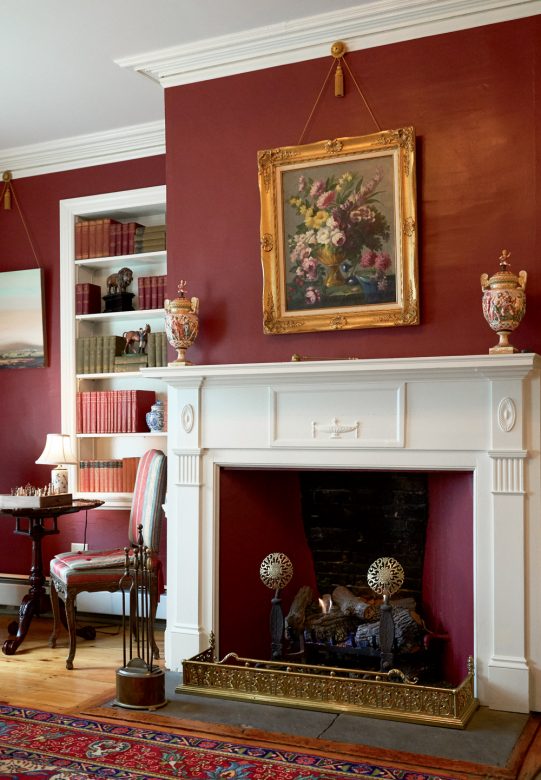
Snugged into an elegant beamed chamber at the Inn by the Bandstand, we are level with the budding treetops, an ideal perch for overlooking history in this town of 14,483. From this 1809 Federal mansion in the heart of Exeter, we can gaze across Front Street and imagine Abraham Lincoln bringing a crowd to its feet at the town hall on March 3, 1860. Just two blocks away, Lincoln’s son, Robert, was attending Phillips Exeter Academy—that venerable prep school founded in 1781 and immortalized in John Knowles’s classic novel A Separate Peace. Thanks to that institution, Exeter has ties to everyone from Daniel Webster to John Irving to Mark Zuckerberg.
Credit: Mark Fleming
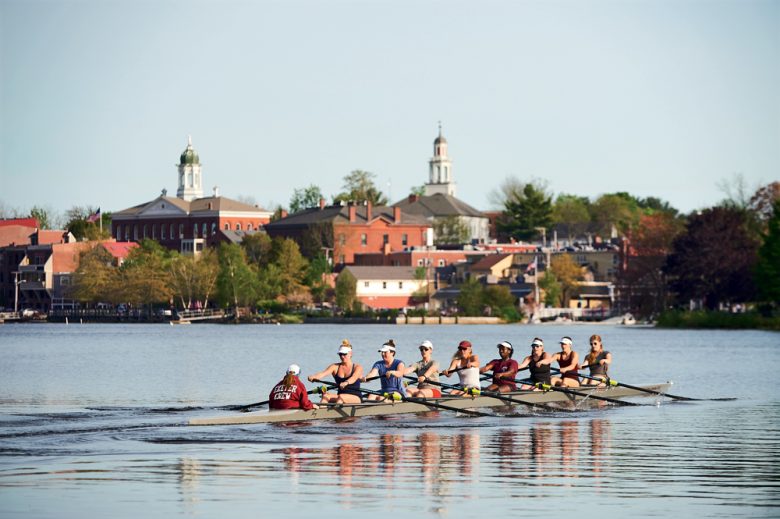
And on busy Water Street, you are still just as apt to overhear students talking about their academy activities, possibly over a perfectly brewed chai latte at D²Java, or under a red umbrella at Laney & Lu Café with an Epic Egg Sammie in hand. Follow Water Street down to Swasey Parkway, and you can stroll the half-mile path that hugs a riverbank once lined with docks and wharves. You can almost hear the creaking of wooden ships. The Phillips Exeter crew team shoots by, the slender boats slicing through placid waters as you look back at the town. The layers of history fade in and out, but they’re there.
The Setting
Just eight miles from the coast and 20 minutes from Portsmouth, Exeter is “very well placed,” says Agostinho Nunes, one of the Inn by the Bandstand’s owners. Streets converge around the bandstand designed by Henry Bacon, best known for the Lincoln Memorial in Washington, D.C. The statue sitting in that memorial was sculpted by Bacon’s friend, Exeter native Daniel Chester French—and it’s worth a ramble down Front Street, past the Phillips Exeter campus, to see French’s bronze World War I sculpture gracing Gale Park. The school melts 672 beautiful acres into the downtown, with walking trails, colonial-era buildings, and a hefty allotment of academic brick, but the real surprise is its Louis I. Kahn–designed library. The monumental brick cube contains a six-story cement atrium defined by massive circular cutouts. Architecture aficionados visit from around the world.
Credit: Mark Fleming
The Social Scene
On Monday nights in summer, Exeter blocks off the streets around the bandstand for concerts featuring the oldest brass band in the country (c. 1847). Swasey Parkway fills up with weekly farmers’ markets, town festivals, and outdoor movies. Kayakers launch into the Squamscott River from the town boat landing beside the Phillips Exeter boathouse. “It’s like a more family-oriented Portsmouth, but without the tourists and the traffic,” says one young woman, who moved here with her husband four years ago to buy a house and start a family.

Credit: Mark Fleming
And then there’s the American Independence Festival, a post-July-Fourth party with a battle reenactment, a chance to quaff Independence Ale where George Washington ate breakfast, and the arrival of the Declaration of Independence via costumed rider.
Eating Out
Lively cafés such as Me & Ollie’s Bakery (its juicy turkey Reuben is a standout) are multitudinous in Exeter, and there are several serious restaurants, too, including Station 19 and Blue Moon Evolution. But the new star in town is chef Lee Frank’s hot spot, Otis, grafted to the side of the Inn by the Bandstand. Amid the convivial din, a few fortunate diners sit at a bar overlooking Frank’s kitchen, where he conjures tastes to rival those of top New England eateries. (Look for the chef’s-choice sampler of five items, which includes such treats as exquisite red fish with carrot purée.) “You don’t have to go to Portsmouth now to get an amazing meal,” says bartender Mike McGuane, who points out that not long after our visit, Frank will be the featured chef at the James Beard Foundation in New York.

Credit: Mark Fleming
Shopping
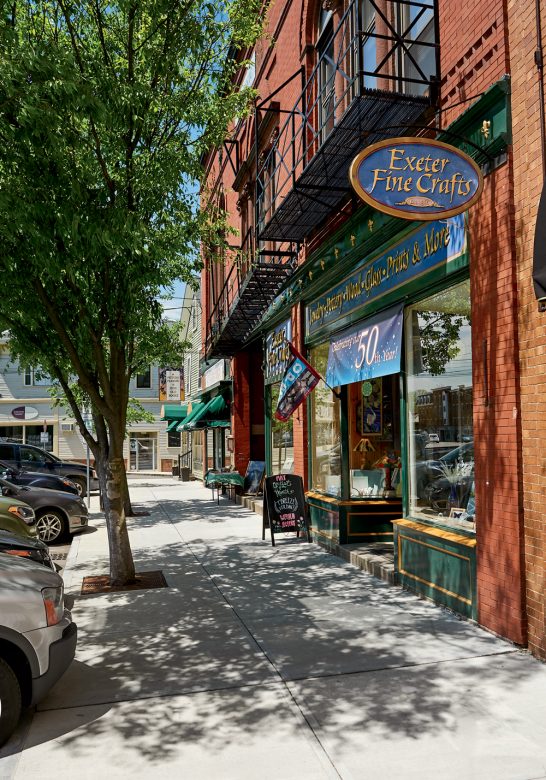
Water Street Bookstore exists in another dimension—the one where time disappears as you absorb a few hundred whip-smart book commentaries taped to the shelves. (You’re practically guaranteed to go home with a book you never dreamed of buying, too.) To move beyond armchair adventures, Travel & Nature offers a dense forest of Patagonia, Marmot, and Osprey gear. Home furnishings veer into “swanky salvage” at Honey-hole, a tiny storefront with eclectic items ranging from local Beeline Skin Care products to a high-end leather messenger bag. “We like to do an antique twist without being old and stuffy,” says Honeyhole owner Heather Dubina, who with her husband, Brian, works rehab magic.
Real Estate
At the time of our visit, a pretty in-town 1875 colonial with three bedrooms and a garage/barn listed at $389,000. Another 1875 beauty—this one needing a bit of cosmetic love and updating—was selling for $244,000. And a pristine 1900 gem with three bedrooms, a new kitchen, and original tin ceilings, situated within walking distance of town, listed at $424,000.

Credit: Mark Fleming
Credit: Mark Fleming
Uniquely Exeter
What other town feels so closely tied to U.S. history that it doesn’t celebrate the Fourth of July—choosing, instead, to reenact the day that the Declaration of Independence was delivered to Exeter, on July 16, 1776? Apart from having a peephole into history (check out the American Independence Museum for unexpected treasures like a Purple Heart awarded by George Washington), Exeter residents enjoy being just minutes from the ocean. And if a city hankering hits, you can hop the Amtrak Downeaster into Boston for $16. Then there’s the free parking—always a friendly gesture in any town.

Credit: Mark Fleming

Credit: Mark Fleming
Getting Your Bearings
The Inn by the Bandstand is lovely, and its breakfasts are downright delicious. But owners Agostinho Nunes and Jaime Lopez go beyond hospitality: They create a home away from home. While we were there, a Phillips Exeter student called to ask if he could stop in for breakfast—and he brought friends. The inn is both “a heaven and a haven,” wrote one guest from Dublin, Ireland. We really could live here. innbythebandstand.com
SEE MORE:
Scenes from Exeter, New Hampshire


Wonderful article about my home town. Beautiful pictures that represent the quaint town well.
So sorry you failed to mention Exeter Inn and the wonderful restaurant there, Epoch. A favorite of ours. As a neighbor from Brentwood, it is our home away from home when we lose power (almost every winter!).
Great article about a great town. Thanks for promoting Exeter.
Good article but cannot believe there isn’t any reference to the beautiful Exeter mill apartments. The building is a staple of the community.
Sounds like a place to put on my “bucket list”!
I love Epoch restaurant, too, and wished the new Hemingway’s restaurant had been mentioned, but it’s not the author’s fault that there’s so much to rave about in Exeter, they couldn’t fit it all in one article 🙂
Yes indeed. I’ve been to Exeter a couple of times and could most definitely live there. In fact, I had that feeling the moment I first got there and stopped my car to park in Water Street.
My wife and I starting to plan for retirement and Exeter sounds like an ideal place. Any recommendations for
retirement communities?