



Earned Gifts of a Boston Winter
The life of the city comes into sharper focus when the cold settles in. Here, we take a closer look at Boston in winter.
By Jon Marcus|Dec 15 2010|

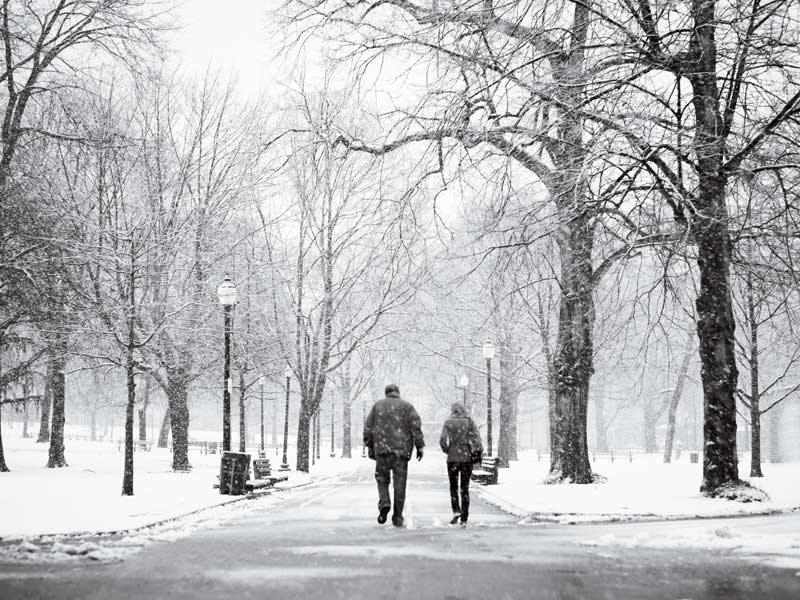
Winter strollers meander the old paths crossing Boston Common.
Credit: Christopher ChurchillBostonians complain about a lot of things, and they especially complain about the winter: the cold, the slush, the sunlessness, the narrow streets and sidewalks compressed further still by crusty banks of snow.
But then, on stormy nights, you’ll find them in a snug North End café, or lingering over a slow-poured Guinness in an Irish pub. Warm and well fed, they’ll shelter behind ice-frosted windows in the early darkness as the snow falls outside, white against the red brick in the lonely glow of streetlights. These moments stop time.

Credit: Christopher Churchill
Photographer Christopher Churchill compares it to September days in his hometown of Camden, Maine, after the summer tourists leave. “You earn those slices of things that remind you why you live here,” he says.
Before the snow turns sooty, before the shoveling and long commutes resume, Bostonians will grow nostalgic for their childhoods–snowball fights and sledding, snow days off from school–the happy privileges of winter in New England.
“When the city shuts down and schools are closed, it’s like a gift of time–time that you usually end up spending close to home with family and friends,” Churchill says. “Who doesn’t like it when a big snowstorm comes through? Who doesn’t have fun?”

Credit: Christopher Churchill

Credit: Churchill, Christopher
Churchill’s conception of fun doesn’t necessarily include driving into Boston when a snowstorm is predicted, only to have the changeable New England weather switch to rain. “It’s tough to forget the drudgery of winter when you’re having to slog through it,” he says. “There’ve certainly been times when I’ve thought, ‘God, it would be good to be a photographer in L.A. right now.'”
The hectic city slows in winter. Even sound seems muffled by the cold and snow–except for, conspicuously, the clear, sharp morning sounds of ice being scraped from windshields and snow from asphalt. The river and, in places, the harbor sometimes freeze. An occasional seagull interrupts the otherwise unbroken monotony of thick, low clouds. The vibrant color of the just-past foliage is smudged to gray. The city turns to black-and-white, its cold stone statues lonely in the windswept snowscape.
Bostonians cocoon at home, or sit in restaurants and bars, watching the snow fall and the plows rumble past. Things come into sharper focus. Fringes of snow grace gnarled, arthritic branches bare of leaves, and draw the outlines of black cast-iron fences.
“You have to be sort of bipolar to live in New England,” Churchill says. “Manic and running around in the summer, and in the winter inward and reflective.” After all, he says, “Who wants to go out on days like that, in sleet and cold? People stay inside.”

Credit: Christopher Churchill
Except for him. He roams the empty-seeming city, cameras and equipment wrapped in Ziploc bags, in search of scenes that aren’t postcard cliches. “I photograph everything in a very nomadic sort of way,” Churchill says. “I spend hours trudging through the cold and finding things that feel like that day or time of day.”
And then, finally, the white flakes fall. “How many days like that do you get where the snow is beautiful?” Churchill reflects. “There’s something about the city when there’s new snow on it that makes you feel the weight of all the history even more. Things look timeless in the snow. Because you know that since the beginning of the world, there’s been snow. It draws you back. There’s something really humbling about remembering we’re at the whim of nature.”

Credit: Churchill, Christopher
As if in solidarity against the elements, Bostonians seem friendlier than usual in winter; they sometimes even talk to strangers. The town is theirs again. Tourists don’t come, or, at least, not nearly as many of them as in spring, summer, or fall.
The buskers flee into the subway stations, where at least occasional rushes of warm, stale air precede approaching trains. Ice, not cheering fans, fills the seats in Fenway Park, although the faithful still come through for tours. They gaze down at the snowy field, imagining it green, surrounded by the noise of the crowd and populated by the boys of summer.
It reminds them to complain again about the winter.
SEE MORE: Boston in Winter | Photographs


Sunlessness? Empty-seeming? Really? Jon, you’ve always been one of my favorite writers, and I’m thrilled to see your byline back on the pages of Yankee. I just love the richly visual descriptions you’ve conjured here. And I’m also thrilled that you’re finding holes in the English language and coining words to fill them! Beautifully written!