Winter Solstice at Mount Auburn Cemetery
During the longest nights of the year, one of New England’s great historic cemeteries comes alive with lights, color, sound, and awe.
By Madeline Bilis|Oct 23 2026|

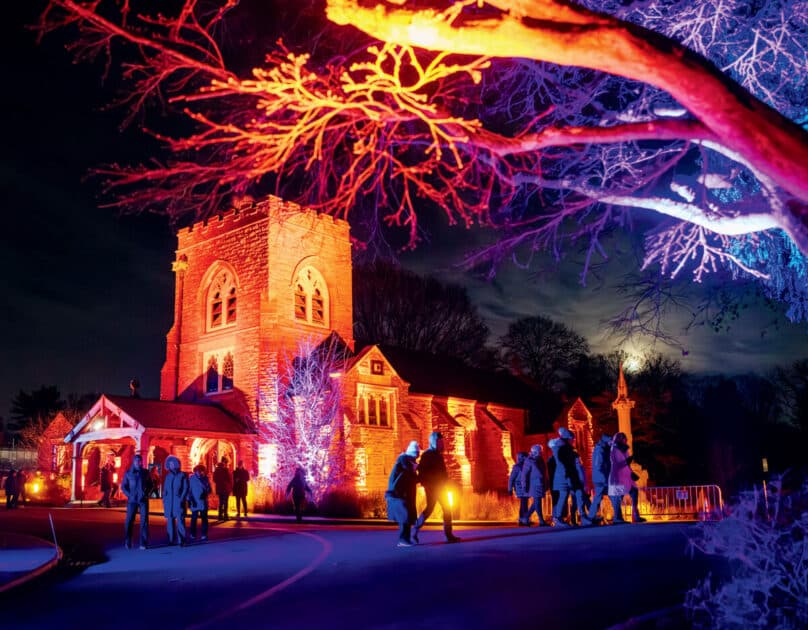
Already a big draw for history and nature lovers, the nearly-200-year-old Mount Auburn Cemetery attracts fans of art and spectacle with its annual celebration of the winter solstice.
Credit: Aram BoghosianThere’s a steady drizzle pelting my umbrella as I dodge puddles on my way to the entrance gate of Mount Auburn Cemetery in Cambridge and Watertown, Massachusetts. Along with my friends Molly and Cal, I’m here to experience “Solstice: Reflections on Winter Light,” the large-scale sound-and-light installation that illuminates the 175-acre property, a National Historic Landmark, during the two weeks leading up to winter solstice. In the deep December darkness, I mutter something to Molly about the rain impeding our visit, not knowing I’d soon find out how wrong I was.
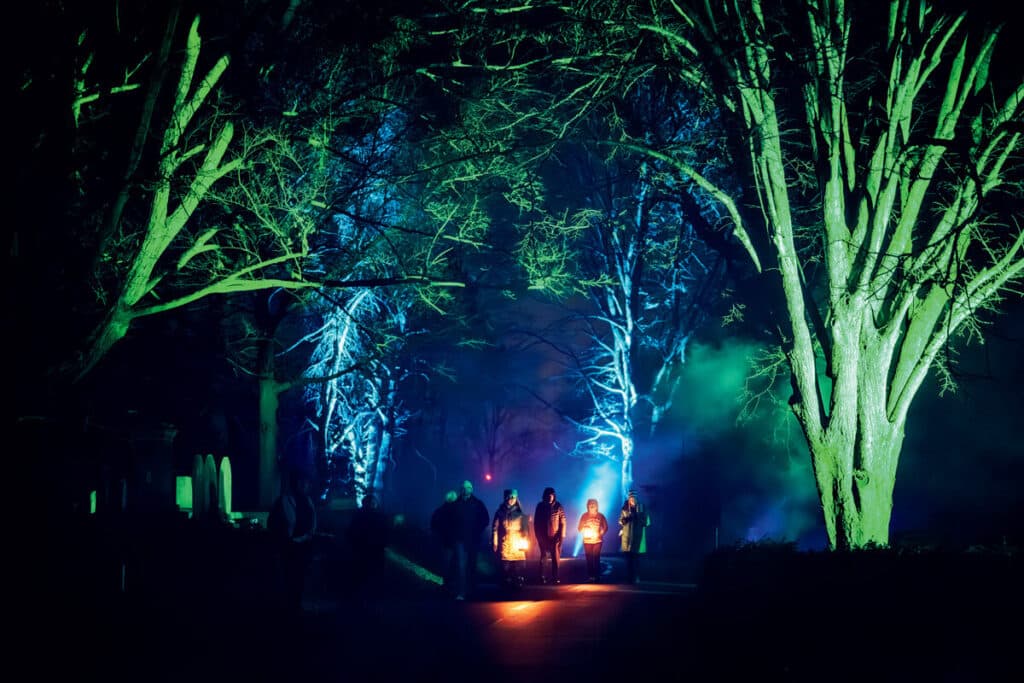
Immediately, we’re met with streaks of light in all colors of the rainbow. They convert bare tree branches to bright-pink statues, make spruces glow in deep blues and oranges, and highlight the curving path before us—all as if a pastoral watercolor painting had morphed into a glow-in-the-dark one. Up ahead, raindrops slice through beams of purple light as ethereal, dreamlike music fills the air.
“Solstice” originally began in 2020 as a way to reimagine Mount Auburn’s winter solstice candle-lighting ceremony in Bigelow Chapel. The cemetery hired MASARY Studios, a Boston-based artist collective known for its site-specific works, to breathe new life into the decades-long tradition. At first, the event was broadcast so people at home could watch the live performances happening inside the chapel. The year after, it became the in-person event it is today, intertwining light, art, and sound into the landscape while still giving visitors the opportunity to light a candle in honor of a loved one.
“Although there are new artworks year over year, the aesthetic and the expression stay central to the idea of the intimacy of a single candle in your hand, or the rejuvenation that you get outside from walking in nature,” says Sam Okerstrom-Lang, MASARY principal and cofounder.
Credit: Aram Boghosian
Credit: Aram Boghosian
MASARY spends about 10 months producing, planning, and programming the show. The team scrupulously balances logistics and creative direction, as working within a 200-year-old active cemetery, arboretum, and botanical garden in wintertime requires careful management. Just after Thanksgiving, they kick off a rapid installation phase, spending three and a half days transporting and installing the equipment, then wiring, tuning, and programming it for more than 20,000 visitors to behold the following month.
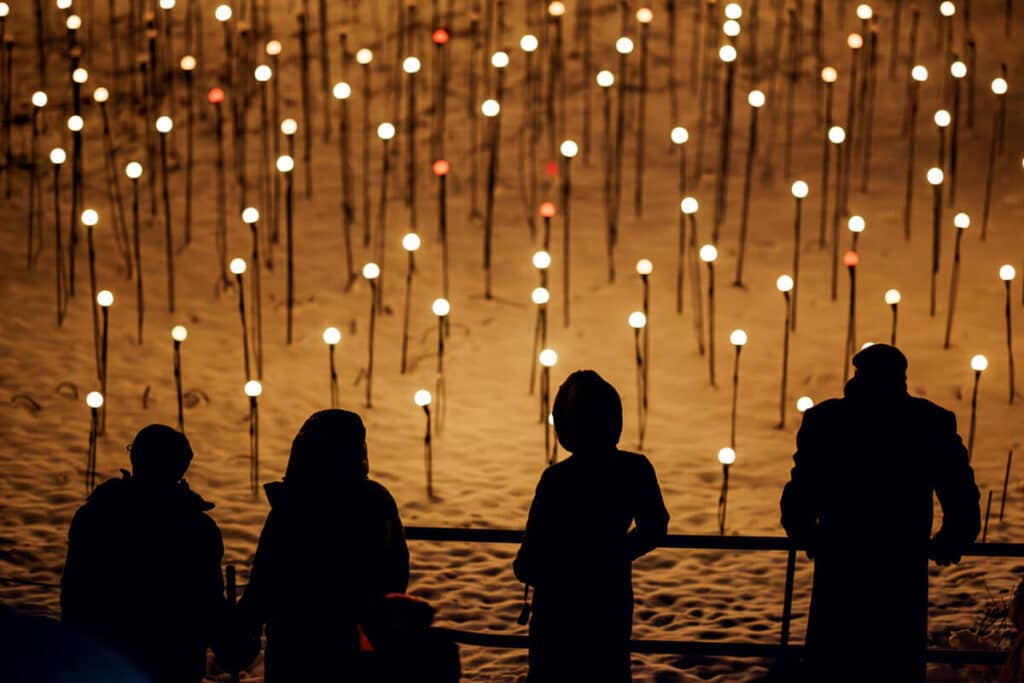
I’m struck once again by the rain. Each individual drop seems to sparkle, mimicking a starry sky in all directions. It’s a fitting addition to “an environment alive with cosmic wonder”—a phrase I note in the description for Arcus Stellarum, an installation that resembles a scintillating white moon, in Hazel Dell, a natural hollow near the cemetery’s main entrance. The experience does prompt me to consider the universe at large; I don’t claim to know much about astrology or celestial marvels, but I suddenly feel small in the best kind of way.
“This event is unique in that it’s contemplative, meditative—it might even be spiritual—but it’s also curious and cosmic,” says Ryan Edwards, another MASARY principal and cofounder. He likens it to a strolling meditation, since the show underscores the beauty of light and reflection during a time when people are intentionally invited to slow down and reflect on the year. It also, he explains, creates a safe space to feel, find solace, and mourn those who’ve passed on.
As my friends and I slowly meander toward Bigelow Chapel, a staff member hands us lanterns to light the way. We stop for some hot chocolate and apple cider at a snack cart before moving on, warm drinks in one hand and glowing lanterns in the other.
Bright rays of magenta and purple spotlight some of the headstones. I sip my cider and think to myself that a gravesite that takes part in an awe-inspiring art installation sounds like an ideal final resting place. We pass a toddler in a stroller, who seems mesmerized by some glowing blue orbs dotting the landscape amid the headstones. “It’s dark,” he says in a squeaky voice, and I concur.
Credit: Aram Boghosian
Credit: Aram Boghosian
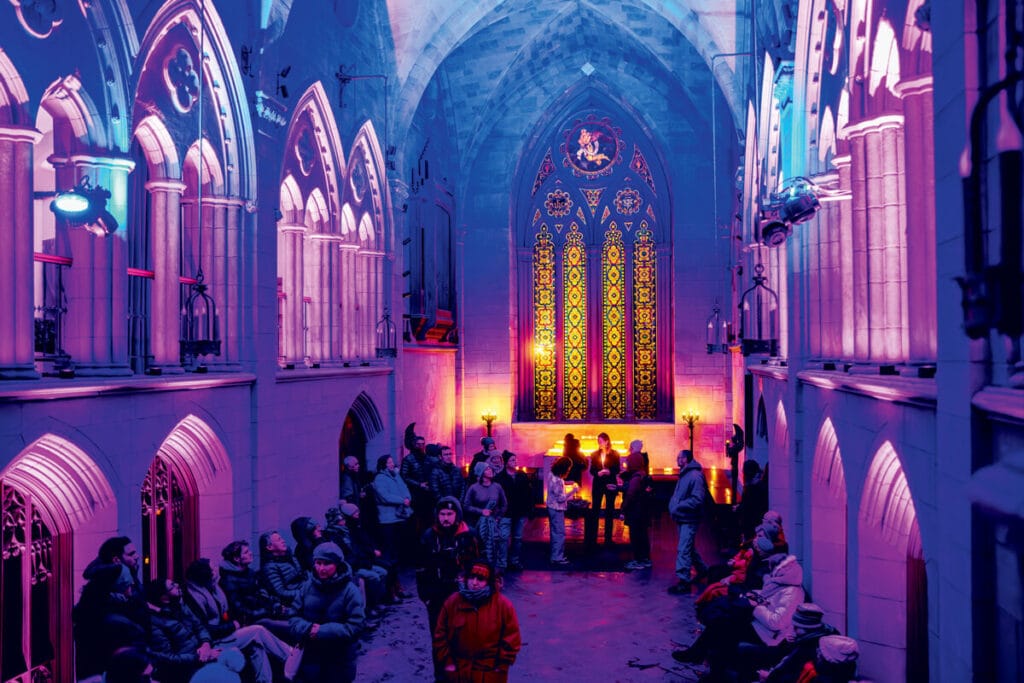
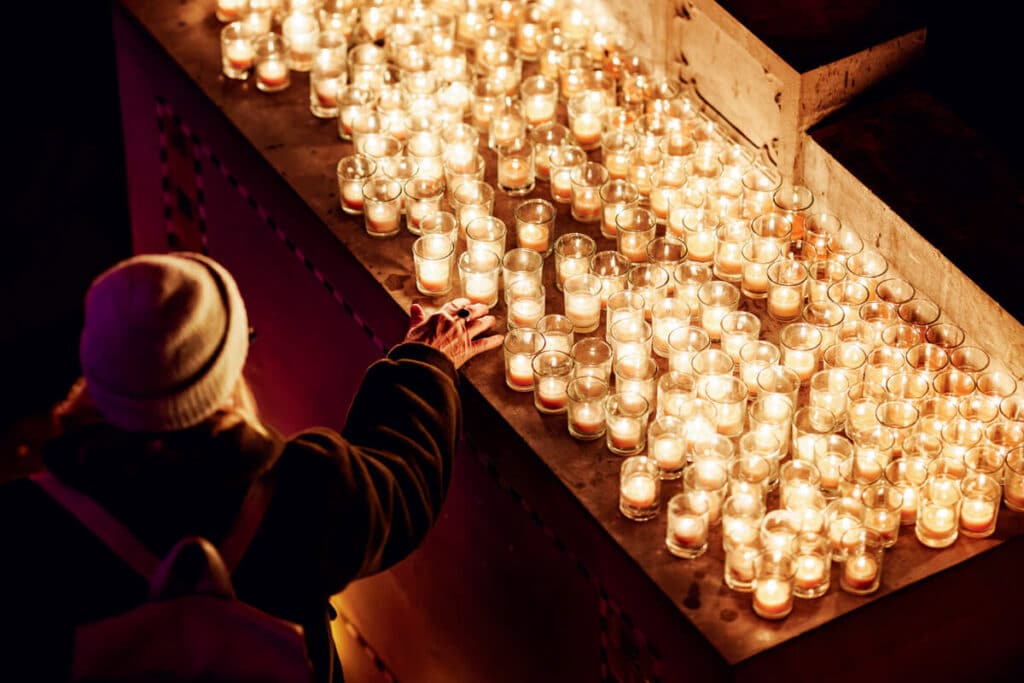
Then we hear the installation at the chapel before we see it: otherworldly melodies floating to our ears until the facade comes into view. There, a small crowd has gathered to watch a pulsing, kaleidoscopic display turn the chapel and its crowning stained-glass window into a galaxy-like apparition. We linger awhile before heading inside, where a line of visitors is invited to light a candle in remembrance of a loved one. I’m still thinking about the pretty lights until a woman in front of me brings me back down to earth: “I need two,” she says to the attendant. “One for my husband and one for my daughter.”
We take our candles into the main hall of the chapel, where rows and rows of them cover seemingly every surface, casting a deep orange glow on the stone walls around us. I silently decide to light a candle in honor of my grandfather, who would be over the moon to hear I’m writing a story for one of his favorite magazines, then pause to listen to a violinist performing on a balcony above us. Another stroller-bound toddler beside me stares up at the performer, wide-eyed, and I join him in doing this for a few minutes.
Once we make our way out of the chapel, we’re back into the rain, and I can now freely admit that the weather actually enhanced the spectacle. The show, it turns out, can be a lot of things at once: a strolling meditation, a night of remembrance, a memorable musical performance, or simply a display of pretty lights to be enjoyed with a cup of hot apple cider. For me, it’s become all four, plus one other thing: an annual tradition.
This year’s installation of “Solstice: Reflections on Winter Light” at Mount Auburn Cemetery runs 12/5–12/21. For tickets or more information, go to mountauburnsolstice.org.
This feature was originally published as “A Midwinter Night’s Dream” in the November/December 2026 issue of Yankee.