Wild Blue Wonder | Bluet Wild Blueberry Wine
With Bluet wild blueberry wine, two Maine-bred winemakers have found inspiration for a fizzy new product – and just maybe a way to help save the state’s wild blueberry industry.
By Rowan Jacobsen|Jun 21 2021|

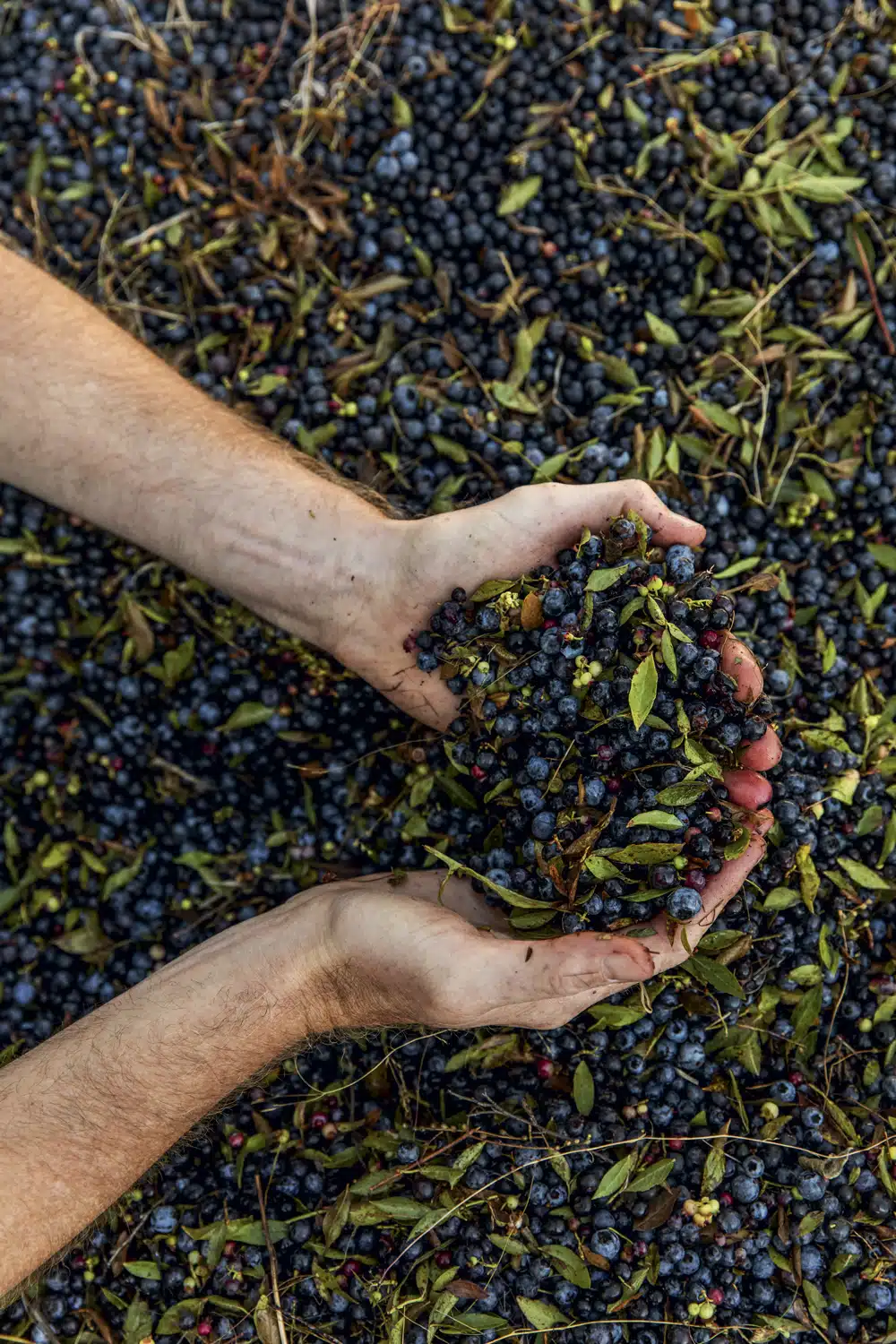
Wild Maine blueberries
Credit: Greta RybusCredit: Greta Rybus
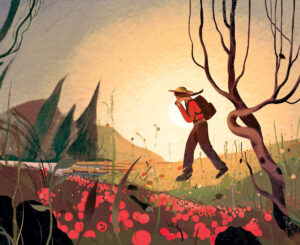
Michael Terrien squats in the field and picks a handful of fruit. He crushes it, squeezing the shockingly purple juice into a plastic beaker. He pours a few drops into one end of a refractometer, a pipe-size device that measures sugar levels. As he waits for the result, he picks another berry and pops it into his mouth, chewing pensively as he stares at the distant hills.
Terrien is a winemaker who lives in Napa Valley. He makes an acclaimed Chardonnay and Pinot Noir, and consults for some of Napa’s most prestigious labels. And he is doing what he’s done every August for most of his adult life: visiting the fields, tasting the fruit, deciding when to pick and how to turn this fragrant abundance into the best possible wine.
“How do we tell the story of this fruit?” he asks his winemaking partner, Eric Martin, who is sampling his own berries a few feet away. “How do we learn from it and make a wine we respect?”
Martin laughs. “I remember being 26 and working the harvest with you in Napa back in the ’90s, and you were saying, ‘How am I going to honor this fruit? How am I going to honor this farmer?’ And it’s the same now.” He pops some fruit into his mouth and exclaims, “This is delicious. I really like the balance of sweet and tart.”
“I agree,” Terrien replies. “Just shockingly beautiful. It smells woodsy and mineral-y, like granite.” He runs his hand over a seam of bedrock breaching the surface, as if to make the connection.
“It’s amazing how different it can be,” says Jeremy Howard, the grower of this fruit. “The flavor profile from patch to patch and year to year can change tremendously.”
It’s the kind of conversation that growers and winemakers have always had, and in so many ways this scene could be anywhere in Napa: slopes stippled with fruit, pickers in the distance filling bins. But this isn’t California. And these aren’t grapes.
We’re at Appleton Ridge, Maine, standing in a field of wild blueberries, Maine’s second-most-famous food. Unlike the “highbush” blueberries cultivated worldwide, wild blueberry bushes rise less than a foot off the ground and produce tiny berries with intense flavor. They thrive in cold climates on thin, acidic soils, especially the glacier-scoured reaches of Down East Maine, where 36,000 acres of fields are maintained, a heathlike region known as the blueberry barrens.
Martin and Terrien, who grew up in Maine and still return each summer with their families, began making wine out of their favorite fruit nine years ago. At first it was on a lark, but they liked the results so much they kept experimenting, and in 2014 they launched Bluet, an all-natural wine made entirely from wild blueberries, or “bluets,” as Thoreau called them, borrowing the old word used by the French settlers who first encountered the fruit. To Thoreau, they were “little blue sacks of swampy nectar and ambrosia commingled,” which certainly sounds like the kind of thing one should turn into wine.

Credit: Greta Rybus
Bluet was not the first blueberry wine, but most earlier efforts were the kind of syrupy funk that has given generations of country fruit wines a bad name. Terrien was the first person with serious winemaking chops to tackle the fruit, and he was not fooled by its sugar. Wine grapes like Pinot Noir have twice the sugar content of blueberries, for instance, “but you don’t make pie out of Pinot Noir.” He went straight to méthode champenoise, the technique employed in Champagne to produce a dry, sparkling, extraordinarily aromatic wine. The result turned heads, in Maine and beyond.
I’d tasted my first bottle of Bluet the day before meeting Martin and Terrien in the barrens, and it was a revelation. The mind has no idea what to make of a champagne glass of midnight-purple juice topped with a frothy pink head. The darkness and density suggest extreme red wine. The word blueberry inclines one to expect sweetness. And so that first delicate, bracingly tart sip comes as a shock.
But at least then you know what to expect. On the second sip you start to appreciate the clean snap of it, and by the third the nuances are coming through, the ethereal notes of citrus and rose petal that Terrien talks about. And by the fourth you’re hooked. (I immediately wanted to try it with Maine’s other iconic food, and Terrien approved: “What grows together goes together. Roasting a lobster over a charcoal fire and drinking a bottle of Bluet is a very lovely combination.”)
“It’s like the blueberry had this flavor that hadn’t been unlocked,” Martin says as we pick our way through the field, sampling from different plants. “Once you strip away the sugar by converting it into alcohol, you reveal its essence, and it’s this really beautiful expression that no one’s tasted before, even though it’s been hiding in plain sight.”
Bluet’s production has doubled each year, but at 3,000 cases per year it’s still tiny. Now the state and its blueberry growers would very much like Martin and Terrien to go big. Crushed by a global tsunami of highbush blueberries, more and more of Maine’s 485 remaining blueberry growers are giving up, despite having the most flavorful blueberries on the planet.

Credit: Greta Rybus
“We started doing this just for fun,” says Martin. “We thought it would taste good and would speak to the place. But once we started working with growers and discovered how desperate they are, that changed. Blueberries grow on land that’s otherwise agriculturally worthless. You can’t grow corn or potatoes on it. The only other thing you can do with it is condos and cul-de-sacs.”
The industry has tried to expand its options with dozens of value-added products, but only wine has a market that puts tremendous value on flavor and place, says Martin. “When we started explaining that we wanted to take the unique character of their fruit and put it into a bottle so people could experience it, their eyes lit up, and they said, ‘That’s the story that we’ve been trying to tell!’ This is what wine is set up to do.”
That story can’t come a moment too soon for family operations like Brodis Blueberries, where we are standing, which has been growing blueberries in this spot since the Civil War. “We were talking with Grandmother Brodis,” Martin says, “and she just looked at us and said, ‘I don’t want to be the one.’ And we knew exactly what she meant. This tradition could be lost very quickly.”
As they wrestle with the implications, Martin and Terrien gaze across the Wyeth-like vista of yellowing greens rolling like waves up and over the glacier-smoothed hills, breaking against old stone walls. Both men are in their 50s, with graying temples and teenage kids. Terrien is tall and thin, with a sumptuous head of hair that gives him a John Kerry–esque mien. Martin has curly hair and would look thin next to anyone other than Terrien. Both have built successful careers away. And both are now feeling the magnetic tug of Maine. It’s that week of August when everything starts to turn. The sun is still strong, but something about the way it angles across the burnished fields reminds you that it’s not high summer anymore. There’s an urgency to the crickets. There are berries to be picked. Time is shorter than you think.
When you ask Martin and Terrien how Bluet began, they will tell you about the bachelor party a decade ago on a Maine island where the group of friends drank everything they’d brought until they were left with one bottle of homemade blueberry wine, and they drank that and Terrien said, “There’s gotta be a better way to make blueberry wine.” But then they will stop and back up and talk about how the Civil War turned Maine’s delectable yet inaccessible specialty into a national obsession. And then they will stop again and back way up and talk about the glaciers.
About 35,000 years ago, the last in a series of ice ages gripped New England. Glaciers a mile high pushed down from Canada, bulldozing Maine’s topsoil deep into the Atlantic Ocean. When the climate warmed and the glaciers retreated, about 12,000 years ago, they left a raw landscape of granite till, molded into rolling hills. One of the first colonizers of this harsh terrain was a little plant called Vaccinium angustifolium, the wild blueberry. By partnering with a fungus that was adept at mining nutrients from rock, the blueberry was able to get a toehold in those infertile, acidic environments where little else could grow. And for more than 10,000 years, it has persisted, forming low mats that stay blanketed by protective snow in winter. In May it sends up tubular white flowers, followed by juicy blue fruits in August, and in fall the barrens blush crimson. It is one of the most distinctively Down East of landscapes, a palette of colors washing across the naked hills.
Native Americans managed their own fields for thousands of years, and colonists followed suit, but blueberries were little more than a local celebration each August. With thin skins and abundant juice, they fall apart within days. It wasn’t until the Civil War, when the sardine canneries of coastal Maine lost their southern markets and began canning blueberries for Union soldiers, that the means to share the bounty with out-of-staters was at hand. Soon canneries were being built throughout the barrens.
With no competition—the fruit grew almost nowhere except Maine and the Maritimes—blueberries boomed in the late 1800s, with 150,000 acres in production. Cans featuring Maine’s iconic fruit became ubiquitous throughout the country, allowing people to make pies year-round.
But the seed of the wild blueberry’s downfall was planted in the early 1900s, when the USDA began crossbreeding plants with the tallest stems and largest berries. It was successful, though the berry lost its woodsy intensity in the process. By the 1930s, highbush blueberries with huge fruit were being widely grown. The larger berries looked more impressive and had thicker skins that allowed them to withstand shipping.
In the 1950s, freezer technology arrived and bought the wild blueberry some time. While highbush berries dominated the produce aisle, the flavorful wild berry was the go-to for frozen. (It got a boost in the early 2000s, when it was found to have the highest antioxidant content of any fruit. Cranberries and cultivated blueberries are a distant second and third.) Today, 99 percent of the crop is frozen, usually the day it comes out of the fields.
But the past decade has brought Maine’s industry to its knees. Highbush blueberry production has exploded worldwide, much of it in countries with alarmingly low costs of labor. Maine’s annual 50-million-plus pounds of berries amounts to just 3 percent of the global blueberry crop. As this blue glut has exceeded the demand for fresh berries, the excess is dumped on the frozen market at fire-sale prices. From an all-time-high price of $1.07 per pound in 2007, the price for frozen berries cratered to about 25 cents per pound in 2016 and 2017 before settling in the past few years at 46 to 60 cents per pound—right around the break-even point, according to Lily Calderwood, the wild blueberry specialist for the University of Maine Cooperative Extension.
With economics like that, says Calderwood, it’s no wonder many of Maine’s blueberry farmers are looking to get out. “We’re in a big transition,” she told me. “A significant percentage of the growers are more than 75 years old and want to retire. There’s a critical need for new farmers. But they aren’t coming.”
Eric Martin and Michael Terrien didn’t know about the travails of the industry when they drank that first syrupy bottle of blueberry wine at that bachelor party a decade ago. They just knew there had to be a better way to honor the berry they’d both grown up adoring.
The two had been tight as kids, running around the Portland area playing capture the flag, building snow forts, and picking berries every August. “The best picking was always under the power lines,” Martin remembers. “But you had to be fast, because everyone knew where they were.” He became hooked on the unique joy of popping a handful at once. “It wasn’t just one flavor, but six or seven at once. Some sweet, some tart, some waxy.”
They both ran off to California. Terrien became known for his minimal-intervention winemaking, letting the fruit and the land speak for itself at a time when most winemakers were embracing technology to control flavor as predictably as possible. Martin worked the crush with him for fun.
Martin wound up in North Carolina with a career as a novelist, but the two friends stayed tight, reuniting in Maine every summer. After the bachelor party, they had blueberries on the brain. A year later, they were both at a wedding where all the food was sourced locally, Martin remembers. “The corn, the lobsters, the honey. Everything except the wine. We were drinking Michael’s wine from California. And Michael said, ‘Why aren’t we drinking Maine wine? Where’s the Maine wine?’”

Credit: Greta Rybus
Maine’s climate is not conducive to classic wine grapes, but wine is just fermented fruit, and Maine had plenty of that. Fresh blueberry juice is deep purple, a color so saturated it makes the most potent red wines look wan. Previous blueberry pioneers had been tricked into trying to emulate big red wines, adding sugar to raise the alcohol content and aging in oak barrels to give the wine a vanilla richness.
But Terrien saw through the color. If you closed your eyes, you tasted juice that was light in body, low in sugar, and high in acid, with tons of minerality. And that all reminded him of a wine he knew well: Champagne. For centuries, the winemakers of Champagne—France’s northernmost wine region, where grapes struggle to ripen—made a poorly received still wine that was a little too tart and thin in the mouth, until their eureka moment: Bubbles! Carbonation adds a sense of body and mouthfeel and helps lift the aromas to the nose. Terrien needed to make the Champagne of Maine.
And with that revelation, Bluet’s course was set. Martin and Terrien commandeered the basement of an old barn on Damariscotta Lake owned by Terrien’s uncle, lowering the racks of bottles through a hole in the floor using a block and tackle they rigged up. The crush was done with the help (and feet) of friends and family.
The wine was amazing, just 7 percent alcohol, with flavors unlike any grape wine. “It has this beautiful complexity,” says Terrien. “Citrusy, floral, deep forest. It’s almost like the early earth, very primordial.”
Part of that complexity comes from the wild blueberry’s genetic diversity. Never domesticated, it still reproduces from seed. So while all highbush blueberries are clones of the same few varieties, propagated as cuttings, every wild blueberry plant is unique. A typical field will have 1,500 different varieties. Some plants are just a few feet across, while others can be the size of football fields. This gives every blueberry field a beautiful patchwork quality.
At first, Martin and Terrien kept their day jobs in California and North Carolina, aware that the whole endeavor had a whiff of midlife crisis. (“Instead of sports cars and girlfriends,” says Martin, “we ran off together to make blueberry wine.”) But Bluet soon developed a cult following at Maine’s top restaurants and wine stores. “People dug it,” says Coco O’Neill, the wine buyer at Portland’s Central Provisions [who has since joined Bluet as sales and marketing lead]. “People come to us to try new things, and Bluet’s high acidity works really well with food. I drink quite a bit of it.”

Credit: Greta Rybus
Not that there weren’t some kinks to work out. Originally they filtered the wine lightly, hoping to preserve as much flavor as possible, but the particles acted as nucleation points for carbonation—as they discovered when bottles of the 2014 vintage began exploding, including a case in the Blue Hill Wine Shop. “It was painted all over the ceiling,” says Martin. “We got a photo.”
They solved that problem by filtering completely, but they introduced another in 2015 by including blueberry leaves with the fruit in the fermentation. Grape skins are high in tannins, the astringent compounds that give red wine its tealike texture and body. Blueberry skins aren’t, but the leaves are, so Terrien included leaves to add dimension. “It tasted like a copper penny,” he says.
“It was just flat-out bitter,” Martin concedes. “But now when we open those bottles, it’s mellowed out.”
In fact, the wine ages beautifully. Those antioxidants protect it without the need for the sulfites used in grape wine. That 2015 was one of my favorite vintages, with a leathery depth that invited slowly savoring each sip. “File that in your head,” Terrien told me. “Now what will it be like in 20 years? Because it’ll last. We’re still getting the balance right, but we’ve proven to ourselves that there’s a magic to this fruit. That it can tell the story of this place.”
Most blueberry farmers aren’t used to buyers who want to hang out in the fields and test the fruit, so Martin and Terrien sought out a handful of small growers who wanted to partner with them long-term, paying double the going rate—still a bargain compared with grapes, which go for $3 a pound in Napa Valley—and making it clear that the goal was to show off the fruit.
That approach paid off, says Calderwood. “They did a great job of building relationships. This is an industry with a lot of history and tradition. The farmers are very proud of their crop, and they are extremely concerned that it gets valued as a commodity crop rather than for its unique qualities. They love to see the words ‘Maine Wild Blueberries’ together on a label. They need that story to be told. So they are very excited about what Bluet has done.”
“That’s what we realized we’d stumbled into,” says Martin. “The whole industry is trying to figure out how to get people to appreciate their fruit, and they just can’t make it work. They’ve got the best blueberries in the world, but to experience that, you’ve got to go there, scoop them up, and eat them.”
Or make wine out of them. If the first question was whether blueberry wine could be any good, Bluet has now settled it. But now everyone has a new question: How big could this thing be?
After Brodis Blueberries, we visit two more small operations, checking the fruit and putting in orders. In a few days, the berries will be harvested (tractors with giant rakes have largely replaced hand-pickers), dumped into 1,000-pound bins, and left to macerate for a week, the color and flavor of the skins soaking into the juice. Then they’ll be pressed at a nearby cider press and the juice trucked to the Bluet winery, which is now in a South Portland industrial park—far less romantic than that barn by the lake, but way more practical.
“The barn was great for playing around,” says Terrien, “but it’s not going to solve the problem.”
“We’re at 3,000 cases now,” says Martin, “but we want to get up to 25,000 cases pretty soon.”
And then, perhaps, 250,000. “There’s 30,000 tons of fruit out there,” says Terrien. Enough to make 30 million bottles of wine. “How do we absorb 10,000 of it, and make a product that people want to buy nationally?”
The first answer to that question is the four-pack of baby-blue cans Terrien pulls out of a cooler in his truck. The cans are skinny, sexy, cold, and wicked tart, just the thing at the end of a dusty August day.
While the Champagne-style bottles have been steady sellers, the cans have been flying off shelves, which doesn’t surprise Martin. “You want to be a part of people’s lives. And in Maine that means boats and picnics on the beach.”
The cans also solve the color dilemma, Terrien points out. “You can’t see it, so you don’t have any preconceptions. All you know is that it says wild blueberries, zero sugar. I think there’s a moment now where people are eager for something that’s healthy and pure and real, and we happen to be doing exactly that.”
The state of Maine seems to agree. “People are stepping up,” says Martin. “Maine is extraordinary. Everyone wants to see this succeed.” Bluet has been the beneficiary of grants for agricultural and economic development, and now investors are circling. “They’re saying, ‘Yeah, we see this as a long game, but it’s the best idea we’ve heard in a while.’ They’re telling us that we just need to raise a bunch of money and go for it.”

Credit: Greta Rybus
What would that look like? Well, there’s something they want to show me.
We drive up through the fields, winding along until we come out on a ridgetop with 360-degree, heart-in-your-throat views of the surrounding forests and fields, bluish hills peeking up in the distance. Here and there, patches of berries poke up from the grass, but the weeds have taken over.
“It’s for sale,” Martin says. “Wouldn’t it make an amazing spot for a tasting room? I have this dream of a Blueberry Wine Trail, with farmhouse wineries and tasting rooms dotting the barrens.”
Suddenly, everything flips in my mind. I’ve been thinking about how Bluet can be a vehicle to bring the berries to the people, not how it can bring the people to the berries. Yes, I can absolutely see a tasting room. And I can easily see myself on a weekend escape, tooling through the barrens as if it were the Napa of 50 years ago, pulling up to a rustic tavern and tasting my way through a flight of Terrien’s Terroir Series on a breezy porch.
“It’s about working with the same piece of ground and seeing what that tastes like year after year after year,” Terrien says with the giddiness of a pioneer. Appleton Ridge in Knox County. Jake’s Pasture in Sedgwick. The vast Down East barrens. “What would it be like to make wines from each of those places? Does it taste different from the horseback eskers in the barrens where all the granite was dumped? From western slopes versus eastern ones? Does it ripen earlier up on the rocky tops than on the slopes? These are things that matter a lot with grapes, but we’re just at the beginning of learning.”
That learning will depend on an entire macrosystem of small growers and producers, says Martin. “We need more people messing around with blueberries.” To that end, they’ve produced a free how-to guide for making blueberry wine, and they’re teaching courses at community colleges. Already, a few new wineries have sprung into being.
As we stand there, breathing the berry-scented breeze, I wonder if anywhere else on earth has a 100-mile Zen garden of fruit just begging to be explored. A Lost World of wine. The young farmers will find it. And the young romantics will follow. And then everyone else who is young or old and aching to be immersed in a place that rises up and floods the senses in its own unmistakable flavor.
“It’s so beautiful,” says Martin. “It just belongs here.”
And as I murmur my assent, somehow another wicked-tart can has found its way into my hand, so bracing, so Maine. I eye the little plants hiding beneath the weeds and think maybe I was wrong about time being short. They’ve been here 10,000 years, and they’re just getting started.
Come along on our visit to Bluet on the new season of Weekends with Yankee, now airing on public television stations nationwide. To learn more, go to weekendswithyankee.com.