



The Day I Tried to Forget | First Person
Twenty years after September 11, 2001, a veteran Boston Globe journalist comes to grips with remembering the day America will never forget.
By Yankee Magazine|Aug 26 2021|

By Tatsha Robertson
Some 3,000 people lost their lives on September 11, 2001, as did many others afterward, from the long-term effects of exposure to various toxic substances released. I did not lose friends or family members that day—I merely covered the events, and the aftermath, as a Boston Globe reporter assigned at the time to New York. It is a day most Americans will never forget, but for me, despite my avoidance of personal loss, it’s a day I’ve tried very hard not to remember.
For nearly 20 years after I reported on the terrorist attacks, I stopped reading about them. I found myself avoiding the anniversaries and switching news channels when there was something on about September 11. During my first year as People’s crime editor, I called in sick the day my team was to get an exclusive tour of the Freedom Tower.
My avoidance had nothing to do with fatigue, but everything to do with a hopeless feeling I got in the pit of my stomach as I reported what I was seeing. I’m getting that sensation again as I write. There’s only one way to describe that day: It was like we were caught in the midst of World War III, and all we could do was wait for the next shoe to drop.
At the time, I was the Globe’s national correspondent. It was my dream job, one that allowed me to travel all over the country to report either breaking stories or enterprise stories I came up with myself.
A month before the attacks, Kenneth Cooper, the Globe’s national editor, called me and my colleague Cindy Rodriguez into his office for a brief meeting. Elections were happening in Los Angeles and New York City on September 11. He wanted to explore race and the election. As I was Black and Cindy was Puerto Rican, we were a perfect team to write about the voting experience in those cities. The question was, which place would we be reporting in? “I’ll let you guys figure that out,” Ken said.
Cindy, a native New Yorker, wanted us in California, but I fought for New York City, which is still my favorite city in the world, and that’s where we went. I soon realized the decision may have saved our lives, since we took the train to New York instead of Flight 11 from Boston to Los Angeles, which hijackers took over and slammed into the north tower.
The early morning of September 11, however, was anything but terrifying. It was beautiful and sunny; I remember one anchor, a morning-show host, prophetically calling it “quiet, almost too quiet.”
We were staying in a bed-and-breakfast in Harlem. After a quick morning jog, we returned just in time to see on television the second plane strike the south tower. We jumped onto a subway train, which eventually stopped in its tracks. We were trapped there when the buildings collapsed, first the south tower and then the north. I had a transistor radio, which helped me and Cindy, and dozens of worried New Yorkers who stood around us, to piece together what was going on.
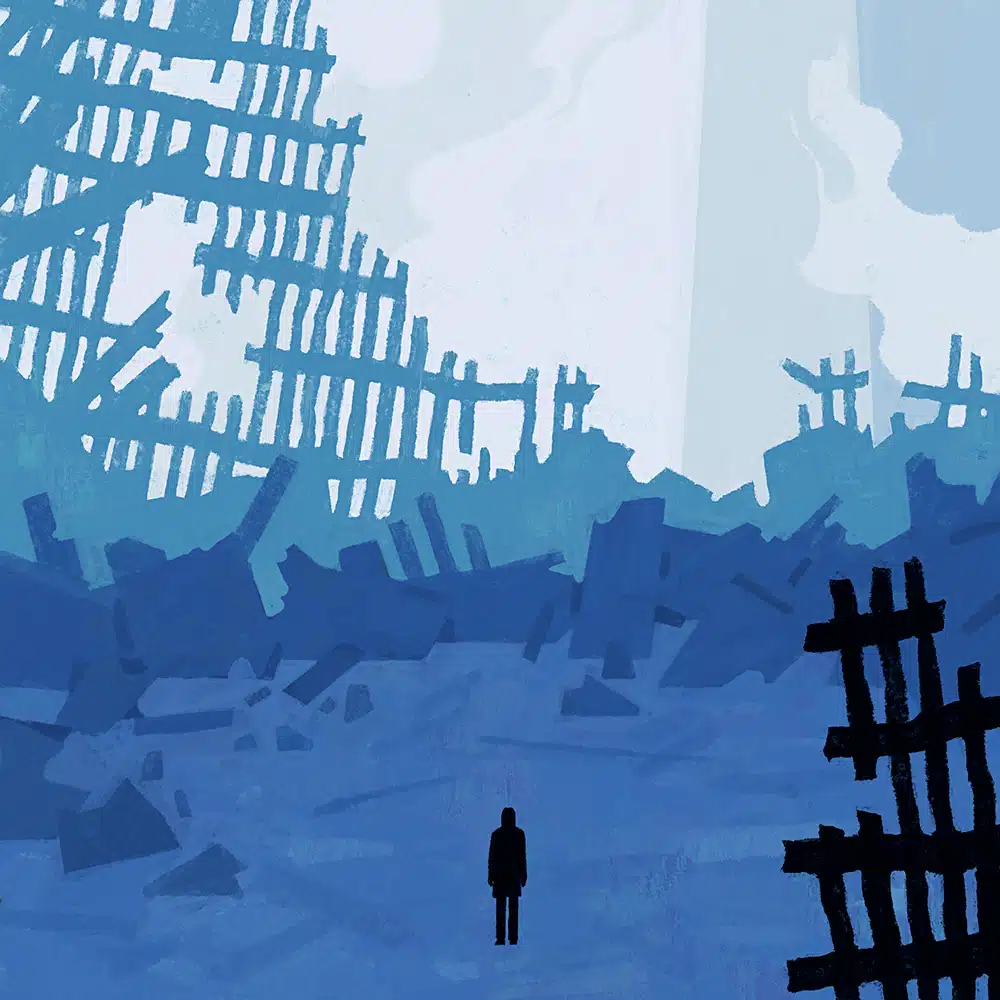
When we emerged above ground, I was able to get fairly close to ground zero, where I couldn’t help but stare at the iconic remnants, the twisted and smoking steel, the bed of rubble and debris, the burning fires. Rudy Giuliani, who was seen as a hero that day, gave me a lift to Midtown, where reporters waited for the injured to arrive at the hospital. They never did, because there were very few survivors.
I was used to covering shootings and plane crashes, but this was different. One television reporter correctly described what all of us were experiencing—the burning buildings, the thousands of photographs of victims pasted on walls, the ash falling on our bodies, the burning-tire smell that permeated the city—as an “orgy of terror.”
For weeks I remained in New York, listening to the stories people told me about their loved ones calling from planes and from burning buildings, right before their deaths.
While reporting, I was able to block the grief. But it was when I sat in the quiet of the hotel—and afterward, when I had returned to Boston—that the sheer terror of it all would hit me.
I’ll never forget interviewing a woman whose identical twin sister died in the attacks. When I was alone, I couldn’t help but try to imagine what it must feel like to look in the mirror every day and be reminded of your sister’s tragic death. The famous photograph of a man jumping from one of the towers stuck in my head, too. Who was he? I wondered as I tried to go to sleep. What was he thinking as he dropped to his death?
Exposed to these traumatic stories, I internalized them when I was alone. The voices of the victims reverberated in my head. The anxiety I felt in my stomach reminded me of something else. Although born in Boston, I grew up mostly in South Carolina, the heart of the Bible Belt, where my mother often talked about the end of the world. She talked about the fire and the pain that was coming our way. That hopeless feeling in my gut as I reported on September 11 and the days afterward was exactly what I felt when my mother warned of the end times.
There was something about the attacks that had us all questioning the future. Life would go on, but it was definitely the end of the world I knew; changes were coming, and those changes I wouldn’t be able to avoid.


Yes, 9/11 was truly an “orgy of terror.” And we didn’t know if/when more deadly attacks were coming. Perfect description!
A powerful story. Thank you for your honesty
LV- beautiful and painful reflection. In these past 29 years folks have been retraumatized in so many ways yet, like the writer, we are resilient. Powerful work. Thank you. Peace.
This article made me feel like I was there in New York during one of the most traumatic events in U.S. history. I appreciate the author marking 9/11 as the day our nation shifted from comfort to the unexpected.
Yes. I live in Boston and remember the horror of that day clearly. The author connecting it to end of times so many religious folks talk about was chilling.
My mom’s from South Carolina too…
Love this deep dive into so many powerful emotions and memories!!
This evocative account, of the worst terrorist attack on American’s soil, triggered my own sense of panic, anxiety, sadness, anger and mostly hopelessness as I felt throughout that fateful day of 9/11. It was a surreal development. I was in bed just waking up, as in most mornings back then, listening to the BBC World News when I heard the news presenter exclaiming: “another plane just hit the other tower”. To my mind it must have been an incident taking place in the Middle East or in some war-torn faraway place. Then I got curious, I switched the TV on, I saw the twin-towers (one of them with a dark gaping hole) with plume of thick black smoke bellowing into the sky. I remembered noticing a few news helicopters buzzing around and hovering over the burning towers. It was unreal. I switched the TV to another channel, I heard Washington DC was under attack. That was too much, I quickly got dressed. I desperately tried to call my then girlfriend, now my wife, who was also in New York City that day, all cellular phone lines went dead, I could not reach her until a little after 3:00 PM. But landline phones were still working. As time went by more bad news came out: The Pentagon was hit, then another hijacked plane crashed in Shanksville, Pennsylvania. My heart sank. How could the Pentagon be hit? We are the USA, the most powerful nation on earth, we have the mightiest armed forces on the planet: Who could do that to us?
In sum the day of 9/11 was to me like a lucid dream in which I did not control how things were developing and worse I could not get out of this horrible dream.
The 9/11 events shattered the notion I harbored of absolute certainty of safety and protection that I had living in the confines of our borders. It is only a few months later while traveling in New York City and further reading about these murderous events that the loss of 3,000 innocent men and women became a real tragedy of historical proportion.