



How the Puritans Banned Christmas
The Puritans banned Christmas in Massachusetts in 1659. But why? Learn more about this Scrooge-like moment in New England history.
By Heather Tourgee|Dec 08 2021|

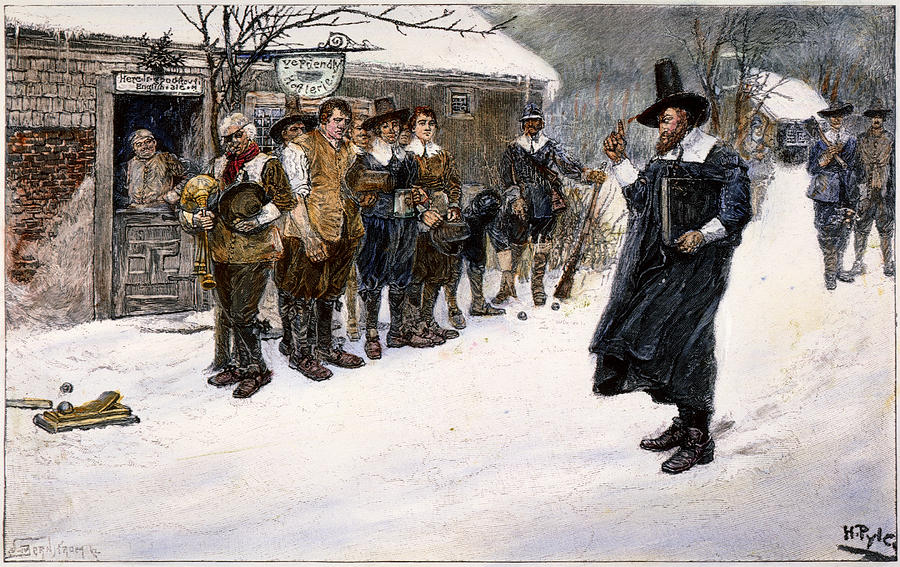
"The Puritan Governor interrupting the Christmas Sports," by Howard Pyle c. 1883
Credit: Public DomainIs it true that the Puritans banned Christmas in Massachusetts? A short, easily-overlooked paragraph from an early law book of the Massachusetts Bay Colony reads as follows:
“For preventing disorders arising in several places within this jurisdiction, by reason of some still observing such festivals as were superstitiously kept in other countries, to the great dishonor of God and offence of others, it is therefore ordered by this Court and the authority thereof, that whosoever shall be found observing any such day as Christmas or the like, either by forbearing of labor, feasting, or any other way, upon such accountants as aforesaid, every person so offending shall pay of every such offence five shillings, as a fine to the county.”
Yes, you read that right. In 1659, the Puritan government of the Massachusetts Bay Colony actually banned Christmas. So how did one of the largest Christian holidays come to be persecuted in the earliest days of New England?
Christmas in 17th-century England actually wasn’t so different from the holiday we celebrate today. It was one of the largest religious observances, full of traditions, feast days, revelry, and cultural significance. But the Puritans, a pious religious minority (who, after all, fled the persecution of the Anglican majority), felt that such celebrations were unnecessary and, more importantly, distracted from religious discipline. They also felt that due to the holiday’s loose pagan origins, celebrating it would constitute idolatry. A common sentiment among the leaders of the time was that such feast days detracted from their core beliefs: “They for whom all days are holy can have no holiday.”
This meant that Christmas wasn’t the only holiday on the chopping block. Easter and Whitsunday, other important historical celebrations, were also forbidden. Bans like these would continue through the 18th and 19th centuries (the US House of Representatives even convened on Christmas in 1802). As Puritanism started to fall out of favor, however, Christmas was almost universally accepted throughout the US by 1840, and was eventually declared a National Holiday in 1870.
This post was first published in 2015 and has been updated.
You may also like…
Blue Laws? Blame the Puritans
Why George Washington Had Two Birthdays
Why We Celebrate Thanksgiving on the Fourth Thursday in November



Today, it no longer the “meek”, becoming, the ” plurality”…
Today, it no longer the “meek”, becoming, the ” plurality”…???
Today, is it, no longer, the “meek”, but, becoming, the “plurality”…???
The majority example has been set. (unmeaningfully), naintainging it’s Inperitive…
Change: to (m), maintaining…
Nice, short and interesting piece on an important and often ignored topic.
I enjoyed the piece. Let’s not overthink the meaning and enjoy learning a little more about early New England..
Thank you Heather Tourgee.
Exactly!
Christmas is a Catholic holiday not a Christian holiday even if it is celebrated by both today.
Catholics are Christians.
But are all Christians Catholics?
LOL – only the bad Catholics are good Christians and this is coming from someone who was raised in that cult and later became a Christian.
????????
I was raised Catholic and learned in grade school from the next door Evangelical neighbor boy that I was not a Christian when he asked, “Are you Christian or Catholic.” I said, “both.” He said, “you can’t be both. You are one or the other.” LOL Perhaps that explains why today I am neither. Neither the time nor the inclination to indulge such nonsense. That said, like any good pagan, I do enjoy a good Xmas celebration! LOL
So interesting to read how my ancestors from back then viewed the different aspects of holidays and laws since leaving England
Interesting
Christmas was first celebrated in the mid 4th century and although sporadically celebrated for the next 500 years became widely celebrated among Christians from the early 9th century. This was a time when there was only one universal Christian religion, long before the split between orthodox and non-orthodox Christians in 1054 and the western divide of Christianity between the various Catholic and Protestant Christians during the 15th and 16th centuries.
Another interpretation of the Puritans’ disdain for Christmas was that the holiday was supposedly “Popish” (i.e. Roman Catholic) – which makes sense in a way because the Puritans wanted to “purify” their church from any trace of Catholicism. On the other hand, many other Protestant churches, like the Lutheran Church, didn’t reject Christmas.
Those were my ancestors. I claim the history but not the sentiment.
Here too. Brewster descendant. And I find it hilarious people think Christ was born Dec 25…
Christmas is full of pagan traditions. The Christmas tree, Santa Claus, reindeer, etc etc. It is a celebration of the return of the sun, Saturnalia. In order to bring Christian’s on board they included Christ into it to make it more palatable for the Christians.
Christmas is about the birth of Christ. Many things have changed since the 1800 which I am thankful for. The true meaning of Christmas is about giving and sharing with the less fortunate.
We stopped celebrating December 25, several years ago. The more we looked into the pagan origins, the more we wondered, “What fellowship does light have with darkness?” If “the root determines the fruit,” why not cling to the olive tree?
I haven’t celebrated Christmas in years. What a relief it’s been.
Christmas is a Catholic holiday, first recorded in 200 AD. It took some study and research to narrow down the birthday, so naturally, it took awhile for the practice to move through Christendom.