



Corn Season
Growing up on America’s oldest family farm had, like the crop that defined it, a sweetness that passed all too soon into memory.
By Yankee Magazine|Jun 18 2018|

Corn Season
Credit: Sally Tharpby Rebecca Tuttle
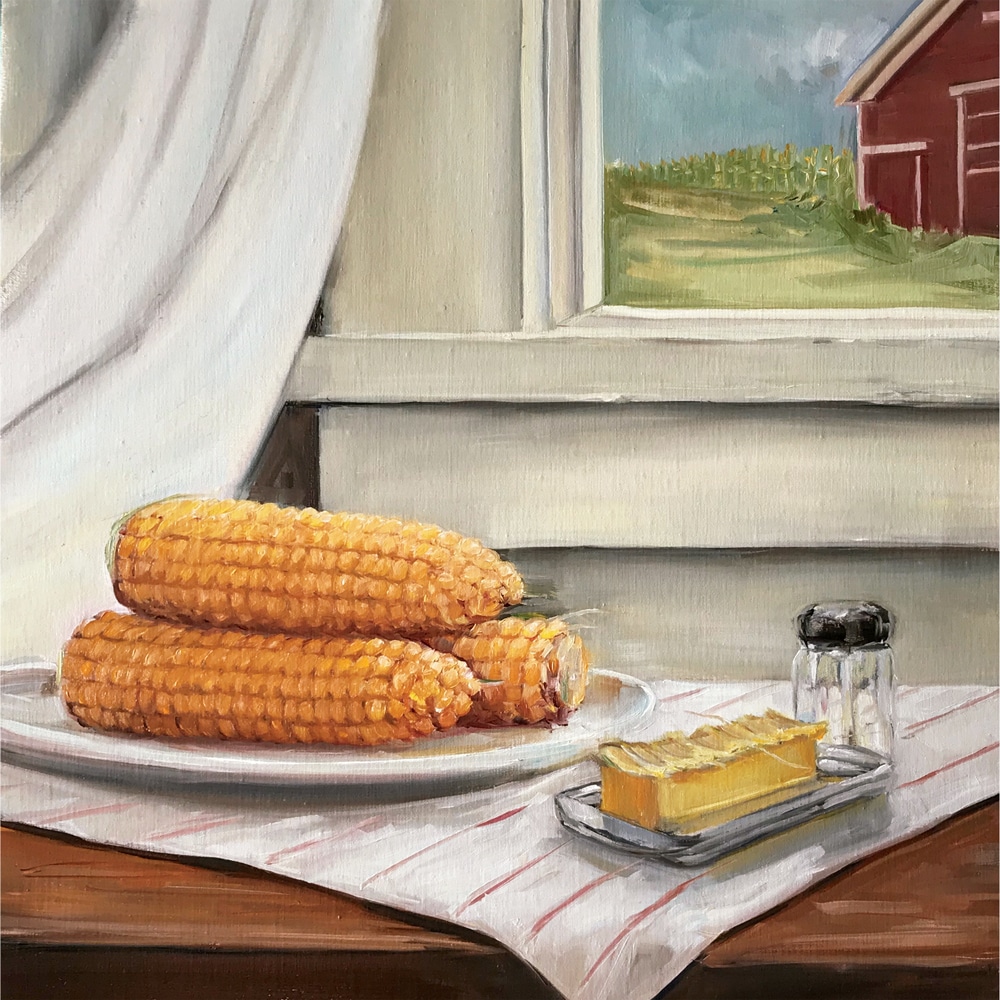
I was 23 years old before I first tasted corn that was not grown by my father. I was visiting friends and wanted to be polite, but what was on my plate bore little resemblance to the corn on the cob I was used to: just-picked, steamed until barely done, and rolled lengthwise on a dedicated stick of butter. Corn that snapped when you bit into it to release the milky juice inside each kernel. The corn I ate that night at my friends’ house was store-bought and tough, even though it had been boiled hard for what seemed to me a terrible length of time. And the people at the table spread butter on it with their knives! I had never seen such a thing.
My father, and his father before him, and all of the fathers and sons in my family back to 1636, plowed and planted a patch of fertile soil that lay between two tidal rivers in seacoast New Hampshire. The original 20 acres had been an English land grant from King Charles to John Tuttle, a barrel maker who sailed from Bristol with his wife, Dorothy, to start a new life on a new continent, carving out a subsistence farm from a pine forest.
Almost three centuries later, it was my grandfather, Penn Tuttle, who first grew sweet corn to sell. The ninth generation of Tuttles to farm that piece of land, he was the one who first wondered if our farm might be the oldest in the country still owned by the same family. It was.
My grandfather graduated from high school in 1908, and within a few years he had made a name for himself with the vegetables he grew on the farm and delivered to small grocery stores in nearby towns. All of his vegetables were popular, but it was his corn that people loved the most. Grocers found that customers would ask for “Tuttle’s corn” and that they would pay a premium for it.
After the war, the small grocery stores were gradually replaced by super-markets stocked from central warehouses. Iceberg lettuce shipped from California and tomatoes from Florida picked green and wrapped in cellophane began to take the place of the hand-washed greens and juicy, vine-ripened beefsteaks my grandfather delivered. The successful wholesale vegetable business that Penn Tuttle had built was beginning to falter.
In 1956, when I was 4 years old and my grandfather had turned the farm over to my father, my parents decided to renovate an old red barn that was close to the road and turn it into a retail farm stand, a rarity in those days. My father grew—and my mother sold—more than 50 kinds of vegetables, from spring-dug parsnips in April to enormous, lumpy Blue Hubbard squash in October. In the 1960s, when the main ingredient in most people’s salads was California iceberg, Tuttle’s Red Barn offered 11 varieties of homegrown lettuce. Oak leaf. Ruby. Buttercrunch. Black-seeded Simpson.
But it was the corn that brought the crowds. On the first Saturday of corn season, always our busiest day of the summer, we hired a policeman to direct traffic. Nobody got a day off on a corn weekend. Sometimes it was nearly impossible for the boys bringing in the baskets brimming with just-picked corn, green and moist and still warm from the sun, to make their way through the crowd to dump their bushels onto the big display table my father had built with pine lumber from our land. Thirteen years old and full of importance in my sneakers and cutoff jeans, I’d clear a path to the table, shouting, “Excuse me! Stand back! Make way for the fresh corn!”
My father picked the corn every few hours as needed throughout the day, 25 or so bushels at a time. We never held leftover corn overnight. Eating even hours-old corn was unheard of in our family; what was left at the farm stand when we slammed the overhead doors down every evening at closing time was taken out back and dumped over the barbed-wire fence for our small herd of Black Angus cattle.
When the sugar-enhanced varieties came on the market in the 1980s, and corn no longer needed to be picked fresh in order to taste sweet, my father resisted the trend. He believed that a depth of flavor was lost, flavor replaced by sweetness. “It just doesn’t have that corn taste,” he’d say. He felt the same way about Butter and Sugar and the other ultrasweet bicolor varieties that followed it. Although he finally gave in to customer demand and planted the new varieties, he was never convinced.
Credit: courtesy of Rebecca Tuttle
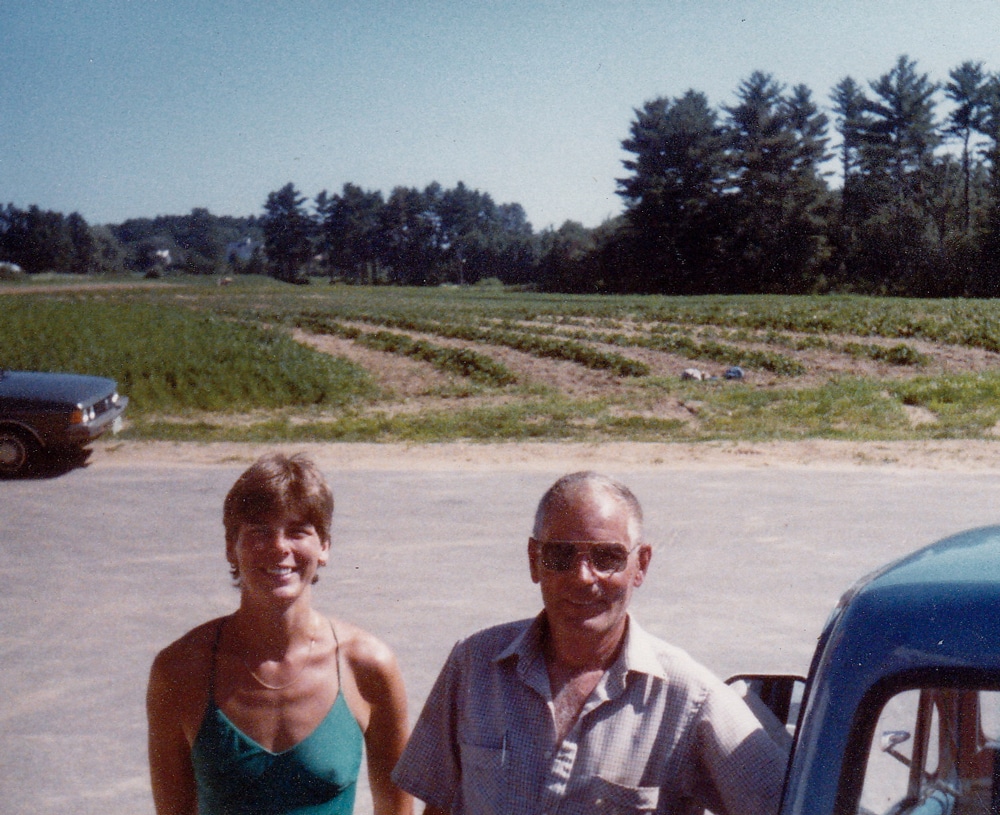
My father picked every ear of corn himself, as he didn’t trust any of the young local boys who worked for us in the summer to know if an ear was ready or if it was “slack” and needed another day or two to fill out. He would walk between the rows, picking with both hands, never slowing his long stride. There was always one boy behind him, carrying the basket. He was “the lugger.” It was an important job: The lugger had to keep pace with my father, carrying an increasingly heavy basket, in tune with when each handful of ears would be tossed back. When that boy’s basket was full, another boy had to be ready to take his place with an “empty.” The only time I could be the lugger, following my father down the long rows with the corn leaves brushing against my cheeks, was when he was picking corn for our family’s supper. Girls didn’t work in the fields, he told me. My job, and my older sister Lucy’s, was to work in the stand with our mother, selling the vegetables he grew. My only brother, Will, graduated from lugger to picker eventually, but working on the farm was never Will’s passion, as it had been for my father and grandfather. And for me. I followed my father whenever he’d let me, doing the morning barn chores, riding in the back of his pickup along the farm roads as he checked the progress of his crops, sampling the first of the corn, just-picked and raw, as we stood between the rows of tall green stalks.
My brother left the farm as soon as he could. He went to college, sold cars for a while, and then got a job as a sales rep for Campbell Soup, stocking suburban Boston supermarkets with cases of tomato bisque and cream of mushroom.
Thirty years before, when he was Will’s age, my father had sat studying at an open window in his Harvard dorm on a warm spring day. He saw crocuses beginning to bloom, closed his books, and hitchhiked the 70 miles north to the farm, just to see what was happening. Had his father spread the hen manure yet? Plowed and harrowed? Had he planted peas? My grandfather said that was the day that he knew my father, one of three brothers and a sister, would be the one to take over the farm.
The summer I was 17, I went to summer school for six weeks, up to then the longest stretch of my life away from the farm. When I came home in August, I brought a group of new friends with me. I wondered what these suburban kids would think of my life: the muddy boots in the hallway, the ancient black slate sink in the kitchen, my father’s old truck. Were we poor? I had never thought of it before.
It was suppertime. Corn season. My father and I, as we did every evening in late July and August, headed out to pick the corn we would be eating not more than an hour later, steamed until just barely done in my mother’s huge dented aluminum kettle on the wood-burning kitchen range. As five other teenagers and I climbed into the back of my father’s dusty red Ford pickup and clattered down the farm road toward the cornfield, I saw in the faces of my friends that what I had always taken for granted was, just possibly, something special.
Back at the house, we sat in the back of the pickup husking the bushel of corn, saving the husks for our two horses nickering at the fence. I showed my pals what my father had taught me: that every strand of corn silk is a hollow tube. I told them how the male part of the corn plant, the tassel, matures and drops its pollen onto the female part, the undeveloped ear waiting below, its green silks pointing upward, a little sticky, to receive the pollen. Then each grain of pollen travels down a hollow silk to where the silk is attached to the naked cob. And a kernel begins to form. When an ear of corn has a missing kernel, it’s because that silk never got pollinated, I told them. The ear slowly ripens, swelling like the pregnant female it is, and the silks outside the husk begin to shrivel and turn brown. If the ear isn’t picked and eaten while the kernels are still tender and full of sweet juice, the kernels continue to grow, then harden on the cob. And now they are mature seeds, ready to fall to the soil and begin the cycle again. A new generation.
The following summer I convinced my father to let me help him more on the farm. I had never been very good at being nice to the customers at the farm stand. If someone complained about the radishes being too small, or too big, or complained about the high price of our corn (75 cents a dozen), I took it personally and might snap, “Do you know how hard my father works to grow these vegetables?” I was sick of seeing people squeeze the tomatoes, then put them back. I was tired of the sound of the cash register and the endless questions about whether we had something fresher in the back room. I longed to be outside in the silent morning, in the fields with my father and his beautiful rows of crops.
He let me join him, but only for the early-morning hours. I still needed to be at the stand for the rest of the day. I worked twice as hard as I thought possible, six days a week from 7:30 in the morning until 6:30 every night, or later if we had irrigation pipe to move.
Picking corn wasn’t the only thing my father reserved for himself. The boys in the crew picked the peas and strawberries and beans. The more senior ones might be trusted on beets and carrots and scallions and radishes, or cucumbers and squash. But he didn’t trust anybody else to properly harvest what he called the “fussy crops.” What I now realize is that those were his favorites. He wanted to save them for himself. He loved getting up at dawn, being all alone in the fields before the crew arrived and he had to start issuing orders.
First he had me cut and bunch parsley. When I didn’t mess that up, he let me take the red pickup and cut lettuce. At first he told me how many heads of each variety to cut each day, but soon he trusted me to take inventory from the previous days’ sales and figure it out on my own. Later in the summer, he turned over his favorite job, picking peppers and eggplant, to me. They were my favorites, too: so shiny and beautiful. Like him, I loved the solitude of the task, walking barefoot between the rows in that sandy loam, filling my basket with what I pretended were massive green and red and purple jewels.
That summer, right after my high school graduation, a reporter and a photographer from Life magazine arrived to do a story about “America’s Oldest Family Farm.” My sister, Lucy, had been living and teaching in Paris since her college graduation; Will was in Boston working for Campbell Soup. When the reporter asked my father what might happen to the farm in the future, he shook his head. “I don’t know,” he said. “It is kind of tough when you turn out one son and you have all your hopes on him and they don’t materialize.” Will liked to play golf, he said. Maybe he could turn the farm into a golf course. The reporter looked up from her notebook. “What about your daughter?” My father chuckled. “I’ve never heard of a woman farmer.”
But a week later, he let me start learning the tractor work. He showed me how to start the irrigation pump down at the pond. He started telling me stories about his father and grandfather and great-uncle and the improvements they had made to the farm. He invited me to accompany him to the monthly evening meetings of the New Hampshire Vegetable Growers Association. He was 50 years old that year, sure that his only son would never come home for good.
The article in Life magazine came out in the fall of 1971, at the start of my second year of college. The full-page photographs and the words that accompanied them painted a picture of our farm as a place of exquisite beauty and deep-rooted history. Reading it in my dorm room, I wept.
Two weeks later, my brother quit his job and came home to work the farm. My father was, of course, overjoyed. He told me my best bet to live on a farm would be to marry a farmer.
My sister came home from Europe that summer and pitched in, building a house nearby with her husband and working as hard as I did. Will was more interested in marketing than farming, and more interested in playing golf than anything else. I got married in 1978, but not to a farmer. Five years later, after my second child was born, I reluctantly gave up the work I had loved.
When my father turned 65 he officially deeded the farm to my brother, as was the family tradition. Will wasn’t the farmer in the family, but he was the son. Even though I knew it was coming, I took the news hard. “What if all three of us had been boys?” I asked my father tearfully. “You weren’t,” he replied.
Once in control, Will made huge changes. He took out a big bank loan and built a spacious climate-controlled year-round addition onto the old barn. The area that used to be the charming post-and-beam farm stand was now used for storage. He bought a tractor-trailer and drove it to Boston two mornings a week to buy produce from the big wholesale market there. He put in walk-in coolers to keep it all fresh. Soon we were selling bananas and iceberg lettuce and Florida corn. There was a gift shop and garden center. My sister managed a deli department, where she sold imported cheeses and fine olive oil. My family stopped referring to Tuttle’s Red Barn as “the stand,” as we always had. Now everyone called it “the store.”
I hated the changes. “I don’t like it either, Beck,” my father said. “But it’s your brother’s farm now, and he gets to make the decisions.” He told me that he had accomplished his work, passing the farm to the only son of the 11th generation of Tuttles.
My parents had both died by the time the recession hit and the big bank loan came due. There was no money to pay it. No money for seeds or fertilizer. No energy left to keep going. The year I turned 60, there was no corn planted on the farm for the first time in any living person’s memory.
Our brother’s voice broke when he gave my sister and me the news that he had to sell the farm.
I have a vegetable garden in Maine where I grow my own corn now. Like my mother, I keep a stick of butter just for corn in the refrigerator all summer, with bits of corn silk embedded from the previous night’s cob-rolling. My children and their children and their cousins will likely never be farmers. Their bare feet will never feel that rich Tuttle soil on a summer afternoon. But at least they’ll know what fresh corn tastes like.

Brilliant article, in the tradition of E. B. White. Refreshing and heart-breaking.
What a wonderful comment to make to this particular writer!
A beautiful and moving story of days gone by. I remember with such fondness my grandparents farm. An era that lives in our hearts and minds and on faded black and white photographs. Your story brought tears to my eyes.
Lovely! We were permitted to ride our horses through your fields in winter, skirting rows of corn stubble. No end in sight.
Beautiful description of how corn born. Symbolic . I loved how you inform. Heart wrenching Becky… the subtext powerful. I felt your loss. Congrats on writing this piece!
What a poignant story of a true tragedy in America’s history, the loss of America’s family’s farms. I don’t know if Tuttles would have remained in the family if it had been deeded to Becky but I think her heart might have fought harder for it, hard to say. I grew up as a little kid from Portsmouth going with my Dad to Tuttles every summer, especially during corn season! We would often get 6 dozen of delicious corn at a time and have dorm fests at dinner, with fresh corn and plates of your tomatoes and pickling cukes.
I do have to say, when you changed from the Tuttle big red barn to the Tuttle Store, something changed….the feel of the family farm was definitely diminished. Wishing all the best to you and your family. Thank you for all the years of great produce and great memories I had with my Dad with the trips to The Farm.
So deep and perfect about what was an American tradition and family life. Sad and full of life. Generous and spare. And a powerful story of a girl and her father. Thank you.
I loved this story, though the demise of the family farm saddened me. What a wonderful girlhood you had, growing up on the oldest farm in America. I am Facebook friends with Joyce Maynard and learned of this article from a post. I seem to remember Joyce mentioning your family’s corn in a post of hers awhile back. I’ve been lucky enough to meet Joyce on a few occasions.
This article choked me up, i think from a sense of loss. At our house we still call it Tuttle’s but it isn’t the same. It was part of my childhood as was the stick of butter dedicated to corn. Rebecca has wonderful memories and also the realization that’s at times progress has robbed us of something Thank you for a lovingly written article
This story is so moving that I had to reach out. Thank you for sharing a bit of yourself with us. I now see corn in an entirely new light and with anticipation and excitement come dinner time. In the days of prominent food politics and the struggles of the local food movement, it takes a Herculean effort to raise a voice for the farm families, the actual root of where food comes from. I feel your loss, I feel your indignation in what still feels like a old boys club in this day and age. I want to tell you that your words have inspired at least one young female farmer today.
Hi Becky I just are some fresh picked corn at the farm and it was delicious. Not all is lost and it’s $3.99 a dozen at tender crop.Dan
Thank you for a beautiful and heartbreaking story. I mourn for what could have been. Your brother, put into a role he couldn’t play, and you, deprived of the role your heart was meant to play—-just because you were the girl! It makes me appreciate the changes I have seen in my lifetime. Perhaps today, your Dad would have been able consider the possibility that his one child whose heart was one with the farm, should have been given the chance to continue its traditions.
Wonderful but heartbreaking story. I kept hoping that Rebecca would end up with the farm [I’m the kind of person who loves for things to go on, year after years, just as they always have]. I know it’s irrational & unrealistic, but I can’t help it [I’m a Cancer]. But how amazing that the farm remained in the same family since the days of the Pilgrims! That’s something to be very proud of…
Just read this beautiful and heart wrenching article, beautifully written Becky!Tearful and joyous, sweet and sad, but a lovely girlhood you had with your Dad.
Sad but sweet story I think the Dad made a bad choice.Growing up in Oklahoma my Dad had one hundred acres in the Caney River bottoms.Now a four lane highway covers most of it.I had dreamed many times when a child what it would be like when I was older on the farm.Now it lays under four lanes of dirt and asphalt. I have told my wife and children about the fireflys in the hayfield and other storys how it was on the farm.Dad and Mom are in their eightys now and we talk about the farm from time to time.
What a wonderful and honest story.I will not eat a,y other fresh corn until our local B J farm in Greenwhich N.Y. is open.This year it was late due to rains and cool weather,so was chomping at the bit waitng,but so worth it,I cook mine about 3 minutes and roll it in butter the same as Rebecca.I am a never in saving our local farmlands and belong to our local Agricultural. stewardship,to make sure future generations can enjoy the fruits of our farmers labor.Thanks for writing your article it touched me deeply!
Thank you for sure a wonderful article!
Being from Massachusetts, corn on the cob season was celebrated as the arrival of summer!
I remember we used to have what my Mom referred to as ‘Pope family summer supper’ corn on the cob, rolled in butter with salt and pepper, and a fresh tomato salad! Simple, and soo wonderful!
Do not know many people who insist on fresh corn ( never had it a few hours old)! Will cook less in the future!
Thank you for the memories,
I have enjoyed reading this beautiful, sad story so very much. It is amazing that one piece of land has stayed in the same family since the 1600’s. It is so sad that that history has ended. I feel sorry for your brother, who was not meant to be a farmer and you, Becky, who I feel was. I love to shop at the Farmer’s Market and bring home the wonderful fruits and vegetables that are offered. I will think about Tuttle’s Farm every time I shop.
Such a poignant and nostalgic story of growing up and working a family farm in New England. It brought the reader into the setting as I could feel, taste and smell the surroundings, the air and the vegetables and fruit. Thank you for transporting the reader into that time and place. Such a great piece of literature.
Thank you for such a moving remembrance, Rebecca. Your article made me cry because I remember having experienced a bit of farm life. I live in New Jersey and have wonderful memories of summer visits to my great uncle’s raspberry farm in Freehold in the 1950s and 1960s. My cousins and I got to ride the tractor and Uncle Joe’s horse Champy and we sold raspberries at his roadside stand, but that was only part of what made it so special. I’ve reminisced about it over the years and my family smiles and says it must have nice. But the thing is that you never really appreciate it if you haven’t experienced it. Sadly, Freehold has experienced the same fate and almost all the land is now filled with housing developments. I can’t bring myself to go back because it’s too sad and I fear that there’s nothing left of the Freehold of my childhood except my memories. Fortunately, they can never be taken away. Thank you for giving me the happy opportunity to close my eyes and relive those summers for a little while. Maureen R.