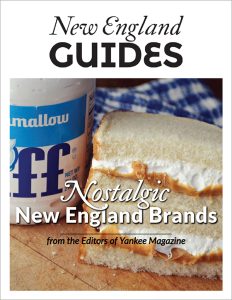
Nostalgic New England Brands from the Editors of Yankee Magazine
Best of New Hampshire from the Editors of Yankee Magazine [easy-social-share buttons=”facebook,twitter,pinterest,google,mail,print,more” sharebtn_style=”icon” counters=0 style=”icon” point_type=”simple”] Table Of Contents: B&M Brown Bread in a Can Necco Wafers | History of America’s Oldest Candy Moxie | Maine’s Favorite Soda Fluffernutters | A Favorite New England Sandwich Table Talk Pies Hoodsie Cups | The Classic New England Ice […]
As a ready-to-eat version of the regional bread favorite, B&M Brown Bread in a can is a quirky, beloved, and convenient New England tradition.
In New England, one of the most popular varieties of brown bread is made by B&M in Portland, Maine, and it’s sold in a can. It might sound strange to the non-native Yankee to imagine buying bread in a can at the supermarket alongside the baked beans (which B&M also makes with pride), but if you’ve ever steamed a loaf yourself at home, you know it can take a while, making the can a handy alternative.
B&M Brown Bread in a can — a New England classic.
Credit: Aimee Tucker
B&M Brown Bread in a can — a New England classic. Credit: Aimee Tucker
It’s not clear when B&M (the letters stand for co-founders George Burnham and Charles Morrill) started selling their version of the classic New England bread (a sweet variety made from cornmeal, wheat and rye flours, and molasses), but like its Necco Wafer and Moxie kin, the bread has been around so long it’s hard to imagine a time when it wasn’t for sale. The company got its start back in 1867 canning meats, seafood, and corn, but by 1927 B&M’s brick oven baked beans hit the market, and business (if you’ll pardon the pun) boomed on a national scale. The company was sold several times starting in 1965, but despite each new ownership, both the B&M name and the Portland plant have remained.
When eating canned bread (B&M sells the bread in both original and “with raisins” for those that like things sweet), a handy can opener is necessary to first remove both the top and bottom lids, and then, with a gentle shake, the bread emerges and is ready for slicing.
Brown bread lightly toasted and topped with butter.
Credit: Aimee Tucker
Brown bread lightly toasted and topped with butter. Credit: Aimee Tucker
Dense, moist, and made from natural ingredients, B&M’s brown bread is a solid ready-to-eat representative of the classic New England dish. Some folks enjoy eating the bread sliced up as-is at room temperature, but you can also warm it in the microwave or toaster oven. It’s good topped with butter, cream cheese, or jam.
You can also make it a meal by serving the bread topped with a generous ladle of baked beans. Hot dogs on the plate are also not uncommon. In many households, hot dogs and baked beans with brown bread (canned or homemade) was a Saturday night tradition. For many, it still is.
Necco Wafers | History of America’s Oldest Candy
Made in New England since 1847, Necco Wafers are a classic American candy with nostalgic appeal.
If taste is linked to memory, then one of the easiest ways to jump back to childhood is to eat a Necco Wafer, America’s oldest continuously manufactured candy.
Even tearing the paper to unroll the tube does it — the puff of powdered sugar and mingling flavor-scents, both sweet and spicy, hitting your nose. Lemon? Wintergreen? Chocolate? Yes, the combination can seem odd by today’s candy standards, but the flavor blend is a familiar one if you grew up eating Necco Wafers, and just one bite (which is more of a “SNAP”) makes the time-travel complete.
For your tastebuds, anyway.
Necco Wafers are a New England made American classic.
Necco Wafers are proudly made using the candy’s original formula (they leave modern influences to the brand’s ever-changing Sweethearts “conversation hearts” each Valentine’s Day), but despite the classic approach they’ve held on to their place at the checkout next to richer, fattier, and fruitier candies. Nostalgia aside, we suspect that Necco Wafer’s exceptional use as gingerbread house shingles, edible poker chips, or practice hosts for a first communion helps keep wafer sales strong, and it’s likely the wafers partnered with the aforementioned Sweethearts (the top-selling Valentine’s Day candy) that bring in enough to keep the company’s many brands (including Mary Janes, Squirrel Nut Zippers, Candy Buttons, Clark Bars, Sky Bars, Haviland Mints, and more) going — much to the delight of many classic candy consumers.
Here’s a little background info. The wafers are made by the New England Confectionery Company (NECCO…see that?) in Revere, MA, but while NECCO the company wasn’t formed until 1901, the wafer candies have been made the exact same way since 1847. That means that while Abraham Lincoln was in the White House and Thomas Edison was inventing the light bulb, the familiar rolls of flavored wafers were for sale (wouldn’t you like to guess which flavor would have been each man’s favorite?). During the early 20th century explorers took them to the Arctic and the South Pole, while the army sent them to soldiers overseas during WWII because the wafers didn’t melt or spoil.
The original flavor lineup (orange, lemon, lime, clove, chocolate, cinnamon, licorice, and wintergreen) hasn’t budged, but if you want, you can also buy rolls of just chocolate Necco wafers, and another variety that we’ve never seen, Tropical Necco Wafers, which have coconut, passion fruit, strawberry, lime, banana, and mango flavors. Curious about how the wafers are made? Check out the “How Necco Wafers Are Made” photo page on the NECCO website.
While it’s true that there are many folks who find Necco Wafers chalky and bland (the candy routinely comes in last alongside the marshmallow circus peanut on the annual list of “What’s the worst Halloween candy?”), the wafers also have their loyal fans that will buy them as long as NECCO keeps making them, and they do. Approximately 4 billion wafers a year are produced and sold — all without advertising! — for a candy recipe from the days of the Mexican–American War. It’s hard to beat that…
Moxie | Maine’s Favorite Soda
Celebrating Moxie – Maine’s favorite soda with the curious flavor you either love or hate, but can’t forget!
If you’re “from away” you might not like the taste, but for many New Englanders, a long, cold sip of Moxie is a crisp, carbonated reminder of home. If you’ve never tried it, it’s hard to describe the distinct flavor, but like a lot of things in life, people seem to either love it or hate it. We think Moxie tastes like a subtle, not-too-sweet blend of wintergreen and licorice, but others…well…they toss around words like medicine, motor oil, and “root beer that’s gone really funky.”
For shame.
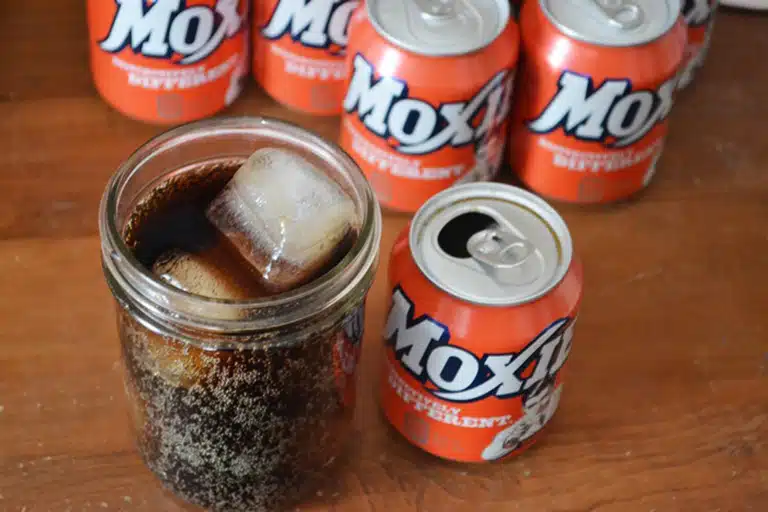
Moxie – New England’s signature tonic!
Credit: Aimee Tucker
Moxie – New England’s signature tonic! Credit: Aimee Tucker
Of course, to drink Moxie you’ve got to be able to find it. While it was once available in more than 30 states and parts of Canada, today the memorable soda (or tonic, depending where in New England you’re from) is almost exclusively found in our six states.
So, what’s the Moxie story? In 1876 Maine-born Dr. Augustin Thompson invented the original Moxie while living in Lowell, Massachusetts as a concentrated medicine (the name might have been inspired by Moxie Falls or Moxie Pond in Maine, but nobody knows for sure) with ingredients like gentian root, wintergreen, sassafras and possibly even cocaine. In 1884 he decided to add carbonation and re-brand the product “Moxie Nerve Food” which claimed to have “cured drunkards by the thousands, effectively too; made more homes happy; cured more nervous, prostrated, overworked people; prevented more crime and suffering in New England than all other agencies combined” — at 40 cents per quart bottle. By the early 1900s Moxie (they dropped the “nerve food” in 1906 after the Food and Drug Act tightened label regulations) was the nation’s favorite soft drink, outselling modern-giant Coca-Cola, which first hit the market in 1886.
Wildly popular, Moxie had a lot of imitators, but the brand worked hard to hold onto its title as the original “distinctively different” drink. Imagine a soda claiming it was pure and wholesome for children today? In the 1920s Moxie did!
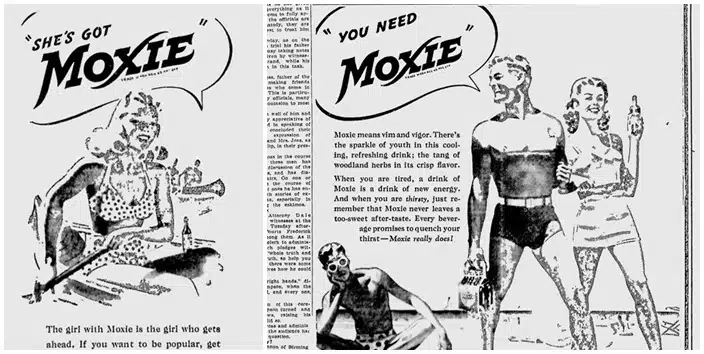
By the 1940s, Moxie was especially known for its advertising gimmicks, giveaways, Ted Williams endorsements, and the signature “pointing” Moxie Boy. The giveaways ran the gamut from posters, bottle openers, and paper fans to sheet music, sets of dishware, and ornate, carved clocks. In fact, Moxie was such a household name that the word “moxie” also entered the lexicon as word meaning energy, pep, and spunk. Vigor, if you like.
Moxie newspaper ads from the 1940’s.
Today, many Moxie memorabilia items are considered collectible. In 1969, Yankee devoted an article to Moxie memorabilia as antiques, paying particular attention to the Horsemobile — a life-sized model horse attached to a car and steered from the saddle, touting the joys of Moxie.
While the drink’s national popularity began to decline as tastes evolved and Coca-Cola and Pepsi (which dates back to the 1890s) grew stronger, New Englanders refused to give it up. It’s true that Moxie maintains a core group of loving loyalists throughout the region, but Maine is where Moxie is arguably most beloved. For more than 30 years the town of Lisbon has held a 3-day Moxie Festival the second week in July, celebrating all things Moxie with a clambake, fireworks, cooking contest, parade, book sale, car show, race, and more. The state loves Moxie so much that in 2005 it became the state’s official soft drink.
Beyond grocery store shelves, special Moxie collections are on display at the “Moxie Wing” of Matthews Museum of Maine Heritage and Clark’s Trading Post in Lincoln, New Hampshire (where the world’s only surviving original Moxie Horsemobile is on display), not to mention for sale at places like Zeb’s General Store in North Conway, New Hampshire.
While the taste of Moxie is memorably distinct, there are many who point out that if you’re trying it now for the first time, you’re still not getting the “original” Moxie experience. They say it’s not as carbonated as it used to be, or as bitter (which is a bad thing). This could be changing palates or the loss of sassafras (federally banned in 1960 as a potential carcinogen), but it could also be the high fructose corn syrup instead of sugar.
Since 2007, Moxie has been owned by Japan’s Kirin Brewery Company, Ltd., which also owns the Coca-Cola Bottling Company of Northern New England where Moxie is made.
But like it or not, it’s ours, and has been for more than 130 years. Now that’s something to drink to!
Not in New England? Fear not! Moxie (regular, diet, and turbo-charged energy) is available for purchase online via the Moxie website, where you’ll also find historic photos and recipes for Moxie cocktails, Moxie Baked Beans, and Moxie Chocolate Cake.
Here’s to another century of Moxie!
Fluffernutters | A Favorite New England Sandwich
Made with peanut butter and Marshmallow Fluff on white bread, the Fluffernutter sandwich is a New England classic with a history as long as it is sweet.
Flip open a few lunchboxes in a New England elementary school cafeteria, and I suspect at least one of them will contain a Fluffernutter sandwich — that heavenly, sweet combination of white bread, peanut butter, and marshmallow creme so beloved by Yankee children that it’s been known to stick around on lunch menus well into adulthood.
A classic New England Fluffernutter sandwich.
Credit: Aimee Tucker
A classic New England Fluffernutter sandwich. Credit: Aimee Tucker
We say “sticks” intentionally, since the Fluffernutter is the kind of sandwich that leaves most eaters (especially young ones) in need of a vigorous face-scrub after it’s finished. Why? The “Fluff” in Fluffernutter stands for Marshmallow Fluff, our preferred local brand of thick and gooey marshmallow creme. The marshmallow creme concept (described in The Encyclopedia of Sandwiches as “a spreadable concoction of melted marshmallows and corn syrup”) wasn’t a new one back in 1917 when entrepreneur Archibald Query began making and selling his version door to door in Somerville, MA, but after Query sold his formula to nearby candy makers H. Allen Durkee and Fred Mower, production and popularity steadily increased until Marshmallow Fluff was arguably the region’s top marshmallow creme supplier. And by the 1960s, the word “Fluffernutter,” in all of its gooey glory, was synonymous with the sandwich we love today.
You might be surprised to learn that Marshmallow Fluff (which is still made by Durkee-Mower in Lynn, MA) has just 4 ingredients (corn syrup, sugar, dried egg whites, and vanillin) and no artificial preservatives. It’s also gluten-free, kosher, and (at least in some households) a totally acceptable substitute for marshmallows in hot chocolate. Fluff is so popular that there’s even a National Fluffernutter Day (October 8) for hardcore Fluff fans, and the town of Somerville, MA still celebrates its Fluff pride with an annual Fluff Fest.
Building a Fluffernutter is simple. Take 2 slices of white bread (when you’re dealing with this much sugar and salt it doesn’t really make sense to reach for the sprouted wheat bread, now does it?), then slather one with creamy peanut butter and the other with Marshmallow Fluff. We find that the Fluff is easier to spread if you scoop out a large amount to start, so don’t be bashful. Now press the two pieces together, and dig in!
Creamy peanut butter and sweet Marshmallow Fluff.
Credit: Aimee Tucker
Creamy peanut butter and sweet Marshmallow Fluff. Credit: Aimee Tucker
While some folks live and die by the classic Fluffernutter, there are other that like it made with toasted bread (just remember to spread the peanut butter and Fluff onto the toast while it’s still hot!), or “Elvis-style” with added sliced bananas. You can also swap out the classic Fluff for Strawberry or Raspberry Fluff (yes, both varieties exist), but it’s been our experience that you don’t see too many pink Fluffernutters. If you want a fruity sandwich, that’s what a peanut butter and jelly sandwich is for!
Marshmallow Fluff
Credit: Aimee Tucker
Marshmallow Fluff Credit: Aimee Tucker
Table Talk Pies
Made in Worcester, MA since 1924, Table Talk pies are a sweet and nostalgic New England favorite.
We love pie here in New England. Whether it’s wild Maine blueberry, apple with cheddar, or creamy pumpkin during the holiday season, the irresistible combination of golden, buttery pastry filled with sweet fruit or smooth custard is, for many, the perfect dessert. Love pie but hate to bake? Not to worry! Since 1924, Table Talk Pies in Worcester, Massachusetts has been supplying New England (and beyond) with a popular assortment of tasty pies in favorite flavors like blueberry, apple, lemon, chocolate eclair, pineapple, cherry, pumpkin, peach, banana creme, chocolate creme…and more.
Table Talk pies are a New England-made favorite.
Credit: Aimee Tucker
Table Talk pies are a New England-made favorite. Credit: Aimee Tucker
Instantly recognizable with its cheerful red and white packaging, Table Talk got its start selling to restaurants and hotels, but expanded to retail by the 1930s. Before the days of convenience store chains and fast food, they were a welcome sight at coffee shops and other small stores. Table Talk makes a standard 8-inch pie, but they’re most known for their 4-inch “snack pie.” The company says they bake over 80 million of the snack-sized pies each year! As for ingredients, they also say they’re proud to use “wild blueberries from Maine, Washington and New York Apples, Georgia peaches, pumpkins from the Amish farmlands of Pennsylvania, sweet potatoes grown in the rich soils of North and South Carolina and pecans from Texas and Louisiana.”
The little pies, we can attest, are the perfect size for warming up and topping with a scoop of ice cream, and if your favorite part of the pie is the crust, having a whole “mini pie” guarantees you’ll get some in every bite.
Today, the pies come in disposable foil plates, but before that, they (and all mass-produced pies) were baked and sold in aluminum pans. Table Talk aluminum pans, boasting the phrase “New England Flaky Crust Pie – 10c Deposit,” have since become an easy and affordable collector’s item. Other pie brands, like Py-O-My and Bluebird, are also vintage favorites.
Table Talk pies come in flavors like bluberry, apple, lemon, and
chocolate eclair.
Credit: Aimee Tucker
Table Talk pies come in flavors like bluberry, apple, lemon, and chocolate eclair. Credit: Aimee Tucker
Another New England pie company, the Frisbie Pie Co. (owned by Table Talk since 1958), also conjures up fond memories for many New Englanders. Founded in 1871 in Bridgeport, CT, Frisbie is most famous for being credited with providing the original inspiration for the frisbee toy. Legend says that pie-loving students at Yale University used the empty tins as flying discs on the New Haven Green. Noticing the growing fad, an inventor developed a plastic version, dubbed “the frisbee” in honor of Frisbie’s Pies.
But is the story true? Well, kind of. Frisbee inventor Walter “Fred” Morrison had never heard of Frisbie Pies or even visited Connecticut when he started selling flying discs on the west coast in the late 1930s, but after selling his design to toy developer Wham-O in 1957, the name was changed to Frisbee after the Frisbie pie tins. In short: Yale students with their Frisbie’s tins didn’t inspire the original invention, but without them there would be no Frisbee flying disc brand name. Not bad for a New England pie!
Snack-sized pies, ready for sampling.
Credit: Aimee Tucker
Snack-sized pies, ready for sampling. Credit: Aimee Tucker
It’s tough to track down much more than the basics in the Table Talk story, but you can stumble across a few fun facts online. According to one source, Table Talk used to buy the entire 400,000-ton annual crop of Prince Edward Island blueberries for their pies! It also claimed that every year on Washington’s birthday the company would make 16,000 cherry pies to be sold at Lechmere for 88 cents each. In keeping with the fondness for fun, Table Talk is now an enthusiastic participant in “Pi Day” celebrations that take place worldwide each March 14th (or 3.14).
Hoodsie Cups | The Classic New England Ice Cream Treat
Can’t decide between chocolate and vanilla? Go for a Hoodsie Cup — one of New England’s favorite ice cream treats since 1947.
Here in New England, the Hoodsie Cup has been the saving grace of those who can’t decide between chocolate or vanilla ice cream since 1947. The 3-oz. paper cup neatly (well, nearly) divided in half by the two flavors is a product of the Massachusetts-based Hood dairy, and is one of the regional treats many New Englanders claim to miss the most after moving away, perhaps because they’re a lot harder to pack into a suitcase than a roll of Necco Wafers or six-pack of Moxie.
Hoodsie Cups—one of New England’s favorite nostalgic ice-cream.
Credit: Aimee Tucker
Hoodsie Cups—one of New England’s favorite nostalgic ice-cream. Credit: Aimee Tucker
It might also be that, for many of us, Hoodsie Cups (or just plain “Hoodsies”) are a tastebud-reminder of childhood, when the cups were often handed out at birthday and classroom parties, summer cookouts, and church suppers. We remember pulling up on the little tab that peeled back the paper lid to reveal the ice cream below, and gleefully digging in with the accompanying wooden spoon, which was really just the shortened, hourglass-shaped equivalent of a tongue depressor.
Like the aforementioned Necco Wafers and Moxie, if you grew up with Hoodsies, you probably hang onto an ardent fondness for the little cups, but unlike Necco Wafers and Moxie, Hoodsies aren’t an acquired taste. In New England, where ice cream is king, the Hoodsie remains a popular treat nearly 70 years after their introduction. In fact, since Hood is the official ice cream brand of the Boston Red Sox, you can even show your Sox pride while enjoying a Hoodsie. We call that a win/win.
Today, Hoodsie Cups are sold at grocery stores in bags of 10. Since our memory of eating Hoodsies is so firmly coupled with the wooden spoon we thought there would be a stash of them in the bottom of the bag, but there wasn’t so we made do with a regular spoon, which didn’t feel right. Perhaps the wooden spoons are relegated to the convenience store ice cream freezer or ice cream truck?
Wooden spoon or not, the Hoodsie Cup remains a clear New England favorite.
Sky Bar | New England’s Classic Chocolate Candy Bar
One of America’s oldest chocolate bars, Sky Bar is an old-fashioned New England candy favorite filled with caramel, vanilla, peanut, and fudge.
A chocolate bar made by Necco (of the famous Necco Wafers) in Revere, Massachusetts, Sky Bar has four separate milk chocolate chambers, each filled with sugary goodness in flavors that Necco describes as “caramel, vanilla, peanut, and fudge.” For those who can’t make up their minds, Sky Bar is the perfect choice. Why settle for one flavor when you can get four?
Sky Bar | New England’s Classic Chocolate Candy Bar.
Credit: Aimee Tucker
Sky Bar | New England’s Classic Chocolate Candy Bar. Credit: Aimee Tucker
Sky Bar debuted in 1938 with a grand skywriting campaign. Newspaper ads promoted the spectacle by urging members of the public to “Keep your eye on the sky!” and look for “Letters a mile high — written at 10,000 feet in the sky — visible ten miles — A thrill to see!”
The bar actually was something to celebrate, since Sky Bar was the first chocolate bar to have four distinctly different centers encased in chocolate. Molded chocolate bars debuted in the 19th century, but it wasn’t until the first half of the 20th century that they really took off, with thousands of different bars being made and distributed by individual companies. Today, it’s hard to find many small and independent chocolate bar manufacturers, but Necco is one of the few, making it all the more beloved by chocolate-loving Yankees with long memories.
In addition to its tasty and sweet properties, the Sky Bar (or at least one of its advertising signs) was also witness to history. In 1945, following V-E Day and the end of three long years of wartime blackout, the lights were finally turned on again in New York’s iconic Times Square. After years of darkness only six were primed and ready for power, and Necco’s Sky Bar was one of them.
Today, Sky Bar remains a favorite for many here in New England, where it’s still available in candy stores and supermarket checkout displays alongside the numerous offerings from Hershey’s and Mars. For those who can’t find it, but miss those 4 distinct flavors, the internet comes to the rescue again! You can order Sky Bar online by the bar or case.
Humpty Dumpty Chips | Maine’s Potato Chip
A Maine favorite since 1947, Humpty Dumpty chips are a potato tradition and regional snack favorite thanks to unique flavors like Sour Cream & Clam and All Dressed. Learn more about the Pine Tree State’s favorite snack.
Munching on potato chips is an American past-time, and while a few “big brands” have a clear advantage in today’s market, there are still plenty of regional varieties — whether old favorites or new, small-batch brands — that reflect the tastes of local consumers.
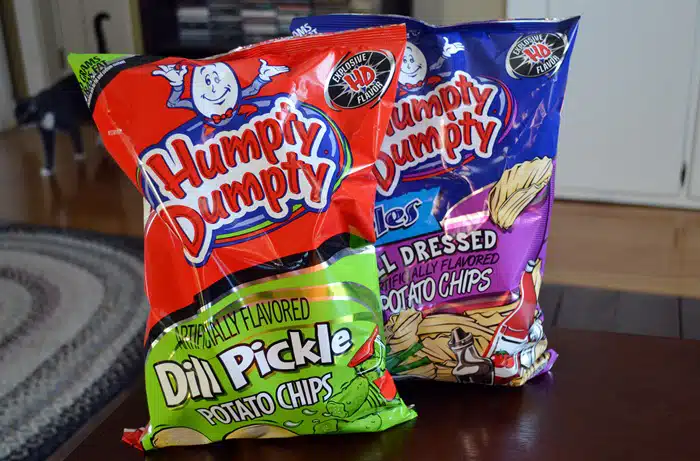
Humpty Dumpty potato chips – a Maine classic.
Credit: Aimee Tucker
Humpty Dumpty potato chips – a Maine classic. Credit: Aimee Tucker
So why the potato chip obsession? According to The Oxford Companion to American Food and Drink, home recipes for fried “potato shavings” began appearing in cookbooks as early as 1824, but the product’s fragility made it hard to package and transfer. During the 1930s and 1940s better packaging led to increasing potato chip popularity, but it wasn’t until the 1950s, when television commercials began promoting salty snacks with gusto, that potato chips and their peanut, popcorn, and pretzel cousins really took off. As a snacking nation, we’ve never looked back.
Humpty Dumpty is often cited as Maine’s favorite (and yes, also bargain) potato chip brand, getting its start in South Portland, Maine as The Humpty Dumpty Potato Chips Company, Inc. back in 1947. The company changed hands a few times over the years, most notably in 2000 when it was sold to a Canadian snack company before its current owner, Old Dutch Foods, took over in 2006. With flavors like Ketchup, Dill Pickle, Salt & Vinegar, BBQ, plus the popular Sour Cream & Clam and All-Dressed flavors, Humpty Dumpty’s US sales are limited almost exclusively to Maine, and yet, the brand maintains a loyal and enthusiastic following among Mainers and the many folks who visit the Pine Tree state each year.
The Dill Pickle variety isn’t for everyone (the first sour whiff of the opened bag can be like a punch in the nose)…
…but the All Dressed can be better, a ridged “everything” chip flavored like (as the label kind of illustrates) barbecue sauce, ketchup, and salt & vinegar. Hearty in texture thanks to the ripples the Dill Pickle chips lacked, the BBQ/ketchup flavor is the first thing you’ll taste, but the tang of the salt & vinegar rounds out the flavor, and the result is (for us, at least) pretty addictive.
We should note that Ruffles also makes an “All Dressed” variety, but it’s only available in Canada, so if you’re curious to try an “everything chip,” you’ll have to head to Maine, get a local to mail you some, or (of course) turn to the internet.
Even if Humpty Dumpty chips aren’t your favorite regional potato chip brand, when you rip open a bag (perhaps alongside a cold can of Moxie), you can at least pat yourself on the back for continuing a nearly 70 year Maine tradition!
Snow’s Clam Chowder
Craving clam chowder but short on time? Since 1920, Snow’s Clam Chowder has been a favorite New England quick chowder tradition.
Here in New England, we’re passionate about homemade clam chowder, but for times when (for convenience’s sake) we must resort to canned, a popular brand with local Maine roots is Snow’s Clam Chowder.
Snow’s has been a New England canned clam tradition since 1920, when Fred Snow first opened the F.H. Snow’s Canning Company in Pine Point, Maine just a few miles north of Old Orchard Beach. While the company offered up a host of canned offerings (from corn chowder and minced clams to Welsh rarebit and sardines), the most popular product in the line was Snow’s Clam Chowder, allegedly made from an old family recipe. For generations, the company was big business in Pine Point, employing roughly 100 residents, and Snow was heralded in 1946 as “Maine’s Millionaire Clam Digger” by the Boston Sunday Post. Later, in the late 1950s, Fred’s son Harold, who had been working alongside his father and making extensive improvements to the company’s efficiency, merged Snow’s with dairy giant Borden.
Snow’s clam chowder comes in either condensed form or (as pictured here) ready-to-serve.
Credit: Aimee Tucker
Snow’s clam chowder comes in either condensed form or (as pictured here) ready-to-serve. Credit: Aimee Tucker
As the company grew, it added even more products to the lineup and expanded its advertising. We were especially amused to see that, during the early 1970s under Borden, the slogan for Snow’s was “There’s a streak of Yankee cussedness in every can.” By 1990, Borden had moved Snow’s operations from Maine to Cape May, NJ, where larger production facilities helped keep up with demand (the Pine Point plant closed in 1994), and that’s still where Snow’s is made and canned today, although after multiple mergers and purchases, it’s now a part of Bumble Bee Foods.
Snow’s sells cans of their condensed chowder (the kind where you have to add milk to water before heating) and cans of the ready-to-serve variety, which proves much more appetizing in both looks and taste. Inside was a creamy chowder with noticeable chunks of clam and potato. Not too shabby for something out of a can, but then again, this is New England, where we revere bread in a can, so why not chowder?
Wondering about the world of canned chowder (were there any earning rave reviews?), we did some searching online and came across a post on product review blog Dave’s Cupboard, including a comprehensive guide to more than 20 canned chowder varieties. Of Snow’s ready-to-eat, Dave says “The difference between this and Snow’s condensed is like night and day. Delicious broth, just the right consistency, luscious with cream and butter. Plenty of clams (mostly small pieces, but there are some fairly good chunks in there too) and lots of chunky potatoes. This is good enough to buy again!”
And for the chowder-desperate with nowhere to turn but the supermarket, we’d be inclined to agree, provided one can add a little milk for enhanced richness, a good crank of freshly ground pepper, and the customary handful of oyster crackers.
Bell’s Seasoning | A New England Thanksgiving Classic
A New England spice blend classic dating back to 1867, Bell’s Seasoning has been making Thanksgiving taste good for nearly 150 years.
The New England Thanksgiving shopping list may vary from one year to the next (“Is this the year we try to convince Nana she’ll like homemade cranberry sauce?” some of you may be wondering), but there’s one thing we can most definitely be sure of — for turkey and stuffing fans, that list will include a box of Bell’s Seasoning.
One of the oldest spice mixes in the country, Bell’s dates back to 1867, when William F. Bell of Newton, Massachusetts created the blend from an old family recipe. Since then, nothing has changed…and come to think of it, neither has the box. Immediately recognizable with its colorful, (now) vintage looking label, lettering, and hand-drawn turkey, Bell’s is the throwback that never left.
Bell’s Seasoning, with its spout to nowhere. Lift up the flap, and you’re met with the wall of the box. Press that down, though, and you’re all set.
Credit: Aimee Tucker
Bell’s Seasoning, with its spout to nowhere. Lift up the flap, and you’re met with the wall of the box. Press that down, though, and you’re all set. Credit: Aimee Tucker
So, what’s in Bell’s Seasoning? Each box contains a savory, salt-free, and all-natural blend of rosemary, oregano, sage, ginger, marjoram, thyme, and pepper with no added preservatives, additives, or artificial ingredients. Combined, the aroma is pure Thanksgiving.
No really, we mean that. When Yankee employees weighed in on what a whiff of Bell’s smells like to them, the answers were things like chicken, turkey, stuffing, the holidays, and “something exotic.” And since it was created a mere four years after President Abraham Lincoln declared Thanksgiving a federal holiday in 1863, maybe it’s fair to say that Bell’s had a subsequent hand in establishing the official savory, spicy profile of the holiday season?
We can’t say that for sure, but Bell’s has certainly won a spot in the hearts and stomachs of New Englanders, both local and transplanted elsewhere.
To elaborate, a few years ago we ran a recipe for cornbread stuffing, and a reader named Susan had this to say about it:
“Cornbread stuffing? Look out, Yankee Magazine–you’re turning into Southern Living. Cornmeal is for johnnycakes, not stuffing! My Rhode Island and Massachusetts grandmothers always used a firm white bread such as Pepperidge Farm (or homemade), lots of onions, salt and pepper, and plenty of Bell’s Seasoning, made in East Weymouth, Massachusetts. Now, that’s a Yankee recipe!”





 Best of New Hampshire from the Editors of Yankee Magazine
 Best of New Hampshire from the Editors of Yankee Magazine