Lost and Vintage Recipes: Desserts and Sweets from the Editors of Yankee Magazine
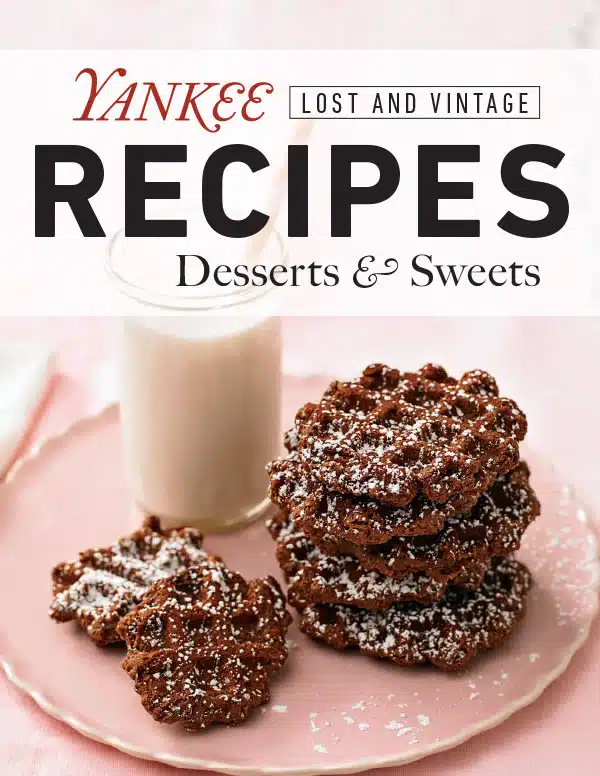
Lost and Vintage Recipes: Desserts and Sweets from the Editors of Yankee Magazine [easy-social-share buttons=”facebook,twitter,pinterest,google,mail,print,more” sharebtn_style=”icon” counters=0 style=”icon” point_type=”simple”] When we searched Yankee’s archives for the foods that would fill this book, it became clear that the pie, cake, cookie, pastry, and candy recipes in our trove were the most timeless of the lot and the […]
By Yankee Magazine|Apr 18 2017|

 Lost and Vintage Recipes: Desserts and Sweets from the Editors of Yankee Magazine
 Lost and Vintage Recipes: Desserts and Sweets from the Editors of Yankee Magazine
When we searched Yankee’s archives for the foods that would fill this book, it became clear that the pie, cake, cookie, pastry, and candy recipes in our trove were the most timeless of the lot and the easiest to adapt to contemporary tastes. Fads may come and go, but sweets never truly go away—they’re too delicious to be lost. Stack cakes, apple dumplings, lemon meringue pie, cream puffs, popcorn balls, and thumbprint cookies are as appealing today as they were in our grandmothers’ day.
AUNT MAE’S THUMBPRINT COOKIES
About 20 years ago, we ran this recipe with a story from reader Charlotte S. Undercoffer: “My mother died when I was 13, and my father’s sister tried to make Christmas special for me and my brother. The most important day during the holiday season was the day that we baked Aunt Mae’s thumbprint cookies. After we had mixed all the ingredients, she put the little balls of dough on the baking pan. Then we used our thumbs to make the indentation for the jelly. (It always had to be cherry jelly for us—but any kind is good.)”
TOTAL TIME: 1 HOUR 30 MINUTES • HANDS-ON TIME: 45 MINUTES • YIELD: 16 COOKIES
1/2 cup (1 stick) salted butter, softened 1/4 cup firmly packed light-brown sugar 1 large egg, separated 1 cup all-purpose flour 1 teaspoon vanilla extract 1/2 teaspoon table salt 1 cup chopped walnuts 1/2 cup cherry, raspberry, or strawberry jam, divided
- In the bowl of a standing mixer or, if using a handheld mixer, in a large bowl, beat butter and brown sugar until light and fluffy, about 4 minutes. Add egg yolk, flour, vanilla, and salt, and mix well.
- Preheat the oven to 400Åã. In a small bowl, beat the egg white until frothy. Put walnuts in another small bowl.
- Roll cookie dough into walnut-size balls; then roll each ball in the egg white and then the walnuts. Arrange on two ungreased cookie sheets and press the center of each cookie with your thumb (this is a great activity for young kids). Bake 5 minutes; then reduce heat to 325 degrees. Bake 8 minutes more; then remove the cookies from the oven and check to see whether the thumbprints remain. If not (the cookies do tend to puff up), use the handle of a wooden spoon to re-press the thumbprints; then return the cookies to the oven until they’re light golden brown, 5 to 7 more minutes. Remove from oven and cool at least 30 minutes; then spoon a bit of jam into the center of each cookie.
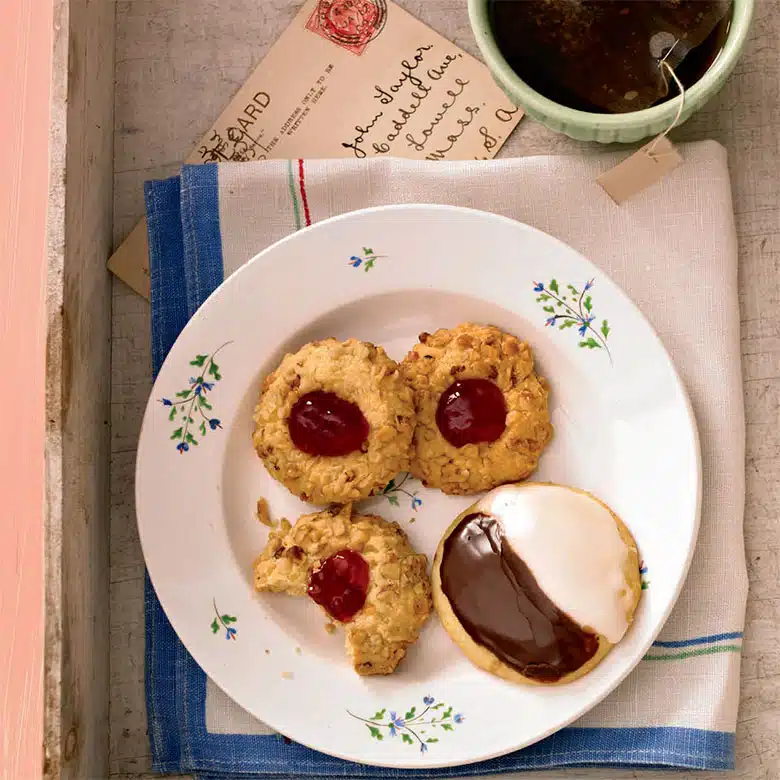
BLACK & WHITES
New Yorkers may claim these cookies as their own, but anyone who grew up in New England with a decent bakery nearby probably has deep memories of these tender cookies with the chocolate and vanilla icings on top.
This recipe ran in the June 1999 issue of Yankee. Reader Helen Beatty Beal wrote, “During the hard-time 1930s, our family of seven lived in Boston. Papa was lucky to keep a low-paying job, and Mama made all our clothes, baked our bread, and planned each meal to stretch Papa’s pay. We always had nourishing but dull desserts, such as bread or rice pudding, gingerbread, or applesauce.
“Our summers were spent in a small cottage on Hough’s Neck, Quincy. The cottage had minimal cooking facilities, and desserts were eliminated except for very special occasions. I was sent to the Laurel Crest Bakery with 35 cents to purchase seven ‘Black-and-Whites.’ I’ll never forget how good these shop-baked goodies tasted, and I always associate them with special happenings and our wonderful, carefree summers.”
TOTAL TIME: 1 HOUR • HANDS-ON TIME: 45 MINUTES • YIELD: ABOUT 2 DOZEN 4-INCH COOKIES
NOTE: Frosting the cookies while they are still slightly warm makes it much easier to spread the glazes.
FOR THE COOKIES: 3 cups all-purpose flour 1 teaspoon baking powder 1 teaspoon baking soda 1/2 teaspoon table salt 1/2 cup vegetable shortening, plus more for baking sheets 1/4 cup salted butter 1-1/2 cups granulated sugar 2 large eggs 1 teaspoon vanilla extract 1 cup buttermilk (or 1 cup milk plus 2 teaspoons vinegar)
FOR THE CHOCOLATE GLAZE: 4 tablespoons cocoa powder (Dutch-process or natural) 3 tablespoons plus 1 teaspoon warm water 2 tablespoons vegetable oil 2 tablespoons light corn syrup 2 cups confectioners’ sugar
FOR THE VANILLA GLAZE: 2 cups confectioners’ sugar 2 tablespoons warm water 1 tablespoon light corn syrup 1/2 teaspoon vanilla extract
- Preheat the oven to 375Åã and grease two baking sheets (or line with parchment paper). Set aside.
- First, make the cookies: In a medium-size bowl, whisk together the flour, baking powder, baking soda, and salt, and set aside. In a large bowl, cream the shortening, butter, and sugar together until light and fluffy, about 4 minutes. Add the eggs and 1 teaspoon vanilla and beat well. Add one-third of the flour mixture and mix briefly; then add one-third of the buttermilk and mix again. Repeat twice until all ingredients are fully combined.
- Drop the cookie batter by the tablespoon onto the prepared baking sheets, leaving about 2 inches between cookies. Bake until golden brown at the edges, 12 to 15 minutes, rotating pans halfway through the baking.
- Meanwhile, make the glazes: For the chocolate, stir the cocoa, water, oil, and corn syrup together in a small saucepan over low heat. Whisk in confectioners’ sugar and beat until smooth. Set aside.
- For the vanilla glaze, stir together the confectioners’ sugar, water, corn syrup, and vanilla until smooth.
- When the cookies are done, transfer to wire racks to cool. While they’re still slightly warm (see “Note”), use a small off-set spatula to frost half of each cookie with the vanilla glaze. Let them dry for 5 minutes; then rinse the spatula and apply the chocolate glaze to the other halves.
MARY’S LEMON–NUTMEG MELTAWAYS
Bliss! A light, lemony cookie that’s a snap to make. Cornstarch makes it truly melt-in-your-mouth tender, and the lemon–nutmeg flavor is bright and unexpected. It’ll be a welcome addition to your holiday-cookie repertoire.
TOTAL TIME: 40 MINUTES • HANDS-ON TIME: 20 MINUTES • YIELD: ABOUT 3 DOZEN COOKIES
1-1/4 cups cake flour 1/4 cup cornstarch 1/4 teaspoon table salt 10 tablespoons unsalted butter, softened 1/2 teaspoon freshly grated nutmeg 1/2 cup confectioners’ sugar, plus more for glass 2 tablespoons fresh lemon juice 1 tablespoon freshly grated lemon zest
- Preheat the oven to 325 degrees. Sift cake flour, cornstarch, and salt onto waxed paper.
- Beat the rest of the ingredients in the mixer until light and fluffy. Add dry ingredients and beat on low speed until mixture is smooth.
- Shape teaspoonfuls of dough into balls and place on ungreased baking sheets. Using the bottom of a glass dipped in confectioners’ sugar, flatten balls slightly into 1-1/4 inch circles.
- Bake until golden brown around the edges, 15 to 17 minutes. Cool on baking sheets for 2 minutes; then transfer to wire racks to finish cooling.
GRANDMA TAILOR’S SUGAR COOKIES
We love the story of this recipe’s origins, which came from a reader named Diane Elliott: “My grandmother, Agnes Tailor, was famous in the little Iowa town where she lived (and in her family) for her wonderful sugar cookies. Although I’ve never known for sure, I suspect the recipe may have come in the covered wagon when her parents, Eliza Ann and Carleton Braley, went from Vermont to Iowa in about 1860. Certainly Grandma never had a written recipe, always making the cookies from memory. When I was a teenager in the 1940s, my mother finally was able to get Grandma to write the recipe out and send it to us.
“Well, we tried that recipe several times and the cookies were okay, but not melt-in-yourmouth good like Grandma’s. She insisted it was just our imagination, however, because ‘That’s exactly the way I make them.’ Finally . . . when it was time to replenish her cookie supply, Mother sat and watched. Grandma talked as she stirred the cookie dough, reciting the recipe: ‘One cup shortening,’ she said, and in the bowl went the (aha!) one cup of real butter. ‘Two eggs, beaten,’ went in the bowl. Then Grandma said, ‘A half-cup of milk,’ and into the bowl went (aha again!) a half-cup of heavy cream. At last we knew why hers were so much better than ours!”
1-1/2 cups granulated sugar 1 cup salted butter, softened, plus more for baking sheets 2 large eggs 1/2 cup heavy cream 1 teaspoon vanilla extract 4 cups all-purpose flour, plus more for work surface 1-1/2 teaspoons baking powder 1/2 teaspoon table salt
- Using a handheld or standing mixer, cream sugar and butter until light and fluffy, about 4 minutes. Add eggs, one at a time, stirring well after each. Beat in cream and vanilla. Add flour, baking powder, and salt, and stir. Turn dough out onto a piece of waxed paper, press into a disk, and refrigerate at least 30 minutes (up to 3 days).
- Preheat the oven to 350 degrees. Grease 2 baking sheets or line with parchment paper and set aside.
- On a lightly floured counter, roll the dough out to a 1/8 -inch thickness, and cut into shapes using a cookie cutter. Gather and roll the dough again as needed. Transfer the cookies to the prepared sheets and bake until golden brown, 12 to 15 minutes.
JOE FROGGERS
Molasses–spice cookies date back to the Colonial era, but this variation with rum in the batter comes from Marblehead, Massachusetts. Locals say the cookies are named after Joseph Brown, a free African American man who served in the Revolutionary War and opened a tavern in town. His wife, Lucretia Brown, did the cooking, and these cookies, made in an iron skillet, were her specialty. According to Marblehead Myths, Legends, and Lore by Pam Matthias Peterson, “when the batter hit the pan, it ran in all directions and formed shapes that looked like a frog’s body and legs.” (Our recipe produces a firm dough rather than batter.) Given their shape and the fact that the tavern was next to a frog pond, the name stuck.
TOTAL TIME: 50 MINUTES PLUS 45 MINUTES CHILLING • HANDS-ON TIME: 40 MINUTES • YIELD: 4 DOZEN COOKIES
1/3 cup plus 1 tablespoon hot water 2-1/2 tablespoons dark rum, such as Gosling’s 3 – 3-1/2 cups all-purpose flour, plus more for work surface 1-1/2 teaspoons table salt 1 teaspoon baking soda 1-1/4 teaspoons ground ginger 1/2 teaspoon ground cloves 1/2 teaspoon ground allspice 1/4 teaspoon freshly grated nutmeg 1/2 cup (1 stick) salted butter, softened, plus more for baking sheets 1 cup granulated sugar 1 cup unsulphured dark molasses
- In a small bowl, combine hot water and rum. In a large second bowl, whisk together 3 cups flour with the salt, baking soda, and spices. Set aside.
- In another large bowl, cream together butter and sugar until light and fluffy, about 4 minutes.
- Add water and rum to creamed mixture and beat well. Add one-third of the flour mixture and stir; then stir in half the molasses, scraping down the sides as you go. Repeat with an additional third of the flour mixture and the remaining molasses. Finally, add the rest of the flour mixture. If dough seems too loose, add the extra 1/2 cup flour.
- Divide the dough into two balls, cover with plastic wrap, and chill at least 45 minutes (up to overnight).
- Preheat the oven to 375 degrees and grease two baking sheets or line with parchment.
- You have two options for shaping the cookies: On a floured surface, you can roll the dough out to a 1/2 inch thickness and use a floured 2-inch cookie cutter or drinking glass to cut the dough into rounds. Transfer the cookies to the prepared baking sheets, leaving about 2 inches between cookies. Or you can skip the rolling and instead break off walnut-size pieces of dough and roll them into balls between your palms. Arrange the balls on the baking sheets. Put some granulated sugar into a bowl and press the bottom of a drinking glass into the sugar; then press it onto each ball of dough, flattening it before baking.
- Bake the cookies until set but still soft in the middle, about 10 minutes. Cool on wire racks.
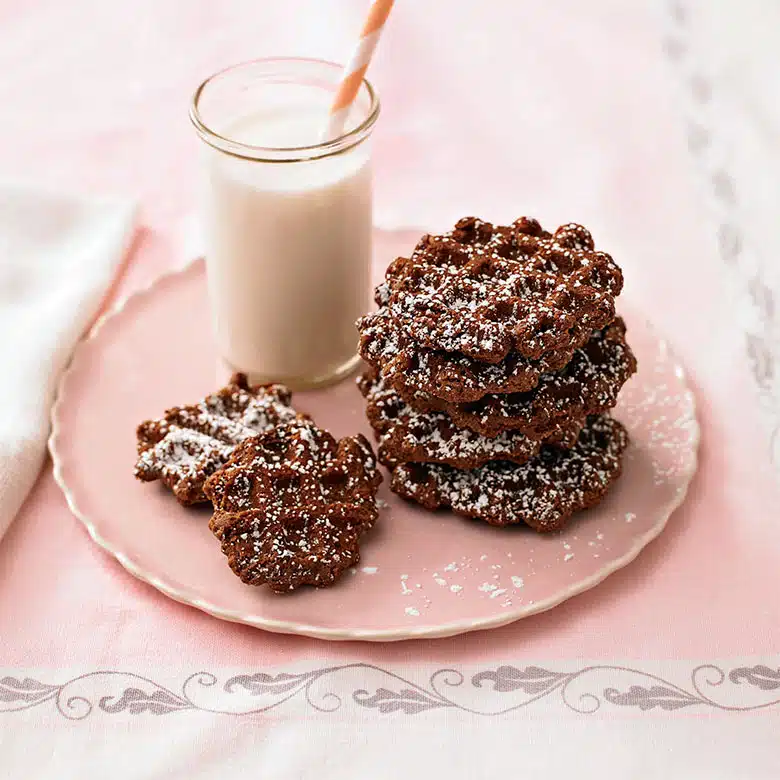
YANKEE’S CRISP-CHEWY WAFFLE IRON BROWNIES
This recipe first ran in a 1953 issue of Yankee, appearing in a story called “Recipes from Old ‘Receipt’ Books” by Nancy Dixon. It begins, “One of the nicest things that happens to us in the Yankee Recipe Department is when we receive really and truly fascinating cookbooks that also serve a worthy cause. Our latest acquisition is Two Hundred Years of Lebanon Valley Cookery . . . The book—with a scrubbed white cover with an easy-to-handle blue spiral binding—is by the Ladies Guild Church of Our Savior (Episcopal) in Lebanon Springs, N.Y., and the cookery editor has rightfully starred some of the following as unusual, ancient, and modern.” This recipe is so clever that we’re wondering why it ever got lost. The waffle iron gives the brownies crispy ridges, but the inside remains rich and fudgy. They’re novel and fun and incredibly easy to make.
TOTAL TIME: 35 MINUTES • HANDS-ON TIME: 35 MINUTES • YIELD: 10 TO 12 BROWNIES
NOTE: You need to let the brownies sit for a minute on the hot, opened iron before trying to remove them. Otherwise they’ll be too soft and likely to crumble.
1/2 cup salted butter, softened 1-1/4 cups granulated sugar 3 squares unsweetened (baking) chocolate, melted 1 teaspoon vanilla extract 2 large eggs, beaten 1-1/3 cups all-purpose flour 1/2 teaspoon baking powder 1/2 teaspoon table salt Vegetable oil (for waffle iron) Garnish: powdered sugar
- Preheat your waffle iron. In the bowl of a standing mixer, cream butter and sugar until fluffy. Add melted chocolate and vanilla and stir. Add eggs, one at a time, stirring well after each.
- In a separate bowl, whisk together flour, baking powder, and salt. Add dry ingredients to chocolate mixture and stir just until evenly combined.
- When the waffle iron is ready, spray or brush with vegetable oil. Drop a heaping tablespoonful of batter into the center of each grid on your iron. Close the lid and cook until the brownies are crisp and dry on the outside, 4 to 6 minutes, depending on the iron (check after 4 minutes). Open the waffle iron and let brownies sit for 1 to 2 minutes, until firm enough to remove (don’t skip this step). Transfer to a plate and sprinkle with powdered sugar. Repeat with remaining batter.
SOUR CREAM “MONKEY FACE” COOKIES
Mildred Starratt Robbins grew up in Boston, but spent summers with her grandparents on their Nova Scotia farm. In 1996, she wrote to us to share her grandmother’s best cookie recipe and tell the story of its origin. “The place was pure joy to me when I was a child,” she wrote. “Cottage Cove, Nova Scotia, nestled against the temperamental Bay of Fundy, was a village of eight houses, a wharf, a fish house, a smokehouse, and an assortment of barns, cool icehouses, woodsheds, carriage sheds, and outhouses. Every year we took the SS Yarmouth or Evangeline out of Boston late on a summer afternoon and arrived in Yarmouth the next morning. Off we went to the eight-room farmhouse where my grandparents raised nine children without benefit of electricity, running water, or central heat.
“The kitchen was everyone’s favorite room, and the big old stove was in use every day. My brother and I were happy to search the shoreline for kindling wood in hopes that Grandma would make cookies. Sometimes cream would sour since there was no refrigeration . . . and then Grandma would make Monkey Face Cookies. Decorating the soft cookies with three raisins for eyes and mouth was often my job.”
These delicious morsels taste like sugar cookies with a bit more tang, and though Mildred liked to decorate her with raisins, we also recommend chocolate chips.
TOTAL TIME: 35 MINUTES • HANDS-ON TIME: 25 MINUTES • YIELD: ABOUT 3 DOZEN COOKIES
4 tablespoons (1/2 stick) salted butter, softened, plus more for cookie sheets 1 cup granulated sugar 1 large egg, lightly beaten 1/2 cup sour cream 1 teaspoon vanilla extract 2 cups plus 2 tablespoons all-purpose flour 1 teaspoon baking soda 1/4 teaspoon table salt Garnish: raisins or chocolate chips
MAIDS OF HONOR TARTS
According to British cooking maven Delia Smith, these tarts are rumored to have originated at Richmond Palace in the 16th century. The fillings have changed over the years—ours are made with jam and a simple almond-paste topping—but the appeal of these bite-size treats hasn’t changed at all.
TOTAL TIME: 1 HOUR 30 MINUTES • HANDS-ON TIME: 45 MINTES • YIELD: ABOUT 42 TARTS
NOTE: Almond flour is available at many supermarkets these days—look for it in the gluten-free or natural-foods aisle (Bob’s Red Mill is a popular brand). You can also find it at natural-foods stores, Whole Foods markets, or gourmet shops. You may substitute hazelnut flour or pistachio flour, if you prefer.
FOR THE CRUST: 2-1/2 cups all-purpose flour, plus more for work surface 1/3 cup granulated sugar 1/2 teaspoon table salt 1 cup (2 sticks) chilled unsalted butter, plus more for pans 6–8 tablespoons ice water Confectioners’ sugar (for dusting)
FOR THE FILLING: 1 large egg 1/2 cup granulated sugar 2/3 cup almond flour (see “Note,” above) 1-1/2 tablespoons milk 1/2 teaspoon almond extract 1/4 teaspoon table salt 3/4 cup seedless raspberry or strawberry jam
- First, make the crust: In a medium-size bowl, whisk together the flour, sugar, and salt. Add the butter to the bowl and use a pastry cutter or a fork to break it down into small pieces. Next, use your fingers to work the butter into the flour. (Rub your thumb against your fingertips, smearing the butter as you do.) Stop when the mixture looks like cornmeal with some pea-sized bits of butter remaining. Sprinkle 6 tablespoons of ice water over the mixture and stir with a fork until the dough begins to come together. If needed, add 1 or 2 more tablespoons of water.
- Turn the dough out onto a lightly floured counter and knead three times, or just enough to make a cohesive dough. Gather the dough into a ball, then divide into two pieces. Press each piece into a disk and wrap in plastic wrap. Refrigerate for at least 20 minutes.
- Meanwhile, make the filling. Using a mixer, beat together the egg and sugar for 1 minute. Add the almond flour, milk, almond extract, and salt, and beat until combined. Set aside.
- Preheat the oven to 400 degrees and set an oven rack to the bottom position. Grease the cups of 2 mini-muffin pans (or line with paper liners) and set aside.
- Remove the first disk of dough from the refrigerator, dust the counter with more flour, and roll the dough out to a 1/4 inch thickness, turning it often to prevent sticking. Cut the dough into rounds using a 2-1/2 to 3-inch-wide biscuit cutter or drinking glass. Gather and roll the dough again as needed to use up scraps.
- Tuck a pastry round into each of the muffin cups, folding the dough as needed to make it fit. Spoon a scant teaspoonful of jam into each of the tarts and top with a spoonful of the almond topping.
- Repeat with remaining dough, jam, and topping. Transfer to the oven and bake until nicely browned on top, 18 to 22 minutes. Garnish with a dusting of confectioners’ sugar.
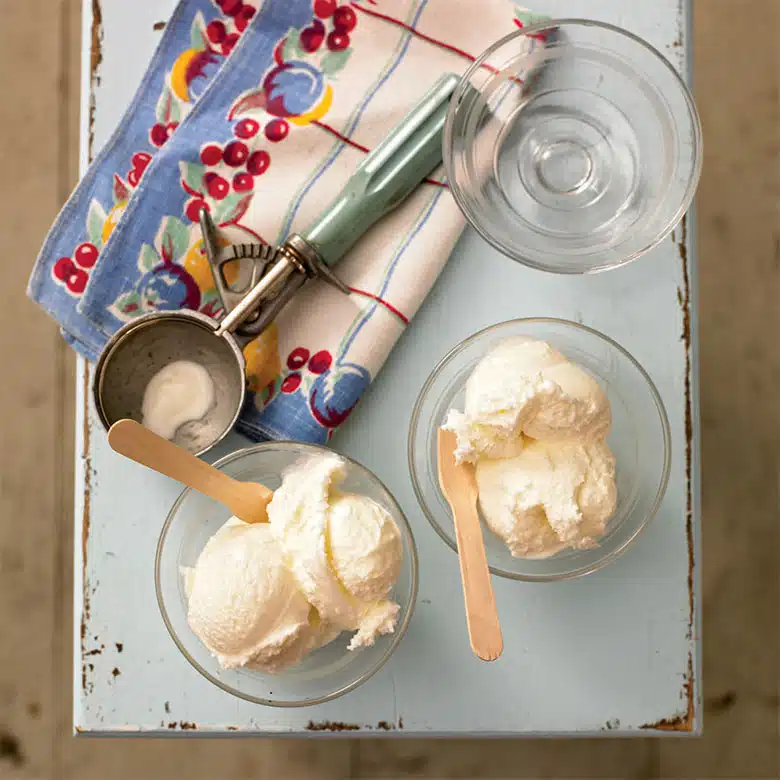
LEMON SHERBET
The word sherbet comes from the Arabic sharab or sharbat, a cold, sweetened drink usually made with fruit juice. Over time, the cold fruit juices were frozen into fruit desserts. Sherbets probably reached their peak of popularity in this country from the 1950s to the 1970s when Howard Johnson’s orange sherbet was its signature dessert. Today, sorbets, made with only fruit and sugar, are more popular, whereas sherbets, which contain a small amount of milk or cream, are less common.
But this dessert—submitted by reader Irmarie Jones, who received it from her mother-in-law in the 1950s—will hopefully reintroduce you to sherbet. It manages to be simultaneously rich, creamy, zingy, and light, all while taking less than 15 minutes to prepare. Given the amount of cream in the recipe, it probably qualifies as more of an ice cream than a sherbet, but its texture is lighter. Really, it’s in a class of its own.
TOTAL TIME: 3 HOURS • HANDS-ON TIME: 15 MINUTES • YIELD: ABOUT 1 QUART (8 SERVINGS)
NOTE: You can make this recipe by simply freezing the mixture in a glass or plastic container, but you’ll get the smoothest texture if you prepare it in an ice cream maker.
Juice of 2 large lemons 1-1/2 cups granulated sugar 1-1/2 cups milk 1 cup heavy cream
- In a medium-size bowl, whisk together the lemon juice and sugar until sugar is mostly dissolved. Add the milk and whisk until sugar is fully dissolved. In a separate bowl, whip the cream to medium peaks.
- Gently fold the whipped cream into the lemon mixture and transfer to an ice-cream maker or an airtight freezer-safe container (see “Note,” above). Freeze according to manufacturer’s instructions. For firmer sherbet, transfer to your freezer for at least 2 hours before serving.
RASPBERRIES ROMANOFF
Despite all the tensions between the United States and the Soviet Union in the middle of the 20th century, classic Russian fare, such as beef Stroganoff, caviar, and raspberries Romanoff, was considered the height of sophistication. This simple dessert remains a great way to serve an elegant parfait that you can prepare between courses.
TOTAL TIME: 8 MINUTES • HANDS-ON TIME: 8 MINUTES • YIELD: 6 SERVINGS
2 cups vanilla ice cream, softened 1 cup heavy cream, whipped 1/4 cup no-pulp orange juice 2 quarts raspberries, fresh or frozen and thawed 1/2 cup confectioners’ sugar
- Place softened ice cream and whipped cream in a bowl and beat with a fork until blended. Stir in orange juice.
- Meanwhile, crush berries in medium-size bowl and stir in confectioners’ sugar.
- Spoon into glasses or dessert cups, alternating cream and berry mixtures. Serve immediately.
RHUBARB PUDDING
Everything comes up rosy in this pudding, which proves that rhubarb doesn’t need strawberries to shine.
TOTAL TIME: 1 HOUR • HANDS-ON TIME: 15 MINUTES • YIELD: 6 TO 8 SERVINGS
4 cups chopped rhubarb (3/4 inch chunks) 1 cup plus 1/2 cup granulated sugar 1/4 cup unsalted butter, melted, plus more for baking dish 1 teaspoon vanilla extract 2 large eggs, well beaten 1/2 cup all-purpose flour 1/2 cup whole-wheat flour 1 teaspoon baking powder 1/2 teaspoon table salt
- Preheat the oven to 375Åã and butter a 2-quart baking dish.
- In a large mixing bowl, toss together the rhubarb and 1 cup of the sugar.
- In a medium-size bowl, combine the melted butter, vanilla, eggs, both flours, baking powder, the remaining 1/2 cup of sugar, and salt.
- Add rhubarb to the batter and stir to combine. Pour the batter into the prepared baking dish. Transfer to the oven and bake until the pudding is browned on top but still a bit soft inside, about 45 minutes.
CHESTNUT CREAM
This recipe was a 1959 contribution by a reader named Mrs. Pauline McConnell, who wrote, “I wish someone would revive the chestnut dishes of long ago. We always had baskets of chestnuts in our root cellar at home. One of our favorite dishes was chestnut cream. This dish is approximately 150 years old and has been passed down from generation to generation in my family.”
TOTAL TIME: 40 MINUTES • HANDS-ON TIME: 10 MINUTES • YIELD: 6 SERVINGS
NOTE: Using preroasted, vacuum-packed chestnuts sold in glass jars saves time and makes this recipe easy. Look for them in supermarkets during the holidays and in most gourmet and Whole Foods stores year-round (a warning, though: they can be expensive off-season). Don’t use the canned type, which generally lack flavor. To roast chestnuts yourself, cut an X through the flat bottom of each nut (this helps with peeling later). Toss chestnuts with 1/3 cup of canola oil. Spread on a baking sheet and roast at 425Åã until tender, 25 to 35 minutes. Return chestnuts to the bowl, toss, and cover bowl with plastic wrap. Cool, then peel.
1-1/2 pounds peeled, roasted chestnuts, roughly chopped (see “Note,” above) 1-1/2 cups milk 1 cup granulated sugar 1 cup water 1 teaspoon vanilla extract 1 cup heavy cream, whipped to firm peaks Garnish: chocolate shavings
- In a small saucepan over medium-high heat, simmer chestnuts with milk until soft, about 10 minutes. In a small saucepan, combine the sugar and water and simmer until the sugar dissolves.
- Drain chestnuts, discarding milk, and puree in a food processor with sugar syrup until smooth. Transfer to a medium-size bowl and chill in the refrigerator until cool, 30 minutes. When cool, stir in the vanilla and fold in the whipped cream. Pile into a dish and chill before serving. Garnish with chocolate curls if you like.
GRAPE-NUT PUDDING
America went mad for breakfast cereals in the late 1800s, when the Kellogg brothers founded the Battle Creek Sanitarium and the Sanitas Food Company, advocating a diet rich in whole grains. Rival cereal maker C. W. Post, a former patient at Battle Creek, created “Grape-Nuts” in 1897. The pudding came soon after. We found a recipe for Grape-Nut pudding in a 1901 church cookbook published by the Dudley Street Baptist Church in Boston, and the dish appears to have gained wider national popularity by the 1920s. It seems that New Englanders have a particular fondness for this creamy custard with its cereal “crust” on the bottom, and many of our great diners still feature it on their menus.
TOTAL TIME: 1 HOUR 30 MINUTES • HANDS-ON TIME: 25 MINUTES • YIELD: 8 SERVINGS
Butter (for baking dish)
4 cups milk 1 cup Grape-Nuts cereal 4 large eggs 1/2 cup (scant) granulated sugar 2-1/2 teaspoons vanilla extract 1/4 teaspoon table salt 1/2 teaspoon freshly grated nutmeg Garnish: whipped cream (optional)
- Preheat the oven to 350 degrees and butter a 2-quart baking dish. Put milk and Grape-Nuts in a medium-size saucepan over medium-high heat and bring to a simmer. Remove from heat, stir, and let cool 15 minutes. In a medium-size bowl, beat eggs with sugar, vanilla, and salt. Add the cooled milk and Grape-Nuts to egg mixture and stir well. Pour into the prepared baking dish. Sprinkle nutmeg over the top. Set the baking dish into a deep roasting pan.
- Place in the oven and pour water into the roasting pan, enough to reach halfway up the side of the baking dish. Bake until almost set in the center, 50 to 60 minutes. There should be a very slight jiggle when you shake the pan, and a knife inserted into the center should come out clean. Let the pudding set on top of the stove for at least 20 minutes before serving. Serve plain or with whipped cream.
POPPY’S RICE PUDDING
We love it when readers send us their family recipes, especially when there are stories attached. Jim Juliano sent us this one in 1998, along with the story of his grandfather, James Anastasio, who immigrated to America from Italy in 1904, at the age of 12. “He settled in the New Haven, Connecticut, area and soon began working in the restaurant business,” Jim wrote. “By 1920, he opened up the Sterling Restaurant on State Street. In 1949 . . . he opened the J.A. Restaurant a few blocks away on Temple Street. There he remained until his retirement in the late 1950s.
“After his retirement, Sunday ‘dinner’ (an early afternoon event) at Poppy’s became a family tradition, with my grandfather and his wife, Margie, surrounded by their five children and eight grandchildren. The meal often included pot roast or chicken pot pie and a lively discussion of the events of the day. Dessert was likely Poppy’s famous rice pudding.”
We love how this recipe bakes into a two-layer treat: silky custard on top, with tender rice and raisins underneath. If you prefer, you can also make this pudding in a double boiler on the stovetop. Just be sure to keep the water at a simmer so the eggs don’t curdle.
TOTAL TIME: 1 HOUR 20 MINUTES • HANDS-ON TIME: 30 MINUTES • YIELD: 6 TO 8 SERVINGS
Butter (for baking dish) 4 extra-large eggs 2/3 cup granulated sugar 1/4 teaspoon table salt 1 teaspoon vanilla extract 4 cups milk 1 cup cooked rice 1/2 cup raisins (optional) Garnish: ground cinnamon
- Butter a 9×13-inch baking dish. Set aside. Bring a kettle of water to a simmer. Preheat the oven to 325 degrees.
- In a large mixing bowl, beat the eggs well. Beat in sugar, salt, vanilla, and milk; then add rice and raisins (if using). Pour into the prepared baking dish and sprinkle the top with cinnamon.
- Place the filled dish into a larger pan; then fill that pan with the simmering water so that it comes about halfway up the outside of the baking dish. Bake until custard is just firm and lightly browned on top, 45 to 60 minutes.
INDIAN PUDDING
Early colonists brought with them to America a fondness for British “hasty pudding,” a dish made by boiling wheat flour in water or milk until it thickened into porridge. Since wheat flour was scarce in the New World, settlers adapted by using native cornmeal, dubbed “Indian flour,” and flavoring the resulting mush to be either sweet (with maple syrup or molasses) or savory (with drippings or salted meat). In time, the dish evolved into one that was resoundingly sweet, with lots of molasses and additional ingredients such as butter, cinnamon, ginger, eggs, and sometimes raisins or nuts. Recipes for Indian pudding began appearing in cookery books in the late 1700s.
TOTAL TIME: 2 HOURS 30 MINUTES • HANDS-ON TIME: 30 MINUTES • YIELD: 6 TO 8 SERVINGS
4 cups whole milk 1/2 cup cornmeal 1/2 cup molasses 1/4 cup maple syrup (any grade) 2 tablespoons unsalted butter, softened, plus more for baking dish 2 large eggs, beaten 1 teaspoon table salt 2 teaspoons granulated sugar 1/2 teaspoon ground cinnamon 1/2 teaspoon ground ginger 1/8 teaspoon freshly grated nutmeg Garnish: vanilla ice cream or whipped cream (optional)
- Preheat the oven to 300 degrees and grease a 1.-quart baking dish.
- Bring milk to a simmer in a double boiler over high heat. Slowly add the cornmeal, whisking to combine. Continue to cook, whisking often, for 15 minutes.
- Add molasses slowly; then remove from heat. Add maple syrup and the rest of the ingredients, and stir until smooth.
- Pour mixture into the prepared baking dish, and bake until the pudding is set and the top is browned, about 2 hours. Serve hot or cold, topped with vanilla ice cream or whipped cream.
DR. BOYLSTON’S HONEYCOMB PUDDING
If you’ve ever traveled down Boylston Street in Boston, you may have wondered where the street got its name. It pays honor to Dr. Zabdiel Boylston, who braved the threat of mob violence in 1721 in order to get Bostonians inoculated against smallpox. In doing so, he introduced vaccination to the United States. Boylston also performed the first surgery by an American physician and removed the first breast tumor in 1718. He was also the great-uncle of President John Adams. This pudding, which tastes a bit like a very moist gingerbread topped with lemon sauce, was one of his favorite desserts. As it cooks, the baking soda bubbles, leaving the little holes from which the dish gets its name.
TOTAL TIME: 45 MINUTES • HANDS-ON TIME: 30 MINUTES • YIELD: 8 SERVINGS
FOR THE PUDDING: 1/2 cup all-purpose flour, plus more for pan 1/2 cup granulated sugar 1/2 teaspoon ground cinnamon 1/4 teaspoon ground cloves 1/4 teaspoon ground allspice 1/4 teaspoon table salt 1/2 cup (1 stick) salted butter, melted, plus more for pan 1/2 cup warm milk 4 large eggs, beaten 2 teaspoons baking soda 3/4 cup molasses
FOR THE SAUCE: 1 cup granulated sugar 1/4 cup (1/2 stick) salted butter, softened Juice of 1 lemon 1 large egg, beaten 1/4 teaspoon table salt 3 teaspoons cornstarch 1 cup simmering water
- Preheat the oven to 350 degrees. Butter and flour a 9×5-inch loaf pan and set aside.
- Make the pudding: In a large bowl, whisk together the flour, sugar, spices, and salt. Add the melted butter, milk, eggs, baking soda, and molasses, and stir to combine. Pour the mixture into the prepared pan and bake until firm, 30 to 40 minutes.
- Meanwhile, make the sauce: Working off the heat, put the sugar and butter in a medium-size saucepan and stir. Add the lemon juice, egg, salt, and cornstarch, and stir. Add the simmering water; then set the pot over low heat and cook, stirring continuously, until the mixture thickens.
- When the pudding is cooked, turn it out on a warmed serving dish. Slice (the honeycomb will show); then spoon the sauce over the slices and serve warm.
BLACKBERRY COBBLER
“We lived in the country,” wrote reader Dorry Lou Wharton about this family recipe, which she sent to us in the early 1990s, “and every summer Mother would take me blackberry picking . . . We would fill our buckets with sweet berries and head for home, where Mother always made us a delicious blackberry cobbler. I look back on those times with such fond memories, and I have passed the recipe on to my own daughters . . . I had my husband plant [blackberry bushes] in our garden. Today as I fill my pail and walk across the lawn, my mouth starts to water thinking of the blackberry cobbler I will soon be making.”
TOTAL TIME: 55 MINUTES • HANDS-ON TIME: 15 MINUTES • YIELD: 6 SERVINGS
1/4 cup salted butter, softened, plus more for pan 2/3 plus 1/4 cup granulated sugar, divided 1 cup all-purpose flour 2 teaspoons baking powder 1/4 teaspoon table salt 1/2 cup milk 2 – 2-1/2 cups blackberries 1 cup pomegranate, cherry, or berry juice Ice cream (optional)
- Grease an 8-inch square baking pan. Preheat the oven to 375 degrees and set a rack to the middle position.
- In the bowl of a standing mixer or, if using a handheld mixer, in a large bowl, beat together butter and 2/3 cup sugar for 2 minutes. In a medium-size bowl, whisk together flour, baking powder, and salt. Add dry ingredients to butter mixture and stir to combine. Add milk and beat until smooth. Pour into baking pan. Sprinkle with blackberries; then pour the juice over all and sprinkle with remaining . cup sugar. Bake until golden brown, 35 to 45 minutes. Serve warm with ice cream, if you’d like.
ORCHARD FRUIT SLUMP
A “slump” is a fruit dessert made in a skillet and topped with sweet biscuits. It’s a variation on “cobbler” (which is often cooked in a baking dish). Meanwhile, a “grunt” is a slump prepared in a covered pot on the stove so that the steam cooks the biscuits.
TOTAL TIME: 55 MINUTES • HANDS-ON TIME: 35 MINUTES • YIELD: 6 TO 8 SERVINGS
NOTE: You can substitute any fruit, as long as the total volume is 6 cups. If your fruit is particularly juicy, reduce the water by 1/2 cup.
FOR THE FILLING: 3 cups peaches, peeled, cut into 1/2-inch wedges (see “Note,” above) 1-1/2 cups cherry halves 1-1/2 cups plums, cut into 1/2-inch wedges 2/3 cup firmly packed light-brown sugar 1/4 cup all-purpose flour 1-1/2 tablespoons fresh lemon juice 1/2 teaspoon ground ginger
FOR THE TOPPING: 1-1/2 cups all-purpose flour 1/2 cup quick-cooking oats 1 tablespoon baking powder 1/2 teaspoon ground cinnamon 1/3 cup granulated sugar 1 large egg, slightly beaten 1/3 cup mik 1/3 cup salted butter, melted Cinnamon sugar
- Preheat the oven to 400 degrees. Toss fruit with brown sugar, flour, juice, and ginger. Pour into a 10- to 12-inch cast-iron pan. Put in oven for about 15 minutes.
- Meanwhile, make the biscuit dough: In a large bowl, whisk together f lour, oats, baking powder, cinnamon, and sugar. Add beaten egg, milk, and melted butter, stirring just until moist. Don’t overmix.
- Remove fruit from oven and drop dough onto fruit, forming about 8 mounds. Sprinkle with cinnamon sugar. Bake until biscuits are lightly browned and juices are bubbling, 15 to 20 minutes.
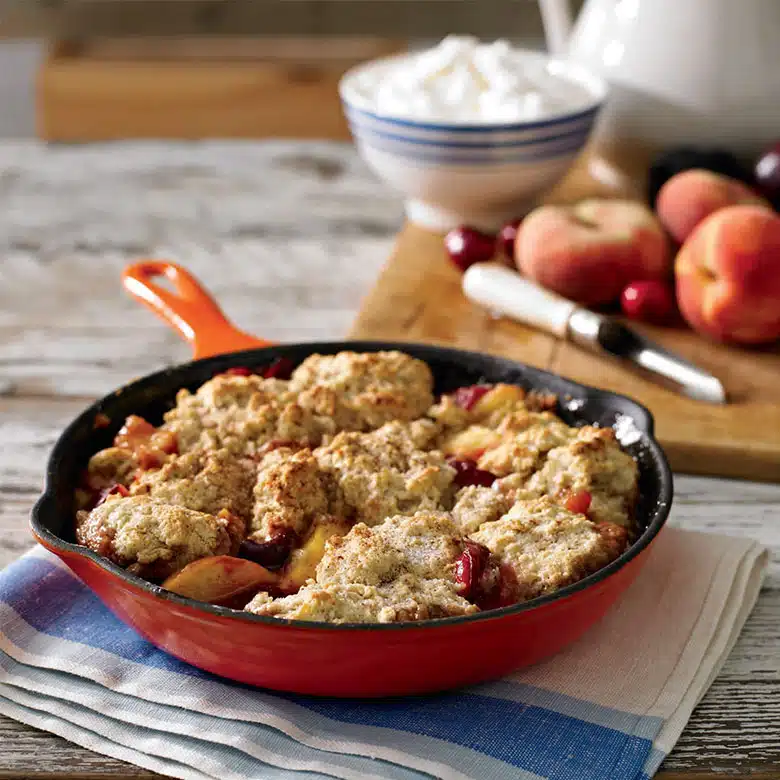
Orchard Fruit Slump
Credit: Heath RobbinsCredit: Heath Robbins
SUMMER BERRY TRIFLE WITH CORNMEAL CAKE
This simple recipe comes from the kitchens of Sterling College in Vermont, where chef Anne Obelnicki and her team source most of their ingredients from Sterling’s own farm and others in the Northeast Kingdom. It’s beautiful arranged in a single 8- or 9-inch glass trifle bowl or in individual serving glasses, and it’s so delicious you’ll want to make trifle a regular part of your dessert repertoire. Feel free to use any combination of raspberries, blueberries, currants, and/or gooseberries.
TOTAL TIME: 2 HOURS 30 MINUTES • HANDS-ON TIME: 45 MINUTES • YIELD: 12 SERVINGS
FOR THE CAKE AND TRIFLE: 1 stick (8 tablespoons) plus 5 tablespoons unsalted butter, softened, plus more for pan 1 cup granulated sugar 2 large eggs 1 teaspoon vanilla extract 1/2 cup plain yogurt, whole or low-fat 1 cup all-purpose flour, plus more for pan 2/3 cup yellow or blue cornmeal 1 teaspoon baking powder 1/4 teaspoon baking soda 6 cups fresh raspberries 1/2 cup honey
FOR THE WHIPPED CREAM: 3 cups heavy cream 2 tablespoons honey
- Preheat the oven to 350 degrees. Butter and flour a 9×5-inch loaf pan. With a standing or handheld mixer, cream butter and sugar until smooth and light, about 4 minutes. Add eggs and vanilla and beat to combine. Add yogurt and blend.
- In a separate bowl, whisk together flour, cornmeal, baking powder, and baking soda. Add dry ingredients to the wet ingredients and mix well. Spoon batter into the prepared pan and bake until a toothpick inserted into the center comes out with moist crumbs attached but no wet batter, about 1 hour. Cool completely on a rack, about 45 minutes. You may make the cake a day in advance.
- Reserve 1 cup of the prettiest raspberries and place the rest of the berries in a bowl; add the honey, folding gently just to combine. Set the mixture aside to macerate for 10 minutes.
- Make the whipped cream: Put heavy cream in a chilled bowl and beat until very loose peaks form. Add honey and continue beating until medium peaks form. Set aside.
- To assemble the trifle, cut cornmeal pound cake into 1/2 inch-thick slices. Line bottom of a 9-inch glass bowl with slices of cake, breaking pieces as necessary to fill in the gaps. Spoon half the berry mixture over the cake, being sure to spoon the juices evenly. Cover with half the whipped cream, spreading to the edge. Repeat with another layer of cake, berries, and cream. Sprinkle the reserved whole raspberries over the top layer of whipped cream.
- Serve right away or refrigerate, covered, for up to two hours.
BUTTERMILK BLUEBERRY BUCKLE
By definition, a “ buckle” is a cake studded with fruit and capped with a crumble topping. The berries settle down into the cake batter during cooking, while most of the pecan-crumble mixture stays on top. Buttermilk lends a delicate tang.
TOTAL TIME: 1 HOUR 10 MINUTES • HANDS-ON TIME: 35 MINUTES • YIELD: 10 SERVINGS
NOTE: If you don’t have buttermilk on hand, you can substitute clabbered milk: Add 1 tablespoon of lemon juice or white wine vinegar to 1 cup of whole or 2% milk and let stand for 10 minutes before using.
FOR THE TOPPING: 1 pound fresh or frozen blueberries 1/4 teaspoon plus 1 teaspoon ground cinnamon 1 tablespoon granulated sugar 1/2 cup firmly packed light-brown sugar 1/3 cup all-purpose flour 1/4 teaspoon freshly grated nutmeg 1/2 cup finely chopped pecans 3 tablespoons cold salted butter, cut into small cubes, plus more for pan
FOR THE CAKE: 7 tablespoons salted butter, at room temperature 3/4 cup granulated sugar 2-1/4 cups all-purpose flour 1-1/2 teaspoons baking powder 1/2 teaspoon baking soda 1-1/2 teaspoons kosher or sea salt 1 cup buttermilk (see “Note,” above) 1 large egg
- Preheat the oven to 350 degrees. Grease a 9×13-inch baking pan. In a medium-size bowl, toss the blueberries with the 1/4 teaspoon cinnamon and 1 tablespoon sugar. Set aside.
- Meanwhile, in a small bowl, toss the remaining 1 teaspoon cinnamon with the brown sugar, flour, nutmeg, and pecans. Scatter the cold butter over all, and use a pastry cutter or fork to work it in until the mixture looks like very lumpy wet sand. Refrigerate until ready to use.
- Make the cake: Using a standing or handheld mixer with a whisk attachment, cream together the butter and sugar in a large bowl until the mixture is fluffy and very pale, 5 to 8 minutes. In a separate bowl, whisk together the f lour, baking powder, baking soda, and salt. In a third bowl, whisk together the buttermilk and egg. Add one-third of the flour mixture to the butter mixture. Mix briefly; then add half the buttermilk/egg blend and mix again. Repeat, then finish with the remaining flour mixture and stir just until combined.
- Spread the batter evenly into the baking pan (it will be quite thick). Sprinkle blueberries over the batter; then sprinkle the crumble topping over all.
- Bake until the top is golden and a toothpick inserted into the center comes out clean, 35 to 45 minutes. Let cool on a rack for 30 minutes; then serve warm from the pan.
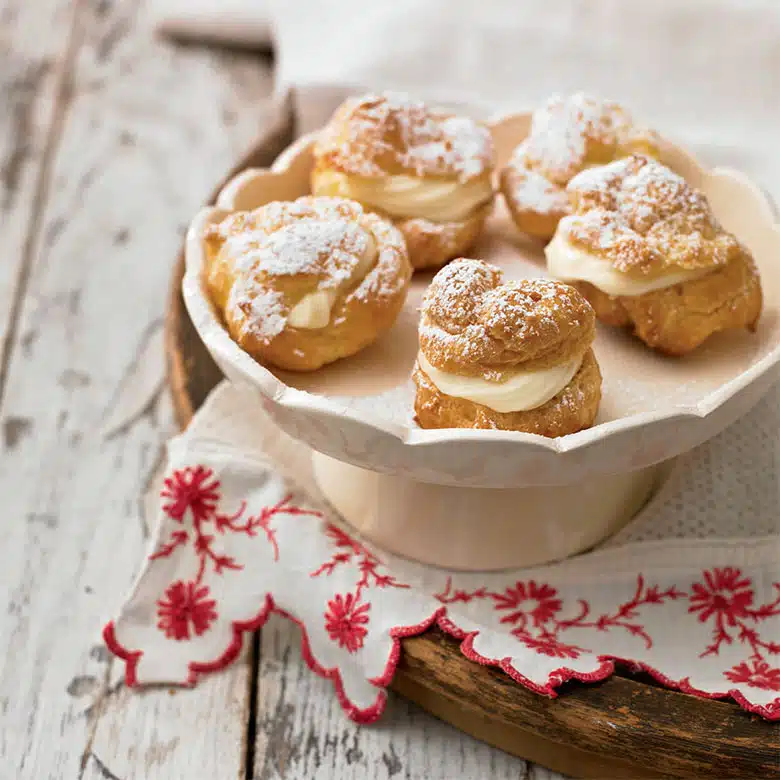
CREAM PUFFS
The choux pastry that forms the shell for these custard-filled delights dates back several hundred years, and cream-filled puffs have been around at least since the days of Antoine Car.me, the famous 18th-century French pastry chef. But here in America, many people associate cream puffs with dessert buffets of the 1950s and 1960s. (Choux pastry puffs were also commonly stuffed with savory fillings, such as chicken or egg salad.)
TOTAL TIME: 2 HOURS 30 MINUTES • HANDS-ON TIME: 1 HOUR 30 MINUTES • YIELD: 24 TO 34 CREAM PUFFS
FOR THE PUFFS: 2 sticks (1 cup) salted butter 2 cups water 2 cups all-purpose flour 1/2 teaspoon table salt 8 large eggs
FOR THE FILLING: 3/4 cups granulated sugar 1/4 cup cornstarch 2 large eggs 1/4 teaspoon table salt 2 cups milk 2 tablespoons salted butter 1/2 cup heavy cream, whipped to firm peaks 1 teaspoon vanilla extract Garnish: powdered sugar
- Preheat the oven to 425 degrees and set a rack to the middle position. Line 2 baking sheets with parchment paper.
- Put butter and water in a medium-size saucepan on high heat and bring to a simmer. Add flour and salt all at once, and stir until mixture forms a smooth ball. Remove from heat. Transfer dough to a bowl and add the eggs, one at a time, mixing well after each addition.
- Spoon or pipe balls tablespoon-size balls of dough onto the prepared baking sheets, leaving 2 inches between them. Transfer to the oven and cook until the puffs are golden, 25 to 30 minutes. (Don’t open the oven door; look through the window instead.) Reduce heat to 350 degrees and bake until nicely browned, about 15 minutes. Remove from oven and cut a small slit into the side of each puff to let the steam out. Transfer to a wire rack to cool.
- Meanwhile, make the filling: In a medium-size bowl whisk together sugar, cornstarch, eggs, and salt. Put the milk and butter in a small pot over medium-high heat and bring to a simmer. Remove from heat. Drizzle 1/2 cup of the hot milk mixture into the egg mixture, whisking continuously. Repeat with an additional 1/2 cup hot milk. Pour this egg mixture back into the pot with the milk and increase heat to medium-high. Cook, stirring often, until mixture begins to bubble and thicken. Transfer to a bowl, cover with plastic wrap pressed against the surface, and cool in the refrigerator at least 1 hour (up to overnight).
- When ready to use, whip the cream with the vanilla until it forms firm peaks. Fold into the cold custard. Use a pastry bag fitted with a metal tip to fill each cream puff or simply slice puffs in half and fill with cream. Sprinkle with powdered sugar and serve.
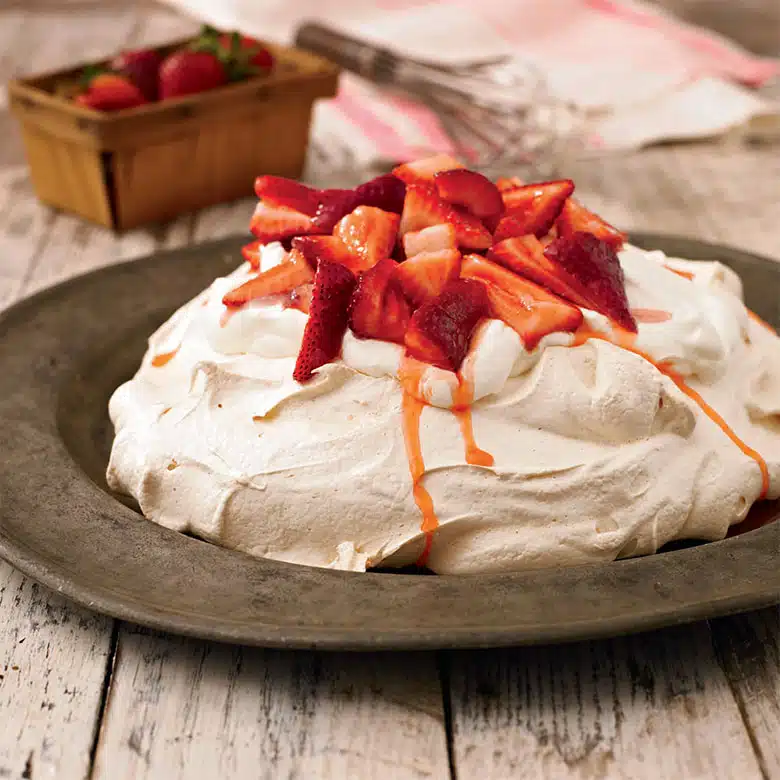
PAVLOVA WITH FRESH STRAWBERRIES & WHIPPED CREAM
Australians and New Zealanders have an ongoing debate about who first created this gorgeous meringue dessert crowned with whipped cream and fresh fruit. You may substitute other berries, kiwi, or mango, but we love it best with strawberries.
TOTAL TIME: 3 HOURS • HANDS-ON TIME: 45 MINUTES • YIELD: 8 SERVINGS
FOR THE MERINGUE: 4 large egg whites 1/8 teaspoon table salt 1 cup granulated sugar 1 teaspoon vanilla extract 1 teaspoon white or cider vinegar 2 teaspoons cornstarch
FOR THE TOPPING: 1 pint (about 12 ounces) fresh strawberries 1/4 cup granulated sugar 1 tablespoon freshly squeezed lemon juice
FOR THE WHIPPED CREAM: 1-1/2 cups heavy cream 1 tablespoon granulated sugar 1-1/2 teaspoons vanilla extract
- Preheat the oven to 300 degrees. Line a sheet pan with parchment paper, trace a 9-inch circle in the center (we used a cake pan as our guide), and turn the paper over.
- In the clean bowl of a standing mixer with a whisk attachment, beat egg whites until frothy. Add salt and continue beating. As soft peaks form, slowly add sugar in a thin stream, beating as you go. Once sugar is incorporated, beat on high speed until firm, shiny peaks begin to form, about 2 more minutes. Stop beating; then gently fold in vanilla, vinegar, and cornstarch with a spatula.
- Spoon the meringue into the center of the traced circle and use the back of the spoon to spread it out to the edges, creating a shallow well in the middle. Put into the oven, reduce heat to 250 degrees, and bake 1. hours. Turn off the oven, leaving meringue inside until it turns crisp and pale but is still a bit soft inside, about 1 hour. Remove from oven and let cool completely.
- While meringue bakes, prepare the fruit: Hull and slice or quarter the berries (depending on size). Mix gently with sugar and lemon juice in a medium-size bowl. Set aside.
- Whip cream, sugar, and vanilla with an electric mixer or whisk until firm peaks form. To serve, carefully peel parchment from meringue and place gently on a large serving platter. Spread whipped cream over meringue. Spoon berries over the top and serve.
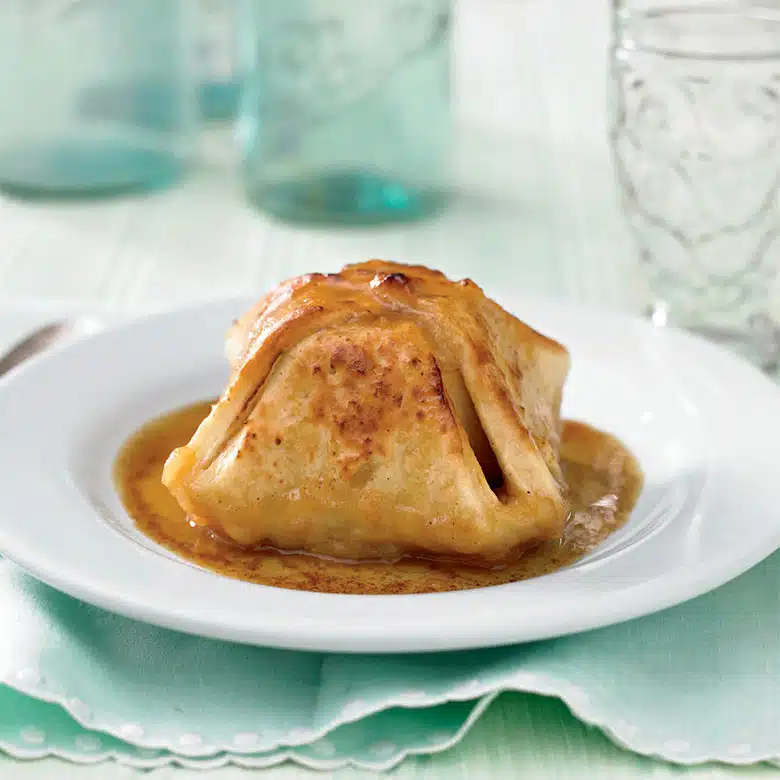
APPLE DUMPLINGS
Apple dumplings have roots in Pennsylvania Greman country, where the pastries emerged as a clever use for leftover pie dough on baking day. They’re so delicious, though, that we’re happy to make up a fresh batch of pastry just for these alone. The sauce thickens as it cooks, turning into a rich and glossy syrup.
TOTAL TIME: 1 HOUR 30 MINUTES • HANDS-ON TIME: 50 MINUTES • YIELD: 6 DUMPLINGS
FOR THE DOUGH: 2 cups all-purpose flour 2 teaspoons baking powder 1/2 teaspoon table salt 1 tablespoon granulated sugar 6 tablespoons cold unsalted butter, cut into small cubes 2 tablespoons cold vegetable shortening 1/2 cup cold milk
FOR THE SAUCE: 1-3/4 cups fresh apple cider 1/2 cup dark rum, such as Gosling’s 1/2 cup firmly packed light-brown sugar
FOR THE APPLES: 1/4 cup firmly packed light-brown sugar 1/2 teaspoon ground cinnamon 6 small firm-sweet apples, such as Pink Lady, Jonagold, or Gala (about 4 ounces each or 1-1/2 pounds total)
- Cut two pieces of parchment paper so they’re 11 inches wide and 16 inches long. Set aside.
- Make the dough: In a medium-size bowl, whisk together flour, baking powder, salt, and sugar. Sprinkle the butter cubes and shortening on top and use your fingers to work them into the dough. Stop when the mixture resembles cornmeal with some pea-sized pieces of butter remaining. Add milk and stir, using a fork, until dough begins to hold together.
- Turn the dough out onto one of the pieces of parchment paper; knead three times, or until the dough feels cohesive. Shape dough into a rough rectangle and cover with the second piece of parchment paper. Roll dough out to roughly the same size as the parchment paper. Carefully transfer to refrigerator; let chill for 30 minutes.
- Preheat the oven to 425 degrees. Meanwhile, make the sauce: In a medium-size saucepan heat cider, rum, and brown sugar over high heat. Bring to a simmer and cook for 5 minutes. Remove from heat and set aside.
- Prepare the apples: In a small bowl, stir together brown sugar and cinnamon; set aside. Peel and core apples; trim if necessary to make each about 3 inches tall.
- Remove the dough from the refrigerator and remove the top layer of parchment. Use a ruler and a knife to trim the dough to an exact 10×15-inch rectangle. Cut dough into six 5-inch squares. Set one apple in the center of each square; fill centers of apples with brown-sugar mixture. Bring corners of dough up together around apples to make four points, gently sealing at top and along seams so that the pastry fits snugly.
- Place dumplings in a large baking dish. Pour sauce around dumplings and transfer to oven; bake for 10 minutes. Reduce oven temperature to 375 degrees and bake until dumplings are golden brown and sauce is bubbling, 25 to 30 minutes more. Serve warm in bowls with extra sauce.
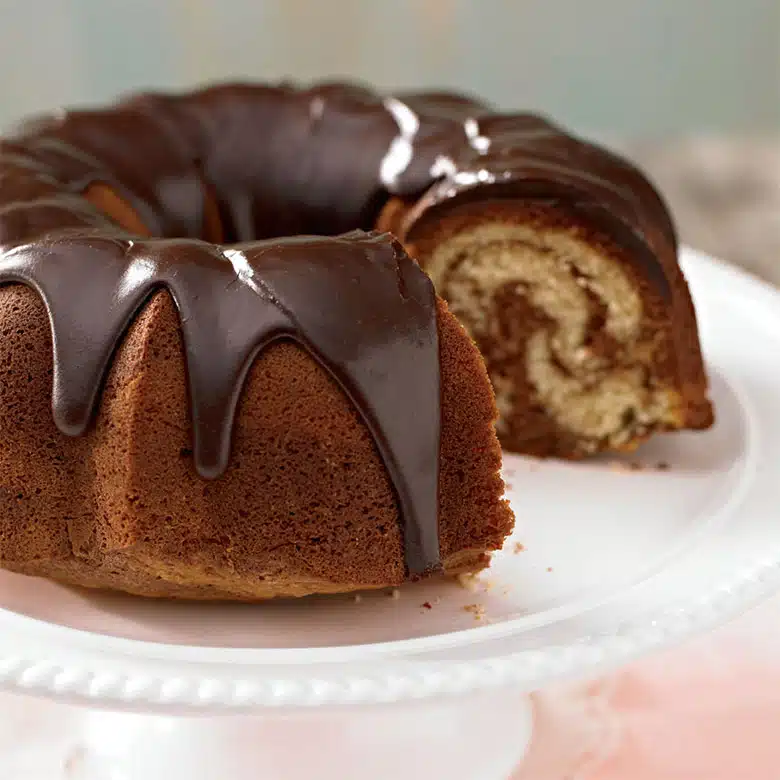
MARBLE BUNDT CAKE WITH CHOCOLATE GLAZE
From 1966 to 1994, Sylvia Hocking of Thomaston, Maine, ran a small home-based bakery that brought her national fame for her coffee cake, blueberry muffins, raspberry buckle, and strawberry pie. She later published a cookbook, Sylvia’s Cakes & Breads: Famous Recipes from a Small Maine Kitchen (Down East Books, 1998). We published a handful of her recipes in our March 1995 issue, and this cake, moist and rich with chocolate swirls, reminds us of the beauty of old-fashioned Bundts.
TOTAL TIME: 2 HOURS 30 MINUTES • HANDS-ON TIME: 45 MINUTES • YIELD: 10 SERVINGS
FOR THE CAKE: 2-3/4 cups all-purpose flour 2-1/4 teaspoons baking powder 1 teaspoon table salt 1 cup (2 sticks) unsalted butter, softened, plus more for pan 1-3/4 cups granulated sugar 1 teaspoon vanilla extract 4 extra-large eggs 3/4 cup milk 4 ounces bittersweet chocolate, melted 1/4 teaspoon baking soda
FOR THE GLAZE: 2 squares (2 ounces) unsweetened baking chocolate 3 tablespoons unsalted butter 1-1/2 cups confectioners’ sugar 3–4 tablespoons hot water 1 teaspoon vanilla extract
- Preheat the oven to 350 degrees. Grease a 10-inch Bundt or tube pan. Whisk together the flour, baking powder, and salt. Set aside.
- In the bowl of a standing mixer or, if using a handheld mixer, in a large mixing bowl, cream the butter and sugar until light and fluffy, 3 to 4 minutes. Add vanilla and mix; then add eggs one at a time, mixing well after each. Add one-third of the dry ingredients, then half the milk. Repeat, scraping down the bowl periodically. Add the remaining third of the dry ingredients and mix until combined.
- Divide the batter into two bowls. Add the melted chocolate and baking soda to one of the bowls and stir until evenly combined.
- To make the marble effect, drop the batters into the prepared pan by the heaping tablespoon, alternating between chocolate and vanilla batches. Try to distribute the batter evenly around the pan.
- Once all of both batters are in the pan, bang it several times on the counter to make the batter level. Use a thin knife to swirl through the mixture several times.
- Bake until a cake tester comes out clean and the cake is fragrant, 60 to 75 minutes. Run a knife around the edges, unmold onto a wire rack, and let cool completely.
- While cake is cooling, make the glaze: Melt the chocolate with the butter in a small saucepan or in the microwave. Add the confectioners’ sugar, hot water, and vanilla at the same time and whisk until smooth. If the glaze seems too thick, add a bit more water. If it’s too thin, add some more sugar.
- When cake is cool, set the rack over a baking sheet or cutting board. While the glaze is still warm, pour it evenly over the cake, letting it drip down the sides and onto the sheet. Let the cake sit 5 minutes before serving.
FLOURLESS (GLUTEN-FREE) CHOCOLATE CREAM ROLL
“This recipe was a favorite when I was growing up,” writes Mrs. J.F. Bradley, who shared it with us some years back. “My mom made it often, and regularly she would make one for Dad at work. Dad was a dentist, and his office was in a building with an adjoining dental laboratory. Now my two youngest daughters request it for dessert for Christmas dinner!”
We love this cake as is—especially because it makes such a delicious dessert for people who can’t tolerate gluten—but here’s a fun variation: Double the whipped cream and fold in 1/2 cup finely crushed peppermint candy, omitting the sugar and vanilla. Roll half the cream inside the cake and use the remainder to frost.
TOTAL TIME: 1 HOUR 20 MINUTES • HANDS-ON TIME: 1 HOUR • YIELD: 10 SERVINGS
Butter (for pan) Flour (for pan and parchment) 5 large eggs, at room temperature Pinch table salt 1 cup confectioners’ sugar 5 tablespoons cocoa powder (natural or Dutch-process), plus more for dusting 1/2 pint heavy cream, whipped and mixed with 1 teaspoon vanilla and 2 tablespoons sugar
- Preheat the oven to 350 degrees and set a rack to the middle position. Grease the bottom, but not the sides, of a 15-1/2 x 10-1/2 x 1-inch baking pan (a jellyroll-size pan). Line with parchment paper and make sure to leave a flap at both ends to help you lift the cake out of the pan when done.
- Separate the eggs. Using a standing mixer and a very clean bowl, beat the egg whites with the salt until firm peaks form. Transfer to another bowl and set aside. Beat the egg yolks for 1 minute, until creamy; then add the sugar. Beat for an additional minute. Add the cocoa and beat thoroughly.
- Fold 1/4 of the beaten whites into the chocolate mixture to lighten it; then gently fold in the remainder in 2 batches. Pour this mixture into the prepared jellyroll pan and smooth the top.
- Bake until the cake feels springy to the touch and a cake tester comes out clean, about 15 minutes. Turn out at once onto a tea towel dusted with cocoa powder. Remove the parchment paper; turn the cake so that it’s oriented vertically and roll up from the bottom, rolling the towel in as you go. Let cool completely; then gently unroll and spread with the sweetened whipped cream. Roll again and chill before slicing.
COFFEE CLOUD SPONGE CAKE
Sponge cakes are a late-18th/early-19th-century creation, achieving a light texture through beating egg yolks and sugar together until they turn pale and lemon-colored. This recipe also uses beaten egg whites and baking powder, so it achieves beautifully lofty heights, as the name implies. The mild coffee flavor is enhanced by the satiny icing.
TOTAL TIME: 2 HOURS 30 MINUTES • HANDS-ON TIME: 45 MINUTES • YIELD: 10 SERVINGS
FOR THE CAKE: 1 tablespoon instant coffee grounds 1 cup boiling water 2 cups sifted all-purpose flour 1 tablespoon baking powder 1/2 teaspoon table salt 6 eggs, separated 1/2 teaspoon cream of tartar 1/2 cup plus 11/2 cups granulated sugar 1 teaspoon vanilla extract 1 cup finely chopped pecans or walnuts
FOR THE ICING: 2 tablespoons salted butter, softened 2 cups confectioners’ sugar 1-1/2 teaspoons instant coffee grounds 1/4 teaspoon table salt 2–3 tablespoons milk Garnish: chopped pecans or walnuts (optional)
- Preheat the oven to 350 degrees. In a small bowl, dissolve instant coffee in boiling water, and set aside to cool.
- In a medium-size bowl, whisk together flour, baking powder, and salt.
- In a large bowl, beat egg whites with cream of tartar until soft peaks form. Add 1/2 cup of the sugar to the egg whites a little at a time, and continue beating until firm, glossy peaks form. Set whites aside.
- In another large mixing bowl, beat egg yolks until smooth; then gradually add remaining 1-1/2 cups sugar and vanilla. Beat at high speed until thick and lemon colored (about 5 minutes).
- Add the dry ingredients alternately with the cooled coffee to the egg-yolk mixture, beginning and ending with dry ingredients. Blend thoroughly. Fold in nuts. Lightly fold in the beaten egg whites until evenly blended.
- Pour into an ungreased 10-inch tube pan and bake until fully cooked, 60 to 70 minutes.
- Immediately invert the pan and set the hole in the center atop a heatproof funnel or bottle to let it cool upside-down (this protects the cake from sinking). Cool completely, about 45 minutes.
- Meanwhile, make the icing: Cream butter; then add confectioners’ sugar, instant coffee, and salt, and mix well. Gradually add milk until icing is of spreading consistency. Frost the cake and sprinkle with chopped nuts if you like.
PUMPKIN CREAM CHEESE ROLL
If rolling up a cake intimidates you, don’t roll from the short end, but rather from the long side of the baked cake. That way, you’ll have fewer turns to make—and fewer chances for the cake to crack or tear. This autumn-hued log can be served year-round but is particularly suited for the Thanksgiving table.
TOTAL TIME: 1 HOUR 50 MINUTES • HANDS-ON TIME: 35 MINUTES • YIELD: 10 SERVINGS
NOTE: The nuts may go inside the roll or decorate the outside; the choice is yours when you roll the cake.
3 large eggs 1 cup granulated sugar 2/3 cup canned pumpkin pur.e (not pie filling) 3/4 cup all-purpose flour, plus more for paper 1/2 teaspoon ground cinnamon 1 teaspoon baking soda 1/2 cup finely chopped walnuts or thinly sliced almonds 3/4 cup confectioners’ sugar, plus more for dusting towel and garnish 1 teaspoon maple syrup (any grade) 1/2 teaspoon vanilla extract 2 tablespoons unsalted butter, softened, plus more for pan and paper 10 ounces whipped cream cheese
- Preheat the oven to 375 degrees. Grease the bottom, but not the sides, of a 15-1/2 x 10-1/2 x 1 inch baking pan (a jellyroll-size pan). Line with baking parchment paper and make sure to leave a flap at both ends to help you lift the cake out of the pan when done. Grease and lightly flour the parchment paper.
- In a large bowl, beat the eggs on high for 5 minutes. Gradually add the granulated sugar, then the pumpkin. Beat in the flour, cinnamon, and baking soda.
- Spread the batter evenly across the pan. Sprinkle the nuts over the batter (see “Note,” above).
- Bake until the batter is set and the cake feels springy to the touch, 14 to 15 minutes.
- Place a clean linen or cotton dish towel larger than the baking pan on a countertop or other flat surface. Dust it with confectioners’ sugar.
- Immediately turn the cake out onto the dish towel, using mitts and grasping the flaps of parchment. Peel off the parchment paper. Starting at the long side, roll up the cake in the towel, making sure to curl in—not merely fold—the cake during the first roll. Let the cake cool in the towel completely.
- To make the filling, beat the confectioners’ sugar, maple syrup, vanilla, and butter in a medium-size mixing bowl until well blended. Beat in the cream cheese until smooth.
- When the cake is cool, carefully unroll it. Spread the cream-cheese filling to within an inch of the edges. Roll the cake again. Cover the cake and refrigerate for at least 1 hour or until ready to serve. Dust with additional confectioners’ sugar.
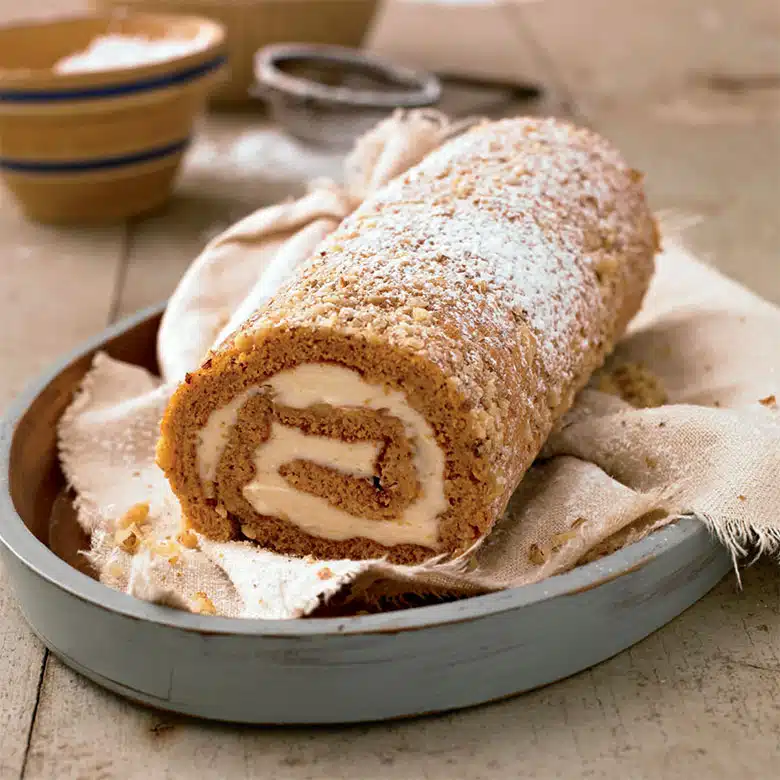
Pumpkin Cream Cheese Roll
Credit: Heath RobbinsCredit: Heath Robbins