Up Close: Bell’s Seasoning
With a New England–born recipe that’s gone unchanged for generations, Bell’s Seasoning continues to rule Thanksgiving as the blend behind the bird.
By Jenn Johnson|Oct 23 2026|

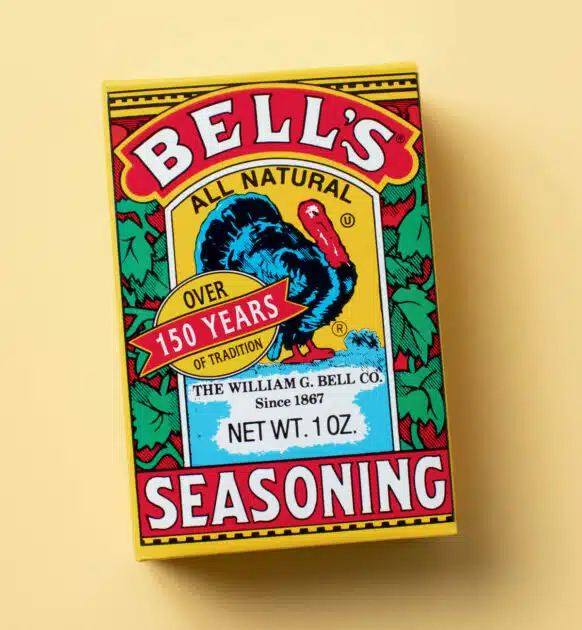
Bell's Seasoning is a classic, salt-free herbal blend created in Boston in 1867 by William G. Bell.
Credit: Heather MarcusThroughout the four-century evolution of today’s Thanksgiving feast, New England has always been a key ingredient. That goes back to the original event planners, of course—the Wampanoag and the English settlers who supped together in Plymouth in 1621—but others have added their own flavor along the way. There was Massachusetts’s “Cranberry King,” Abel Denison Makepeace, who in 1854 founded what is now the largest cranberry grower in the world, and New Hampshire’s “Mother of Thanksgiving,” Sarah Josepha Hale, who successfully lobbied President Lincoln to proclaim Thanksgiving a national holiday in 1863.
This Turkey Day pantheon would not be complete, though, without William G. Bell, whose name still graces the little yellow box of seasoning that for many is the taste of Thanksgiving. Born in 1839 in Hancock, New Hampshire, to a family of Scots-Irish immigrants, Bell had an entrepreneurial spirit that would lead him to the big city of Boston and, at age 22, the founding of his own company selling mainly grocery provisions. Then, six years later, he debuted a meat and poultry flavoring called Bell’s Spiced Seasoning—and a holiday icon was born.
While “Spiced” has long since been dropped from the name, not much else about Bell’s Seasoning has changed: Ornate lettering and a plump blue-black turkey still adorn the humble cardboard box; inside is a bird-enhancing blend of rosemary, oregano, sage, ginger, marjoram, thyme, and pepper that’s still made from the original recipe (which is as closely guarded as ever). Despite the brand being sold and moved a few times—most recently to Greenwich, Connecticut, where it operates as Bell’s Foods LLC—this tasty New England tradition has stayed alive. And that’s something that cooks across the region and beyond can give thanks for, year after year.