The Old Sugar Maple
Deep in a Massachusetts forest, a story of time and fragility unfolds.
By Yankee Magazine|Aug 24 2026|

Deep in a Massachusetts forest, a story of time and fragility unfolds.
Credit: Christian BlazaBy Tim Loftus
I met the sugar maple when I was 15. It was the summer of 1977, and I was working for the Youth Conservation Corps: building trails, hauling felled trees from the forest to build walkways over ecologically sensitive areas, planting hedgerows to support bird habitat. Just over the crest of a forested hill in Spencer, Massachusetts, the supervising forester pointed out the oldest tree he had seen in the area. Based on its four-foot-diameter trunk, he estimated it had started growing “probably around 1777.”
This tree would have about 200 growth rings, I thought. When I was a Cub Scout, I had learned about tree rings—every year, another annual growth ring is added to the outer layer of wood, just under the bark. When my father cut cordwood for the woodstove, I’d count the growth rings on the stumps to figure out how old the tree was when he had cut it down. One time he showed me the tree ring on one stump from the year I was born: eight growth rings in from the bark toward its center.
I had caught the family-history bug, and so my thoughts turned to my two great-aunts, Mayme and Beth, who lived together in the same neighborhood as my family. They were like grandparents to me, and their home was my second home. Sometimes, if I could get them talking about the past, they’d tell me stories of life in the 1890s and early 1900s, before cars, planes, and phones. Before electrical appliances and before indoor plumbing. As children, they had even known some elderly Civil War veterans.
And there I was, that day in 1977, standing by a huge sugar maple that was more than twice as old as my great-aunts. What other, even older events did this tree “witness” in its life?
*****
Though Spencer was a rural town with dairy farms and vast forests, I didn’t pay attention to trees until a college botany class. I needed to identify and collect leaves from native trees in central Massachusetts. While the first dozen or so were easy to find, the remaining took research into tree habitat, reading topographic maps, and hours and hours of trudging through forests, swamps, and wherever trees grew. I found trees I never knew existed around Spencer. But what I never found was a tree as old, or as huge, as the sugar maple I had met a few years before.
There was no road to this tree, just a series of trails, then a long walk through trees and brush. When I visited it, I’d sit under its branches and imagine its birth on some cold March morning so long ago. Not all the ground on this hill would have thawed from its winter sleep yet, and some snow probably still filled the shadowed areas dotting the landscape. But on this southern slope, the soil would have been soft and moist, warmed by the rising spring sun. In this pocket of sunshine and earth, the outer shell of the maple seed had cracked open as the maple embryo pushed from the inside against its protective hard placenta. Through the crack, a small single root had reached into the soil in search of nutrients and water, while the cotyledon, the two embryonic leaves full of chlorophyll, had reached toward the sky to harvest the sun’s energy. The seed was no more, having transformed itself into a sapling.
Other times, I imagined what the tree looked like in 1789, when George Washington was inaugurated as president of the United States. It would have 12 growth rings under its outer bark. Abraham Lincoln was assassinated during the year this tree added its 88th growth ring. It had 115 rings in 1892 when Beth was born, and 121 rings when Mayme was born. The tree added its 184th growth ring in 1961, the year I was born.
I recognized my attachment to the sugar maple during the late 1990s. Perhaps it was from a decade of watching Mayme and Beth become more and more frail, before their own deaths, as their bodies ceased working. My father died. One of my best friends died. The first twinges of knee and back pain in my body were telling me my own parts won’t work forever, either.
As I grew older, I visited the tree every few months, sometimes more. I never cut a trail to this tree, preferring to keep it protected from the pocketknives of lovers inscribing their undying devotion to each other on its bole, and to keep irreverent gawkers from partying at its base as if it were some kind of circus attraction. In January 2010 when I visited the tree, I saw a large branch had broken from the top. Rot had started to spread into its trunk, leaving a few hollowed-out areas. During the ensuing years I continued to hike the hillside, or snowshoe in winter, just to sit with the tree.
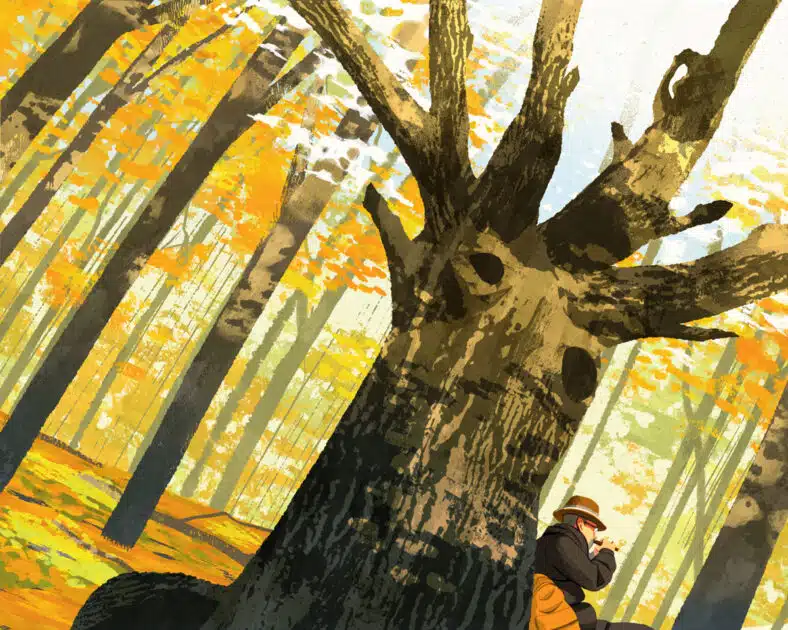
In early spring a decade later, its earthy-red buds were swelling with life and would soon leaf out. The sugar maple had made it through another winter, although not without losing a few additional minor branches. I sat at its base for a while, listening. From my knapsack, I took out a small wooden flute, one that I often carry with me on my woodland wanderings, and played a couple of tunes for my old friend.
Last September the air was hot and humid when I visited again. I was full of scratches, punctures, and prickle holes through my clothes and clear to my skin when I emerged from the protective boundary surrounding the old tree. After decades of natural forest rejuvenation, a small open zone still encircles it. While a few saplings and immature trees have crept in, the older oak, ash, maple, and hickory have respectfully kept their distance. Coarse grasses and blossoming common fleabane, its white petals surrounding yellow button centers, blanketed the ground. It seems as if the forest is allowing the old tree to live out its days in peace.
Today the sugar maple has lost every major branch from its once magnificent crown except one. It’s a large branch more than a foot in diameter where it leaves the bole, reaching another 25 feet into the air. A few of its upper leaves have already started to turn red and yellow, the colors of a New England autumn. How long will the hollow trunk be able to hold the weight of the only remaining living part of the tree? How many more growth rings will it know?
I promised my old friend that I would keep coming back, more often now, to check on it and see how it’s doing. Before I left I scooped up a couple of its remaining leaves. I carefully pressed them between the pages of my journal, then sat at the base of the old sugar maple tree and listened to its stories.
This feature was originally published as “The Old Sugar Maple” in the September/October 2026 issue of Yankee.