Yankee Classic: Leaving the Good Life
A poignant look at the legacy of back-to-the-land pioneers Helen and Scott Nearing.
By Mel Allen|May 12 2024|

This story was originally published in the August 1983 issue of Yankee.
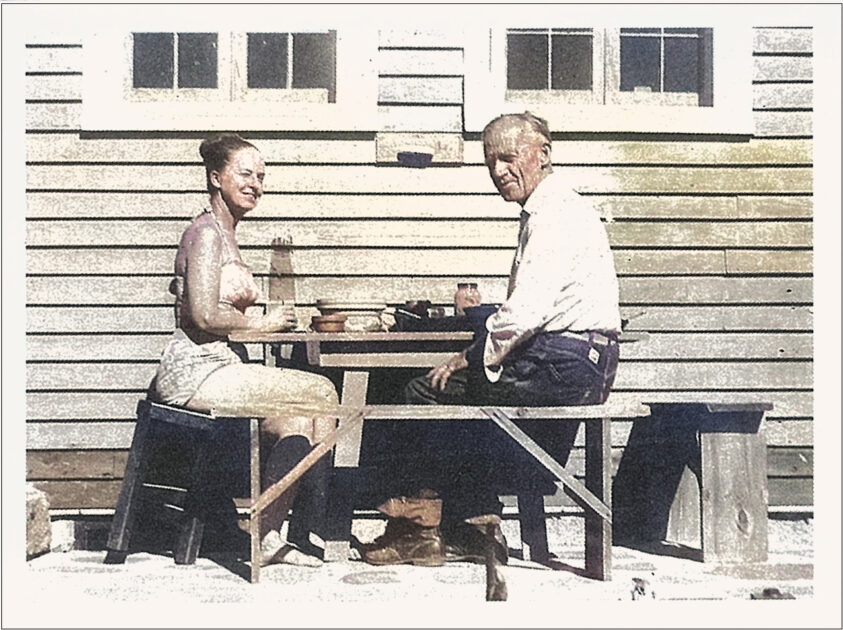
Helen and Scott Nearing, whose book, Living the Good Life, is the bible of the back-to-the-land movement, live on a windswept spit of land on Penobscot Bay in Hancock County, Maine, 20 miles from the nearest stores and banks, in Blue Hill. She is 79; he will be 100 on August 6, and for 50 years they have had little use for towns or stores or banks.
They began homesteading in 1932 on a run-down, 65-acre Vermont farm at the foot of Stratton Mountain, which they bought for $300 down and an $800 mortgage. Scott Nearing was nearly 50 and broke, living in New York City with Helen Knothe, a young violinist who later became his wife. A leading Socialist, he had run for Congress and had sold out lecture halls debating Clarence Darrow. A professor of economics and sociology, he had been fired from three universities for taking stands against child labor and for his pacifism during World War I. His textbooks had been withdrawn and publishers refused his new work. The move to the country was for survival.
They had no electricity and, except for a battered pickup truck, no machinery. They fortified the soil with compost, heated with wood, and built a house of stone. They kept no farm animals and had no children. They ate only the vegetables they raised and the grains and fruits they bartered for. From their sugar bush, they boiled maple syrup for cash. But in 1952, feeling crowded out by Stratton Mountain ski developers, they moved to Maine, to another run-down farm on 140 acres of isolation. He was 70, she 49. They were starting over again.
One cold misty morning late last May, I visited “Forest Farm,” now a garden spot that attracts several thousand people a year. I had seen him twice, in person, giving talks on gardening at venues filled with hopeful homesteaders. His deeply tanned, wrinkled face atop a straight, sturdy body made me think, somehow, that he would scythe his meadow, chop his wood, and plant his garden forever. But this was a melancholy drive down the Maine coast, for I had just received a letter from Helen Nearing that said that Scott was dying. “He’s in no pain,” she had written, “just getting ready to leave a worn-out body.”
There is a sign nailed to a pine tree at the end of the gravel driveway: “Visitors 3-5. Please help us to lead the good life.” They are famous for their stone buildings, all done by hand with stones they have gathered obsessively on walks through the fields, in the woods, or along the shore. When I park I see a garage, a storage shed, an outhouse, the beautiful balconied house completed when Scott was 95, and a five-foot-tall wall surrounding the garden, all of stone, giving me the impression that I have dropped in at the estate of an English lord.
Instead it is Helen Nearing, a white blouse torn at the shoulder, a faded red sweater, and blue corduroys, who greets me. Scott, her barber of 50 years, has not been able to cut her hair; a few strands stick out from her forehead like quills. She is weary, her face drawn, and when she sits down at the long wooden table in the kitchen to talk, her attention wanders, her ears cocked to the living room, where Scott is sleeping. A fire burns in the cookstove. Herbs and onions hang from an oak beam and a breeze rustles chimes.
“I’ve never known him a day sick in bed,” she says. “Never, never. We’ve never had a doctor. He was still working outside half a year ago. But one morning he just took to his bed and started to sleep. I think it was November, like he was hibernating. He was restless for a time, shouting out suddenly at night. Now he’s contented. He doesn’t complain. But sometimes he’ll look at me and say, ‘I wish I could carry the wood in for you.’”
She walks into the living room. The floor is stone, the walls paneled, and a massive wooden table sits before the picture window that looks out upon their cove. There is a woodstove in a corner, and on the other side of the room where bookshelves span the walls, Scott Nearing lies in a hospital bed with the sides up, like a crib, and beside the bed is a cot where Helen has slept the past several months. “This is my job now,” she says quietly. “This is it.”
He stirs at her approach. “What do you want, dear?” he says. His face is softer than I remembered, still tanned and weather-beaten but as peaceful as a baby’s, and above his lip is a thin white mustache.
“Someone’s come to see you,” she says to him.
Blinking, he focuses on me. “Well, good,” he says. “Good.”
I tell him I have found a whole batch of his early books and pamphlets in a secondhand bookstore.
“Thrown away?” he asks.
“No,” Helen says. “They’ve gone to a good person who will keep them.”
“I’m going to have them reprinted,” he says. He takes a deep breath and coughs. “Sure, sure,” Helen says, comforting, and pulls a second blanket over him. He looks out the window to the calm, gray sea. In a moment he is asleep.
They met when Helen was 24. She was a student of Eastern mysticism who had recently returned to the family home in Ridgeway, New Jersey, after studying violin abroad. At her father’s request, she invited Scott Nearing, then separated from his wife and living in Ridgeway, to speak at the Unitarian Church. Nearing took her for a drive. Like Helen, Scott had been born to a wealthy family. Raised in the coal-mining town of Morris Run, Pennsylvania, he was the grandson of Winfield Scott Nearing, the superintendent of the coal company. Young Scott sided with the working class. He had a horror of riches and fancy living. When his first wife decorated their home with lace doilies and cut glass, he bought himself a wooden bowl and spoon and refused to eat from anything else.
“That first night he said, ‘Do you believe in fairies?’” Helen tells me. “I thought, what kind of guy is this? Of course, I believe in fairies, and I told him so, and he was very interested. I was going with four or five fellows at the time, but I was taken with his integrity, his purpose in life. Even those who disagreed with him responded to his warmth. And he was a vegetarian, as I was. I still tease him that if he hadn’t been a vegetarian, we wouldn’t have hooked up.”
We are in the kitchen, and she laughs. “Can you imagine my parents? A Socialist, a married man, and a man 21 years older. It turned their hair white!”
He told her to live poor for a while before she came with him, so she moved to a slum and found work in a Brooklyn candy factory. He told her to return to the glitter of Europe, to be sure she wanted his life. She did. When he asked her to return to the cold-water flat in New York City and help him research a book on war, she cut her long, dark hair and took a boat home.
Soon she was a subsistence farmer in Vermont, where they evolved a system that would continue the rest of their lives. They worked four hours every day producing their food and shelter, four hours at their professions—his writing on social issues, her music—and spent four hours socializing. The latter was a little tricky in the hill towns of Vermont.
“Our ways amused the neighbors, baffled them, or annoyed them,” Helen has written. “That we ate no meat was in itself strange, but during our 20 years in Vermont we never baked a pie.”
In 1946, Scott’s wife died. “I told him ‘I want your name,’” Helen says. “It’s a bad name, and I want it.” In 1947, Scott and Helen were married. “And we’ve endured, haven’t we?” she says. “And we’re so different. His thinking is so pedantic, like he’s always at a blackboard: 1, 2, 3, 4, A, B, C, D. And he gets hooked up with me, who sings, plays the fiddle and the organ, and yodels. And he doesn’t even like music.” She sighs and stands up. “Let’s see if he’s awake,” she says.
“Scotto, open your mouth,” she says, propping up a pillow. “I’m giving you some rose hip juice.”
“That’s nice of you.”
“Rose hip juice you made yourself. Picked them and pressed them.”
He takes a sip. Then another.
“Would you like some more?”
“Is it handy?” he asks.
“Yup. Right here.”
Helen wipes his mouth and smooths his mustache. “He has a mustache now only because I’m too lazy to get in under his nose and shave it. He hates affectation. He heard William Jennings Bryan speak once, and he thought he was such an affected ass that he came home, shaved off his mustache, and gave away his dress suit. And he hasn’t had either one since then.”
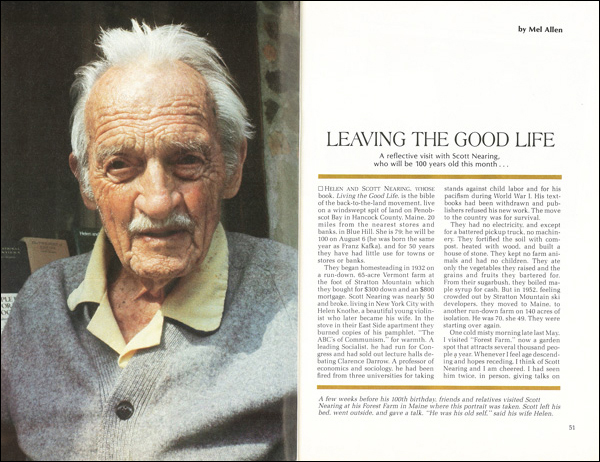
We are speaking in the kitchen about families and the personal price one pays to be Scott Nearing. “People write to Scott,” Helen says, “telling him he is a great man, an inspiration. But he had three sisters and two younger brothers who were ashamed of him. They thought he was a failure. We’d send them his books, and they’d come back unopened. He had two children. His son Bob is still friendly, but Scott severed relations with John in the sixties. He worked for Radio Free Europe, broadcasting propaganda to Europe. Scott said, ‘You’re working against the things I’m working for.’ That was it. His son was John Scott Nearing, but then he dropped the Nearing. I asked Scott once if he would have lived his life differently. He said not in the big decisions, but in his personal relations. I think he meant he wishes he could have gotten along better with his son. But John died, so there’s nothing to be done.”
Past Scott’s bed a door opens into a small, narrow room furnished with a desk, a typewriter, a bookcase. On the wall is a painting of Scott from a photograph by Lotte Jacobi. This room is the Social Science Institute, the publisher of many of Scott’s 50 social science books. Though Living the Good Life was a success, Helen and Scott never touched the royalties for living expenses. All the money went here, to the Institute, to finance the research and publication of Civilization and Beyond; USA Today; The Conscience of a Radical; Freedom, Promise and Menace.
“I’d like someone to do a book of the early writings of Scott Nearing,” Helen says. “Not just excerpts, but great chunks of writing. There are things in there, important things that will never be read by anyone.”
We step back into the living room. Scott is sleeping. His right hand rests on his forehead, as though he is deep in thought. She says softly, “I wonder where the real Scott Nearing is now.”
We eat lunch in the living room, sitting before the picture window on a bench made from a slab of driftwood dragged up from the cove. There is eggplant soup, an enormous ceramic bowl of popcorn, a bowl of steamed millet, peanuts, peanut butter, honey, apples, and bananas. Helen Nearing’s motto of cooking is: “The most nourishment for the least effort.”
“Scotto, we have soup and popcorn,” she calls. She sits for a moment to crack some peanuts, then leaps to her feet to feed him handfuls of popcorn, returns to the table for more peanuts, then leaps up again to give him soup. I think of a mother bird feeding her nestlings, all that flying off and returning.
“Finish your soup,” she tells me. “I’ll give you Scott’s Emulsion.” Into my bowl she drops a couple of spoonfuls of peanut butter and a thick dropper of honey. “Work that down like cement,” she says. She adds a scoop of the millet and some apple slices. “We eat this every day.” She laughs, remembering a letter from a man who, after reading Living the Good Life, insisted on eating from a single bowl. “His wife divorced him. She said she wasn’t going to eat like a dog.”
A car drives up. It is a nurse to give Scott a bath.
“We were in the hospital for 12 days,” Helen says. “I stayed with him in the room. When we got home, I thought I could take care of him, but I fell with him once. When I realized I couldn’t, I just bawled because I thought I had to put Scott Nearing in a home. We went to a home for a while. I stayed with him, and they were very nice to us. But this is where he belongs.”
Since girlhood, Helen had collected stones with bands of black or white around them. She called them “wishing stones” and felt that with them she had powers of divination. One day, knowing they must leave Vermont, she tied a wishing stone to a string, dangled it over a map of Maine, and closed her eyes. She imagined a saltwater farm, isolated enough so Scott could write in peace, run down enough to be cheap. Over Penobscot Bay the stone circled in an ever-tighter arc. That is where they found their present Forest Farm. And it was then that Pearl Buck, who had wanted to buy their Vermont farm, suggested that they write a book about their homesteading adventure.
“It had never occurred to us,” says Helen, “It was just how we lived.” They coauthored Living the Good Life. It sold 3000 copies in 1954, then went out of print. In 1970 Schocken Books reissued it to a new generation. It was compared to Walden, sold 170,000 copies, and made the Nearings celebrities as Scott approached 90. When the energy crisis hit in 1973, TV networks sent nattily dressed reporters to the farm. Scott would take them to his woodpile, hand them a saw, and put them to work. He’d smile into the camera. “No crisis here,” he’d say.
We are upstairs on the balcony outside Scott and Helen’s bedroom, so close to the sea you seem to touch it. “I sit up here,” she says, “and wonder where I’ll go when Scott goes. I think of Switzerland or Holland, where my mother is from. But then I ask myself, what could I get anywhere that I don’t have here. I’ve remade my will so that the house will not go into the real estate market. I want it to be a homestead educational center. People could come and see where Scott Nearing lived.”
“Not where Helen Nearing lived, too?” I ask.
She laughs. “I’m just ‘Helen and,’” she says. “When we sign books he signs his name and hands them to me and I write ‘Helen and.’ If I write my autobiography that will be the title, Helen and.”
We walk into the guest room overlooking the garden. It is used by Nancy Richardson, a 32-year-old Pittsburgh woman who made a pilgrimage to the farm seven years ago, remained in the area, and now helps Helen care for the garden and for Scott. Like others in the house, the room is sparsely furnished. The walls are decorated with Japanese prints, a photograph of Helen’s cat Pusso (killed by a fisher in October, and for which Helen mourns so much she cannot bear to look at it), and a painting of the stone house in Vermont on which this one is modeled.
“I learned detachment when we left Vermont,” Helen says. “I thought if I ever have to leave anywhere again it won’t be as hard as this. And when I went back a few years ago and saw that our house had become a ski chalet, well, I said, it’s time to build its sister.”
Bookshelves fill two walls of the room. “We’ve never had radio or television,” she says. “I’d knit and he’d read to me or he’d shell beans and I’d read to him. If he tried one of his economics books I fell asleep. He liked Robert Louis Stevenson and anything by Tolstoy. I’d slip a science fiction in sometimes. Or stories about animals. Anything about animals.”
She leans down and plucks a book from the bottom shelf. It’s a biography, Scott Nearing: Apostle of American Radicalism, by Stephen J. Whitfield. She grimaces, “I don’t like this at all,” she says. She opens it. She has crossed out paragraphs with a marking pen. She reads the words under her lines:
“This is not an intellectual portrait of Scott Nearing. I expect that his thought cannot bear the weight of intensive scrutiny.” She shuts the book loudly. “I wouldn’t let Scott read it. I said, ‘Don’t bother yourself with it.’”
In the corner of the room are two boxes stuffed with photographs, letters, notes. She says with satisfaction, “It’s all here, a treasure trove. Someday I’ll give them to a sympathetic biographer.” Stacked on a shelf are metal card files crammed with 5 x 7 index cards, their headings ranging from “The Future of Civilization” to “Composting.” “He took notes on everything,” she says. “He taught me his system. ‘Don’t put information in books,’ he would say, ‘where you can’t get at it.’ So I take notes, writing down pithy quotations.”
Among her quotations is this one: “No meal is as good as when you have your feet under your own table.” Beside that she has written, “Scott Nearing, an opinion, 1970.”
We start downstairs. I see four words burned into a plank nailed to the wall: “Sunshine — birdsong — snowfall — trees.” She looks in on Scott. “Your eyelashes are growing into your eyes,” she says. “Here, close your eyes.” She snips quickly. “Thank you very much,” he says.
We go through a door into the woodshed. It can hold eight cords. A cord or so is left from the past winter. “He cut and stacked all that last year,” she says. “Incredible, isn’t it?” A 50-foot-long stone storage shed stands beside the house. Inside, cardboard cartons filled with books are stacked four feet high. “Thoreau had a library of 600 Waldens. We have 6000 Nearings.” In a corner are boxes filled with letters from hopeful homesteaders. “The cruel thing was that more than anything he wanted to teach one class with the same students and watch them grow,” she says. “And that was denied him. But he had more influence than if he had been a college president, don’t you think?”
In the next room are the tools that Scott loves — his axes, including a double-bitted axe he has had since 1900, bow saws, teeth sharp as razors, and wheelbarrows, as clean as if they were in a museum. “Scott has a favorite wheelbarrow,” Helen says. “Whenever we were building with stone, that was the one he used to mix the cement.” He never left a tool in a field. Even if he were only pausing for lunch, he’d wipe it clean with burlap sacking that hung from a peg in the toolshed. He once wrote, “Order in the woodshed, the woodlot, toolshed, yard, and home are essential… Care and artistry are worth the trouble.”
We walk to the nearby farm where Helen and Scott lived for over 25 years before building their new stone house. A few years ago they sold it to Stan Joseph, after already selling many acres to other homesteaders. “We have only four acres left,” Helen says, puffing slightly from the climb past boulders. “I wanted Scott to be relieved of the burden of cutting the grass and trimming the trees and weeding the garden.” She looks at me. “But I never expected that none of the people who bought our land would stay our friends. We never see them. We were too organized, too methodical for them.”
Soon the farm comes into view. A stone wall that took Helen and Scott 14 years to build surrounds the garden. Helen yodels, approaching the house, and we are welcomed inside by Stan Joseph’s girlfriend. Helen has come to look at photos of Scott. There is one she would like copied. The two of them are walking down the road holding hands.
Stan Joseph comes in from the garden. He is a large man with a beard, a large hole in his checked flannel shirt. There is an exchange of greetings. He points out a checkerboard hanging on the wall. “Look at that,” he says. “I paid only a dollar for it at the flea market. I bet I can get $30 for it in the city.”
“You know what you might like to give me is some mint,” Helen ventures. “We have lost ours. I kept giving it away and now we have none left.”
“Sure, Helen. We could work something out. What have you got to swap?”
We walk back to the house, and at 1:30 the mailman comes. He has a package of blankets sent by a Hollywood producer who is interested in making a movie based on their lives. She scoffs: “Can you imagine?” But she is excited, walking into the house. “Our mailman has read some of Scott’s books,” she says. “He says he wants more. He wants a list so he can check off the ones he wants.”
It is time to leave, and I go to Scott Nearing to say goodbye. I have a friend whose courage to build her own house came after reading Living the Good Life, and she asked me to be certain I thanked him for her. So I did.
“You’re welcome, I’m sure,” he says. “I hope it turns out all right.”
We shake hands. His grip is still firm.
“Will I see you again?” he asks.
I say I hope so. I say I would like to.
At the kitchen door Helen presses a dozen book lists in my hand. “Take them to bookstores. Tell them for God’s sake to stock this man.” She hands me a pamphlet of six pages with “SCOTT NEARING” at the top in bold letters. Beside it in smaller type, “August 6, 1883—” with space for one last date and this brief statement:
Scott lived a long and purposeful life. He was dedicated to research and to serving. He searched for knowledge and the truth, while he dedicated himself to serve his fellows. From the ideas on death that appealed to him I have selected some which show the direction of his thought. He undoubtedly goes on researching and learning, and knows more now. This much, at least, we can share of his thoughts.
There would be no ceremony. His body would be cremated and the ashes spread on the garden.
“We planned everything,” she says, “but I stupidly didn’t expect it. We never talked about Scott going first. He was so vital, so strong. We were equals.”
She stands on a knoll while I drive away. In other times she bade farewell to visitors with a ringing yodel, but as I look back she waves goodbye in silence before she turns back to the house. Later it struck me that Scott Nearing was giving Helen his final act of kindness, leaving the good life as he had lived it, slowly, patiently, one step at a time.
August 1983
Shortly after this story was published, Scott Nearing died on August 24. I stayed in touch with Helen. “He had no pain, no doctor, no hospital. It was just time to go,” she recalled.. “It was ten in the morning. I was on the cot with him. I said, ‘It’s all right, go, go into the light, you’ve lived a long and beautiful life, it’s time to go on now, and that’s all right. We’ll get along.’ And he just said, ‘All . . . right,’ and he went.” Helen published “Loving and Leaving the Good Life” in 1993. Two years later, on an early fall evening she was alone in her car when it hit a tree near her home. She was 91. Their Forest Farm homestead is now The Good Life Center which is dedicated to carrying on the Nearings’ work and beliefs.