Deep Impact: The Woods Hole Alvin Submersible and Its Legacy of Deep-Sea Discovery
In the increasingly important world of deep-sea exploration, the Woods Hole Oceanographic Institution’s Alvin submersible has long played an outsize role.
By Michael Wejchert|Oct 21 2025|

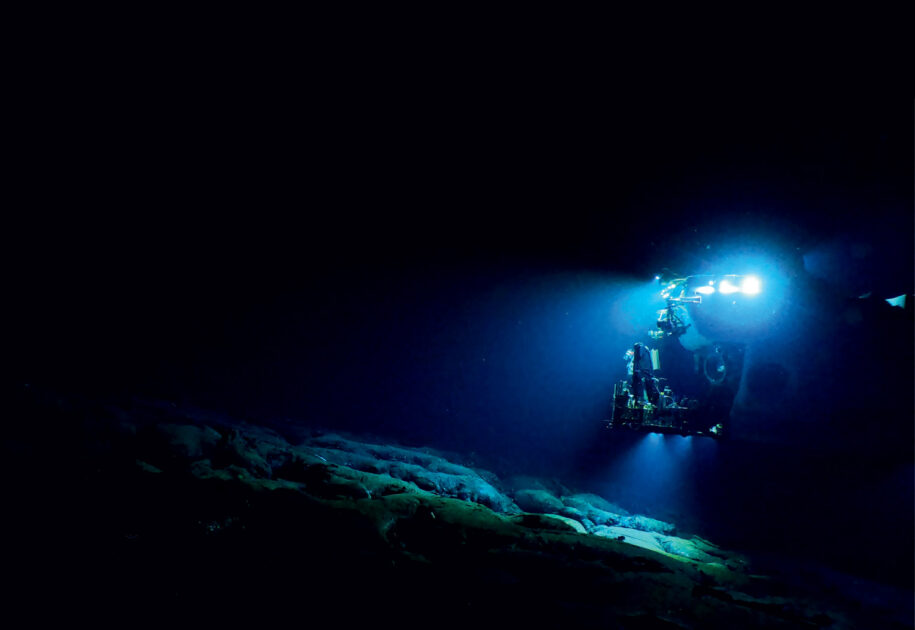
The deep-diving research vessel Alvin arrives at the seafloor during an expedition to the East Pacific Rise, part of a volcanically active underwater mountain range that encircles the globe. In this literal hotbed for researchers, Alvin offers a close-up look at things like oceanic crust formation, plate tectonics, and the creatures who live in this unique deep-sea environment.
Credit: J. McDermott (Lehigh University); T. Barreyre (CNRS, Univ Brest); R. Parnell-Turner (Scripps Institution of Oceanography); D. Fornari (Woods Hole Oceanographic Institution); National Deep Submergence Facility, Alvin Group. Funding support from the National Science Foundation. ©Woods Hole Oceanographic Institution, 2024In 2006, 22-year-old Jill McDermott stared out of a porthole of the deep-submergence vehicle Alvin into a blackness unlike anything she’d ever seen. For over an hour, Alvin had descended into the depths of the Pacific Ocean. Packed into the snub-nosed machine alongside Pat Hickey, manager of the Alvin Group, and Timothy Shank, a deep-sea biologist, McDermott had long since passed the point that sunlight could penetrate the ocean. Now, 8,000 feet underwater, atmospheric pressure pushed on Alvin’s hull almost 250 times more than it does at sea level. McDermott, who had grown up in Madawaska, Maine, a town of roughly 4,000 perched on the Canadian border, was accustomed to quiet. Still, diving in Alvin felt like being in a darker version of outer space.
The cockpit of Alvin was just under seven feet in diameter; alongside the three tiny portholes, monitors and switches and radios ran up the concave walls, taking up every inch of space. Alvin might have felt cramped, but the cavelike dimensions ensured safety—the two-inch-thick titanium sphere that formed the nucleus of the sub had been pressure-tested to depths of more than 14,000 feet. Descending to the ocean floor often took hours, and pilots sometimes buffered the sounds of the ocean pinging into the hull by playing music. But now, as McDermott surveyed the darkness, everything seemed eerily quiet.
Hickey, Shank, and McDermott were heading to a hydrothermal-vent study site located 9 degrees north of the equator on the East Pacific Rise. “9 North” remains one of the most volcanically active vent sites in the world—a place where mineral-rich, heated water is released into an otherwise cold ocean. The biodiverse area had been the site of multiple deep-sea volcanic eruptions in the past few decades, including the first and only one ever observed in real time by humans.
As a graduate student at the University of New Hampshire, McDermott had spent time studying the vents to which she was hitching a ride in Alvin, which operates out of the Woods Hole Oceanographic Institution (WHOI) in Woods Hole, Massachusetts. But this was scant preparation for a visit to the ocean floor. Anyone could read about the sites—the same way anyone could read about the moon—but diving to visit them was the deep-sea version of blasting off on an Apollo mission.
Hickey, one of the submersible’s most experienced pilots, adjusted the ballast of the sub, which then slowly sank before coming to rest on the ocean floor. He leaned over and toggled off Alvin’s lights.
“Um, Pat?” McDermott said, a little nervously.
“Look out there,” Hickey told the young scientist. Taken aback, she stared into the abyss of the midnight zone. “I just wanted you to see how dark it is down here,” Hickey told her, grinning. Then he flicked Alvin’slights back on. The ocean seemed to come alive. Deep-sea creatures that had evolved to create their own lights blinked back, and McDermott realized they were interacting with the submersible.
Hickey piloted the craft toward the 9 North vents, familiar ground for Alvin. In 1977, scientists diving off the Galapagos in Alvin had discovered the vents for the first time. Twenty-nine years later, McDermott was visiting them in the same submersible.
McDermott’s initial dive on Alvin would be the first of many trips she would take to the sea floor on the East Pacific Rise. She has devoted her career to further understanding the unique, almost otherworldly chemistry of hydrothermal vents. Now a professor at Lehigh University, she is one of Alvin’s most frequent users. As remotely operated vehicles become the de factomethod for underwater research, it can be hard to justify diving with a human-occupied vessel like Alvin—unless you’ve taken the plunge yourself.
McDermott has experience with both manned and unmanned vehicles. “When I look back on my work with all these different vehicles, I remember my Alvin dives most clearly,” she says. “I think there’s something about how your brain forms memories that grows stronger in Alvin. Scientifically, I can come up with more ideas because I can remember them more vividly.”
As oceans warm, storms intensify, and scientists grapple to understand the vast swath of ocean that humans have not yet explored, every piece of new information found underwater is a step toward solving an urgent puzzle. Alvin might be a small submersible, but its role in unearthing the ocean’s secrets has been a titanic one.
* * * * *
Since its first official expeditionin 1964, Alvin has taken more than 5,000 individual trips underwater. Ithas dived into active volcanoes and brought explorers to the wreck of the Titanic; along the way, it has appeared in the pages of National Geographic and even made cameos on Saturday-morning cartoons. “It deserves a place in the Smithsonian,” says Dudley Foster, a pilot and manager of the Alvin Group from 1974 to 2006.
Still, Alvin is a long way from becoming a museum exhibit. The sub has undergone such extensive overhauls, modifications, and alterations that its creators would be hard-pressed to recognize its most recent incarnation: Not a single component of the original build remains on the vehicle.
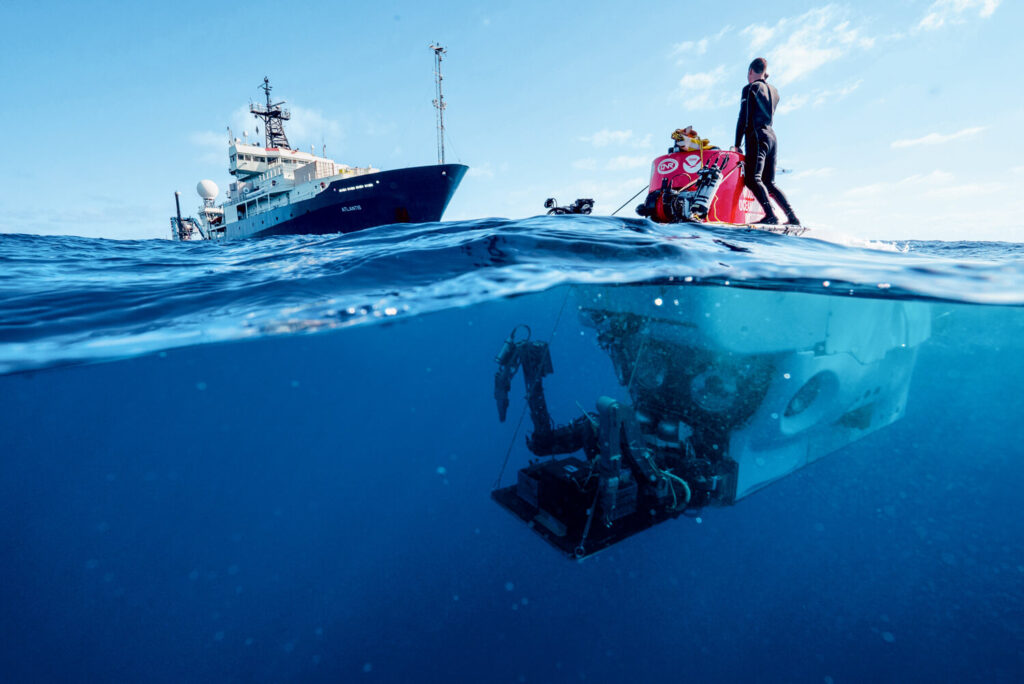
Credit: Luis Lamar, ©Woods Hole Oceanographic Institution
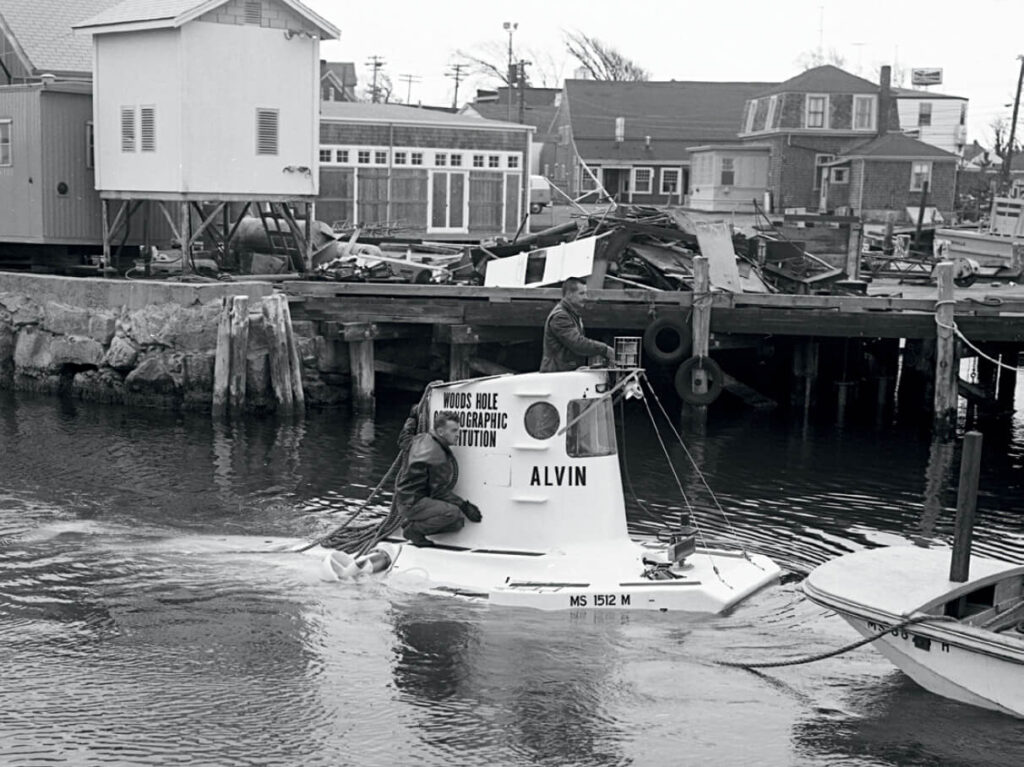
Credit: Woods Hole Oceanographic Institution Archives
In between its long stints on research cruises around the world, it has always called Woods Hole home. These days, Alvin and WHOI are inseparable; the sub’s original metal sail is proudly displayed in front of the Redfield Laboratory on Woods Hole’s teeny main street. At first blush, the cluttered, compact, cedar-shingled downtown might seem like an odd place for Alvin to reside when it’s not underwater, but WHOI’s facilities have shouldered the brunt of ocean research for more than nine decades. Without the eccentric cast of scientists, sailors, and engineers who have kept the vehicle operational, Alvin might have ended up a forgotten relic on a scrap heap. But the inverse is no less true: Without Alvin, many of WHOI’s discoveries would still be unchecked spots on the ocean floor, blanks on the map.
Although the ocean accounts for more than 70 percent of our planet, humans have visited a mere 5 percent of its mass, and nearly all this exploration has roots in the 20th century. In 1956, a scientist named Allyn Vine stood up at an oceanographic conference in Washington, D.C., and proposed a submersible for the specific purpose of research. Vine had worked at WHOI since 1940 and had grown frustrated that he and other researchers were still trying to divine the ocean’s secrets from the surface. Their methods—taking sound samples to study fish and mammals by throwing explosives into the water, then timing their detonations to map the ocean floor—felt archaic.
The only time oceanographers get wet, one of Vine’s coworkers joked, is when they fall overboard. But by 1958, WHOI director Paul Fye slowly came around to Vine’s idea, even though WHOI couldn’t fund a manned submersible on its own. Vine and Fye turned to the Office of Naval Research, which approved a budget and commissioned the construction of a small submersible to be built specifically for the purpose of underwater exploration. The Navy contracted the sub’s design and building to General Mills, and, under the careful eye of a mechanical engineer named Harold “Bud” Froehlich, work began in the same factory that had constructed the machinery to make another American staple, Wheaties.
Froehlich centered his design on a spherical steel hull made to withstand the immense pressure it would encounter underwater. The submersible’s “sail” (essentially a miniature conning tower) and body would be made from aluminum and wrapped in a fiberglass skin, enabling it to descend to around 6,000 feet. To adjust its ballast, a pilot would pump oil into and out of rubber balloons, changing the submersible’s mass in the water, allowing it to rise without adjusting its weight.
On June 5, 1964, in front of a crowd of Navy brass and oceanographers, the completed vessel sat perched on a makeshift gantry in downtown Woods Hole. Onlookers sat on the roof of WHOI’s dockside laboratory, spitting distance from the ocean, and watched as the sub was lowered into the water. Bill Rainnie, a Navy veteran hired in 1961 as the first pilot, took it on a short test dive off the WHOI docks. The odd-looking little craft was given an unlikely name, in part a riff on Allyn Vine’s first and last names, and in part an homage to a group of musical chipmunks that squealed across airwaves in 1958.
* * * * *
One Saturday night in 1966, a WHOI physicist got a call at his home. It was the Navy. A B-52 bomber had collided with its refueling plane off the Spanish coast, killing seven airmen and losing four thermonuclear bombs. By the time the phone rang, three of the bombs had been recovered, but a fourth was still missing; witnesses reported an object drifting down into the Atlantic beneath a deployed parachute. The Air Force asked the Navy to help, the Navy called WHOI, and soon the institute’s Deep Submergence Group was bobbing up and down in the Atlantic, taking turns searching in Alvin.
That the disarmed H-bomb couldn’t physically set off a nuclear reaction was cold comfort. The device contained more than enough TNT to kill anyone who happened to be floating nearby if it exploded. Plus, as the WHOI pilots were warned, it was possible the bomb was leaking plutonium.
For days, pilots worked their way through a murky underwater labyrinth, navigating more by feel than anything else. Marvin “Mac” McCamis, the second Alvin pilot hired by WHOI, was creeping along the sea floor when Rainnie spotted a faint track leading downward more than 2,000 feet below the surface of the Mediterranean. McCamis, who had grown up hunting in Indiana, moved Alvin’s joystick almost by intuition, following the trail the way he’d track an animal through the woods. The strategy worked: Wedged in the middle of a steep incline lay the bomb. Over the course of the next three weeks, the bomb would be lost again, found once more, and eventually hauled to the surface. But during the first successful dive, McCamis and the two other members of the crew found cause to celebrate.
“The three men were smokers,” Alvin chronicler Victoria Kaharl related in her book, Water Baby, “and their craving got the better of them.” Despite the risks of suffocation and fire, the men lit up, sharing a cigarette passed furtively and carefully in the teeny cabin.
* * * * *
Just one year later, Alvin’s first season taking scientists underwater, a swordfish attacked the sub, becoming caught between its steel sphere and fiberglass exterior. Yet the incident was minor compared to what happened next.
At the time, the Deep Submergence Group was using a modified catamaran they’d named Lulu (after Vine’s mother) as a mothership for Alvin. Pilots needed to drive Alvin between Lulu’s twin hulls—a tenuous arrangement even in fair weather and a nightmare in stormy seas. In October 1968, Alvin returned to Lulu after a dive near the Cape. As it docked, one of the weathered, rusty cables used to hoist the sub snapped. Then a second broke. Its hatch open, Alvin began to sink, bobbing up and down through the waves, launching perilously close to the steel drums attached to Lulu’s hulls. The three crew members, ducking and weaving like prizefighters beneath drums and the sinking submersible, launched themselves from Alvin onto Lulu’s pontoon. In a cauldron of froth, Alvin slipped below the surface.
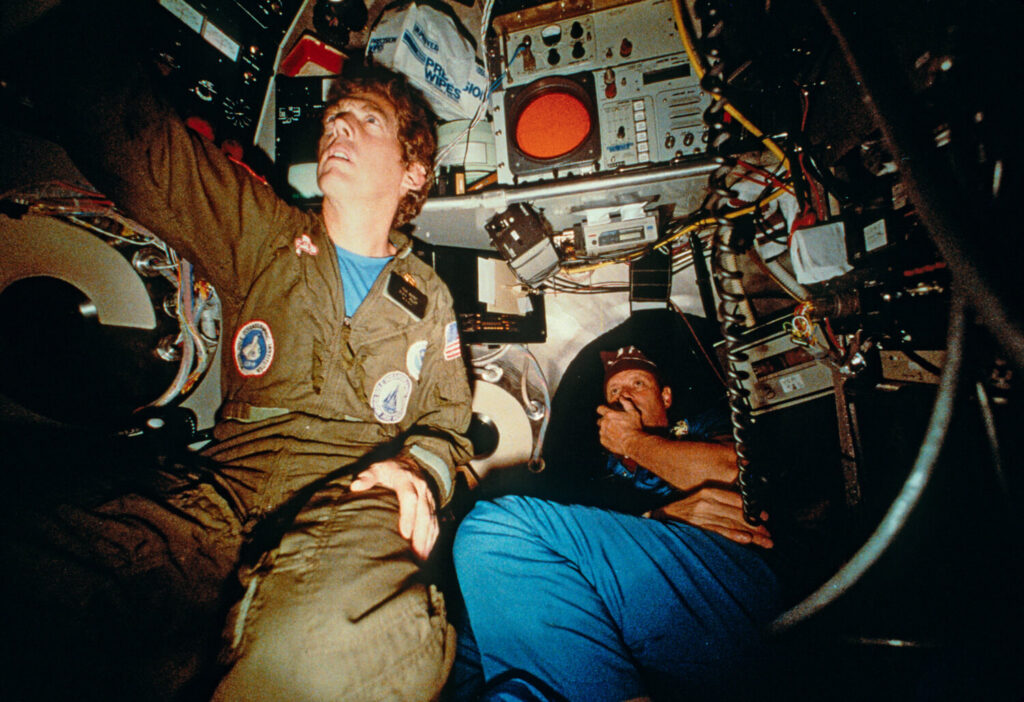
Credit: Woods Hole Oceanographic Institution Archives
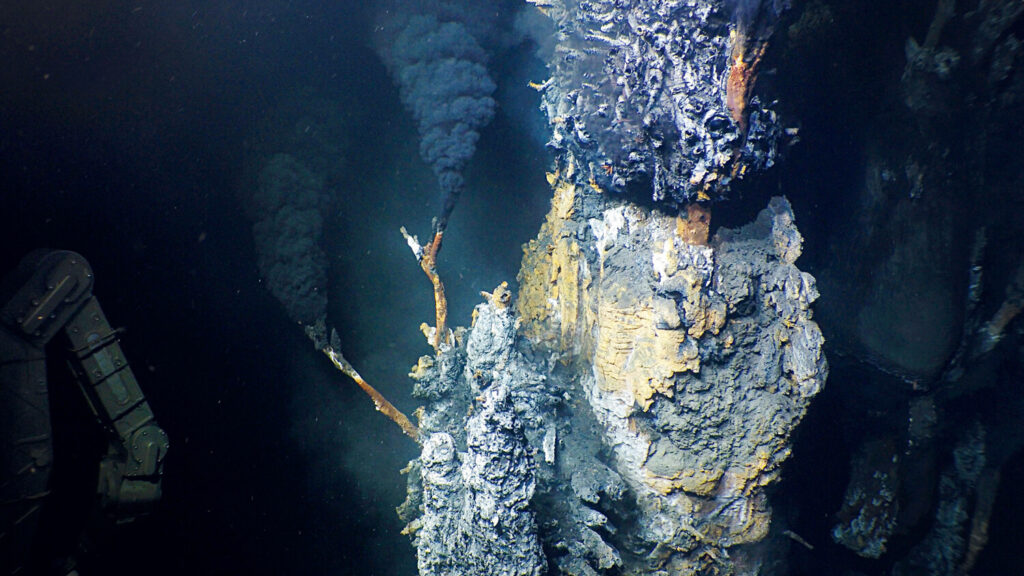
Credit: J. McDermott (Lehigh University); T. Barreyre (CNRS, Univ Brest); R. Parnell-Turner (Scripps Institution of Oceanography); D. Fornari (Woods Hole Oceanographic Institution); National Deep Submergence Facility, Alvin Group. Funding support from the National Science Foundation. ©Woods Hole Oceanographic Institution, 2024
After a heated meeting, the Navy agreed to fund a salvage mission. Despite being nearly a mile underwater for 10 months, Alvin was intact when WHOI finally located and rescued the sub. When engineer Cliff Winget and his coworkers finally drained their prize, they found the baloney sandwiches and apples packed for the dive were also intact. As a test pilot, Winget had “borrowed” aircraft three times in his military career, so he wasn’t going to let fear spoil a packed lunch: He knelt on Lulu’s deck and chomped down on the sandwich. Turned out, it was still good. (Winget’s stunt eventually led curious scientists to launch the notorious “Alvin lunch experiment” to measure the decomposition of organic material at different ocean depths. Now, as some researchers float the idea of using the ocean as a storage unit to hold carbon dioxide—it already absorbs up to 30 percent of man-made CO2—the experiment’s findings have resurfaced as a possible solution to combat climate change.)
By the early 1970s, the decade-old Deep Submergence Group had initiated a second generation of pilots to “fly” Alvin underwater, and undertook a round of significant modifications to keep improving the range of its submersible. For instance, Alvin had a steel hull and an aluminum frame, which meant engineers were constantly battling rust and corrosion. So the group transitioned to Alvin’s first titanium hull, and changed out the aluminum frame for a titanium one.
Like Winget, Dudley Foster had been a fighter pilot before joining WHOI. When he finished up his military service in California, he bounced around, hunting for steady work, eventually taking a job at his father’s trucking service in the Boston area. He considered returning to school to study oceanography, “but I thought I’d like to see what they actually did before I went back,” he remembers now.
Foster sent in an application to WHOI and was immediately hired. At first, he worked as a liaison of sorts between scientists and the engineers responsible for outfitting Alvin. “I was in for a couple of weeks and [WHOI] asked me if I’d like to go out and see how the sub worked,” he recalls. “So, I started going to sea, and I continued doing that for 30 years.”
Foster began training to become one of Alvin’s pilots, who were certified by the Navy. Among other things, candidates were required to sit in a room and draw Alvin’s hydraulics and other systems from memory. “Operating the sub is pretty routine,” Foster says. “I think pilots generally lose interest if they’re not interested in the science, because the science is the pretty big variable.” On its surface, the role of Alvin pilot is buried in the minutiae of safely operating the deep-sea submersible. Informally, though, Alvin pilots have acted as guides to an underwater world. Thousands of researchers have climbed down the sail into Alvin’s tiny cockpit, and every time, a pilot has safely executed each of its missions.
Foster’s career as pilot and program manager coincided with some of Alvin’s most blockbuster discoveries. His initial dives as a pilot-in-command were on the fabled Mid-Atlantic Ridge, and in 1977 he and others took scientists to the East Pacific Rise’s hydrothermal vents for the first time, slaloming the submersible between massive black smokers, which billowed searing mineral water into a frigid ocean. The expedition, mainly composed of geologists, was unprepared for the sheer magnitude of plant and animal life on the ocean floor.
In 1986, on a trip organized by the oceanographer and geologist Robert Ballard, the sub had its most famous dive: to 12,000 feet off the coast of Newfoundland to find the wreck of the Titanic, which had last been seen by floating survivors on April 15, 1912. The grainy black-and-white footage shot from Alvin and the accompanying remotely operated vehicle (ROV) Jason Junior has become synonymous with the modern era of human exploration.
Foster remembers the Titanic dives with the trademark nonchalance of a fighter jock and the analytical mind of an engineer. Hunting for a wreck interested him less than discovering the hydrothermal vents and diving on the Mid-Atlantic Ridge. However, as unmanned vehicles like Jason Junior have gained prominence and reliability, they have often replaced human-occupied vehicles (HOVs). “There are several other [HOV] vehicles in the world that were doing similar things [to Alvin] … but most of them are on a shelf somewhere, if not in a museum,” Foster notes.
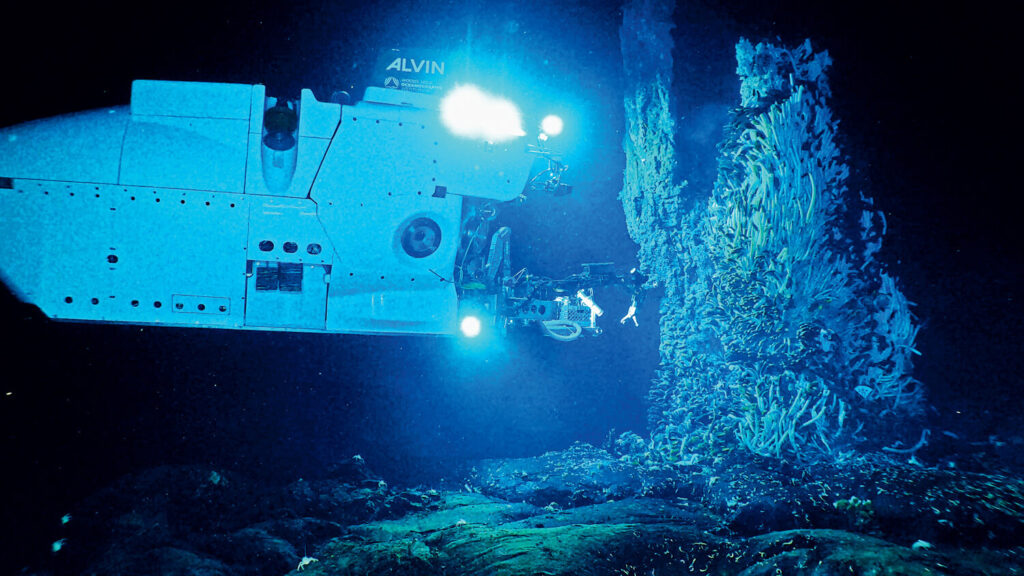
Credit: Dan Fornari, ©WHOI-MISO
It’s true that scientists increasingly rely on ROVs to explore the ocean. But it’s also true that Alvin’s continued presence in the scientific community is driven by something that’s impossible to measure. Bruce Strickrott, current manager of the Alvin Group, is one of the sub’s current generation of believers, bent on carrying the torch and continuing Alvin’s work. Strickrott’s background was perfect Alvin material: a skier, pilot, and scuba diver, as well as a Navy engineer who’d served in Desert Storm. He possessed the perfect blend of engineering savvy and exploratory gusto.
Strickrott’s hiring by WHOI in 1996 coincided with one of Alvin’s routine overhauls, when the submersible was little more than scattered pieces on the institute’s workshop floor. By 1997, it was up and running again, and Strickrott participated in more than 400 dives in his role as pilot, then chief pilot, expedition leader, and finally as head of the Alvin program. During those dives, he watched scores of researchers’ faces light up as they unearthed a world that had once been hidden.
To Strickrott, Alvin isn’t just a vehicle. It’s a window into what makes us most human. “It’s built into our DNA—literally—to go explore, to go places,” he says. “Not just to look at them, but to go to them.
“I’m a zealot,” he adds, jokingly. “I always tell people we’re here to keep the sub going, but I think it actually works the other way around.”
* * * * *
During the winter of 2024–2025, Jill McDermott headed back to 9 North—using Alvin, of course—to study changes in permeability in the hydrothermal vents and to try to accurately predict the next underwater volcanic eruption using the findings. As oceans warm and sea levels rise, there’s a sense that the oceanography the sub enables is far more vital now than when Mac McCamis and crew snuck their forbidden cigarettes on Alvin’s first true mission in 1966.
Assisting McDermott and her team is new pilot Kaitlyn Beardshear, who, at just 28, is the second-youngest person in the program’s history to take Alvin’s controls. Modern Alvin pilots must spend time working at each facet of the sub’s operation: becoming a Navy-certified maintenance technician, being a swimmer who assists with dives, working on the sub’s launch and recovery process, working as both surface controller and launch coordinator. The process can take years. Only after all this, plus a Navy board review, are newly minted pilots like Beardshear cleared to sit behind Alvin’s controls.
Immense pressure squeezes the 23-foot-long vehicle, but this might be outweighed by Alvin’s heavy heritage. “There’s a legacy here,” Beardshear says, “and you want to uphold that. You’re not just responsible for people and the sub, and their safety, but the history behind this, too.”
When it returns, Alvin will be brought onshore, torn apart, rebuilt, tinkered with, improved. And then, once again, Alvin will be taken back out to sea, ready to explore another unknown beneath the waves.
This feature was originally published as “Deep Impact” in the November/December 2025 issue of Yankee.