When the Rains Don’t Stop
As coastal communities grapple with the threat of rising seas, New England’s river towns face a different wave of climate peril.
By Howard Mansfield|Jan 01 2024|

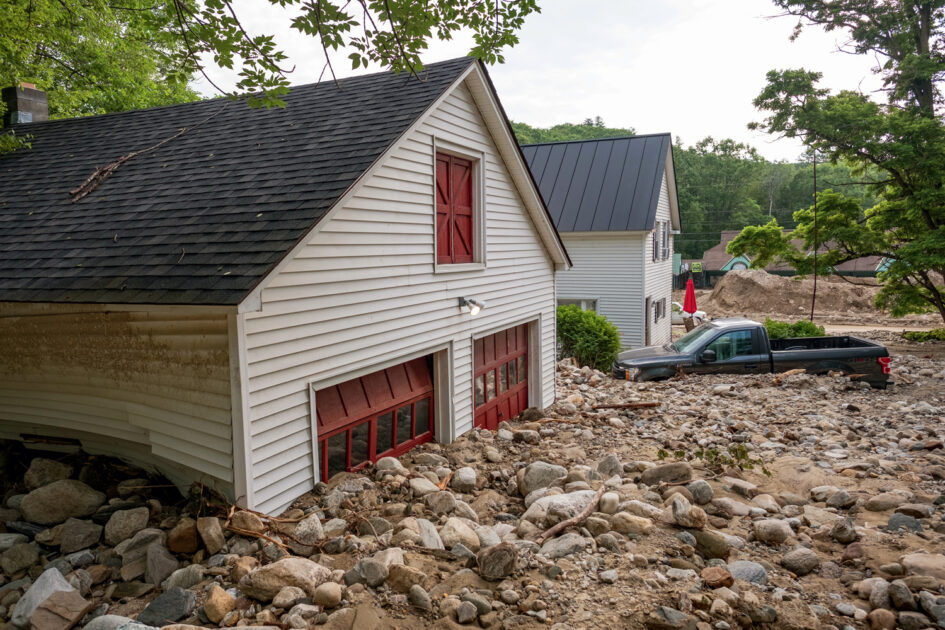
A home near the base of Okemo Mountain Resort in Ludlow, Vermont, is engulfed in rocks and mud in the wake of last summer’s devastating floods.
Credit: Richard BeavenEveryone has two countries: their own and France, say Francophiles. And the same could be said about Vermont. For many, the Green Mountain State has come to stand in for New England. Home to just 647,000, Vermont hosts more than 13 million visitors a year. It’s a strong brand, say marketing experts, like Coke or Disney. “Vemontness” sells many products.
Vermont is also seen as a safe refuge, a good place to avoid the ravages of a changing climate. It takes first place on the SafeHome.org Risk Index, and second on a list of the states facing the least danger from climate change, as ranked by the independent insurance broker PolicyGenius.
But consider some other rankings. From 2011 to 2021, Vermont had 17 federally declared weather disasters—seventh among states, not far behind the expected leader, California. And it comes in fifth in terms of money spent per person to rebuild after an extreme weather event.
The Vermont brand and climate reality are diverging. Like so many New England communities whose economies thrived for centuries in large part because of their rivers, Vermont’s beloved, calendar-image towns set in river valleys were built in a climate we no longer have. And so last July, the state’s trim little capital city, Montpelier, made national news as its streets were flooded with muddy water from the Winooski River. More than five inches of rain fell in one day, with more than 12 inches for the month—five times the usual rainfall. Residents watched as the Wrightsville Reservoir, a few miles upriver, rose to within a foot of its spillway.
As businesses and homeowners hauled out river muck and piled ruined furniture in heaps on the sidewalks, they were told that this “once in a century” flooding can happen again at any time. Welcome to a new planet.
On the Black River, in Ludlow, 75 miles south, this was how one small town faced a storm unlike any it had known.
* * * * *
With the rain falling hard, Angela Kissell’s week began at 1:30 a.m. She couldn’t sleep. The day before, Sunday, July 9, she was out knocking on doors in her town, Ludlow, warning people that they might have to evacuate tomorrow. She’d been watching the weather reports: Vermont was facing a deluge.
Or you could say that her week had begun back in April, when she went to the Ludlow select board and told them that the town was not prepared for emergencies. They needed a new emergency management director. The current director had not held a meeting in four or five years. This was touchy. She knew the director—Ludlow is a small town, after all—and typically she doesn’t like to cause a stir, but this was urgent. Ludlow sits in a steep, narrow valley, close upon the Black River. If its waters rise fast, as they did when Tropical Storm Irene hit in 2011, the river overflows its banks.
The board thought it over and appointed Angela director in May. She’d had time to call only one meeting to review their emergency planning before she found herself facing a storm that would be more damaging than Irene. “The first day was a little rough,” she said. There were no written procedures, but working with their new municipal manager, the police and fire chiefs, and the highway department, “I felt like we got a rhythm.”
Or you could say that her week had begun long before, when she was growing up. Angela, now 48, is one of those people who feels called on to serve. With her husband, Fran, she’s also a volunteer firefighter in two towns, Ludlow and neighboring Plymouth. Fran is the deputy chief in Ludlow. If a call comes in for both departments, they get in their car and pause at the bottom of their driveway, deciding which department will get them to the call sooner.
* * * * *
In the early-morning hours, not long after Angela had woken up and gotten into town, the fire department was called, in quick succession, first to the base lodge of Okemo Mountain Resort, then to evacuate a small, low-lying mobile home park, and also to rescue itself. The fire station is across the road from the big resort’s entrance.
Water four feet deep was rushing over Route 103 right by the fire station. “We’ve got one truck out,” Angela recalled. “And then it got to the point—it was like at 4:30 or five o’clock—we couldn’t gain access. So all the other equipment was in the building.”
The fire department had already moved its base uphill to the police station, which is the emergency operations center. The highway department was doing “an amazing job, clearing and cleaning [the road],” she said, and around 8 a.m. they had rescued the key trucks. The fire department had escaped.
* * * * *
Firefighters went right from Okemo to the Black River Mobile Home Court, 15 homes arranged in a horseshoe between Main Street and the river. It’s a small community within the community, looked after by its owner, Gerald Sheehan, who lives three houses down. Gerry is always around checking on things, the residents say.
Peggy Fletcher was asleep when a firefighter came knocking at her door at 4:30 a.m. “I didn’t even know it was raining,” she said. Peggy, 76, had returned after 45 years away down South, teaching the deaf. When her husband died, her children convinced her to come home to Vermont. Her son has “a place on the mountain,” at Okemo, and her daughter lives next door to her.
A firefighter in full gear must have been an imposing figure at that hour. “He told me to gather a few things for a couple of days and he followed me around, helped me put some things into a bag, and then he took me out on the deck,” she said. He waded into the water, now thigh-high, and had Peggy grab onto his back. She rode him out of the flood. “He was sloshing through the water. Lights were flashing. It was like a movie,” she said. Her daughter was waiting in her car. They didn’t go far—just across the road, uphill to the community center. They spent the next day and a half there. Peggy could see her home and her car. “The water is up to like where the hood is. Oh God, I just see the nose of the car.”
* * * * *
More than two months’ worth of rain fell on Ludlow in two days. A mudslide closed Route 103. The town was cut off. For 24 hours the only medical help was the local EMT. A trapped truck driver escaped to a floating hot tub. It was five hours before a swift-water rescue team, fighting the raging current, could get to him. He was treated for hypothermia.
The town’s one supermarket, Shaw’s, flooded, as it had in Irene. A railroad trestle washed out, leaving the tracks hanging in midair. The wastewater treatment plant was wrecked. The basements and first floors of houses and businesses were covered in river mud. Mounds of rocks and mud blocked Okemo’s main entrance. Ludlow’s new $300,000 skate park, finished one week before the storm, was washed away. At the mobile home park, the trailer closest to the river went for a ride, ending up smashed and twisted into a parallelogram. But the four old dams in town—Angela’s biggest worry—held. The water level in one was just a foot from the top; the other three went over the spillway.
Angela and many of her fellow firefighters slept that first night, Monday, on the floor of the police department; there was no way to get home. That day the fire department responded to 18 calls, about as many as they’d get all month in an average July.
Even when she did get home, Angela was still answering calls and emails—she’s the town clerk in Plymouth, another hard-hit town. She had two phones in front of her, ringing constantly. Angela and Fran were at the station from 7 or 8 in the morning until 9 or 10 at night. In her first week as Ludlow’s emergency management director, from Monday through Sunday, she put in 100 hours. “I felt responsible for everybody in this town,” she said.
* * * * *
After the rain, the world rushed in. Hundreds of eager volunteers showed up. The owners of seasonal homes in town came back. Mennonites from around the country, experienced in disaster relief, got right to work. Volunteers overwhelmed the various websites and Facebook community groups, offering to help. Someone had to match them with donated tools and jobs to do—no small task.
That’s where the Mud Puppies came in. Three women—Kelly Stettner (who named the team), Melissa Rockhill, and Laurie Marechaux—who never met in person. They couldn’t—they were cut off—but with social media, Google spreadsheets, and phones, they coordinated about 350 volunteers who mucked out basements, tore out wet wallboard and insulation, and rounded up lost boats and docks. They made sure that residents connected with the Red Cross, the Salvation Army, and the many agencies that were there to set up things like water tests and unemployment insurance. As part of the grassroots Black River Action Team, the Mud Puppies were experienced in mobilizing the public.
“We would be on the phone till 11:30 at night in conference calls, figuring out our next plan of action,” said Laurie. “I was so exhausted. I never knew I could be that tired.” Laurie had lived through Irene, and knew what do when it was time to evacuate: She grabbed her homeowner’s insurance policy and called her claim into FEMA. Once she got back home, she went right out to the mobile home park, whose owner, Gerry, is a friend from her school days. She went to comfort “these broken people,” she said. “They’re broke and they’re hurt; their souls are crushed. They’re scared, and it’s going to rain more.”
The Mud Puppies always sent out volunteers in pairs. “This mucking out was really dangerous stuff. Slippery, slimy, vintage basement stairs that maybe had no railings,” said Laurie. The silt could be five feet deep, sometimes mixed with diesel fuel and chemicals. “One job took six days of teams of five people mucking out in buckets,” she said. After that, a basement had to be hosed down, sometimes with water from tank trucks, sprayed with a mold inhibitor, and dried out.
“The second homeowners came out to help like you would not believe,” she said. “These people were generous with their time, their energy, their focus, and their emotional support.” One woman found her on Facebook and offered to bring two dehumidifiers, but, as Laurie recalled, “they could have done an airdrop of them, and there still wouldn’t be enough to go around.” So she told the woman, “I don’t want the dehumidifiers to be lonely”—could she find 18 more? The woman showed up with 25 units, worth about $5,000. “I was so grateful.”
And after all this work, Laurie, 67, who went through five surgeries for breast cancer the previous year, volunteered for more. “I went right in to the town manager, and I said, ‘We’re going to need a long-term recovery committee, and I’m ready.’”
At the mobile home park, the firefighters returned to Peggy’s door, this time with a check for $2,500. She used it to help pay for a new car. An anonymous donor had contacted the fire department and asked them to decide how to distribute the money. Angela, Fran, and the department’s chief, Peter Kolenda, made a list. The donor sent the checks, and they had the happy task of handing them out.
* * * * *
Ludlow rushed to clean up, to aid neighbors. Roads, railroads, houses are being rebuilt; some businesses are restarting. Happy endings. But: “There will be a next time,” Angela said.
She’s not alone in saying this. This is what Vermonters are being told in almost every recovery and planning meeting. “It’s a pretty big leap, I think, for a lot of people to realize that this could happen again, once you get through it all,” she said. “We’re trying to recover and rebuild, and nobody wants to think, Oh gosh, it could happen in two months from now, or a month from now.”
On a sunny day late in August, I catch up with Angela at the fire station. She talks me through everything that happened during the flood. Even though the floods are six weeks gone, Angela and Fran have canceled their summer vacation. There’s still too much going on in town, and down in the Caribbean the hurricane season has gotten off to one of its busiest starts in 100 years. One of those hurricanes could come their way, she says. “We’re bound to get one of them.”